

10 Great Uses for an Orangery Extension
Transform your home with these inspiring orangery ideas. Discover practical uses from kitchen-diners to home offices, garden rooms to guest suites. Complete UK guide with costs, planning, and expert tips.
Quick Answer: What Are the Best Uses for an Orangery?
The 10 best uses for an orangery extension are: 1) Kitchen-diner extension, 2) Home office or study, 3) Garden room or sunroom, 4) Dining room, 5) Living room or family room, 6) Children’s playroom, 7) Hobby or craft room, 8) Guest suite or annexe, 9) Home gym or wellness space, and 10) Swimming pool enclosure or pool house. Each offers unique benefits depending on your needs, property layout, and lifestyle requirements.
Key facts: Orangery costs range from £25,000-£100,000+. Most fall under Permitted Development (no planning permission needed). Construction takes 12-20 weeks. Orangeries typically add 5-15% to property value, often recovering 75-100% of investment. Unlike conservatories, orangeries have substantial brick walls (50-75% solid construction) with central glass lantern roofs, making them suitable for year-round use.
Key Facts: Orangery Extensions (UK 2026)
- Definition: An orangery combines brick/stone walls (50-75% solid) with a flat roof featuring central glass lantern
- Typical cost range: £25,000-£100,000+ depending on size and specification
- Construction time: 12-20 weeks from planning to completion
- Planning permission: Usually falls under Permitted Development rights (no permission needed)
- Building Regulations: Must comply fully (no exemptions like conservatories)
- Thermal performance: U-values: walls ≤0.18 W/m²K, roof ≤0.13 W/m²K, glazing ≤1.4 W/m²K
- Value added: Typically adds 5-15% to property value, recovering 75-100% of investment
- Best for: Year-round living spaces, better thermal performance than conservatories
- Popular locations: England – particularly period properties and homes seeking additional living space
The 10 Best Uses for Orangery Extensions
Now let’s explore the 10 most popular and practical uses for orangery extensions, with specific considerations for each application.
1 Kitchen-Diner Extension
Transform your cooking and dining experience with a light-filled kitchen orangery. This is the most popular use, creating a stunning heart-of-the-home space that connects seamlessly with your garden.
- Perfect for open-plan living
- Excellent natural light for food preparation
- Indoor-outdoor dining connection
- Adds significant property value
Best for: Families, entertainers, period properties needing modern kitchen spaces.
Consider: Plumbing/electrical requirements, ventilation for cooking, durable flooring.
2 Home Office or Study
Create a productive, inspiring workspace separated from main living areas. The natural light and garden views boost creativity and wellbeing while maintaining professional environment.
- Separate work-life boundaries
- Excellent natural light reduces eye strain
- Professional background for video calls
- Peaceful, focused environment
Best for: Remote workers, professionals, students, creative workers.
Consider: Internet connectivity, heating for winter use, storage solutions.
3 Garden Room or Sunroom
A versatile space for relaxing, reading, or enjoying your garden regardless of weather. Perfect for plant enthusiasts, bird watchers, or simply as a peaceful retreat with garden views.
- Year-round garden enjoyment
- Ideal for houseplants needing light
- Flexible multi-purpose space
- Enhances connection to nature
Best for: Garden lovers, retirees, meditation/yoga practitioners.
Consider: Heating for winter, shading for summer, moisture-resistant materials.
4 Dining Room
Create a spectacular dedicated dining space for family meals and entertaining. The lantern roof provides atmospheric evening light, while garden views enhance every dining experience.
- Formal entertaining space
- Atmospheric evening lighting
- Connection to garden for al fresco dining
- Distinct from kitchen prep areas
Best for: Entertainers, families with older children, dinner party hosts.
Consider: Table size/shape, serving access from kitchen, lighting flexibility.
5 Living Room or Family Room
Extend your main living space with a light-filled addition perfect for relaxing, television viewing, or family gatherings. The orangery’s thermal performance ensures comfort year-round.
- Additional living space
- Perfect TV/games room with natural light
- Separate from kitchen noise
- Ideal for multi-generational living
Best for: Growing families, multi-generational households, film/TV enthusiasts.
Consider: TV positioning relative to light, comfortable seating layout, acoustic considerations.
6 Children’s Playroom
Provide a dedicated, safe play area with natural light and garden views. Keeps toys and mess contained while allowing supervision from main living areas. Perfect for creative play and activities.
- Contains toys and mess
- Safe, visible from house
- Natural light for activities
- Easy garden access for play
Best for: Families with young children, homeschooling spaces.
Consider: Durable/washable surfaces, safety glazing, storage solutions, heating.
7 Hobby or Craft Room
Dedicated space for arts, crafts, music, or other hobbies requiring good light and separation from main living areas. The orangery provides perfect conditions for detailed work and creative pursuits.
- Excellent natural light for detailed work
- Contains hobby materials/mess
- Inspirational garden views
- Separate from household activities
Best for: Artists, crafters, musicians, model makers, sewing enthusiasts.
Consider: Workbench space, storage for materials, task lighting, ventilation.
8 Guest Suite or Annexe
Create self-contained accommodation for guests or family members. Can include sleeping area, seating, and ensuite facilities. Provides privacy while keeping guests close.
- Privacy for guests/family
- Potential rental income
- Multi-generational living solution
- Increases property flexibility
Best for: Frequent hosts, multi-generational families, potential rental income.
Consider: Plumbing for bathroom, separate access, heating controls, sound insulation.
9 Home Gym or Wellness Space
Dedicated fitness area with natural light and garden views makes exercise more enjoyable. Suitable for yoga, pilates, gym equipment, or spa facilities. Ventilation and temperature control are key.
- Natural light boosts workout motivation
- Separate from living areas
- Can include shower/changing
- Year-round exercise space
Best for: Fitness enthusiasts, yoga practitioners, health-conscious households.
Consider: Flooring for equipment, ventilation, mirror placement, storage.
10 Swimming Pool Enclosure
Extend swimming season by enclosing an existing pool or building a new indoor pool within an orangery structure. Provides natural light while controlling temperature and humidity.
- Extends swimming season
- Natural light without overheating
- Architectural feature
- Can include lounging area
Best for: Properties with pools, luxury installations, year-round swimming.
Consider: Humidity control, non-slip flooring, pool equipment housing, ventilation.
Orangery Costs, Planning & Building Regulations
Understanding the practical aspects of orangery construction is essential for successful planning.
Cost Breakdown for Orangery Extensions
| Orangery Size | Typical Cost Range | What’s Included |
|---|---|---|
| Small (15-20m²) | £25,000 – £40,000 | Basic construction, standard glazing, basic finishes |
| Medium (20-30m²) | £40,000 – £70,000 | Better specifications, higher quality glazing, improved finishes |
| Large (30m²+) | £70,000 – £100,000+ | High specifications, luxury finishes, bespoke elements |
| Kitchen Orangery | £50,000 – £100,000+ | Includes kitchen units, appliances, plumbing, electrical |
| Luxury/Bespoke | £100,000 – £200,000+ | Highest specifications, complex designs, premium materials |
Additional cost factors: Location (London/South East typically 15-20% higher), site access challenges, ground conditions, planning requirements (conservation areas etc.), interior finishes, heating systems, electrical/lighting specifications, and any specialist features like underfloor heating or smart home integration.
Planning Permission for Orangeries
Most orangery extensions in England fall under Permitted Development rights, meaning planning permission isn’t required if specific criteria are met:
Permitted Development Criteria for Orangeries
- Size limits: Single-storey rear extensions only. Maximum depth: 8m for detached houses, 6m for semi-detached/terraced (4m if in Article 2(3) designated land)
- Height limits: Maximum height 4m (or 3m if within 2m of property boundary)
- Garden coverage: Cannot cover more than 50% of garden area (including other extensions)
- Position: Cannot extend forward of principal elevation facing highway
- Materials: Should be similar in appearance to existing house
When planning permission IS required: Listed buildings, properties in conservation areas, Article 4 direction areas (where Permitted Development rights have been removed), properties with previous extensions using up allowance, forward-facing extensions, or exceeding size limits.
Building Regulations Compliance
Unlike conservatories, orangery extensions have no Building Regulations exemptions and must comply fully with all relevant parts:
| Building Regulation Part | Requirements for Orangeries |
|---|---|
| Part L (Conservation of Fuel and Power) | Thermal efficiency standards: Walls ≤0.18 W/m²K, Roof ≤0.13 W/m²K, Glazing ≤1.4 W/m²K, Air permeability ≤5.0 m³/h.m² |
| Part A (Structure) | Structural stability, foundation design, roof strength calculations |
| Part B (Fire Safety) | Means of escape, fire separation if not open plan to house |
| Part F (Ventilation) | Adequate ventilation rates, background and rapid ventilation provision |
| Part P (Electrical Safety) | Electrical installation certification, safe design and installation |
Regional Considerations: England
Orangery requirements and considerations can vary across England, but generally, the same principles apply. However, there are some regional factors to consider:
England Homeowners
In England, most orangery extensions fall under Permitted Development rights, provided they meet the criteria. However, planning permission may be required in designated areas such as Conservation Areas, Areas of Outstanding Natural Beauty, or for listed buildings. It’s always advisable to check with your local planning authority.
Local Building Control Experience
At Room Outside, we’ve worked with Building Control departments across England. We understand local variations in interpretation and requirements, ensuring smooth approval processes for clients throughout the country. Our experience includes complex projects in conservation areas and listed buildings.
Design Considerations for Your Orangery
Successful orangery design balances aesthetics, functionality, and practical considerations:
Orientation and Light
Consider sun path throughout the day. South-facing orangeries get more sun (need shading solutions), north-facing get consistent indirect light (better for art/hobby rooms). East-facing get morning sun, west-facing get afternoon/evening sun.
Connection to House and Garden
How will the orangery connect to existing rooms? Consider door positions, level changes, and visual connections. How will it connect to the garden? French doors, bi-folds, or sliding doors each offer different benefits.
Roof Lantern Design
Lantern size, shape, and position significantly affect light quality. Larger lanterns = more light but potentially more heat gain/loss. Consider opening sections for ventilation. Lantern design should complement overall architecture.
Materials and Finishes
Brick/stone should match or complement existing property. Consider window/door materials (timber, aluminum, uPVC each have different aesthetics and maintenance requirements). Internal finishes should suit intended use.
Services and Systems
Heating (underfloor works well), lighting (consider dimmable options for evening atmosphere), electrical outlets (position for intended furniture layout), internet connectivity, audio-visual provisions, shading/curtains.
Common Questions and Misconceptions
Myth: “Orangeries are only for period properties”
Fact: While traditionally associated with Georgian and Victorian architecture, modern orangery designs work beautifully with contemporary properties. Clean lines, minimalist detailing, and modern materials can create stunning contemporary orangeries that complement any architectural style.
Myth: “Orangeries are cold in winter and hot in summer”
Fact: Modern construction techniques and high-performance glazing mean well-designed orangeries maintain comfortable temperatures year-round. With proper insulation, efficient heating, and solar control glass, temperature variations are minimal compared to main house.
Myth: “Orangeries are more expensive than traditional extensions”
Fact: Cost per m² is often comparable to or slightly less than traditional extensions. While glazing elements cost more than solid walls, the reduced wall area (compared to fully glazed conservatories) and simpler roof structure can balance costs. Each project differs based on specification.

Areas We Cover Across England
We offer free, no-obligation consultations throughout England, with particular expertise in the South East including Kent, Surrey, Sussex, Hampshire, London, and surrounding counties. Whether you’re in early planning stages or ready to proceed, our team at Room Outside can provide expert guidance on orangery design, costs, planning, and construction.
Sources, References, and Further Reading
Official Government Sources: UK Planning Portal – Permitted Development rights for householders; HM Government Approved Documents (Building Regulations); Local planning authority guidelines across England.
Industry Data: Royal Institution of Chartered Surveyors (RICS) – Home extension value research; Federation of Master Builders (FMB) – Extension cost data; Glass and Glazing Federation (GGF) – Thermal performance standards.
Technical Standards: BS 8213-4:2016 – Windows and doors – Part 4: Practical guidance on installation; BS 5250:2021 – Management of moisture in buildings; BS EN 14351-1:2006+A2:2016 – Windows and doors.
Industry Experience:Room Outside – 50+ years of orangery design and construction experience across England; proprietary data from completed projects; client satisfaction surveys and case studies.
About This Guide
This comprehensive guide was created by Room Outside, specialists in orangery extensions since 1973. With over 50 years of experience and hundreds of completed projects across England, we have extensive practical knowledge of orangery design, planning requirements, Building Regulations compliance, and construction best practices.
Our team includes qualified designers, experienced project managers, and skilled craftsmen who work together to create beautiful, functional orangery extensions that enhance homes and lifestyles. This guide reflects current best practices, regulatory requirements, and market trends as of January 2026.
Last updated: January 2026 | Reviewed for accuracy: Planning and Building Regulations verified against current legislation
Frequently Asked Questions About Orangery Extensions
What are the best uses for an orangery extension?
The 10 best uses for an orangery extension are: 1) Kitchen-diner extension, 2) Home office or study, 3) Garden room or sunroom, 4) Dining room, 5) Living room or family room, 6) Children’s playroom, 7) Hobby or craft room, 8) Guest suite or annexe, 9) Home gym or wellness space, and 10) Swimming pool enclosure. Each offers different benefits depending on your needs, property layout, and lifestyle requirements.
How much does an orangery extension cost in the UK?
Orangery extension costs in the UK typically range from £25,000 to £100,000+ depending on size, specification, and location. Basic small orangeries (15-20m²) cost £25,000-£40,000. Medium-sized orangeries (20-30m²) cost £40,000-£70,000. Large luxury orangeries (30m²+) cost £70,000-£100,000+. Costs include design, Building Regulations approval, construction, and basic finishes. Additional factors include glazing specification, heating requirements, interior finishes, and site access.
What is the difference between an orangery and a conservatory?
The main differences are: 1) Construction: Orangeries have substantial brick or stone walls (typically 50-75% solid walls), while conservatories are predominantly glass (75%+ glazed). 2) Roof: Orangeries have a flat roof with central glass lantern, conservatories have pitched glass roofs. 3) Thermal performance: Orangeries maintain more consistent temperatures year-round. 4) Planning: Orangeries often blend better with period properties. 5) Use: Orangeries work better as year-round living spaces.
Do you need planning permission for an orangery in the UK?
Most orangery extensions fall under Permitted Development rights and don’t require planning permission, provided they meet criteria: maximum height 4m (3m if within 2m of boundary), no more than 50% of garden covered, not forward of principal elevation, materials similar to house. However, planning permission is required for listed buildings, conservation areas, or where Permitted Development rights have been removed. Always check with local planning authority.
What building regulations apply to orangery extensions?
Orangeries must comply with Building Regulations including: Part L (thermal efficiency – U-values: walls ≤0.18 W/m²K, roof ≤0.13 W/m²K, glazing ≤1.4 W/m²K), Part A (structure), Part B (fire safety), Part F (ventilation), and Part P (electrical). Unlike conservatories, orangeries don’t have exemptions and must meet same standards as traditional extensions. Building Control approval is required before construction begins.
How long does it take to build an orangery extension?
A typical orangery takes 12-20 weeks from planning to completion. Timeline breakdown: Design & planning (2-4 weeks), Building Regulations approval (2-4 weeks), Manufacturing (4-6 weeks), Groundworks & foundations (2-3 weeks), Construction (4-6 weeks), Finishing & snagging (2-3 weeks). Factors affecting timeline include planning requirements, size, complexity, weather, and material availability. Professional installers provide detailed schedules.
Do orangeries add value to a property?
Yes, well-designed orangery extensions typically add 5-15% to property value, often recovering 75-100% of investment. The best value-adding uses are kitchen-diner extensions and open-plan living spaces. Factors affecting value added include: quality of construction, integration with existing property, thermal performance, natural light, and how well it meets local market demands. Estate agents report kitchen-diner orangeries often add significant value.
Are orangeries warm in winter and cool in summer?
Modern orangeries with proper specification are comfortable year-round. Key elements for thermal comfort include: high-performance glazing (U-values ≤1.0 W/m²K), insulated walls and roof, adequate heating (underfloor heating works well), proper ventilation (including opening roof lanterns), and solar control glass or blinds. With these features, orangeries maintain temperatures within 2-3°C of main house in winter and remain comfortable in summer without excessive heat gain.
What size orangery can I build without planning permission?
Under Permitted Development rights in England, you can build an orangery up to: 8m deep for detached houses, 6m deep for semi-detached/terraced houses (4m if in Article 2(3) land), maximum height 4m (or 3m if within 2m of boundary), not exceeding 50% of garden area, not forward of principal elevation. Single-storey rear extensions only. These limits apply provided your property still has Permitted Development rights.
What are the advantages of an orangery over a traditional extension?
Orangery advantages include: 1) More natural light than traditional extensions, 2) Unique architectural character blending indoor/outdoor living, 3) Often faster construction than brick extensions, 4) Can be more cost-effective per m², 5) Excellent thermal performance with modern glazing, 6) Creates distinctive ‘wow factor’ space, 7) Works particularly well with period properties, 8) Flexible for various uses from kitchens to garden rooms.
Can I build an orangery on a sloping garden?
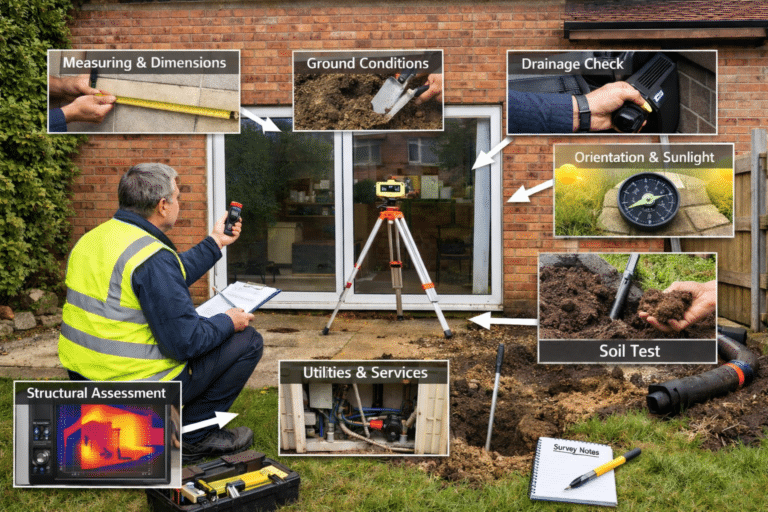
Yes, orangeries can be built on sloping sites, though costs may be higher due to required groundworks and potentially more complex foundations. Solutions include stepped foundations, retaining walls, or creating a level platform. Proper drainage is crucial on slopes. A site survey by professionals like Room Outside will identify the best approach for your specific site conditions.
What maintenance does an orangery require?
Maintenance requirements depend on materials used. Typical maintenance includes: cleaning glazing (inside and out), clearing roof lantern gutters/drainage, checking and cleaning seals, maintaining any moving parts (opening roof vents, doors), and periodic repainting of timber elements if used. Modern aluminum frames require minimal maintenance. Quality installations should come with maintenance guidance specific to the materials used.
Talk to an orangery specialist: 01243 538999 – Our team at Room Outside will discuss your requirements and arrange a free consultation at your property.
Transform Your Home with an Orangery Extension
Ready to explore how an orangery could enhance your home? Our experienced team at Room Outside can help you design the perfect space for your needs, whether it’s a kitchen-diner, home office, garden room, or any of the other brilliant uses we’ve explored. Book a free consultation to discuss your project.
01243 538999 Call us anytime – David our digital assistant will take a few details so the right specialist can follow up personally.