

The Hidden Costs of Choosing the Cheapest Conservatory Quote
Why that bargain quote could cost you twice in the end—thin glass, weak frames, failed foundations, and the real price of cutting corners.
The Uncomfortable Truth
The cheapest conservatory quote is rarely the cheapest option. Budget installations frequently develop serious problems within 5-10 years—leaking roofs, failing seals, subsiding foundations, and thermal performance so poor the room is unusable for half the year.
We regularly meet homeowners across Kent and the South East who’ve paid £15,000-£25,000 for a conservatory, spent another £8,000-£15,000 trying to fix problems, and now face complete replacement. The “saving” became an expensive lesson.
The Hidden Cost Reality
- Foundation failure: Rectification costs £8,000-£20,000 (more than many budget conservatories)
- Roof replacement: £5,000-£15,000 when polycarbonate or cheap glass fails
- Missing Building Regs: Delays property sales, requires £500-£3,000 to resolve
- Energy costs: Poor thermal performance adds £400-£800 annually to heating bills
- 5-year failure rate: Industry estimates suggest 15-25% of budget conservatories show serious problems within 5 years
- Typical rectification total: 40-60% of original purchase price spent on repairs
Where Budget Companies Cut Corners
When a conservatory quote is 30-50% below competitors, the saving has to come from somewhere. Here are the six areas where budget installers most commonly cut costs—and what happens as a result.
Inadequate Foundations
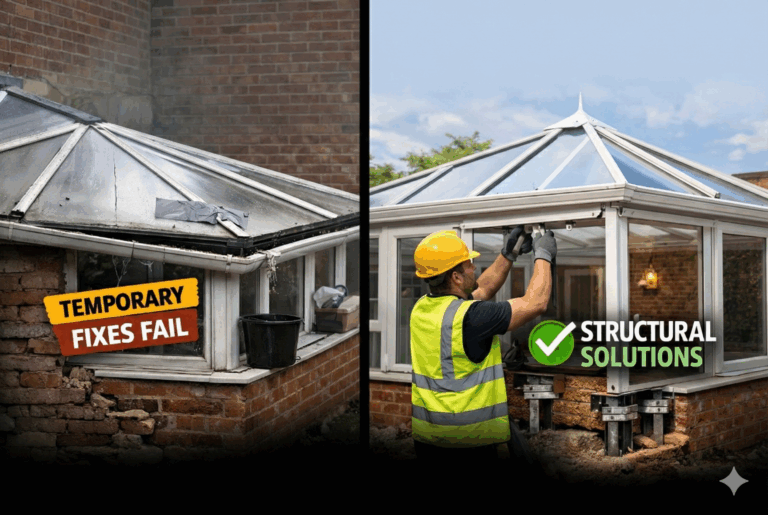
The biggest hidden cost. Budget installers may pour foundations too shallow (450mm instead of 1000mm+), skip proper ground investigation, or use insufficient concrete. The conservatory looks fine initially—problems emerge 3-7 years later as the structure moves.
What happens: Cracking, doors that won’t close, gaps appearing between conservatory and house, water ingress, structural instability.
Thin-Walled Frames
Quality uPVC frames have wall thicknesses of 2.8-3mm with galvanised steel reinforcement. Budget frames use 2mm walls, minimal reinforcement, and rely on glazing for rigidity rather than structural integrity.
What happens: Frame flex causes seal failures, glazing units crack or pop out, doors drop and bind, water penetration at joints, premature degradation.
Budget Glazing
Polycarbonate roofs instead of glass, standard double glazing instead of low-E coated units, basic soft-coat glass that fails prematurely. Some budget quotes include glazing U-values of 2.0+ W/m²K—nearly twice what quality units achieve.
What happens: Room too hot in summer, freezing in winter, polycarbonate yellows and becomes brittle, seal failures cause misting, higher energy bills.
No Building Regulations
While conservatories under 30m² with thermal separation can be exempt, many budget installers don’t even confirm exemption criteria are met. They certainly don’t handle Building Regs when they’re required—because that adds cost.
What happens: Problems when selling (solicitors flag it), potential safety issues, may need retrospective approval or indemnity insurance, could affect home insurance.
Rushed Installation
Budget companies work on volume and tight margins. Installers are under pressure to complete jobs quickly and move on. There’s no time for proper site preparation, careful sealing, or quality checks.
What happens: Water ingress from day one, poor finishes, gaps and misalignments, incomplete sealing, problems emerge within months rather than years.
No Meaningful Warranty
Budget companies often offer impressive-sounding warranties—10 years, even 15 years. But they’re not backed by insurance, the company may not exist in 3 years, and the small print excludes almost everything.
What happens: Company disappears or refuses claims. No insurance-backed guarantee means no recourse. You’re left paying for repairs the “warranty” should cover.
The Cheap Conservatory Timeline: What Typically Happens
This is a composite picture based on conversations with homeowners we’ve met over the years—people who came to us after their budget conservatory failed. The pattern is remarkably consistent.
Everything Looks Fine
The conservatory looks great. You’re delighted with the “bargain” price. Minor issues (small draughts, a bit of condensation) seem normal for a new build. You convince yourself the expensive quotes were just profiteering.
Niggles Start Appearing
Doors start sticking. You notice condensation between glazing units (seal failure). The roof creaks more than expected. Heating bills seem high—but maybe that’s just energy prices? You call the company; they make excuses or do minor fixes.
Reality Sets In
Water ingress after heavy rain. Visible cracks in the brickwork junction. Multiple failed glazing units. The room is unusable in winter (too cold) and summer (too hot). You call the company—phone disconnected, or they deny responsibility.
Throwing Good Money After Bad
You spend £3,000-£8,000 on repairs: new roof, resealing, replacement units. Some problems improve; others persist. A surveyor mentions the foundations look inadequate. The repairs are expensive but incomplete.
Complete Replacement Required
Structural movement is now undeniable. Multiple professional opinions confirm: the conservatory cannot be economically repaired. Foundation underpinning alone would cost more than the original build. Complete replacement is the only sensible option.
Double What You “Saved”
Original conservatory: £18,000. Repairs over 7 years: £7,000. Complete replacement with quality build: £45,000. Total spent: £70,000. A quality build from day one: £40,000-£50,000.
The False Economy in Numbers
The homeowner in this scenario “saved” £22,000 by choosing the cheapest quote. They ended up spending £70,000 total—£20,000-£30,000 more than doing it right first time—plus years of frustration, disruption, and a room they couldn’t properly use.
This isn’t a worst-case scenario. It’s a pattern we see repeatedly across Kent, Surrey, Sussex, and Hampshire.
20-Year Total Cost Comparison
The true test of value isn’t the initial price—it’s total cost of ownership over the structure’s lifetime. Here’s how a budget conservatory compares to a quality build over 20 years.
Budget Conservatory
Quality Conservatory
The quality conservatory costs £32,300 less over 20 years—and at year 20, it’s still performing well with decades of life remaining. The budget option has been replaced once and may need replacing again.
Warning Signs in a Conservatory Quote
Before you sign anything, learn to recognise the red flags that suggest a quote is too good to be true. For detailed guidance on selecting the right company, see our comprehensive guide to choosing a conservatory or glass extension company.
Price 30%+ below competitors without clear explanation of why
Large deposit required (more than 10-15% upfront)
Vague specifications—no frame profiles, glazing U-values, or foundation details
No site survey—quote given without visiting your property
Pressure tactics—”price only valid today” or “last slot available”
No physical premises—just a mobile number and PO box
No trade association membership (GGF, FENSA, CERTASS)
Warranty not insurance-backed—just a company promise
What Quality Companies Do Differently
Understanding what you should expect helps you evaluate quotes properly. Here’s what separates reliable conservatory companies from budget operators.
| Element | Budget Approach | Quality Approach |
|---|---|---|
| Foundations | Minimal depth, often no ground investigationRISK | Proper survey, depth to specification, drainage consideredSAFE |
| Frame Specification | Thinnest possible walls, minimal reinforcement | Heavy-duty profiles, full steel reinforcement, quality hardware |
| Glazing | Basic double glazing, U-value 2.0+, possibly polycarbonate roof | Low-E coated, argon-filled, U-value 1.0-1.4, glass roof standard |
| Building Regs | Ignored or misrepresented | Assessed, handled properly, certificates provided |
| Installation | Rushed, subcontracted, minimal supervision | Employed teams, proper timescales, quality checks |
| Warranty | Company promise only (worthless if they disappear) | Insurance-backed guarantee from independent provider |
| After-Sales | Phone disconnected within 2 years | Established company, service department, ongoing support |
The Value of Experience and Stability
A company that’s been operating for decades—like Room Outside, established in 1973—has a reputation to protect. They can’t afford to cut corners because their business depends on referrals and repeat customers.
Budget operators often work a different model: win work on price, complete quickly, move on before problems emerge, dissolve and restart under a new name if complaints mount. The “company” behind your warranty may not exist when you need it.
Learn more about why we do things differently and the standards we maintain.
Questions to Ask Before Signing
Before committing to any conservatory quote, get clear answers to these questions. Evasive or vague responses are warning signs.
About the Structure
- What foundation depth and type will you use, and how do you determine this?
- What frame profiles are specified, and what are the wall thicknesses?
- What glazing U-values are included? What about the roof?
- How will Building Regulations be handled—exempt, or approval required?
- What drainage provisions are included?
About the Company
- How long have you been trading under this name?
- Can I visit your showroom or workshop?
- Who will actually install my conservatory—your employees or subcontractors?
- What trade associations are you a member of?
- Can you provide references from installations completed 3+ years ago?
About Protection
- Is the warranty insurance-backed by an independent provider?
- What deposit do you require, and how is it protected?
- What happens if problems arise after installation?
- What’s your complaints procedure if we’re not satisfied?
The Deposit Question
Quality companies typically require 5-15% deposit with the balance on completion or staged payments. Large upfront deposits (30-50%) are a red flag—either the company has cash flow problems or is taking excessive risk with your money.
If a company goes into liquidation after taking your deposit, you may lose everything. Deposits should be protected through a scheme or held in a client account. Ask for proof.

Explore Related Conservatory Guides & Resources
About This Guide
This guide is based on Room Outside’s 50+ years of experience in the conservatory industry, including conversations with homeowners whose budget installations have failed. Cost estimates reflect 2026 market rates in the South East UK and typical rectification work. Individual circumstances vary.
Last updated: March 2026 | Author: Room Outside
Frequently Asked Questions
Why do cheap conservatories fail?
Cheap conservatories fail because of cost-cutting in critical areas: inadequate foundations that subside, thin-walled frames that flex and leak, budget glazing that fails thermally, poor drainage causing water damage, missing Building Regulations compliance, and substandard workmanship. These problems typically emerge within 5-10 years.
What are the hidden costs of a cheap conservatory?
Hidden costs include higher heating bills from poor thermal performance, repair costs for leaking roofs and failed seals, potential foundation rectification at £8,000-£15,000, replacement glazing, Building Regulations retrospective approval, reduced property value, and potential legal issues when selling. Many homeowners spend 40-60% of the original price on repairs within 10 years.
How long should a conservatory last?
A quality conservatory should last 25-40 years for uPVC, 30-50 years for aluminium, and 40-60+ years for hardwood. Budget conservatories often show serious problems within 5-10 years and may need complete replacement within 15 years. The difference is in foundation quality, frame specification, glazing quality, and workmanship.
What happens if a conservatory has no Building Regulations?
Missing Building Regulations approval can cause serious problems when selling. Solicitors will flag the issue, potentially delaying or collapsing sales. You may need retrospective approval (£500-£2,000), indemnity insurance, or structural modifications. The conservatory may also be unsafe, uninsured, or causing damage to your home.
How much does it cost to fix a failed conservatory?
Rectification costs depend on the problems. Foundation underpinning: £8,000-£20,000. Complete roof replacement: £5,000-£15,000. Frame replacement typically means complete rebuild: £25,000-£50,000. Retrospective Building Regulations: £500-£3,000 plus modifications. Many homeowners find complete replacement is more economical than extensive repairs.
What should I look for in a conservatory quote?
Look for detailed specifications including foundation depth and type, frame profiles and wall thickness, glazing U-values and safety compliance, Building Regulations handling, insurance-backed guarantees, payment terms protecting deposits, and clear warranty terms. Be wary of quotes lacking detail, requiring large upfront deposits, or significantly below competitors.
Are cheap conservatory companies safe to use?
Not necessarily. Many budget companies operate with minimal overheads, no showroom, no workshop, and subcontracted labour. Some disappear before problems emerge, leaving homeowners with no warranty recourse. Check company age, reviews, trade association membership, insurance-backed guarantee availability, and physical premises before committing.
Is it worth paying more for a quality conservatory?
Yes, when comparing total cost of ownership over 20-30 years. A quality conservatory costing 40% more upfront but lasting twice as long with lower maintenance and energy costs delivers better value. It also adds more to property value and avoids the stress, disruption, and expense of early failure and rectification work.
Call us anytime – David, our digital assistant, will take a few details so the right specialist can follow up personally. 01243 538999 or request a consultation online
Choose Quality from the Start
We’ve spent 50 years building conservatories that last—and we’ve seen too many homeowners pay twice for budget installations that fail. Get transparent pricing for quality work, backed by insurance guarantees and our commitment to lasting craftsmanship.
Book Free ConsultationCall us anytime on 01243 538999 – David, our digital assistant, will take a few details so the right specialist can follow up personally.
Room Outside: Quality conservatories since 1973.
Serving Kent, Surrey, Sussex, Hampshire, London & surrounding areas.