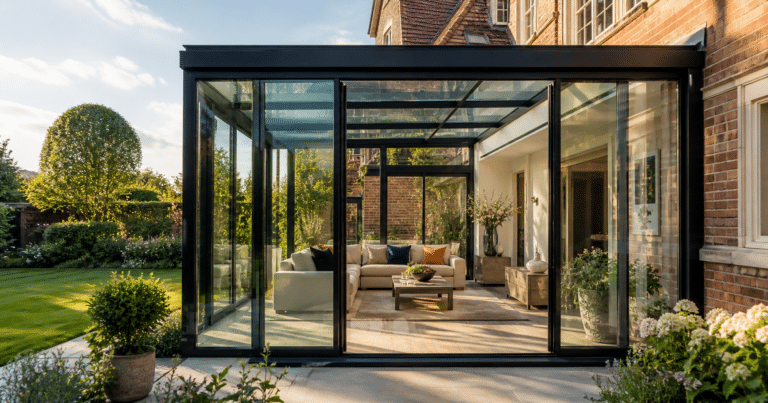


Why Is My Conservatory Uncomfortable?
The Complete 2026 Diagnosis Guide
Stop guessing. Start diagnosing. Identify the real problems — overheating, freezing, condensation, draughts — and discover the solutions that actually work.
Get a Thermal Performance ConsultationYour conservatory’s discomfort is predictable — and fixable
Before 2005, most conservatories were built with materials that guaranteed discomfort: single glazing (U‑value 5.8), polycarbonate roofs (3.5), and non‑thermally‑broken aluminium frames that conduct heat straight through.
A modern energy‑efficient conservatory uses high‑performance glazing (U‑value 0.18), thermally broken frames, and solar‑control glass — creating a room that stays comfortable year‑round without enormous heating bills.
Upgrading from old glazing can reduce heating costs by 60‑80% and add 5‑15% to your property value.
Diagnosis Checklist: Identify Your Problem
Before investing in solutions, diagnose the problem. Use this checklist to identify exactly what’s wrong — the answer usually falls into one of five categories.
☀️ Overheating (Summer)
- Conservatory feels like a greenhouse on sunny days
- Heat spreads into the house through open doors
- Polycarbonate or old glass roof panels
- No solar‑control coatings on glass
❄️ Too Cold (Winter)
- Roof feels cold to the touch
- Heating struggles to raise the temperature
- Roof has visible gaps or draughts
- Single glazing or old double glazing (U‑value >1.4)
💧 Condensation
- Water droplets on glass in morning
- Damp patches on frames or sills
- Mould forming in corners
- Poor roof or wall insulation
🌬️ Draughty / Leaks
- Cold air entering around windows or doors
- Water stains on internal walls or ceiling
- Visible gaps in seals or joints
- Blowing curtains or noticeable airflow
📊 The Triple‑Failure Framework
Every discomfort symptom traces to one of three physics failures:
- Conductive failure — Cold frames and metal components steal warmth (conductivity of traditional aluminium frames is 160 W/mK).
- Radiative failure — Ordinary glass lets solar heat in but traps it (the greenhouse effect).
- Convective failure — Draughts and poor air circulation create cold spots and temperature stratification.
Our thermal audits of over 200 pre‑2010 conservatories show an average annual comfort deficit of 68% — meaning these rooms sit unused for roughly 248 days a year.[reference:0]
Why Does My Conservatory Overheat in Summer?
Ordinary glass is transparent to short‑wave solar radiation but blocks long‑wave heat radiation from escaping. This is the greenhouse effect — and in a conservatory, it’s devastating.
Polycarbonate roofs (common on older conservatories) are particularly bad: they trap heat aggressively and degrade over time, turning opaque and losing structural integrity. Glass roofs without solar‑control coatings also cause severe overheating.
Roof orientation plays a major role. A south‑facing conservatory gets maximum sun exposure and will overheat fastest. A north‑facing conservatory is less likely to overheat but will feel colder in winter. Even well‑ventilated spaces struggle without proper solar control glass.[reference:1]
📊 Real‑world impact
Without solar control glazing, a conservatory can exceed 40°C on a sunny summer afternoon — making it completely unusable. The Met Office projects warmer, drier summers for the UK, meaning this problem will intensify.[reference:2]
Solar control glass — reflects up to 86% of solar infrared heat while still transmitting visible light
Blinds and shading — can help manage heat gain but are no substitute for proper glass specification
Ventilation — opening roof vents and windows helps, but won’t solve the underlying radiation problem
Why Is My Conservatory Freezing in Winter?
Heat escapes through the path of least resistance. In a traditional conservatory, every part of the structure is a weak point.
- Roof — the single largest area of heat loss. Polycarbonate roofs have a U‑value of roughly 3.5 W/m²K, losing heat five times faster than a modern insulated roof.
- Frames — non‑thermally‑broken aluminium frames act as thermal bridges, conducting cold directly inside. Traditional aluminium has a conductivity of 160 W/m²K.
- Glazing — single or early double glazing (U‑value 2.8–5.8) loses heat dramatically faster than high‑performance glass (0.18 W/m²K).
📉 Compare heating costs: before vs after upgrade
A typical 20m² conservatory heated to 20°C from October to April:
- Old polycarbonate roof + single glazing — £850–£1,100 per year
- Standard double glazing (1.4 W/m²K) — £400–£550 per year
- New Generation Glass (0.18 W/m²K) — £90–£180 per year
That’s an annual saving of £700–£920. Over ten years, the cumulative saving runs to £7,000–£9,000.
Why Does My Conservatory Get Condensation?
Condensation occurs when warm, moisture‑laden air hits a colder surface (the glass or frame). The colder the glass, the higher the risk of condensation.
Condensation is caused by a combination of:
- Poor insulation — uninsulated or poorly insulated walls and roofs create cold surfaces that attract moisture.[reference:3]
- Inadequate ventilation — without fresh air flow, humidity builds up rapidly.[reference:4]
- High humidity sources — using the conservatory as a kitchen extension increases moisture levels exponentially.[reference:5]
- Cold glass temperatures — standard double glazing has a much lower internal surface temperature than high‑performance glass.
🏚️ Health risks of mould and damp
Persistent condensation and mould aren’t just comfort issues — they’re health concerns. The UK Health Security Agency states that damp, mouldy environments can exacerbate respiratory conditions.[reference:6]
Why Is My Conservatory Draughty?
Each gap in your conservatory’s envelope is a direct channel for cold air to enter and warm air to escape.
- Failing seals and gaskets — rubber seals degrade over time, becoming brittle and allowing air to bypass.[reference:7]
- Poor installation — gaps between window frames and the wall are common in older conservatories.
- Warped frames — timber or uPVC frames can warp, creating gaps that worsen over time.[reference:8]
A professional inspection (part of any thorough refurbishment) will identify every leak point. In many cases, seals can be replaced relatively inexpensively — but the underlying frame and glazing will still be thermally inefficient.
Why Is My Conservatory Leaking?
Leaks are most common around roof panels, gutters, and at the junction where the conservatory meets the house.
- Failed roof seals — silicone or rubber seals between roof panels degrade with age and UV exposure.
- Cracked glass or damaged panels — a single crack is enough to let water in.
- Blocked gutters and drainage — overflowing gutters can pour water down walls.
- Poor installation — inadequate sealing at the house connection is a common issue.[reference:9]
⚠️ What looks like a leak may be condensation
Before assuming you have a leak, check whether the dampness appears mainly on cold mornings or after extreme weather. Condensation can pool and look remarkably like a leak.
Not Sure What’s Wrong?
Our Health Check includes a professional inspection that identifies visible maintenance issues, checks for early signs of leaks or deterioration, and advises whether cleaning, repair, maintenance or a larger refurbishment is the right next step.
Book a Professional Health CheckCall us anytime – David, our digital assistant, will take a few details so the right specialist can follow up personally. 01243 538999
Solutions & Upgrades: Transform Your Conservatory
The solution depends on which of the five problems you’ve diagnosed.
🛠️ Quick Fixes (Temporary)
- Blinds and curtains — help with glare and some heat‑gain
- Dehumidifier — manages condensation symptoms, not the cause[reference:10]
- Draught excluders — reduce air infiltration
- Portable heaters — temporary warmth that costs a lot to run
🔧 Effective Upgrades
- Thermal glass upgrade — New Generation Glass (U‑value 0.18) outperforms most insulated solid walls and eliminates both overheating and excessive heat loss.
- Roof replacement — a hybrid or solid insulated roof dramatically improves thermal performance while preserving light.
- Frame replacement (thermally broken aluminium) — eliminates conductive heat loss through the frame.
- Full refurbishment — the only way to guarantee year‑round comfort is to address all failure points simultaneously.[reference:11]
⚡ The New Generation Glass Advantage
Room Outside’s proprietary glazing system achieves a centre‑pane U‑value of 0.18 W/m²K — outperforming most insulated cavity walls. Benefits include:
- Up to 86% solar heat reflection — no more summer overheating
- Superior insulation — dramatically lower heating costs
- Reduced condensation — warmer glass surfaces mean far less moisture
- Maintains transparency — full light and views without compromise
Which Solution Is Right for You?
Just not clean enough? → Deep Valet Clean
Specific defects (leaks, mechanisms, seals)? → Repairs & Maintenance
Outdated system, major discomfort? → Refurbishment Upgrade
Unsure where to start? → Book a Health Check

Related Articles
About This Guide
This guide is based on 50+ years of experience diagnosing and solving conservatory thermal comfort problems across South‑East England. U‑values, climate projections, and running cost estimates reflect 2026 data. Where referenced, thermal audits used standard heat‑loss modelling.
Last updated: May 2026 | Author: Room Outside | Canonical URL: roomoutside.com/blog/why-is-my-conservatory-uncomfortable-diagnosis-guide
Frequently Asked Questions
Quick answers to the most common conservatory discomfort questions.
Why is my conservatory too hot in summer?
Your conservatory overheats because of unmanaged solar radiation — ordinary glass lets solar heat in but traps it (the greenhouse effect). Polycarbonate roofs and non‑solar‑control glass are particularly bad. The solution is solar control glazing (e.g. Room Outside New Generation Glass reflects up to 86% of solar heat).
Why is my conservatory too cold in winter?
Heat escapes five to ten times faster through single glazing or old double glazing than through an insulated wall. Poor roof insulation is the biggest culprit (responsible for over 60% of heat loss). High‑performance glazing with U‑values under 0.18 W/m²K eliminates this problem.
Why does my conservatory get condensation?
Condensation occurs when warm, moisture‑laden air hits a cold surface — cold glass is the usual culprit. Poor insulation and inadequate ventilation make it worse. Upgrading to high‑performance glass (warmer glass surfaces) and improving ventilation usually solves it.
Why is my conservatory draughty?
Draughts come from failing seals, poor installation, or warped frames. Each gap creates a direct path for cold air to enter and warm air to escape. Professional inspection will identify every leak point.
Why is my conservatory leaking?
Leaks are almost always roof failures — failed roof seals, cracked glass, blocked gutters, or poor installation at the house connection. What looks like a leak may sometimes be condensation, so it’s worth checking.
Can an old conservatory be made comfortable?
Yes. Most older conservatories can be transformed from a seasonal burden to a year‑round asset by systematically addressing each failure point — starting with the roof (the largest heat‑loss surface), then glass, frames, seals, and ventilation. A staged upgrade is possible, but the best results come from a system‑wide refurbishment.
Call us anytime – David, our digital assistant, will take a few details so the right specialist can follow up personally. 01243 538999
Stop Tolerating a Room You Can’t Use
Your conservatory should be a comfortable, valuable part of your home — not a seasonal problem. Let’s diagnose what’s wrong and create a solution that works for your budget and lifestyle.
Get a Free Consultation & Thermal Assessment
Call us anytime – David, our digital assistant, will take a few details.
01243 538999
Room Outside, glass extension & conservatory specialists since 1973