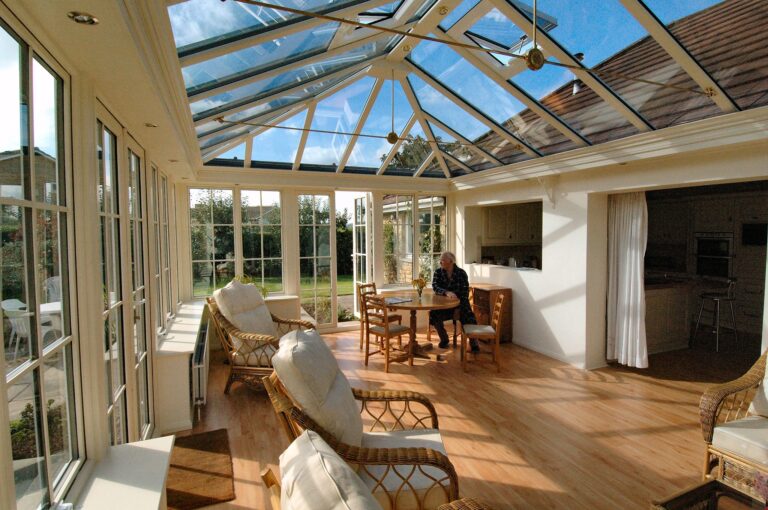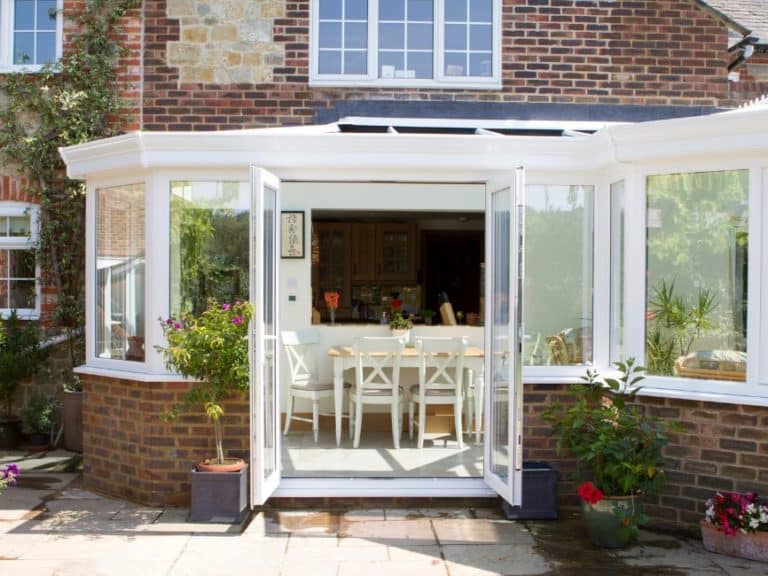

Bespoke conservatory by Room Outside featuring large windows, a glass roof, and a cozy seating area, surrounded by greenery.
roomoutsideuk
07th March, 2026

Building Regulations for Glass Extensions: What Your Installer Must Get Right

Room Outside: Outdoor Living Inspiration | Roomoutside

Building Regulations for Glass Extensions: What Your Installer Must Get Right

The complete UK guide to Part L, Part P, glazing safety, exemptions, and compliance—everything you need to know before your project begins.

Quick Answer

Most conservatories are EXEMPT from Building Regulations if they meet all these criteria: floor area under 30m², built at ground level, thermally separated from the house by external-quality doors/windows, independent heating with separate controls, and glazing meeting safety standards.

You WILL need full Building Regulations approval if: the conservatory exceeds 30m², you remove the separating doors, the structure has a solid roof (orangery-style), or you’re building something other than a true conservatory. Part P electrical requirements apply regardless of exemption status.

Key Facts: Glass Extension Building Regulations (2026)

  • Exemption threshold: Conservatories under 30m² with thermal separation are generally exempt
  • Thermal separation requirement: External-quality doors/windows must remain between conservatory and house
  • Part L (Thermal): Non-exempt extensions require walls at 0.28 W/m²K, roofs at 0.16 W/m²K
  • Part P (Electrical): All electrical work must be certified regardless of exemption status
  • Part K (Glazing): Safety glass mandatory below 800mm and in/near doors
  • Removing doors: Exemption LOST—full compliance required retrospectively
  • Completion certificate: Essential for property sale—solicitors check for these
  • Approved Inspectors: Alternative to local authority Building Control
30m²
Max exempt floor area
0.28
Wall U-value (W/m²K)
1.4
Window U-value (W/m²K)
800mm
Safety glass threshold

Understanding the Conservatory Exemption

Building Regulations exist to ensure buildings are safe, energy-efficient, and accessible. Unlike planning permission (which controls what you can build and where), Building Regulations control how you build—the technical standards that must be met.

Conservatories benefit from a specific exemption in the Building Regulations, but this exemption has strict conditions. Understanding these conditions is essential because losing the exemption means full compliance is required—often at significant cost.

The Five Conditions for Exemption

ALL Five Conditions Must Be Met:

Floor area under 30m² — measured internally
Built at ground level — not on an upper floor or raised platform
Thermally separated — external-quality walls, doors, or windows between conservatory and house
Independent heating — with separate controls, not connected to main house system
Glazing compliance — safety glass in all required locations (Part K)

Critical: Part P Still Applies

Even if your conservatory is exempt from most Building Regulations, Part P (Electrical Safety) still applies. All electrical work must be carried out by a competent person registered with NICEIC, NAPIT, or similar scheme, OR inspected and certified by Building Control. This includes lighting, sockets, underfloor heating, and any fixed electrical installation.

The Building Regulations Parts Explained

Building Regulations are divided into “Parts” (also called Approved Documents), each covering a different aspect of construction. Several Parts apply to glass extensions:

Part L: Conservation of Fuel & Power

Thermal performance requirements

Sets minimum thermal performance standards to reduce energy consumption. For non-exempt extensions:

  • Walls: U-value ≤ 0.28 W/m²K
  • Roof: U-value ≤ 0.16 W/m²K
  • Floor: U-value ≤ 0.18 W/m²K
  • Windows/doors: U-value ≤ 1.4 W/m²K
  • Roof windows: U-value ≤ 1.6 W/m²K

Part P: Electrical Safety

Always applies—even if exempt

Covers electrical installations in dwellings. Requirements:

  • Work must meet BS 7671 wiring regulations
  • Must be done by competent person OR certified by Building Control
  • Competent person schemes: NICEIC, NAPIT, ELECSA, etc.
  • Installation certificate must be issued
  • Applies to all new circuits, not just major work

Part K: Protection from Falling & Impact

Glazing safety requirements

Requires safety glazing in “critical locations”:

  • All glass below 800mm from floor level
  • Glass in doors up to 1500mm height
  • Glass within 300mm of doors, up to 1500mm
  • Safety glass: toughened (BS EN 12150) or laminated (BS EN ISO 12543)
  • Must be permanently marked with standard

Part A: Structure

Structural stability and foundations

Ensures the structure is stable and adequately supported:

  • Foundations adequate for ground conditions
  • Structure designed to carry loads safely
  • Resistance to ground movement
  • May require engineer’s calculations
  • Tree proximity often requires deeper foundations

Part M: Access & Use

Accessibility requirements

Promotes accessibility for all users:

  • Level or ramped threshold access preferred
  • Door widths adequate for wheelchair access
  • Step-free access where reasonably practicable
  • Requirements less stringent for domestic extensions
  • Good practice even if not strictly required

Part B: Fire Safety

Means of escape and fire spread

Ensures safe escape in fire situations:

  • Generally minimal requirements for single-storey extensions
  • May apply if conservatory affects escape routes
  • Fire spread to boundaries considered
  • More relevant for attached garages or bedrooms
  • Smoke alarms should be extended if appropriate

When the Exemption Does NOT Apply

Several situations mean your glass extension cannot benefit from the conservatory exemption and requires full Building Regulations approval:

SituationExempt?What’s Required
Conservatory under 30m², thermally separatedYesPart P electrical certification only
Conservatory over 30m²NoFull Building Regulations approval
Doors removed (no thermal separation)NoFull compliance including Part L upgrades
Solid roof (orangery-style)NoFull Building Regulations approval
Connected to main heating systemNoFull Building Regulations or separate controls
Built above ground floorNoFull Building Regulations approval
Glass extension (not conservatory)DependsLikely requires full approval

The Door Removal Problem

This is the most common compliance issue we encounter. Many homeowners remove the doors between conservatory and house to create an open-plan space. The moment you do this:

  • The conservatory exemption no longer applies
  • The space becomes part of your home’s heated envelope
  • Full Part L compliance is required retrospectively
  • This typically means upgrading glazing to achieve required U-values
  • Roof performance becomes critical (0.16 W/m²K is challenging for glass)
  • Costs can be significant—often £10,000-£30,000+ depending on size

If you want an open-plan connection, plan for Building Regulations compliance from the outset.

Part L in Detail: The Thermal Challenge

Part L (Conservation of Fuel and Power) presents the biggest technical challenge for glass extensions that don’t qualify for exemption. The 2021 update to Part L significantly increased requirements, and further tightening came in 2025.

Current U-Value Requirements (2026)

ElementRequired U-ValueTypical Solution
External walls≤ 0.28 W/m²KInsulated cavity wall or SIPs
Roof (pitched)≤ 0.16 W/m²KSolid insulated roof with rooflights
Roof (flat)≤ 0.16 W/m²KInsulated warm roof construction
Floor≤ 0.18 W/m²KInsulated concrete slab
Windows & doors≤ 1.4 W/m²KHigh-performance double/triple glazing
Roof windows/skylights≤ 1.6 W/m²KPremium roof glazing units

The Glass Roof Dilemma

Here’s the challenge: if your extension has a primarily glass roof and isn’t exempt, achieving the 0.16 W/m²K roof requirement with glazing is technically impossible with current technology. Even the best triple-glazed units achieve around 0.7-1.0 W/m²K.

Solutions include:

  • Hybrid roof design: Solid insulated perimeter with central glass lantern—the orangery approach
  • Compensating calculation: Improving other elements (walls, floor) beyond minimum to offset the glass roof’s underperformance
  • SAP calculation: Whole-building energy modelling demonstrating overall compliance
  • Limiting glazed area: Keeping glass roof area small relative to solid sections

The Compensating Calculation Approach

Building Regulations allow flexibility through “compensating calculations.” If one element underperforms, others can exceed minimum standards to achieve overall compliance. For glass-roof extensions, this might mean:

  • Walls significantly exceeding 0.28 W/m²K (e.g., achieving 0.15)
  • Floor insulation beyond minimum (e.g., 0.12 W/m²K)
  • Premium glazing throughout (triple-glazed, argon-filled)

A thermal modelling specialist or your Building Control officer can advise on what’s achievable for your specific design.

Part P: Electrical Safety (Always Applies)

Whether or not your conservatory is exempt from other Building Regulations, Part P electrical requirements always apply. This is a common area of non-compliance—and a significant risk.

What Part P Requires

  • Competent person installation: Electrical work should be carried out by an electrician registered with a competent person scheme (NICEIC, NAPIT, ELECSA, etc.)
  • Self-certification: Registered electricians can self-certify their work and notify Building Control on your behalf
  • Building Control route: If using an unregistered electrician, you must notify Building Control before work starts, pay a fee, and have the work inspected
  • Certification: You must receive an Electrical Installation Certificate (for new circuits) or Minor Works Certificate (for smaller work)

Conservatory Electrical Work Includes:

  • Lighting circuits
  • Socket outlets
  • Underfloor heating controls
  • Electric underfloor heating elements
  • Outdoor lighting connected to the conservatory
  • Audio/visual wiring if fixed
  • Smart home system wiring

Why This Matters When Selling

Solicitors conducting property searches will ask for Part P certificates for any electrical work done since 2005. Missing certificates create complications during property sales—potentially requiring retrospective inspection (expensive) or indemnity insurance. Ensure you receive and retain electrical certificates.

Glazing Safety: Part K Requirements

Glass in “critical locations” must be safety glass—either toughened (which shatters into small, relatively harmless pieces) or laminated (which holds together when broken). This requirement applies even to exempt conservatories.

Critical Locations Defined

LocationRequirement
All glazing below 800mm from floor levelSafety glass mandatory
Glazing in doors (any part of door)Safety glass mandatory up to 1500mm
Glazing within 300mm of door edgeSafety glass mandatory up to 1500mm
Overhead glazing (roof glass)Must not cause injury if broken—typically laminated
Glass balustrades or barriersStructural glazing requirements apply

Safety Glass Standards

  • Toughened glass: BS EN 12150—must be permanently marked
  • Laminated glass: BS EN ISO 12543—must be permanently marked
  • Marking location: Usually etched or sandblasted in corner of pane
  • Roof glazing: Inner pane should be laminated (holds together if broken)

Checking Your Existing Glazing

Look in the corner of each glass pane for a small etched mark showing the safety standard (BS EN 12150 for toughened, BS EN ISO 12543 for laminated). If there’s no mark in critical locations, the glass may not be safety glass—a compliance issue that could need addressing, particularly if selling the property.

Building Control or Approved Inspector?

For non-exempt glass extensions, you’ll need Building Regulations approval. You have two options for obtaining this:

AspectLocal Authority Building ControlApproved Inspector
ProviderYour local councilPrivate company
Legal statusEquivalent—both can issue valid certificatesEquivalent—both can issue valid certificates
Typical costFixed fees, often competitiveCompetitive, may offer packages
SpeedCan be slower in busy periodsOften faster response times
FlexibilityStandard processesMay offer more flexible inspection times
Local knowledgeDeep knowledge of local conditionsMay be less familiar with local issues

Many installers work regularly with specific Approved Inspectors and can arrange this as part of their service. Either route leads to the same legal outcome—a completion certificate confirming compliance.

Common Mistakes Installers Make

After 50+ years building glass extensions, we’ve seen many compliance problems—often created by less experienced installers. Here are the most common issues:

Watch Out For These Red Flags:

“You don’t need Building Regs for a conservatory” — True only if ALL exemption conditions are met. Many installers oversimplify this.
No Part P electrical certificate provided — Electrical work ALWAYS needs certification. Demand your certificate at completion.
Suggesting door removal is “fine” — Removing thermal separation without addressing Building Regulations is a compliance breach.
Non-safety glass in critical locations — All glass below 800mm and in/near doors must be safety glass. Check for BS marking.
Inadequate foundations near trees — Tree root activity requires deeper foundations. Failure here causes structural movement.
Connecting heating to main system — Lose exemption if the conservatory heating isn’t independently controlled.

What Documents Should You Receive?

At project completion, ensure you receive the following documentation—these are essential for future property sales:

For Exempt Conservatories:

  • Part P Electrical Certificate — Electrical Installation Certificate or Minor Works Certificate
  • Building Control notification — if an unregistered electrician was used
  • Glazing certificates — confirming safety glass compliance
  • Structural warranty — if provided by installer
  • Product warranties — frames, glazing, hardware

For Non-Exempt Extensions:

  • All of the above, PLUS:
  • Building Regulations Completion Certificate — from Building Control or Approved Inspector
  • Structural engineer’s calculations — if required
  • Energy Performance Certificate (EPC) — may be required depending on circumstances

Store Documents Safely

Keep all completion certificates, warranties, and compliance documents with your property deeds. When you sell, your solicitor will request these—missing documents can delay or complicate sales, potentially requiring retrospective inspections or indemnity insurance.

Room Outside

Glass Extension Specialists | Established 1973 | 50+ Years Experience

Room Outside designs and builds conservatories, orangeries, and glass extensions with full Building Regulations compliance. We handle all approvals, certifications, and documentation—giving you complete peace of mind. Call 01243 538999 for expert advice.

Glass Extension Coverage Areas in South East England

Room Outside designs and builds compliant glass extensions across the South East of England:

KentSurreyEast SussexWest SussexHampshireLondonBerkshireEssex

Sources, References, and Further Reading

Official Sources: Building Regulations 2010 (as amended); Approved Document L (Conservation of Fuel and Power); Approved Document P (Electrical Safety); Approved Document K (Protection from Falling, Collision and Impact); Planning Portal guidance.

Industry Experience: Room Outside – 50+ years experience delivering Building Regulations compliant glass extensions.

Note: This guide covers England and Wales. Scotland and Northern Ireland have different Building Regulations systems.

Last updated: March 2026 | Expert review: Requirements verified against current legislation

Frequently Asked Questions

Do glass extensions need Building Regulations approval?

It depends. Conservatories are often exempt if under 30m², thermally separated from the house, with independent heating and compliant glazing. Orangeries, solid-roof extensions, and structures without thermal separation require full Building Regulations approval.

What is thermal separation and why does it matter?

Thermal separation means maintaining external-quality doors/windows between the conservatory and house. This preserves the house’s thermal envelope. Remove these doors and the exemption no longer applies—full Part L compliance becomes required.

What are the Part L requirements for glass extensions?

Part L sets thermal performance standards: walls ≤0.28 W/m²K, roofs ≤0.16 W/m²K, floors ≤0.18 W/m²K, windows/doors ≤1.4 W/m²K. Glass roofs face challenging requirements that often need compensating through other elements.

Do I need Building Regulations for electrical work?

Yes—Part P applies regardless of whether the conservatory is otherwise exempt. Electrical work must be done by a registered competent person (NICEIC, NAPIT, etc.) who self-certifies, OR inspected by Building Control. Always obtain your electrical certificate.

What glazing safety requirements apply?

Part K requires safety glass (toughened or laminated) below 800mm from floor level, in doors, and within 300mm of doors up to 1500mm height. Safety glass must be permanently marked with BS EN 12150 (toughened) or BS EN ISO 12543 (laminated).

What happens if I remove the conservatory doors?

The exemption no longer applies. The space becomes part of your home’s heated envelope, requiring full Part L compliance retrospectively. This typically means upgrading glazing, improving roof insulation, and potentially the heating system—often £10,000-£30,000+.

Do I need a completion certificate?

For exempt conservatories, only Part P electrical certification is required. For non-exempt extensions, you must receive a completion certificate from Building Control or an Approved Inspector. Solicitors check for these when you sell your property.

What’s the difference between Building Control and Approved Inspector?

Both can oversee Building Regulations compliance with equal legal standing. Building Control is your local authority service; Approved Inspectors are private companies. Both issue valid completion certificates. Many installers work with specific Approved Inspectors.

Call us anytime – David, our digital assistant, will take a few details so the right specialist can follow up personally. 01243 538999 or request a consultation online

Need a Compliant Glass Extension?

We handle all Building Regulations requirements, from initial design through to completion certificates. Every project is delivered with full documentation—giving you complete peace of mind now and when you sell.

Book Free Consultation

Call us anytime on 01243 538999 – David, our digital assistant, will take a few details so the right specialist can follow up personally.

Room Outside: Glass extension specialists since 1973.
Serving Kent, Surrey, Sussex, Hampshire, London & surrounding areas.
Bespoke conservatory by Room Outside featuring large windows, a glass roof, and a cozy seating area, surrounded by greenery.
roomoutsideuk
06th March, 2026

Designing a Bespoke Orangery

Designing a Bespoke Orangery: From Initial Vision to Architectural Reality | Room Outside

Designing a Bespoke Orangery

From Initial Vision to Architectural Reality

The Art of Bespoke Design

A bespoke orangery is more than a building project—it’s a creative collaboration that transforms how you live. Unlike off-the-shelf solutions that force your vision to fit standardised dimensions, bespoke design starts with your property, your lifestyle, and your aspirations, then crafts a unique architectural response.

This guide reveals the complete journey from initial inspiration to finished structure. Understanding each stage helps you participate meaningfully in the design process, make informed decisions, and ultimately achieve an orangery that feels inevitable—as if it was always meant to be part of your home.

4-8
Months total process
8
Key design stages
100+
Decisions refined
1
Unique creation

What Defines a Bespoke Orangery?

The term “bespoke” is often misused in construction. A truly bespoke orangery isn’t simply a standard design in a custom size—it’s a ground-up architectural creation conceived specifically for your property, requirements, and aesthetic preferences.

Bespoke vs. Made-to-Measure: The Critical Difference

Made-to-measure takes an existing design and adjusts dimensions to fit your space. The proportions, details, and overall character remain essentially unchanged.

Bespoke creates an entirely new design from scratch. Every proportion, every detail, every material choice responds to your specific context. The result exists nowhere else—it’s yours alone.

The Defining Characteristics of an Orangery

Orangeries occupy a unique position between conservatories and traditional extensions. Their architectural DNA includes:

  • Solid corner pillars: Brick, stone, or rendered columns that anchor the structure and provide thermal mass
  • Perimeter flat roof: An insulated roof section around the edges, creating internal pelmets for lighting and services
  • Central glass lantern: A raised glazed roof section flooding the interior with natural light
  • Substantial appearance: More extension-like than a conservatory, with greater visual weight
  • Superior thermal performance: The solid elements provide insulation that fully glazed structures cannot match

The Design Journey: Eight Stages

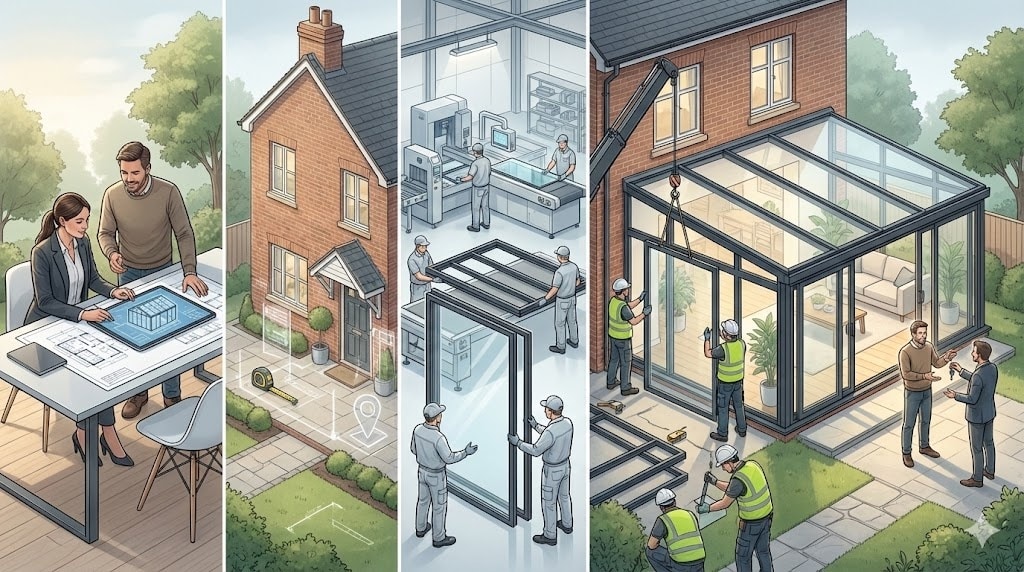
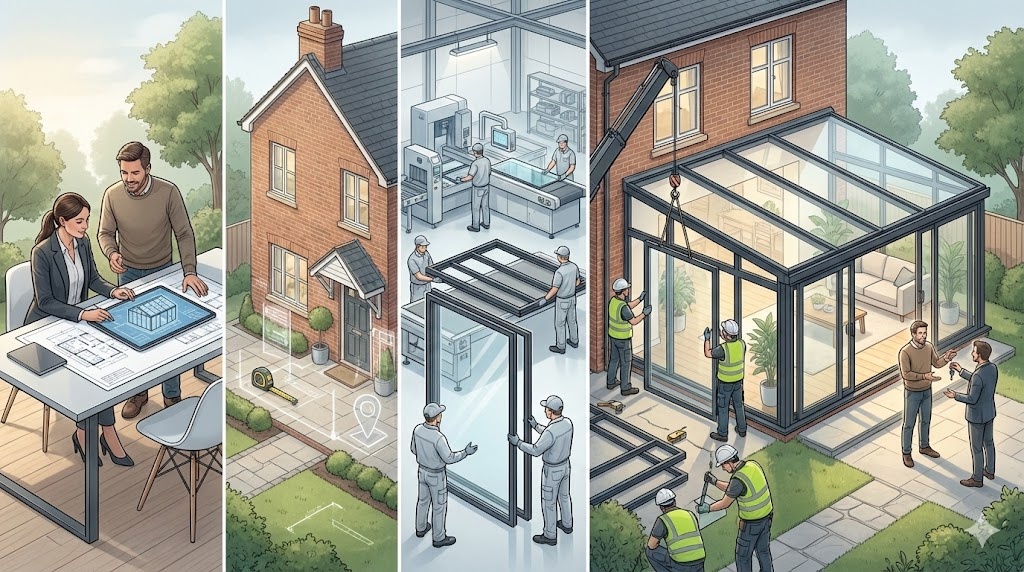
Creating a bespoke orangery follows a structured yet flexible process. Each stage builds upon the last, progressively refining your vision into buildable reality.

1

Initial Consultation & Discovery

1-2 weeks

The journey begins with listening. A skilled designer seeks to understand not just what you want, but why you want it—the underlying aspirations that will shape every subsequent decision.

  • How do you currently use your home? What frustrations exist?
  • How do you envision using the new space?
  • What architectural styles appeal to you?
  • What materials and colours resonate?
  • What’s your investment range?
  • Are there constraints we should know about?
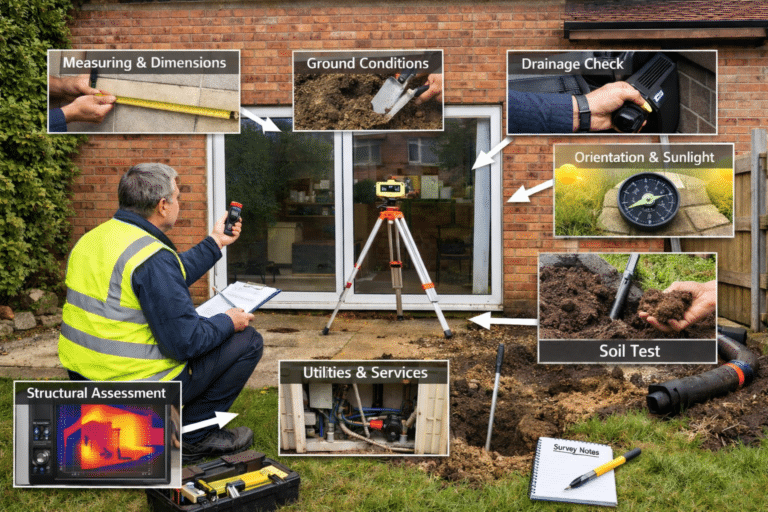
2

Site Survey & Analysis

1 day + analysis

The physical context shapes everything. A comprehensive survey captures not just dimensions, but the subtle factors that influence design success.

  • Precise measurements of house and garden
  • Orientation analysis (sun path, prevailing weather)
  • Ground conditions and drainage patterns
  • Existing architectural details to reference
  • Neighbouring properties and sight lines
  • Service locations (drainage, utilities)
3

Concept Design

2-4 weeks

With understanding and analysis complete, design creativity begins. Initial concepts explore different approaches—testing proportions, styles, and configurations.

  • Sketch designs exploring options
  • 3D visualisations showing spatial impact
  • Scale drawings indicating proportions
  • Material mood boards
  • Initial budget estimates
  • Discussion of trade-offs and possibilities
4

Design Development

2-4 weeks

The chosen concept is developed into a detailed design. Every element is specified, from major structural decisions to finishing details.

  • Detailed floor plans and elevations
  • Material specifications (frames, glazing, roofing, masonry)
  • Hardware selections (doors, windows, handles)
  • Interior elements (flooring, lighting, heating)
  • Refined 3D visualisations
  • Detailed cost proposal
5

Planning & Approvals

8-12 weeks

Securing necessary permissions ensures your orangery is legally compliant and protects your investment.

  • Assessment of Permitted Development rights
  • Planning application if required
  • Listed Building Consent for heritage properties
  • Building Regulations submission
  • Party Wall notifications if applicable
  • Liaison with local authority throughout
6

Technical Design & Engineering

2-3 weeks

The design is translated into precise manufacturing and construction documentation.

  • Structural engineering calculations
  • Foundation design
  • Detailed manufacturing drawings
  • Glazing schedules and specifications
  • Services routing (electrical, heating)
  • Final quality assurance review
7

Manufacturing

4-6 weeks

Components are fabricated in controlled factory conditions, ensuring precision and quality impossible to achieve on-site.

  • Frame fabrication and finishing
  • Glazing unit manufacture
  • Roofing components prepared
  • Hardware and fittings assembled
  • Quality control inspections
  • Delivery coordination
8

Construction & Completion

4-8 weeks

The vision becomes reality as skilled craftspeople bring together all elements on site.

  • Site preparation and excavation
  • Foundation construction
  • Masonry work for pillars and plinths
  • Frame installation
  • Roofing and glazing
  • Internal finishing and handover

The best bespoke designs feel inevitable—as though the orangery was always part of the original architect’s intention, simply waiting to be realised.

— Design Philosophy, Room Outside

Design Considerations: The Elements of Excellence

Bespoke design involves hundreds of decisions, each contributing to the final result. Understanding the key considerations helps you engage meaningfully with the design process.

Proportional Harmony

The orangery should relate to your home’s existing proportions—window rhythms, floor-to-ceiling heights, and architectural language.

Light & Orientation

Understanding how sunlight moves across your site throughout the day and year shapes glazing placement and shading strategies.

Interior Flow

How will the orangery connect to existing rooms? How will furniture be arranged? Traffic patterns and sight lines matter.

Material Palette

Frames, masonry, roofing, and finishes must work together and complement your existing property’s materials.

Garden Integration

The orangery mediates between house and garden. Consider views, access to outdoor spaces, and landscape design.

Services Integration

Electrical outlets, lighting design, heating systems, and smart home integration should be planned from the start.

Material Choices: Building Character

The materials you choose fundamentally shape your orangery’s character, performance, and longevity. Each option brings distinct qualities.

Hardwood Timber

Classic warmth & character
  • Aesthetic: Natural warmth, traditional character, ages beautifully
  • Species: Oak, sapele, accoya, or engineered options
  • Finish: Painted, stained, or natural oiled
  • Lifespan: 40-60+ years with maintenance
  • Maintenance: Periodic refinishing (5-10 years)
  • Heritage: Ideal for period properties and Conservation Areas
  • Investment: Premium pricing reflects craftsmanship required

Aluminium

Contemporary precision & longevity
  • Aesthetic: Slim sightlines, crisp modern lines
  • Profiles: 20-35mm sightlines maximise glass area
  • Finish: Powder coating in RAL colours, dual-colour options
  • Lifespan: 40-50+ years with minimal maintenance
  • Maintenance: Occasional cleaning only
  • Thermal: Modern thermal breaks achieve excellent U-values
  • Versatility: Suits contemporary and traditional designs

Timber-Aluminium Hybrid

Best of both worlds
  • Concept: Timber interior, aluminium exterior cladding
  • Interior: Warm timber aesthetic inside
  • Exterior: Weather-resistant aluminium outside
  • Maintenance: Minimal—aluminium protects timber
  • Performance: Excellent thermal values
  • Aesthetic: Traditional feel without maintenance burden
  • Investment: Premium option combining benefits

Masonry Options

The structural foundation
  • Brick: Match existing house or complementary contrast
  • Natural stone: Premium option for character properties
  • Render: Smooth or textured finish, painted any colour
  • Reconstructed stone: Cost-effective alternative to natural
  • Cladding: Timber, composite, or modern materials
  • Thermal mass: Solid elements moderate temperature swings
  • Matching: Sourcing reclaimed materials for seamless integration

The Lantern Roof: Crown of the Orangery

The lantern roof is the defining architectural element of an orangery—the feature that floods the interior with light while creating visual drama. Lantern design involves careful consideration of proportion, glazing, and structural elements.

Lantern Roof Design Elements

  • Pitch angle: Steeper pitches shed water better and create more internal volume; shallower pitches are more contemporary
  • Glazing bars: The framework dividing glass panels—aluminium for slim profiles, timber for traditional character
  • Ridge details: Decorative finials, cresting, or clean minimal lines depending on style
  • Ventilation: Integrated vents in the lantern promote natural airflow and temperature regulation
  • Glass specification: Solar control coatings essential for roof glass; self-cleaning coatings reduce maintenance
  • Proportion: The lantern’s size relative to the perimeter roof creates visual balance
Lantern StyleCharacterBest Suited For
Traditional pitchedClassic Georgian/Victorian aesthetic with decorative detailsPeriod properties, Conservation Areas
Contemporary minimalSlim frames, clean lines, maximum glassModern homes, minimalist interiors
Flat roof lanternLow profile, unobtrusive, clean geometryBungalows, restricted height situations
Structural glassVirtually frameless, maximum transparencyUltra-contemporary designs

Investment: Understanding the Costs

Bespoke orangeries represent significant investment. Understanding cost factors helps set realistic expectations and make informed decisions about where to allocate budget.

CategoryDescriptionTypical Range
Modest bespoke3m x 3m, aluminium frame, standard glazing£50,000-£70,000
Mid-range bespoke4m x 4m, premium glazing, quality masonry£70,000-£100,000
Premium bespokeLarger size, hardwood/hybrid, high-spec throughout£100,000-£150,000
Exceptional projectsLarge scale, complex design, premium everything£150,000+

Factors Influencing Cost

  • Size: Larger orangeries cost more, but cost-per-square-metre often decreases with scale
  • Frame material: Hardwood typically 20-30% more than aluminium
  • Glazing specification: Premium temperature-controlled glass adds 15-25% over standard
  • Masonry complexity: Natural stone significantly more than brick or render
  • Site conditions: Difficult access, sloping sites, or complex foundations add cost
  • Interior specification: Flooring, lighting, heating, and finishes vary widely
  • Planning requirements: Listed buildings and complex applications incur additional fees

Value Perspective

A well-designed bespoke orangery typically adds 5-10% to property value—often exceeding the construction cost in desirable areas. More importantly, it transforms daily living: breakfast in morning sunlight, evening entertaining that flows between indoors and out, a year-round connection to your garden. The value extends far beyond financial return.

Working With Your Designer

The designer-client relationship is central to bespoke success. Understanding how to participate productively in this collaboration leads to better outcomes.

Getting the Most From the Design Process:

Gather inspiration: Collect images that resonate—not just orangeries, but interiors, materials, and atmospheres that appeal to you
Be honest about budget: A good designer works within constraints—being upfront enables realistic proposals
Explain how you live: Daily routines, entertaining patterns, and family dynamics inform functional design
Share concerns openly: Worries about neighbours, planning, or practical issues are better addressed early
Trust expertise: When recommendations differ from your initial ideas, explore the reasoning—experience often reveals considerations you hadn’t anticipated
Allow time: Bespoke design cannot be rushed. Invested time during design prevents costly changes during construction

Room Outside

Bespoke Orangery Specialists | Established 1973 | 50+ Years Experience

Room Outside creates bespoke orangeries that transform homes across the South East. Each project begins with listening, develops through creative collaboration, and culminates in architectural spaces that feel inevitable—as though they were always meant to be. Call 01243 538999 to begin your design journey.

About This Article

This editorial draws on 50+ years of Room Outside’s experience designing and building bespoke orangeries across Kent, Surrey, Sussex, Hampshire, and London. The design process described reflects our collaborative approach refined over five decades.

Last updated: March 2026 | Author: Room Outside Design Team

Frequently Asked Questions

What is a bespoke orangery?

A bespoke orangery is a custom-designed glazed extension featuring solid corner pillars, a perimeter flat roof, and central glass lantern. Unlike off-the-shelf designs, every element is tailored specifically to your property’s architecture, your lifestyle, and your aesthetic preferences.

How long does the design and build process take?

The complete process typically takes 4-8 months: design development (4-8 weeks), planning if required (8 weeks), Building Regulations (4-6 weeks), manufacturing (4-6 weeks), and construction (4-8 weeks). Complex projects may take longer.

How much does a bespoke orangery cost?

Bespoke orangeries typically cost £50,000-£150,000+ depending on size, materials, and specification. A modest design starts around £50,000-£70,000, while large premium projects with hardwood frames and high-spec throughout reach £100,000-£150,000 or more.

What’s the difference between an orangery and conservatory?

Orangeries feature solid corner pillars, a flat perimeter roof with internal pelmet, and a central glass lantern—creating a more substantial, extension-like appearance. Conservatories have predominantly glazed walls and roofs. Orangeries typically offer better thermal performance.

Do I need planning permission for an orangery?

Many orangeries fall within Permitted Development rights if they meet size limits (3m depth attached, 4m detached, max 4m height, under 50% garden). Listed buildings always require consent. Conservation Areas have additional restrictions. Your designer will advise.

What materials are best for orangery frames?

Premium options include hardwood timber (warm character, traditional appeal), aluminium (slim sightlines, minimal maintenance), and timber-aluminium hybrid (timber interior, aluminium exterior). Each offers distinct aesthetic and performance characteristics.

Can an orangery be used year-round?

Yes—with proper specification. Temperature-controlled glazing, insulated roof sections, underfloor heating, and appropriate ventilation create comfortable conditions throughout the year. A well-designed orangery becomes a genuine extension of your living space.

How do I choose between contemporary and traditional design?

Consider your property’s architecture, personal taste, and context. Period homes often suit traditional detailing, while contemporary designs complement modern properties. Sometimes contrast works beautifully. A skilled designer helps navigate these choices.

Call us anytime – David, our digital assistant, will take a few details so the right specialist can follow up personally. 01243 538999 or request a consultation online

Ready to Begin Your Design Journey?

Every bespoke orangery starts with a conversation. Share your vision with our design team and discover how we can transform your home—creating a space that feels like it was always meant to be there.

Book Free Design Consultation

Call us anytime on 01243 538999 – David, our digital assistant, will take a few details so the right specialist can follow up personally.

Room Outside: Bespoke orangery specialists since 1973.
Serving Kent, Surrey, Sussex, Hampshire, London & surrounding areas.
Bespoke conservatory by Room Outside featuring large windows, a glass roof, and a cozy seating area, surrounded by greenery.
roomoutsideuk
05th March, 2026

What Makes a Conservatory Truly Luxury?

What Makes a Conservatory Truly Luxury? The Details That Distinguish Premium from Standard

What Makes a Conservatory Truly Luxury?

The Details That Distinguish Premium from Standard

The Essence of Luxury

A luxury conservatory isn’t simply a standard conservatory with a higher price tag. It represents a fundamentally different approach to design, materials, engineering, and craftsmanship. The details that distinguish premium from standard are often invisible to the untrained eye—yet they determine whether your conservatory will be a refined living space you treasure for decades, or a room that disappoints within years.

After 50+ years designing and building conservatories across the South East, we’ve identified 15 defining characteristics that separate truly luxurious conservatories from their standard counterparts. This guide reveals what to look for—and what questions to ask—when investing in a premium glazed extension.

The 15 Hallmarks of a Luxury Conservatory

  • 1. Frame material: Precision-engineered aluminium or hardwood (not standard uPVC)
  • 2. Sightlines: Slim profiles of 20-35mm (vs 60-70mm standard)
  • 3. Glazing: Temperature-controlled glass with solar control coatings
  • 4. Thermal performance: U-values under 1.0 W/m²K throughout
  • 5. Hardware: Premium handles, hinges, and multi-point locking systems
  • 6. Finish: Marine-grade powder coating or hand-finished timber
  • 7. Joints: Seamless welds and hidden fixings
  • 8. Design: Bespoke proportions tailored to your property
  • 9. Roof: High-performance glass or insulated lantern options
  • 10. Climate control: Integrated heating, ventilation, and smart controls
  • 11. Lighting: Architectural lighting designed into the structure
  • 12. Base: Engineered foundations with proper damp-proofing
  • 13. Installation: Factory-finished components, minimal site cutting
  • 14. Warranty: 10-25 year guarantees on frames and glass
  • 15. Longevity: 40+ year lifespan (vs 20-25 years standard)
40+
Years lifespan
20mm
Slim sightlines
86%
Solar heat blocked
365
Days comfortable

1. Frame Material: The Foundation of Quality

The frame material is the single most important decision in any conservatory project. It determines structural capability, thermal performance, aesthetic refinement, maintenance requirements, and lifespan. While standard conservatories typically use uPVC, luxury designs favour precision-engineered aluminium or premium hardwood.

Premium

Aluminium & Hardwood

  • Slim profiles: 20-35mm sightlines maximise glass area
  • Structural strength: Spans larger openings without intermediate supports
  • Longevity: 40-50+ year lifespan with minimal maintenance
  • Thermal breaks: Modern systems achieve excellent U-values
  • Finish options: RAL colours, anodised, or marine-grade coating
  • Refinement: Crisp lines and sophisticated aesthetic
Standard

uPVC

  • Bulkier profiles: 60-70mm sightlines reduce glass area
  • Limited spans: Requires more framework for structural support
  • Shorter lifespan: 20-25 years before degradation
  • Discolouration: Can yellow and become brittle over time
  • Limited colours: Foil wraps can peel; fewer options
  • Budget aesthetic: Lacks refinement of premium materials

Why Sightlines Matter

Sightlines refer to the visible width of frame profiles. Slimmer sightlines mean more glass and less frame—maximising light, views, and visual elegance. The difference is significant:

  • Premium aluminium: 20-35mm sightlines
  • Standard uPVC: 60-70mm sightlines
  • Impact: Up to 15% more glass area with premium frames

In a 4m x 3m conservatory, slim sightlines can add over 1m² of additional glass—noticeably increasing light and creating a more refined aesthetic.

2. Glazing Technology: Comfort Through Innovation

The glass in a luxury conservatory is far more than a transparent barrier. It’s sophisticated technology that manages heat, light, UV radiation, and sound. Standard conservatories often use basic double glazing that makes the space uncomfortable in both summer and winter. Premium conservatories use temperature-controlled glass that transforms performance.

How Temperature-Controlled Glass Works

Temperature-controlled glass incorporates multiple technologies:

  • Solar control coating: Microscopic metallic particles reflect infrared radiation, blocking up to 86% of solar heat while allowing visible light through
  • Low-E coating: Reflects heat back into the room during winter, dramatically reducing heat loss
  • Argon or krypton fill: Noble gases between panes insulate better than air
  • Warm-edge spacers: Reduce thermal bridging at glass edges
SpecificationStandard GlazingPremium Glazing
Solar heat rejection20-30%Up to 86%
U-value (thermal)1.4-2.0 W/m²K0.7-1.0 W/m²K
Light transmission75-80%70-75%
UV protection60-70%99%+
Year-round comfortLimitedExcellent

The result is a conservatory that remains comfortable in the height of summer without air conditioning, and retains warmth in winter without excessive heating costs. Premium glazing transforms a conservatory from a seasonal space into a 365-day living area.

Self-Cleaning Glass: A Luxury Standard

Roof glass that’s difficult to clean is a perennial frustration with standard conservatories. Luxury designs incorporate self-cleaning glass using photocatalytic coatings that break down organic dirt with UV light, allowing rain to sheet off and take the debris with it. The result: clear roof glass with minimal maintenance.

3. Hardware & Fittings: The Details You Touch

Every time you open a door or window, you interact with the hardware. In standard conservatories, handles and hinges are often afterthoughts—basic components that function but lack refinement. In luxury designs, hardware is carefully selected to match the overall quality and provide years of smooth, reliable operation.

Premium Hardware Characteristics

1

Handles & Locks

Solid stainless steel or brass construction. Multi-point locking systems with smooth action. Contemporary or traditional designs to complement architecture.

2

Hinges

Heavy-duty concealed hinges rated for 60kg+ doors. Adjustable for perfect alignment. Corrosion-resistant marine-grade finishes.

3

Soft-Close Mechanisms

Integrated soft-close systems prevent slamming. Smooth, controlled closing action. Reduces wear on seals and frames over time.

4

Threshold Details

Low-profile aluminium thresholds for accessibility. Integrated drainage channels. Weather seals that maintain compression.

5

Ventilation

Discrete trickle vents or automated systems. Passive stack ventilation in roof designs. Optional integration with smart home systems.

6

Security Features

Laminated glass options. Shoot-bolt locking systems. Secured by Design accreditation on premium systems.

4. Design & Proportions: Beyond Off-the-Shelf

Standard conservatories often feel “added on” because they’re based on modular dimensions that don’t relate to the existing property. A luxury conservatory is designed specifically for your home—its proportions, materials, and architectural language carefully considered to complement and enhance the original building.

The Bespoke Design Process

  • Site analysis: Understanding orientation, views, neighbouring properties, and existing architecture
  • Proportional design: Relating conservatory dimensions to existing window rhythms, floor levels, and roof lines
  • Material selection: Choosing frame colours, glass specifications, and details that harmonise with your home
  • Interior consideration: Designing for furniture placement, traffic flow, and connection to existing rooms
  • Future-proofing: Planning for electrical requirements, heating integration, and potential modifications

The “Golden Ratio” in Conservatory Design

Premium designers often apply classical proportioning systems when creating conservatory elevations. The relationship between glass pane widths, mullion spacing, and overall dimensions follows harmonious ratios that create visual balance. This attention to proportion is often subconsciously perceived as “quality”—even by those unfamiliar with architectural principles.

A truly luxurious conservatory doesn’t announce itself as an addition. It appears as though it was always part of the home—as if the original architect had simply forgotten to build it the first time around.

— Design Philosophy, Room Outside

5. Roof Options: The Fifth Elevation

The roof is often called the “fifth elevation” of a conservatory—visible from inside and frequently from neighbouring properties or upper floors of your own home. Standard conservatories use basic polycarbonate or glass roofs with visible framework. Luxury designs offer sophisticated options that transform both performance and appearance.

Premium Roof Configurations

Glass Roof
High-performance glass throughout
  • Temperature-controlled glass with solar coating
  • Self-cleaning external surface
  • Maximum light transmission
  • Slim aluminium glazing bars
  • Dramatic ceiling height and openness
Hybrid Lantern
Solid perimeter + glass lantern
  • Insulated perimeter ceiling (orangery-style)
  • Central glass lantern for light
  • Excellent thermal performance
  • Space for integrated lighting
  • Premium aesthetic with practical benefits
Solid Insulated
Fully insulated with skylights
  • Maximum thermal efficiency
  • Strategic skylights for natural light
  • True extension aesthetic
  • Ideal for south-facing aspects
  • Consistent ceiling plane

6. Climate Control Integration

While temperature-controlled glass dramatically improves comfort, luxury conservatories often incorporate active climate control systems for perfect conditions year-round. This isn’t about compensating for poor design—it’s about achieving total environmental control.

Premium Climate Solutions

  • Underfloor heating: Even heat distribution without radiators intruding on glass walls. Electric or wet systems available.
  • Integrated ventilation: Automated roof vents that respond to temperature sensors. Discrete opening mechanisms.
  • Air conditioning: Concealed split systems or ducted options for properties requiring cooling capacity.
  • Smart controls: Integration with home automation systems. Temperature scheduling and remote control.
  • Blinds and shading: Internal or integral blinds for light control. Motorised options with automated operation.

The Case Against Air Conditioning

A properly specified luxury conservatory with temperature-controlled glass shouldn’t need air conditioning in the UK climate. If a designer suggests air conditioning is essential, question the glazing specification. Modern solar-control glass eliminates the need for mechanical cooling in all but the most extreme circumstances.

7. Finish & Detailing: Where Excellence Shows

The difference between standard and luxury often comes down to details that aren’t immediately obvious but become apparent over time. Premium conservatories exhibit meticulous attention to finish at every junction, corner, and transition.

Premium Finish Characteristics

  • Hidden fixings: Screws and fasteners concealed from view. Clean, uninterrupted surfaces.
  • Seamless welds: Frame joints ground and finished to remove visible seams on aluminium systems.
  • Consistent colour: Factory powder coating (not site-applied paint) with marine-grade durability.
  • Sharp corners: Precision mitres on timber; clean corner blocks on aluminium.
  • Even gaps: Consistent spacing around doors and windows. Proper shimming during installation.
  • Flush thresholds: Minimal trip hazards. Careful consideration of level transitions.
  • Internal sills: Quality materials (granite, composite, hardwood) with invisible fixings.

The Touch Test

Run your hand along frame surfaces, across joints, and around hardware. Premium construction feels smooth and consistent—no sharp edges, no misaligned components, no roughness. Standard construction often reveals imperfections that you feel before you see.

8. Installation Quality: Factory Precision vs Site Improvisation

A luxury conservatory is largely manufactured off-site in controlled factory conditions, then assembled on-site with minimal cutting, drilling, or modification. Standard conservatories often involve significant site work—cutting materials to fit, improvising solutions to unforeseen problems, and relying on installer skill to achieve quality.

Premium Installation Approach

  • Detailed survey: Precise measurements using digital scanning technology
  • Factory fabrication: Components manufactured to exact dimensions
  • Pre-finishing: All powder coating, glazing, and hardware fitted in factory
  • Efficient installation: Rapid on-site assembly of pre-made components
  • Quality control: Factory inspection before delivery; site inspection after
  • Clean site: Minimal waste, dust, and disruption

9. Longevity & Warranty

Perhaps the most significant difference between standard and luxury conservatories is how long they last. A standard uPVC conservatory has a typical lifespan of 20-25 years before frames degrade, seals fail, and replacement becomes necessary. A premium aluminium or hardwood conservatory, properly maintained, will last 40-50 years or more.

FactorStandardPremium
Frame lifespan20-25 years40-50+ years
Frame warranty10 years20-25 years
Glass warranty5-10 years10-20 years
Maintenance requiredAnnual cleaning + periodic repairAnnual cleaning only
Seal replacementEvery 10-15 yearsEvery 20-25 years
Resale value retentionModerateExcellent

When calculating total cost of ownership, the premium conservatory often proves more economical. A structure costing twice as much but lasting twice as long—while performing better throughout its life—represents equal or better value.

Investment Perspective: What Does Luxury Cost?

Luxury conservatories represent a significant investment. Understanding the price landscape helps contextualise what you’re paying for:

CategorySizeTypical Cost
Standard uPVC3m x 3m£12,000-£20,000
Mid-range aluminium3m x 3m£25,000-£40,000
Premium aluminium3m x 3m£40,000-£60,000
Luxury bespoke4m x 4m£60,000-£100,000
Ultra-premium/hardwoodLarge/complex£100,000-£150,000+

The premium reflects superior materials, engineering, craftsmanship, and warranty. It also reflects the expertise required to design and install these structures correctly—knowledge accumulated over decades of specialisation.

Value Added to Your Property

A well-designed, high-quality conservatory or orangery typically adds 5-10% to property value—often exceeding the construction cost in desirable areas. Poorly designed or low-quality structures can actually detract from value. The investment in quality is reflected when you come to sell.

Room Outside

Luxury Conservatory Specialists | Established 1973 | 50+ Years Experience

Room Outside designs and builds luxury conservatories, orangeries, and glass extensions using premium materials and bespoke design. Every project benefits from five decades of expertise in creating exceptional glazed living spaces. Call 01243 538999 to discuss your vision.

About This Article

This editorial draws on 50+ years of Room Outside’s experience designing and building luxury conservatories across the South East of England. Technical specifications reflect current industry standards and manufacturer data for premium glazing systems.

Last updated: March 2026 | Author: Room Outside Design Team

Frequently Asked Questions

What makes a conservatory luxury?

A luxury conservatory is defined by superior materials (precision-engineered aluminium or hardwood), advanced temperature-controlled glazing, bespoke design, exceptional craftsmanship with hidden fixings, premium hardware, and significantly longer lifespan (40+ years vs 20-25 for standard).

Is aluminium better than uPVC for conservatories?

Aluminium offers significant advantages: slimmer sightlines (20-35mm vs 60-70mm), greater structural strength, superior longevity (40+ years vs 20-25), better aesthetics, and more colour options. Modern aluminium with thermal breaks achieves excellent thermal performance.

How much does a luxury conservatory cost in the UK?

Premium conservatories typically cost £40,000-£150,000+ depending on size and specification. A modest premium aluminium conservatory starts around £40,000-£60,000. Large bespoke designs with hardwood frames can exceed £100,000-£150,000.

What is temperature-controlled glass?

Temperature-controlled glass incorporates coatings that block up to 86% of solar heat while allowing visible light through. Low-E coatings also retain heat in winter. The result is year-round comfort without excessive heating or cooling.

How long does a luxury conservatory last?

A properly built luxury conservatory with aluminium or hardwood frames should last 40-50+ years with appropriate maintenance. This compares to 20-25 years for standard uPVC structures. Premium frames typically carry 20-25 year warranties.

Do luxury conservatories add value to a property?

A well-designed, high-quality conservatory typically adds 5-10% to property value—often exceeding construction cost in desirable areas. Quality matters significantly; poorly designed structures can actually detract from value.

What roof options exist for luxury conservatories?

Premium options include: high-performance glass roofs with solar control, hybrid designs with solid perimeter and glass lantern, fully insulated roofs with strategic skylights, and structural glass roofs with minimal framing. Each balances light, thermal performance, and aesthetics differently.

What’s the difference between a conservatory and orangery?

Conservatories have predominantly glazed walls and roofs. Orangeries feature solid corner pillars and a perimeter roof section with central glass lantern, creating a more substantial appearance. Orangeries often offer better thermal performance and a more extension-like aesthetic.

Call us anytime – David, our digital assistant, will take a few details so the right specialist can follow up personally. 01243 538999 or request a consultation online

Ready to Explore Luxury Conservatory Design?

Discover what’s possible when materials, design, and craftsmanship come together without compromise. Our specialists will help you create a conservatory that transforms how you live—and how you feel about your home.

Book Free Design Consultation

Call us anytime on 01243 538999 – David, our digital assistant, will take a few details so the right specialist can follow up personally.

Room Outside: Luxury conservatory specialists since 1973.
Serving Kent, Surrey, Sussex, Hampshire, London & surrounding areas.

Bespoke conservatory by Room Outside featuring large windows, a glass roof, and a cozy seating area, surrounded by greenery.
roomoutsideuk
04th March, 2026

Do I Need Planning Permission for a Conservatory? Every Scenario Explained

Do I Need Planning Permission for a Conservatory? Every Scenario Explained | 2026 Guide

Do I Need Planning Permission for a Conservatory? Every Scenario Explained

The complete UK guide to conservatory planning permission. Find out exactly when you need it, when you don’t, and every scenario in between—from size limits to listed buildings.

Quick Answer

Most conservatories do NOT need planning permission under Permitted Development rights. Your conservatory is likely exempt if: it’s single storey, maximum 3m depth for attached houses (4m detached), maximum 4m height, not higher than existing eaves, doesn’t cover more than 50% of your garden, and isn’t forward of the front of your house.

You WILL need planning permission if: your home is a listed building, you want to exceed size limits, your Permitted Development rights have been removed by an Article 4 Direction, or the conservatory will be forward of the principal elevation facing a highway.

Key Facts: Conservatory Planning Permission (UK 2026)

  • Maximum depth (attached house): 3m from original rear wall (or 4m single storey under Larger Home Extension scheme)
  • Maximum depth (detached house): 4m from original rear wall (or 8m under Larger Home Extension scheme)
  • Maximum height: 4m, or no higher than existing eaves—whichever is lower
  • Near boundary height: If within 2m of boundary, maximum eaves height is 3m
  • Garden coverage: Total extensions and outbuildings must not exceed 50% of original garden
  • Building Regs exemption: Under 30m², thermally separated from house, glazing requirements met
  • Larger Home Extension scheme: Extended to 2028—allows up to 6m (attached) or 8m (detached) with prior approval
  • Application cost: Householder planning application £258; Lawful Development Certificate £258
3m
Max depth (attached)
4m
Max depth (detached)
50%
Max garden coverage
30m²
Building Regs exempt

Understanding Permitted Development for Conservatories

Permitted Development (PD) is a national grant of planning permission that allows certain building works without submitting a planning application. Most conservatories fall within these rights, meaning you can build without formal permission—provided you meet specific criteria.

The rules are set out in the Town and Country Planning (General Permitted Development) (England) Order 2015 (as amended), specifically Schedule 2, Part 1, Class A for extensions. Similar rules apply in Wales, Scotland, and Northern Ireland with some variations.

Definition: What Counts as a “Conservatory”?

For Building Regulations purposes, a conservatory must have:

  • At least 50% of the wall area glazed
  • At least 75% of the roof area glazed or translucent
  • Thermal separation from the house (external-quality doors/windows between)
  • Independent heating controls (not connected to main house heating)

For planning permission purposes, conservatories are treated the same as other single-storey rear extensions—the same size limits apply regardless of how much glass is used.

Every Scenario Explained: Do You Need Permission?

Let’s break down every common scenario. Find your situation below for a clear yes/no answer.

No Permission Needed

Standard rear conservatory under 3m (attached house)

A single-storey rear conservatory up to 3m deep, under 4m high, not within 2m of boundary or with eaves under 3m if it is. Covered by Permitted Development.

No Permission Needed

Rear conservatory under 4m (detached house)

Detached houses have more generous limits—up to 4m depth from the original rear wall without planning permission, subject to other PD criteria.

No Permission Needed

Conservatory with prior approval (up to 6m/8m)

Under the Larger Home Extension scheme, you can build up to 6m (attached) or 8m (detached) with neighbour notification and council prior approval—not full planning permission.

Maybe

Conservatory in a Conservation Area

Rear conservatories may be permitted, but no side extensions or cladding allowed. Check for Article 4 Directions that may remove PD rights entirely.

Permission Required

Conservatory on a listed building

ALL external works on listed buildings require Listed Building Consent, and usually planning permission too. No exceptions for size.

Permission Required

Front or side conservatory facing highway

Conservatories forward of the principal elevation facing a highway always need planning permission—even small ones.

Permission Required

Conservatory exceeding 50% garden coverage

If your conservatory plus other outbuildings would cover more than half your original garden, planning permission is required.

Permission Required

Flat or maisonette

Permitted Development rights for extensions don’t apply to flats or maisonettes—only to houses. Planning permission always required.

Conservatory Size Limits Under Permitted Development

The depth you can build without planning permission depends on your house type and how you’re applying:

House TypeStandard PD LimitLarger Home Extension*Notes
Attached / Semi-detached3m depthUp to 6m depth*Requires prior approval
Detached house4m depthUp to 8m depth*Requires prior approval
Within 2m of boundary3m eaves height maxSame restrictionOverall height still max 4m
Conservation Area3m/4m (rear only)Not availableNo side extensions

*Larger Home Extension Scheme: This scheme has been extended to April 2028. It allows larger single-storey rear extensions (including conservatories) without full planning permission, but requires:

  • Prior approval application to your council (£120 fee)
  • Neighbour notification and consultation period
  • Council assessment of impact on neighbours
  • Written confirmation before you can proceed

Pro Tip: Measure From the Original Rear Wall

Depths are measured from the original rear wall—the rear wall as it existed on 1st July 1948, or when the house was first built if later. If your house has been extended before, you measure from where the original wall would have been, not from the current rear wall. Previous extensions count against your allowance.

Height Restrictions Explained

Height rules are often misunderstood. Here’s exactly how they work:

SituationMaximum Eaves HeightMaximum Overall Height
Within 2m of any boundary3m3m (same as eaves)
More than 2m from boundariesHeight of existing house eaves4m
Any locationCannot exceed existing house eavesCannot exceed existing house eaves

The key point: your conservatory cannot be higher than the existing house eaves, even if that’s less than 4m. If your house has low eaves at 2.8m, that becomes your conservatory’s maximum height.

Building Regulations: Separate from Planning Permission

Building Regulations are completely separate from planning permission. You might not need planning permission but still need Building Regulations approval—or vice versa.

When Conservatories Are Exempt from Building Regulations

Your conservatory is typically exempt from Building Regulations if ALL these conditions are met:

Building Regulations Exemption Checklist:

Floor area under 30m²
Built at ground level
Thermally separated from house by external-quality walls, doors, or windows
Independent heating with separate controls (not connected to house central heating)
Glazing complies with safety requirements (toughened/laminated where required)
Electrical work carried out by certified electrician (Part P compliance)

Warning: Removing the Doors Changes Everything

If you remove the doors between your conservatory and house, the Building Regulations exemption no longer applies. The conservatory becomes part of the house and must comply with current Building Regulations for thermal performance (Part L), structural integrity, and more.

This is one of the most common compliance issues we encounter—and can be expensive to resolve retrospectively.

Special Cases: Listed Buildings and Conservation Areas

Listed Buildings

Listed Building Consent is ALWAYS required for any external works to a listed building—regardless of size. This includes conservatories of any dimensions. You’ll typically need both:

  • Listed Building Consent – assesses impact on historic character
  • Planning Permission – may also be required depending on the works

The good news: modern glazed structures are often viewed favourably by conservation officers because they’re clearly contemporary and don’t pretend to be historic. A well-designed frameless glass extension may have a better chance of approval than a traditional-style conservatory that tries to mimic period features.

Conservation Areas

Conservation Area status doesn’t automatically prevent you from building a conservatory. The key restrictions are:

  • No side extensions visible from a highway (so no side conservatories)
  • No external cladding (not usually relevant for conservatories)
  • Rear conservatories are generally permitted if they meet normal PD limits
  • Article 4 Directions may remove PD rights entirely in some Conservation Areas

Always Check for Article 4 Directions

Some Conservation Areas have Article 4 Directions that remove Permitted Development rights for certain types of development. This means you’d need planning permission even for works that would normally be permitted. Contact your local planning authority to check before assuming you don’t need permission.

Common Myths About Conservatory Planning Permission

Myth #1: “Conservatories under 30m² never need planning permission”

Fact: The 30m² figure relates to Building Regulations exemption, not planning permission. Planning rules focus on depth (3m/4m), height, and position—not floor area. A 20m² conservatory in the wrong position still needs permission, while a 35m² conservatory within PD limits might not.

Myth #2: “If it’s mostly glass, different rules apply”

Fact: For planning permission, conservatories and solid extensions are treated identically—same size limits apply. The glass percentage only matters for Building Regulations exemption. An all-glass conservatory follows the same planning rules as a brick extension.

Myth #3: “My neighbour built one, so I can too”

Fact: Every property is different. Your neighbour might have a detached house (4m limit vs your 3m), a larger garden (different 50% calculation), or may have actually obtained planning permission. Never assume your situation matches someone else’s.

Myth #4: “I can build right up to the boundary with no restrictions”

Fact: You can build up to the boundary, but if within 2m, the maximum eaves height drops to 3m. You may also need a Party Wall Agreement. The rules don’t prevent boundary building—they restrict height.

Myth #5: “Once the conservatory is built, nothing can happen”

Fact: Local authorities can take enforcement action within 4 years of completion for building without required permission. They can require demolition or retrospective applications. Non-compliance also causes problems when selling your property—conveyancing searches reveal missing permissions.

How to Get Certainty: Lawful Development Certificate

If you want legal proof that your conservatory doesn’t need planning permission, apply for a Lawful Development Certificate (LDC). This official document from your local planning authority confirms your development is lawful.

Benefits of an LDC

  • Legal protection: Shields you from enforcement action
  • Property sale: Valuable evidence for conveyancing—solicitors look for this
  • Peace of mind: Official confirmation before spending money
  • Mortgage/insurance: May be required by lenders or insurers

How to Apply

  1. Download the application form from Planning Portal or your council
  2. Provide scaled drawings of your proposed conservatory
  3. Include a site plan showing position, boundaries, and measurements
  4. Pay the fee (£258 for proposed development, 2026)
  5. Wait up to 8 weeks for a decision

Pro Tip: Apply Before Building

Applying for an LDC before building (proposed development) costs £258. Applying after building (existing development) costs the same but gives you no protection if it’s refused—you may face enforcement action. Get certainty before you commit.

Step-by-Step: Checking Your Conservatory

Complete This Checklist Before Building:

Step 1: Check if property is listed, in Conservation Area, or subject to Article 4 Direction
Step 2: Identify your house type (attached or detached) to determine depth limit
Step 3: Measure proposed depth from the original rear wall (not current if extended)
Step 4: Check height (max 4m, or 3m eaves if within 2m of boundary)
Step 5: Calculate total garden coverage (all outbuildings must be under 50%)
Step 6: Confirm position is to the rear, not forward of principal elevation
Step 7: Check Building Regulations requirements (separate from planning)
Step 8: If in doubt, apply for a Lawful Development Certificate (£258)

Room Outside

Conservatory Specialists | Established 1973 | 50+ Years Experience

Room Outside designs and builds luxury conservatories, orangeries, and glass extensions across Kent, Surrey, Sussex, Hampshire, and London. We handle planning considerations, Building Regulations compliance, and create stunning spaces that meet all requirements. Call 01243 538999 for expert advice.

Glass Extension Coverage Areas in South East England

Room Outside designs and builds conservatories across the South East of England, with full knowledge of local planning requirements:

KentSurreyEast SussexWest SussexHampshireLondonBerkshireEssex

Sources, References, and Further Reading

Official Government Sources: Town and Country Planning (General Permitted Development) (England) Order 2015 (as amended); Planning Portal (planningportal.co.uk); Building Regulations 2010 (as amended).

Local Authority Resources: Consult your specific local planning authority for Conservation Area maps, Article 4 Directions, and local policies.

Industry Experience: Room Outside – 50+ years experience designing and building conservatories with full planning and Building Regulations compliance.

Last updated: March 2026 | Expert review: Planning requirements verified against current legislation

Frequently Asked Questions

Do I need planning permission for a conservatory?

Most conservatories don’t need planning permission under Permitted Development rights, provided they meet size limits: max 3m depth for attached houses (4m detached), max 4m height, under 50% garden coverage, and at the rear of the property.

What is the maximum size conservatory without planning permission?

Attached houses: 3m depth (or 4m under Larger Home Extension with prior approval). Detached houses: 4m depth (or 8m with prior approval). Maximum height is 4m, or matching existing eaves if lower. Total outbuildings must be under 50% of garden.

Do conservatories need Building Regulations?

Conservatories are often exempt if: under 30m² floor area, at ground level, thermally separated from the house by doors/windows, have independent heating controls, and glazing meets safety requirements. Remove the separating doors and you lose the exemption.

Can I build a conservatory on a listed building?

Listed Building Consent is ALWAYS required for any external works to a listed building, regardless of size. You’ll usually need planning permission too. Modern glass structures are often viewed favourably as they’re clearly contemporary.

What are the conservatory planning rules for 2026?

Rules remain largely unchanged: 3m depth for attached (4m detached), max 4m height, 50% garden coverage, single storey, rear position only. The Larger Home Extension scheme allowing 6m/8m with prior approval is extended to 2028.

Can I build a conservatory in a Conservation Area?

Yes, rear conservatories are generally permitted under standard PD limits. However, no side extensions are allowed, and some Conservation Areas have Article 4 Directions removing PD rights entirely. Always check with your local planning authority.

How close to the boundary can I build a conservatory?

You can build right up to the boundary, but if within 2m of any boundary, maximum eaves height is restricted to 3m. You may need a Party Wall Agreement if building on or near a shared boundary.

What’s the difference between conservatory and extension for planning?

For planning permission, they’re treated identically—same size limits apply. The difference matters for Building Regulations: conservatories can be exempt if thermally separated with sufficient glazing, while solid extensions cannot.

What is the Larger Home Extension scheme?

A scheme allowing larger single-storey rear extensions (up to 6m attached, 8m detached) without full planning permission. Requires prior approval application (£120), neighbour notification, and council assessment. Extended to April 2028.

What happens if I build without permission?

The local authority can take enforcement action within 4 years, potentially requiring demolition or retrospective applications. Non-compliance causes problems when selling—conveyancing searches reveal missing permissions and can delay or prevent sales.

Call us anytime – David, our digital assistant, will take a few details so the right specialist can follow up personally. 01243 538999 or request a consultation online

Ready to Discuss Your Conservatory Project?

Our specialists understand planning requirements and Building Regulations inside out. We’ll help you design a conservatory that meets all requirements and exceeds your expectations.

Book Free Consultation

Call us anytime on 01243 538999 – David, our digital assistant, will take a few details so the right specialist can follow up personally.

Room Outside: Conservatory specialists since 1973.
Serving Kent, Surrey, Sussex, Hampshire, London & surrounding areas.
Bespoke conservatory by Room Outside featuring large windows, a glass roof, and a cozy seating area, surrounded by greenery.
roomoutsideuk
03rd March, 2026

Garden Room Planning Permission: The Complete Guide for South East Homeowners

Garden Room Planning Permission: Complete 2026 Guide for South East UK | Room Outside

Garden Room Planning Permission: The Complete Guide for South East Homeowners

Do you need planning permission for a garden room? Everything UK homeowners need to know about Permitted Development, size limits, Building Regulations, and when you definitely need to apply.

Quick Answer: Do You Need Planning Permission?

Most garden rooms do NOT need planning permission under Permitted Development rights. Your garden room is likely exempt if it’s: single storey, max 2.5m height within 2m of a boundary, covers less than 50% of your garden (including other outbuildings), not forward of the house front, and used for purposes incidental to the house (office, gym, studio—not self-contained accommodation).

You WILL need planning permission if: your home is a listed building, you’re in a Conservation Area/AONB, your Permitted Development rights have been removed, or the garden room will be self-contained living accommodation.

Key Facts: Garden Room Planning Permission (UK 2026)

  • Maximum height near boundary: 2.5m if within 2 metres of any boundary
  • Maximum height elsewhere: 4m (dual-pitched roof) or 3m (other roof types) if more than 2m from boundary
  • Garden coverage limit: Total outbuildings must not exceed 50% of garden area
  • Building Regs threshold: Generally exempt if under 15m² (or under 30m² if more than 1m from boundary)
  • Conservation Areas: Garden buildings limited to 10m² and cannot be between house and highway
  • Lawful Development Certificate: £103 fee (as of 2026) provides legal confirmation no planning needed
  • Electrical work: Must comply with Part P Building Regulations regardless of size
  • Use restriction: Must be “incidental to the dwelling”—not self-contained accommodation
2.5m
Max height near boundary
50%
Max garden coverage
15m²
Building Regs exempt
£103
LDC application fee

What is Permitted Development?

Permitted Development (PD) is a national grant of planning permission that allows certain building works and changes of use without needing to submit a planning application. For garden rooms, Permitted Development rights mean you can build an outbuilding in your garden without applying for planning permission—provided you meet specific criteria.

These rights are set out in the Town and Country Planning (General Permitted Development) (England) Order 2015 (as amended), specifically Schedule 2, Part 1, Class E for outbuildings. Scotland, Wales, and Northern Ireland have similar but slightly different rules.

Definition: “Incidental to the Enjoyment of the Dwelling”

This legal phrase is crucial for garden rooms. It means the garden building must serve the main house—not be a separate dwelling or primary business premises. Acceptable uses include:

  • Home office (for your own work, not employing staff on site)
  • Gym or yoga studio
  • Art studio or hobby room
  • Games room or home cinema
  • Guest bedroom (without separate kitchen/bathroom forming self-contained unit)
  • Workshop or storage

NOT acceptable: Self-contained granny annexe, separate rental unit, commercial premises with employees/customers visiting regularly.

Garden Room Size Limits Under Permitted Development

Contrary to popular belief, there’s no specific floor area limit for garden rooms under Permitted Development. The restrictions focus on height and total garden coverage.

Height Restrictions

LocationRoof TypeMaximum Height
Within 2m of any boundaryAny2.5m at eaves
More than 2m from boundaryDual-pitched (apex)4m at ridge
More than 2m from boundaryOther (flat, mono-pitch)3m at highest point

The 50% Rule

Total area of ground covered by outbuildings (including your proposed garden room) must not exceed 50% of the total area of the curtilage (garden). This includes:

  • Sheds
  • Garages (if detached)
  • Greenhouses
  • Swimming pools and pool houses
  • Other outbuildings
  • Extensions to the house (for calculation purposes)

The “original” garden area is calculated based on what existed on 1st July 1948, or when the house was built if later. Previous extensions don’t count against your garden area, but they do count as built structures for the 50% calculation.

Common Mistake: Measuring Only the Garden Room

Many homeowners measure only their proposed garden room and think “that’s well under 50%.” But you must include ALL outbuildings. If you have a 100m² garden with an existing 15m² shed and 10m² greenhouse, you’ve already used 25m². Your garden room cannot exceed 25m² without breaching the 50% rule—even though 25m² seems small for a 100m² garden.

When You DO Need Planning Permission

Even if your garden room meets the size criteria, you’ll still need planning permission in certain circumstances:

Planning Permission IS Required If:

Listed building: Any external works to a listed building require Listed Building Consent AND often planning permission
Conservation Area: Additional restrictions apply—garden buildings over 10m² or positioned between house and highway need permission
AONB, National Park, or World Heritage Site: Same restrictions as Conservation Areas
Article 4 Direction: Your local authority may have removed Permitted Development rights for your area
Self-contained accommodation: Garden room with kitchen and bathroom facilities for independent living
Forward of principal elevation: Garden room in front of the house facing a highway
Exceeds height limits: Over 2.5m within 2m of boundary, or over 4m elsewhere
Exceeds 50% coverage: Total outbuildings exceed half your garden area

Building Regulations: Separate from Planning Permission

Building Regulations are entirely separate from planning permission. You might not need planning permission but still need Building Regulations approval—or vice versa. Building Regulations cover structural safety, fire safety, ventilation, drainage, and electrical safety.

When Building Regulations Apply to Garden Rooms

Garden Room SizeSleeping Accommodation?Distance from BoundaryBuilding Regs Required?
Under 15m²NoAnyNo
15-30m²NoMore than 1mNo
15-30m²NoLess than 1mYes
Over 30m²NoAnyYes
Any sizeYesAnyYes

Electrical Work Always Needs Compliance

Regardless of size, electrical installations in garden rooms must comply with Part P of the Building Regulations. This doesn’t mean you need Building Regulations approval for the whole building—but the electrical work must be:

  • Carried out by a competent person registered with NICEIC, NAPIT, or similar scheme, OR
  • Inspected and tested by Building Control, who will issue a certificate

A qualified electrician registered with a competent person scheme will self-certify the work and notify Building Control on your behalf.

Regional Considerations: South East England

The South East has particular planning considerations due to the high number of Conservation Areas, AONBs, and listed buildings. Here’s what to watch for in different areas:

Kent

  • High Weald AONB: Covers significant parts of Kent—garden buildings limited to 10m² under PD
  • Conservation Areas: Canterbury, Tunbridge Wells, Sevenoaks all have extensive Conservation Areas
  • Kent Downs AONB: Strict oversight on building design and materials

Surrey

  • Surrey Hills AONB: Covers approximately 25% of the county
  • Green Belt: Extensive Green Belt restrictions—garden rooms generally permitted but size matters
  • Conservation Areas: Guildford, Reigate, Farnham have substantial protected areas

Sussex (East and West)

  • South Downs National Park: Similar restrictions to AONB—garden buildings limited
  • High Weald AONB: Extends into Sussex
  • Coastal areas: Chichester Harbour AONB has additional considerations
  • Conservation Areas: Brighton, Lewes, Chichester have protected zones

Hampshire

  • New Forest National Park: Very strict planning controls
  • South Downs National Park: Covers eastern Hampshire
  • Conservation Areas: Winchester, Southampton, Portsmouth have protected areas

How to Check Your Local Designations

  • Visit your local council’s planning portal
  • Use the government’s MAGIC Map to check AONB/National Park boundaries
  • Search “[your council] Conservation Areas map”
  • Check your property’s title deeds for restrictive covenants
  • Contact your local planning department if uncertain

How to Get Certainty: Lawful Development Certificate

If you want legal certainty that your garden room doesn’t need planning permission, apply for a Lawful Development Certificate (LDC). This is an official document from your local planning authority confirming that the proposed development is lawful.

Benefits of an LDC

  • Legal protection: Protects you from enforcement action
  • Property sale: Valuable evidence when selling—solicitors check for this
  • Peace of mind: Official confirmation before you spend money building
  • Relatively cheap: Currently £103 for proposed development (2026)

How to Apply

  1. Download the application form from the Planning Portal or your local council
  2. Provide scaled drawings of your proposed garden room
  3. Include a site plan showing position in garden
  4. Pay the fee (£103 for proposed development)
  5. Wait 8 weeks for a decision (statutory timeframe)

Pro Tip: Apply BEFORE Building

If you apply for an LDC after building (certificate of lawfulness of existing development), the fee is higher (£206) and you have no protection if it’s refused—you may face enforcement action. Apply before building for the “proposed” certificate, which is cheaper and gives you certainty before committing.

Common Myths About Garden Room Planning Permission

Myth #1: “Garden rooms under 15m² never need permission”

Fact: The 15m² figure relates to Building Regulations exemption, NOT planning permission. Planning permission depends on height, location, garden coverage, and property designation—not floor area. A 10m² garden room could need permission if it exceeds height limits or is in a Conservation Area.

Myth #2: “It’s in my garden so I can build what I want”

Fact: Permitted Development rights have strict conditions. Exceed them, and you need planning permission. Build without it, and you risk enforcement notices requiring demolition. Your garden is still subject to planning law.

Myth #3: “If my neighbour built one, so can I”

Fact: Every property is different. Your neighbour might have a larger garden (different 50% calculation), be outside a Conservation Area, have different boundary setbacks, or have actually obtained planning permission. Never assume your situation matches theirs.

Myth #4: “Planning permission is expensive and takes forever”

Fact: A householder planning application costs £258 (2026) and has an 8-week statutory decision period. Many straightforward applications are approved without issues. It’s not as daunting as people assume—and it’s far cheaper than demolishing an illegal building.

Myth #5: “I can call it a shed to avoid planning rules”

Fact: What you call it doesn’t matter—how you use it does. A “shed” used as a home office is subject to the same rules as a “garden office.” Planning rules apply based on the structure and its use, not its name.

Step-by-Step: Checking if Your Garden Room Needs Permission

Complete This Checklist Before Building:

Step 1: Check if property is listed, in Conservation Area, AONB, or National Park
Step 2: Check for Article 4 Directions removing PD rights in your area
Step 3: Measure total garden area and all existing outbuildings
Step 4: Calculate if proposal keeps total outbuildings under 50%
Step 5: Check height complies (2.5m within 2m of boundary; 4m/3m elsewhere)
Step 6: Confirm position is NOT forward of principal elevation
Step 7: Confirm use is incidental (office, gym)—NOT self-contained living
Step 8: If ANY doubt, apply for Lawful Development Certificate (£103)

Room Outside

Garden Room Specialists | Established 1973 | 50+ Years Experience

Room Outside designs and builds quality garden rooms, conservatories, and orangeries across Kent, Surrey, Sussex, Hampshire, and London. We handle planning considerations, Building Regulations compliance, and create stunning spaces that meet all legal requirements. Call 01243 538999 for expert advice on your garden room project.

Glass Extension Coverage Areas in South East England

Room Outside designs and builds garden rooms across the South East of England, with full knowledge of local planning requirements:

KentSurreyEast SussexWest SussexHampshireLondonBerkshireEssex

Sources, References, and Further Reading

Official Government Sources: Town and Country Planning (General Permitted Development) (England) Order 2015; Planning Portal (planningportal.co.uk) – Outbuildings guidance; Building Regulations 2010 (as amended) – Schedule 2.

Local Authority Resources: Consult your specific local planning authority for Conservation Area maps, Article 4 Directions, and local planning policies.

Industry Experience: Room Outside – 50+ years experience designing and building garden rooms across South East England with full consideration of planning requirements.

Last updated: February 2026 | Expert review: Planning requirements verified against current legislation

Frequently Asked Questions

Do you need planning permission for a garden room?

Most garden rooms don’t need planning permission under Permitted Development rights, provided they meet criteria: max 2.5m height within 2m of boundary, total outbuildings under 50% of garden, single storey, not forward of the house, and used for purposes incidental to the dwelling.

What is the maximum size for a garden room without planning permission?

There’s no specific floor area limit. The key restrictions are: 2.5m max height within 2m of boundary (4m elsewhere with dual-pitched roof), and total outbuildings must not exceed 50% of your garden area. You could build a large garden room if it meets these criteria.

Do garden rooms need Building Regulations approval?

Garden rooms under 15m² (or under 30m² if more than 1m from boundary) are generally exempt from Building Regulations, provided they don’t contain sleeping accommodation. Electrical work must still comply with Part P regardless of size.

Can I build a garden room in a Conservation Area?

Yes, but with additional restrictions. Garden buildings in Conservation Areas are limited to 10m² under Permitted Development and cannot be positioned between the house and the highway. Larger structures will need planning permission.

Can I use a garden room as a home office?

Yes, using a garden room as a home office is permitted and doesn’t usually require planning permission, as it’s “incidental to the enjoyment of the dwelling.” However, if you employ staff on site or have regular customer visits, this may change the situation.

Can I sleep in my garden room?

Occasional guest sleeping is generally fine. However, if the garden room becomes self-contained living accommodation with its own kitchen and bathroom, it’s no longer “incidental” and will require planning permission. Building Regulations also apply differently to sleeping accommodation.

What happens if I build without planning permission?

The local authority can issue an enforcement notice requiring demolition or retrospective application. When selling, lack of proper permissions will be revealed in searches and can delay or prevent sales. Always verify requirements before building.

How close to the boundary can I build a garden room?

You can build right up to the boundary, but if within 2m of any boundary, maximum height is restricted to 2.5m. For Building Regulations exemption, garden rooms between 15-30m² must be more than 1m from any boundary.

Do I need planning permission for a garden room with electricity?

No, having electricity doesn’t affect planning requirements. However, electrical work must comply with Part P of Building Regulations and should be carried out by a qualified electrician registered with a competent person scheme (NICEIC, NAPIT, etc.).

How do I check if my garden room needs planning permission?

Check all Permitted Development criteria, verify your property isn’t listed or in a designated area (Conservation Area, AONB), check for Article 4 Directions, and confirm your use is incidental. If in doubt, apply for a Lawful Development Certificate (£103) for legal certainty.

Call us anytime – David, our digital assistant, will take a few details so the right specialist can follow up personally. 01243 538999 or request a consultation online

Ready to Discuss Your Garden Room Project?

Our specialists understand local planning requirements across Kent, Surrey, Sussex, Hampshire, and London. We’ll help you design a garden room that meets all regulations and exceeds your expectations.

Book Free Consultation

Call us anytime on 01243 538999 – David, our digital assistant, will take a few details so the right specialist can follow up personally.

Room Outside: Garden room specialists since 1973.
Serving Kent, Surrey, Sussex, Hampshire, London & surrounding areas.
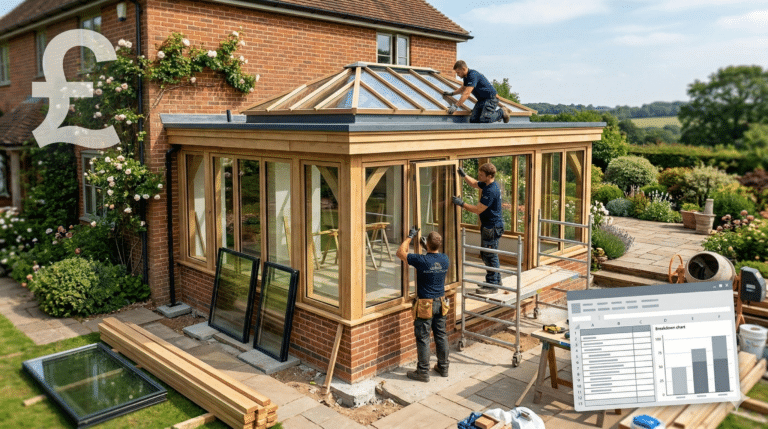
Bespoke conservatory by Room Outside featuring large windows, a glass roof, and a cozy seating area, surrounded by greenery.
roomoutsideuk
27th February, 2026

Orangery Installers Cost: The Complete UK Price Breakdown for 2026

Orangery Installers Cost 2026 UK | Full Price Breakdown & Guide | Room Outside
Cost Guide 2026

Orangery Installers Cost: The Complete UK Price Breakdown for 2026

How much do orangery installers actually cost? From labour rates and foundations to glazing, lantern roofs, and finishing – every cost explained. Avoid hidden charges, compare quotes confidently, and understand what you should really be paying.

20 min read
Updated May 2026
Verified 2026 Prices

Quick Answer: Orangery Installers Cost

Orangery installers cost between £150 and £300 per day for general labour in the UK in 2026. However, the total installed cost of an orangery – including design, foundations, materials, glazing, fitting, and internal finishing – ranges from £30,000 for a small build (10-16m²) to £120,000+ for large or bespoke installations. Per square metre, expect to pay £1,500-£4,700 depending on materials and specification. Premium installers who manage the entire project typically deliver better long-term value than coordinating separate tradespeople.

Key Facts: Orangery Installers Cost (UK 2026)

  • Daily labour rate: £150-£300 per day (general builders); specialist glazing installers typically higher
  • Total installed cost: Small (10-16m²) £30,000-£50,000 | Medium (20-35m²) £50,000-£85,000 | Large (35m²+) £80,000-£120,000+
  • Cost per m²: £1,500 (uPVC) to £4,700 (premium aluminium/hardwood)
  • Cost breakdown: Materials ~40% | Glazing ~20% | Labour ~18% | Foundations ~13% | VAT ~7%
  • Typical timeline: 12-20 weeks from deposit to completion
  • Hidden costs to watch: Drainage diversion, structural engineer, building regulations, landscaping
  • Property value uplift: 5-15% when professionally designed and installed
  • Warranty: Reputable installers offer 10-year structural warranty as standard
£150-£300
Labour per day
£30k-£120k+
Total installed cost
12-20
Weeks to complete
5-15%
Property value uplift

1. What Do Orangery Installers Actually Cost?

When homeowners search for “orangery installers cost,” they’re usually asking one of two questions: what does the labour alone cost, or what does the entire installed orangery cost? Both figures matter, but understanding how they relate to each other prevents nasty surprises when quotes arrive.

An orangery installation involves multiple specialist trades working across several months. Unlike a simple conservatory that might be assembled from a kit in a few days, orangeries require groundwork contractors, bricklayers, structural steelwork, specialist glazing installers, roofers, electricians, plumbers, plasterers, and decorators. The cost of orchestrating all of these trades – or choosing an installer who manages the entire process – is where the real pricing differences emerge.

1.1 Labour-Only Costs

If you’re coordinating trades yourself (which we generally don’t recommend for orangeries), here are typical 2026 daily rates across the UK:

  • General builder/labourer: £150-£250 per day
  • Bricklayer: £200-£300 per day
  • Roofer: £180-£280 per day
  • Electrician: £180-£300 per day
  • Plumber: £180-£250 per day
  • Plasterer: £150-£220 per day
  • Specialist glazing installer: £200-£350 per day
  • Painter/decorator: £150-£220 per day

London and the South East sit at the higher end of these ranges, while the North and Midlands tend to be lower. However, labour-only rates can be misleading because they don’t include management, warranties, or the specialist knowledge needed to create a watertight, thermally efficient structure.

1.2 Full Installation Costs (Supply and Fit)

Most homeowners opt for a full supply-and-fit service where one company handles everything from design through to handover. This is where the “orangery installers cost” becomes meaningful as a single figure. In 2026, typical fully installed costs are:

2. Orangery Installers Cost by Size (2026 UK Prices)

Size is the single biggest factor determining orangery installation costs. Below are realistic 2026 price ranges that include design, planning, materials, all labour, building works, and VAT.

Size CategoryAreaInstalled CostCost per m²
Small10-16 m²£30,000 – £55,000£2,500 – £4,700
Medium20-35 m²£50,000 – £85,000£2,400 – £4,400
Large35-50 m²£80,000 – £120,000+£2,200 – £3,900
Bespoke / ComplexVariable£120,000 – £200,000+Variable

Notice how the cost per square metre generally decreases as size increases. This is because many fixed costs – design, planning, site setup, foundations – don’t scale proportionally with area. A 30m² orangery doesn’t cost twice as much as a 15m² orangery, making larger builds better value per square metre.

2.1 Cost by Material

Frame material significantly affects both the initial installation cost and the long-term value. Here’s how the three main options compare for a medium 20m² orangery:

MaterialInstalled Cost (20m²)Cost per m²LifespanMaintenance
uPVC£25,000 – £40,000~£1,50020-30 yearsLow
Aluminium£45,000 – £85,000~£2,50050+ yearsMinimal
Hardwood Timber£50,000 – £100,000~£3,00050+ years (maintained)High (repaint every 5-7 yrs)

While uPVC is the cheapest option upfront, its shorter lifespan means you may need a complete replacement within 25 years. An aluminium orangery offers the best balance of longevity, thermal performance, and maintenance-free living. Premium hardwood delivers beautiful aesthetics but demands ongoing care to maintain its condition.

3. Orangery Installers Cost: Full Breakdown

Understanding where your money goes helps you evaluate quotes and spot installers who may be cutting corners. Here is a detailed breakdown of orangery installation costs, using a medium-sized (20m²) aluminium orangery as the example.

Cost Breakdown: Medium Aluminium Orangery (20m², ~£85,000)

Materials & Frame Structure(~40%)£34,000
Glazing & Glass Technology(~22%)£18,700
Installation Labour(~18%)£15,300
Foundations & Groundworks(~13%)£11,050
VAT(~7%)£5,950
Total Installed Cost~£85,000

3.1 Materials and Structure (~40%)

The largest portion of your orangery installers cost goes into materials. This includes the aluminium or timber frame system with thermal breaks, insulated cavity walls (achieving U-values as low as 0.18), solid roof insulation (typically 150mm), internal plasterboard lining, external brickwork to match your property, structural steelwork where required, and all fixings, flashings, and membranes. Premium frame systems with genuine thermal break technology cost more than basic profiles, but the difference in year-round comfort is substantial.

3.2 Glazing and Glass (~22%)

Glazing is where specification choices dramatically affect cost. Standard double glazing with Low-E coating and argon gas fill represents the baseline. Upgrading to triple glazing adds approximately 15-25% to the glazing element. Solar control glass (essential for south-facing orangeries), self-cleaning coatings, and premium lantern roof systems with slim aluminium bars all increase this portion. For a New Generation Glass specification, expect this element to represent a higher percentage of the total cost.

3.3 Installation Labour (~18%)

Professional installation labour covers the specialist team who erect the frame, install glazing units, fit the lantern roof, hang doors and windows, and make the structure weathertight. This is distinct from the groundwork and finishing trades. Specialist orangery installers command higher daily rates than general builders because the work demands precision engineering – a poorly fitted lantern roof will leak, and incorrectly installed thermal breaks will fail to insulate.

3.4 Foundations and Groundworks (~13%)

Every orangery needs proper foundations, typically reinforced concrete strip or trench fill foundations excavated to a depth determined by building control (usually 900mm-1200mm depending on soil type and proximity to trees). This element includes excavation, concrete, reinforcement, drainage connections, damp-proof course, and backfilling. Poor ground conditions, high water tables, or the need to relocate drains can push this element higher.

3.5 Additional Costs Not Always in Quotes

Some costs sit outside the main quote. Be aware of:

  • Building regulations drawings and approval: £1,500-£2,500
  • Structural engineer (if required): £500-£1,500
  • Planning permission (if required): £200-£600
  • Drainage diversion: £200-£5,000 (highly variable)
  • Landscaping and making good: £1,000-£5,000
  • Underfloor heating: £1,000-£4,500 depending on system and area
  • Electrics (lighting, sockets, consumer unit upgrade): £1,500-£4,000
  • Internal decoration (flooring, paint, furniture): Variable

⚠️ Hidden Costs: What to Watch For

The most common hidden orangery installation costs catch homeowners by surprise: drain diversion (discovered only during groundwork), asbestos in existing structures being altered, unexpected ground conditions requiring piling (adding £3,000-£10,000), and consumer unit upgrades for new electrics. A thorough site survey by an experienced installer should identify most of these before quoting.

Always ask: “Is this a fixed price or an estimate? What’s excluded?”

Want a Precise Quote for Your Orangery?

Our site surveys identify all costs upfront – no hidden charges, no surprises.

Get a Free Quote

4. Specialist Orangery Installer vs General Builder: Cost Comparison

One of the most important decisions affecting your orangery installers cost is choosing between a specialist orangery company and a general builder. The initial quote may tell one story; the long-term cost tells another.

FactorSpecialist Orangery InstallerGeneral Builder
Initial quoteHigher (all-inclusive)Lower (often excludes items)
Design serviceIn-house, 3D visuals, bespokeOften outsourced or basic
Planning & building regsHandled as part of serviceOften your responsibility
Glazing expertiseSpecialist knowledge, thermal performance focusMay subcontract glazing work
Lantern roof qualityPrecision-engineered, tested systemsVariable quality, leak risk
WarrantyTypically 10-year structuralOften limited or piecemeal
Project managementSingle point of contactYou coordinate multiple trades
Cost overrunsFixed-price contracts commonEstimates often exceeded
Long-term cost (40 years)Lower (quality build, no remedial work)Higher (repairs, replacements likely)

A specialist installer typically costs 15-30% more upfront than a general builder’s estimate. However, the all-inclusive nature of specialist quotes, combined with superior build quality and comprehensive warranties, almost always represents better value over the structure’s lifetime. At Room Outside, we’ve seen numerous homeowners come to us to remediate orangeries originally built by general contractors – correcting leaks, replacing inadequate glazing, and addressing thermal failures. The cost of remediation often exceeds the original saving.

5. 10 Factors That Affect Orangery Installers Cost

Beyond size and materials, several factors can push your orangery installation costs up or down. Understanding these helps you make informed trade-offs during the design process.

📐 1. Size and Footprint

The single biggest cost driver. Every additional square metre adds materials and labour. However, fixed costs (design, planning, site setup) are spread across larger builds, improving per-m² value.

🏗️ 2. Ground Conditions

Clay soils, high water tables, tree root proximity, or sloping sites all increase foundation costs. Piling can add £3,000-£10,000 to the groundwork element alone.

🪟 3. Glazing Specification

Standard double glazing vs triple glazing, solar control coatings, self-cleaning glass, and structural glass roofs all affect cost. Premium glazing adds 15-30% to this element.

🚪 4. Door Choices

Bifold doors (£3,000-£8,000), sliding doors (£2,500-£7,000), French doors (£1,500-£3,500). Wider spans and premium hardware increase costs.

🏠 5. Roof Complexity

A simple pyramid lantern costs less than a multi-ridge design. Curved glass, bespoke shapes, and motorised vents add to the price of the lantern roof element.

📋 6. Planning Requirements

Permitted Development keeps costs down. Full planning applications add £200-£600 plus professional fees. Listed building consent can extend timelines and costs significantly.

🔌 7. Heating and Electrics

Underfloor heating (£1,000-£4,500) vs radiators (from £200). Quantity of sockets, lighting design, and consumer unit upgrades all add to the installation cost.

🎨 8. Finishing Quality

Internal plastering, flooring, decoration, and bespoke joinery like internal pelmets or columns affect final cost. Premium finishes can add £5,000-£15,000.

📍 9. Location

Regional labour rates vary considerably. London and the South East carry a premium of 15-25% over national averages. Rural locations may add transport costs for materials.

🚧 10. Site Access

Narrow side passages, limited parking for delivery vehicles, or rear-access-only sites increase labour time and delivery costs. Crane hire for glass panels adds further expense.

6. Orangery Installation Timeline and Labour Costs

Understanding how long each phase takes helps you anticipate both the disruption and the cost implications. Longer timelines mean more labour days and higher overall orangery installers cost.

PhaseDurationApproximate Labour CostKey Activities
Design & Survey2-4 weeksIncluded in quoteSite survey, measurements, 3D design, specifications
Planning & Approvals4-8 weeks£1,500-£2,500Building regs, planning (if needed), party wall
Manufacture4-6 weeksIncluded in materialsFrame fabrication, glazing units, components
Groundworks1-2 weeks£3,000-£10,000Excavation, foundations, drainage, slab
Structural Build1-2 weeks£4,000-£8,000Dwarf walls, brickwork, steelwork, DPC
Frame & Glazing1-2 weeks£3,000-£6,000Erect frame, install glass, fit lantern, doors
Roofing & Weathertight3-5 days£1,500-£3,000Flat roof, flashings, guttering, downpipes
Internal Finishing2-4 weeks£3,000-£8,000Plastering, electrics, heating, flooring, decorating

The total on-site construction time for a medium orangery is typically 6-10 weeks, with the full project timeline of 12-20 weeks including design, manufacturing, and planning phases. Premium installers overlap phases where possible – for instance, manufacturing frames while groundworks are being completed – to minimise overall project duration.

7. Orangery Installers Cost vs Extension vs Conservatory

Homeowners frequently compare orangery costs with traditional extensions and conservatories. Here’s how they stack up in 2026:

FeatureOrangeryBrick ExtensionConservatory
Cost per m²£1,500-£4,700£2,000-£3,500£1,000-£2,500
Natural lightExcellent (lantern + glazed walls)Limited (windows only)Maximum (all glass)
Year-round comfortExcellent (insulated roof + glazing)Excellent (solid construction)Poor to moderate (heat loss/gain)
Architectural presenceHigh (lantern roof, columns)Moderate (matches existing)Low (can look added-on)
Property value uplift5-15%5-10%3-5%
Lifespan50+ years (aluminium)60+ years15-25 years
PlanningOften Permitted DevelopmentOften requires planningUsually Permitted Development

The orangery sits at the sweet spot between extensions and conservatories – delivering the architectural substance and year-round comfort of an extension, with the natural light and garden connection of a conservatory. For many homeowners across Southern England, this combination delivers the best return on investment.

8. How to Reduce Orangery Installation Costs (Without Cutting Quality)

There are legitimate ways to reduce your orangery installers cost without compromising the quality or longevity of the finished space. Here’s what works and what doesn’t:

8.1 Smart Savings

  • Choose standard sizes: Bespoke dimensions cost more than standard profiles. Work with your installer to optimise dimensions around standard glazing unit sizes.
  • Simplify the roof design: A single pyramid or ridge lantern costs significantly less than multi-pitch or curved alternatives whilst still delivering excellent light.
  • Phase the interior: Have the orangery built as a weathertight shell with basic electrics, then complete interior decoration yourself or in stages.
  • Time your project wisely: Autumn and winter installations may attract discounts when installers have more availability. You also avoid the spring/summer rush.
  • Stay within Permitted Development: Designing to PD limits avoids planning application costs and the risk of delays or refusal.
  • Get multiple quotes: At least three detailed, like-for-like quotes from specialist installers allow meaningful comparison.

8.2 False Economies to Avoid

  • Cheapest frame material: Budget uPVC may save initially but delivers shorter lifespan, poorer aesthetics, and lower property value uplift.
  • Self-managing trades: Coordinating separate groundworkers, bricklayers, glaziers, and roofers yourself risks delays, finger-pointing when issues arise, and no single warranty.
  • Skipping the structural engineer: If your project needs one and you skip it, building control may halt the work – costing far more in delays.
  • Choosing based on price alone: The cheapest quote is almost never the best value. Ask what’s excluded, check the warranty, and visit completed projects.

9. How to Choose the Right Orangery Installer

The installer you choose has more impact on the final result than almost any other decision. Here’s what to look for when comparing orangery installers and their costs.

Orangery Installer Checklist

  • 10+ years of orangery-specific experience (not just general building)
  • In-house design team producing 3D visuals before you commit
  • Own installation teams (not subcontracted)
  • Showroom or completed projects you can visit in person
  • Fixed-price written quotation (not an estimate)
  • Clear breakdown showing what’s included and excluded
  • 10-year structural warranty as standard
  • Handles planning and building regulations as part of service
  • Trade body membership (e.g., Glass and Glazing Federation)
  • Public liability and employer’s liability insurance
  • Verified reviews and testimonials from real customers
  • After-sales service and support beyond handover

When collecting quotes, ensure you’re comparing like-for-like. A quote of £45,000 that excludes foundations, building regulations, electrics, and heating is not cheaper than a £65,000 quote that includes everything. Ask every installer: “What would I need to pay on top of this figure to have a finished, usable room?”

10. Orangery Installers Cost by Region

Labour rates and overall project costs vary across the UK. Here’s how orangery installation costs typically differ by region for a medium-sized (20m²) aluminium orangery in 2026:

RegionTypical Installed Cost (20m²)Labour Premium
Greater London£65,000 – £100,000+20-25% above national average
Surrey & Kent£55,000 – £90,000+10-20%
Sussex & Hampshire£50,000 – £85,000+5-15%
Berkshire & Dorset£50,000 – £85,000+5-15%
Midlands£45,000 – £75,000National average
North of England£40,000 – £70,000-5-10%

These regional differences primarily reflect labour rates rather than material costs, which are broadly consistent nationwide. However, choosing a local specialist who knows your area’s planning authorities and building conditions can save both time and money compared to bringing in installers from further afield.

Room Outside serves homeowners across Kent, Surrey, East and West Sussex, Hampshire, London, Berkshire, Dorset, and Essex – bringing over 50 years of local expertise to every project.

11. Is the Cost of Orangery Installation Worth It?

The cost of hiring orangery installers represents a significant investment – so it’s reasonable to ask whether it pays off. The answer, for most homeowners, is yes, on multiple fronts.

11.1 Property Value

A well-designed, professionally installed orangery typically adds 5-15% to property value. On a £500,000 property, that’s £25,000-£75,000 of added value. Estate agents consistently rank quality orangeries among the most desirable features for buyers, particularly in the South East where indoor-outdoor living is highly valued. The key word is “quality” – a poorly built orangery can actually reduce value, which is why choosing the right installer matters so much.

11.2 Lifetime Cost

Consider the 40-year cost picture:

  • Premium aluminium orangery: £85,000 initial cost, minimal maintenance, 50+ year lifespan = ~£85,000 total over 40 years
  • Budget conservatory: £15,000 initial cost, but replacement at 20 years (~£20,000) plus ongoing repairs = ~£40,000+ over 40 years for inferior space
  • Standard brick extension: ~£60,000 initial cost, replacement windows at 20 years (~£5,000) = ~£65,000 over 40 years with less light

When you factor in energy savings from superior insulation, reduced maintenance costs, and the property value premium, a quality orangery installation often represents the most cost-effective way to add beautiful, usable living space to your home.

11.3 Beyond the Numbers

Some benefits resist quantification: the daily pleasure of a light-filled kitchen-diner, the connection with your garden through every season, the space for family gatherings, and the joy of a room that genuinely transforms how you live at home. These are the reasons most orangery owners say they wish they’d done it sooner.

Room Outside

Orangery Installers & Specialists | Established 1973

With over 50 years of experience, Room Outside designs and installs premium orangeries across Southern England. Our in-house team handles everything from initial design and planning applications through to construction, glazing, and finishing – giving you a single point of contact and a fixed-price guarantee. We’ve installed hundreds of orangeries across Kent, Surrey, Sussex, Hampshire, and London.

Sources and Further Reading

Official sources: UK Planning Portal (planningportal.co.uk) – Permitted Development rights and planning fees; RICS – construction cost data 2026; Building Regulations 2010 (as amended) – Part L requirements.

Industry bodies: Glass and Glazing Federation – installer accreditation standards; Council for Aluminium in Building – technical guidance; Federation of Master Builders – builder rates survey 2026.

Cost data methodology: Prices reflect Room Outside’s project data and verified industry sources for Southern England, updated May 2026. Regional variations apply. All costs include VAT unless stated.

Last updated: May 2026 | Next review: November 2026

Frequently Asked Questions: Orangery Installers Cost

How much do orangery installers cost per day?

General builders charge £150-£250 per day, while specialist glazing installers charge £200-£350 per day. However, most orangery projects are quoted as a fixed total price rather than daily rates, covering all trades and materials in one figure.

What’s the cheapest orangery you can install?

The cheapest fully installed orangeries start around £15,000-£25,000 for small uPVC builds (10-16m²). However, budget builds often compromise thermal efficiency and longevity. A mid-range aluminium orangery from £30,000 delivers significantly better long-term value.

Do orangery installers include VAT in their quotes?

Reputable installers include VAT in quoted prices. Always confirm whether a quote is inclusive or exclusive of VAT – 20% makes a substantial difference. Ask: “Is this the total I will pay?”

How much deposit do orangery installers require?

Typical deposits range from 10-25% of the total project cost, payable when you sign the contract. Staged payments throughout the project are standard. Never pay the full amount upfront.

Can I install an orangery myself to save money?

Self-installation is not recommended for orangeries. They require structural calculations, Building Regulations compliance, specialist glazing handling, and watertight lantern roof installation. Errors can be extremely costly to fix and may compromise safety.

Do orangery installers offer finance?

Many specialist installers offer finance options, from interest-free periods to longer-term payment plans. Check whether the installer is FCA-regulated if they offer credit directly. Room Outside can discuss payment options during consultation.

How do I know if an orangery installer’s quote is fair?

Get at least three quotes from specialist installers (not general builders). Ensure quotes cover the same specification, and compare what’s included and excluded. Fair prices for a medium aluminium orangery (20m²) fall between £50,000-£85,000 in 2026.

What warranty should orangery installers provide?

Expect a minimum 10-year structural warranty on the build, plus manufacturer warranties on glazing (typically 10 years), frames (20-30 years for powder coating), and hardware (5-10 years). Insurance-backed guarantees provide protection if the installer ceases trading.

📞 01243 538999 – Call anytime. David, our digital assistant, will take a few details so the right specialist can follow up personally.

Ready to Get an Accurate Orangery Quote?

No hidden costs, no surprises. Our free site survey and design consultation gives you a fixed-price quote covering everything from foundations to finishing touches.

Book Free Consultation

Specialist orangery installers serving Kent, Surrey, Sussex, Hampshire, London, Berkshire, Dorset, Essex since 1973.

Bespoke conservatory by Room Outside featuring large windows, a glass roof, and a cozy seating area, surrounded by greenery.
roomoutsideuk
26th February, 2026

Aluminium Orangeries: The Complete 2026 Guide

Aluminium Orangeries Complete Guide 2026 | Costs, Benefits, Design | Room Outside
Definitive Guide 2026

Aluminium Orangeries: The Complete 2026 Guide

Everything you need to know about aluminium orangeries: costs, thermal performance, design options, planning permission, and how they compare to uPVC and timber. Expert advice from specialists with 50+ years experience.

22 min read
Updated May 2026
UK Specialist Guide

Quick Answer: Aluminium Orangeries

Aluminium orangeries are premium home extensions combining solid perimeter roofs with central glass lanterns, supported by slim aluminium frames. They offer exceptional strength, U-values from 1.2 W/m²K (thanks to thermal breaks), and 50+ year lifespans with minimal maintenance. Costs range from £30,000 for small designs to £120,000+ for large, complex installations. Aluminium is ideal for modern extensions and period properties alike, available in any RAL colour.

Key Facts: Aluminium Orangeries (UK 2026)

  • Cost range: £30,000-£50,000 (small 10-20m²), £50,000-£80,000 (medium 20-35m²), £80,000-£120,000+ (large 35m²+)
  • Thermal performance: U-values from 1.2 W/m²K with thermal break technology
  • Lifespan: 50+ years with minimal maintenance
  • Frame thickness: Up to 50% slimmer than uPVC, maximizing glass area
  • Maintenance: Occasional cleaning only – no painting required
  • Colours: Any RAL colour available, including anthracite grey (RAL 7016), black, cream, green
  • Planning: Often Permitted Development; check local rules for listed/conservation areas
  • Property value: Can add 5-10% to home value
£30k-£120k+
Typical cost range
1.2
U-value (W/m²K)
50+
Years lifespan
5-10%
Value added

1. What is an Aluminium Orangery?

An aluminium orangery is a home extension characterized by a solid flat roof perimeter, a central glazed lantern, and large windows or glazed panels set within robust perimeter walls—all constructed using aluminium frames. Unlike conservatories which are predominantly glass (typically 75%+ glazed roofs), orangeries maintain architectural presence through solid roof sections while the glass lantern floods the interior with natural light.

When crafted in aluminium, these structures benefit from the material’s exceptional properties: high strength-to-weight ratio allows for slim sightlines (frames up to 50% slimmer than uPVC), while thermal break technology ensures energy efficiency. Aluminium orangeries can be attached to existing properties or designed as standalone garden rooms.

Key Components of an Aluminium Orangery

  • Perimeter roof: Solid insulated panels around the edges, typically finished with plasterboard internally and roofing materials externally
  • Central lantern: Glazed roof structure that rises above the flat roof, allowing light from above
  • Aluminium frames: Slim, strong profiles supporting glazing and roof structures
  • Base walls: Often dwarf walls (600-900mm high) or full-height aluminium columns
  • Glazing: Double or triple glazed units with Low-E coatings and argon gas filling

The aluminium used in modern orangeries is typically powder-coated for durability and available in virtually any colour, from classic anthracite grey (RAL 7016) to heritage shades like cream or green, making them suitable for both contemporary and traditional properties.

2. Why Choose Aluminium for Your Orangery?

Aluminium has become the material of choice for premium orangeries, offering advantages that timber and uPVC cannot match. Here’s why homeowners across Kent, Surrey, Sussex, Hampshire, and London are specifying aluminium.

2.1 Strength with Slim Profiles

Aluminium’s high strength-to-weight ratio means frames can be significantly slimmer than uPVC (up to 50% thinner) while maintaining structural integrity. This maximizes glass area, increasing natural light and views. For example, an aluminium orangery in Surrey might feature floor-to-ceiling glazing with barely visible frames, creating a seamless connection with the garden.

2.2 Thermal Efficiency (Thermal Break Technology)

Modern aluminium orangeries incorporate thermal breaks – insulating barriers made from polyamide or similar materials placed between interior and exterior aluminium surfaces. This prevents heat transfer, achieving U-values as low as 1.2 W/m²K. Combined with double or triple glazing (Low-E coatings, argon gas), aluminium orangeries are comfortable year-round, meeting and exceeding Building Regulations Part L.

2.3 Durability and Longevity

Aluminium is naturally resistant to corrosion, rust, and UV degradation. Powder-coated finishes (applied electrostatically) provide additional protection, typically guaranteed for 20-30 years. Unlike timber, aluminium doesn’t rot, warp, or require repainting. An aluminium orangery installed today will likely last 50+ years with nothing more than occasional cleaning.

2.4 Low Maintenance

For busy homeowners in Sussex or Hampshire, low maintenance is a major selling point. Aluminium orangeries need only:

  • Occasional washing with soapy water to remove dirt
  • Annual gutter and drainage checks
  • Lubrication of hinges and locks (every 2-3 years)

No painting, staining, or preservative treatments are required.

2.5 Design Flexibility

Aluminium can be fabricated into virtually any shape, supporting bespoke designs:

  • Colours: Any RAL colour available – anthracite grey (most popular), black, cream, green, grey, white
  • Dual-colour options: Different colour inside and out (e.g., white internally, anthracite externally)
  • Door integration: Seamlessly incorporate bifold, sliding, or French doors in matching aluminium
  • Lantern styles: Pyramid, ridge, or bespoke lantern designs

2.6 Sustainability

Aluminium is 100% recyclable without loss of quality. The UK aluminium industry recycles approximately 75% of all aluminium produced. Choosing aluminium supports circular economy principles and reduces environmental impact compared to materials that end up in landfill.

🔩 Strength

High strength-to-weight ratio enables slim frames and large glass spans.

☀️ Thermal Efficiency

Thermal breaks achieve U-values from 1.2 W/m²K.

🧼 Low Maintenance

No painting – just occasional cleaning.

🎨 Colour Options

Any RAL colour, dual-colour available.

⏱️ Longevity

50+ year lifespan with proper care.

🌍 Sustainable

100% recyclable, eco-friendly choice.

3. Aluminium vs Timber vs uPVC: Comparison

Choosing between aluminium, timber, and uPVC depends on your priorities – budget, aesthetics, maintenance, and longevity. This comparison helps homeowners in Kent, Surrey, and beyond make informed decisions.

FeatureAluminiumTimberuPVC
Frame thicknessVery slim (20-30mm sightlines)Chunky (50-80mm)Bulky (60-100mm)
Thermal performance (U-value)1.2 – 1.6 W/m²K1.4 – 2.0 W/m²K1.4 – 1.8 W/m²K
Lifespan50+ years50+ years (with maintenance)20-30 years
MaintenanceMinimal – occasional cleanHigh – repaint every 5-7 yearsLow – occasional clean
Colour optionsAny RAL colour, dual-colourStains/paints, limitedLimited, often white/cream
Initial cost£££ (premium)££ (mid-range)£ (budget)
Recyclability100% recyclableBiodegradableDifficult to recycle
AestheticSleek, modern, minimalistWarm, traditionalPractical, less premium

3.1 When to Choose Aluminium

Aluminium is ideal for:

  • Contemporary homes requiring slim sightlines
  • Maximum light and garden views
  • Low-maintenance lifestyles
  • Long-term investment (50+ years)
  • Bespoke designs and custom colours

3.2 When Timber Might Be Better

Timber suits:

  • Period properties where traditional appearance is paramount
  • Listed buildings requiring authentic materials
  • Homeowners willing to maintain regularly
  • Lower initial budgets (though lifetime costs may equal aluminium)

3.3 When uPVC Might Be Considered

uPVC is appropriate for:

  • Tight budgets where initial cost is the only factor
  • Short-term ownership (under 10 years)
  • Less demanding aesthetic requirements
  • Properties where appearance is not critical

However, many homeowners find that the long-term value and aesthetics of aluminium justify the higher initial investment.

4. Aluminium Orangery Costs 2026 (UK Guide)

Understanding costs helps with budgeting and comparing quotes. Prices vary based on size, complexity, glazing specification, and site conditions. Below are typical ranges for aluminium orangeries in 2026.

Size CategoryArea (m²)Typical Cost RangeExample Use
Small10-20 m²£30,000 – £50,000Entrance hall, small dining area
Medium20-35 m²£50,000 – £80,000Kitchen-diner, family room
Large35-50 m²£80,000 – £120,000+Open-plan living, garden room
Complex/BespokeVariable£120,000 – £200,000+Multi-level, curved, heritage projects

Factors Affecting Aluminium Orangery Costs

  • Size: Larger structures require more materials and labour
  • Glazing specification: Triple glazing, solar control coatings, self-cleaning glass add cost
  • Complexity: Curved lanterns, multiple roof levels, bespoke shapes increase price
  • Foundation requirements: Ground conditions may require piling or reinforced concrete
  • Access: Difficult site access increases installation time and cost
  • Finishes: Dual-colour options, special RAL colours, timber-effect interiors
  • Doors: Bifold, sliding, or French doors – larger spans cost more
  • Heating/electrics: Underfloor heating, lighting, power points add to total
  • Location: Regional labour rates vary (London generally highest)

For a precise quotation, contact Room Outside for a site survey and design consultation.

5. Thermal Performance: How Warm Are Aluminium Orangeries?

Modern aluminium orangeries are designed to be comfortable year-round, addressing the historic reputation of glass structures being too hot in summer and too cold in winter. Key technologies include:

5.1 Thermal Break Technology

A thermal break is an insulating barrier (typically polyamide) inserted between the interior and exterior aluminium profiles. This prevents thermal bridging – the direct transfer of heat through the metal. Without thermal breaks, aluminium would conduct heat readily; with them, U-values drop dramatically.

5.2 High-Performance Glazing

Aluminium orangeries use sealed double or triple glazed units with:

  • Low-E coatings: Microscopic metallic layers that reflect heat back into the room while allowing light through
  • Argon or krypton gas fills: Inert gases between panes provide better insulation than air
  • Warm edge spacers: Insulating spacer bars reduce heat loss at pane edges

5.3 Solar Control

For south-facing orangeries, solar control glass can be specified. This incorporates coatings that reflect solar infrared radiation, blocking up to 86% of solar heat while maintaining high light transmission. This prevents overheating in summer without darkening the interior.

5.4 Typical U-Values Achieved

  • Standard double glazing: U-value 1.6 – 1.8 W/m²K
  • Low-E double glazing with argon: 1.2 – 1.4 W/m²K
  • Triple glazing with Low-E and argon: 0.8 – 1.0 W/m²K

Building Regulations Part L typically require U-values of 1.6 W/m²K or better for new extensions, so even basic specifications meet standards.

5.5 Ventilation Considerations

To maintain comfort, roof vents or automated opening windows are essential. Building Regulations require adequate ventilation – typically at least 1/20th of floor area as openable area. Modern aluminium orangeries can integrate:

  • Electric roof vents with rain sensors
  • Automated window openers linked to thermostats
  • Manual vents for simple operation

6. Aluminium Orangery Design Options

Aluminium’s versatility enables a wide range of design styles, from ultra-modern to traditional heritage. Here are key design considerations for homeowners in Kent, Surrey, Sussex, Hampshire, and London.

6.1 Lantern Roof Styles

  • Pyramid lantern: Classic four-sided glazed roof rising to a point, suits traditional and contemporary designs
  • Ridge lantern: Long, rectangular lantern running the length of the roof, ideal for modern extensions
  • Multi-pitch lantern: Complex designs with multiple glazed sections for dramatic effect
  • Flat glass roof: Minimalist option with frameless glazing for ultra-modern look

6.2 Colour Options

Aluminium can be powder-coated in virtually any RAL colour. Popular choices include:

  • Anthracite grey (RAL 7016): Most popular – sophisticated, modern, architectural
  • Black (RAL 9005): Dramatic, contemporary, bold
  • Cream (RAL 9001): Traditional, suits period properties
  • Green (RAL 6005): Heritage colour for rural settings
  • White (RAL 9016): Classic, safe choice
  • Grey (various): Light grey, silver, metallic finishes

Dual-colour option: Different colour inside and out – e.g., white internally for brightness, anthracite externally for kerb appeal.

6.3 Door Integration

  • Bifold doors: Multiple panels fold and stack, creating wide openings (up to 6-8m spans)
  • Sliding doors: Panels slide horizontally, space-saving, ideal where swing space limited
  • French doors: Traditional double doors, outward opening
  • Pivot doors: Large format doors that pivot open, dramatic entrance statements

All door types can be manufactured in matching aluminium, ensuring cohesive design.

6.4 Base Wall Options

  • Dwarf walls: 600-900mm high brick/stone walls, providing insulation and traditional appearance
  • Full-height glazing: Glass from floor to ceiling, maximising views, requires high-performance glazing
  • Aluminium columns: Structural aluminium posts supporting roof, creating open feel

7. Planning Permission for Aluminium Orangeries

Understanding planning requirements is crucial before starting your project. Most aluminium orangeries fall under Permitted Development rights, but exceptions apply.

7.1 Permitted Development Conditions

Your aluminium orangery may not need planning permission if it meets all these criteria:

  • Single storey with maximum eaves height of 3m
  • Maximum height of 4m (if within 2m of boundary, height limited to 3m)
  • Doesn’t extend beyond the rear wall by more than 3m (semi/terraced) or 4m (detached)
  • Doesn’t cover more than half the garden area
  • Materials similar to existing house (aluminium acceptable)
  • Not forward of principal elevation facing a highway
  • No verandas, balconies, or raised platforms

7.2 When Planning Permission IS Required

You WILL need planning permission if:

  • Your property is listed (plus Listed Building Consent required)
  • You’re in a Conservation Area, National Park, AONB, or World Heritage Site
  • Previous extensions have used your Permitted Development allowance
  • You exceed size/height limits
  • Your property has Article 4 Direction removing PD rights
  • Building a detached orangery in some circumstances

7.3 Listed Buildings and Conservation Areas

Aluminium can be suitable for listed buildings if designed sensitively. Conservation officers often prefer aluminium for its slim sightlines and clear distinction between old and new. However, you’ll need both Listed Building Consent and planning permission. Heritage colours (cream, green) and traditional proportions help gain approval.

Room Outside has extensive experience with listed property extensions across Sussex, Surrey, and Hampshire.

7.4 Building Regulations

All orangeries must comply with Building Regulations covering:

  • Part L (Conservation of fuel and power): Thermal performance standards
  • Part A (Structure): Structural integrity
  • Part B (Fire safety): Escape routes and fire resistance
  • Part F (Ventilation): Adequate ventilation
  • Part K (Protection from falling): Glazing safety

Reputable installers like Room Outside handle Building Regulations approval as part of the service.

8. Aluminium Orangery Installation Process

Understanding the installation timeline helps with planning. Typical projects take 12-20 weeks from deposit to completion.

Stage 1: Initial Consultation (Week 1-2)

Site survey, discuss requirements, budget, and design preferences. Assess planning needs and access constraints.

Stage 2: Design and Quotation (Weeks 3-6)

Detailed designs, 3D visuals, and itemised quotation. Finalise glazing specifications, colours, and door choices.

Stage 3: Planning and Approvals (Weeks 6-12)

Submit planning application if required. Prepare Building Regulations submission. Listed Building Consent applications may take longer.

Stage 4: Manufacture (Weeks 8-14)

Aluminium frames fabricated off-site. Quality control ensures precision.

Stage 5: Groundworks and Foundations (Weeks 10-16)

Excavate foundations, pour concrete, install drainage. Prepare site for frame delivery.

Stage 6: Installation (Weeks 14-18)

Erect aluminium frame, install glazing, fit roof lantern, doors, and windows. Make weathertight.

Stage 7: Finishing (Weeks 16-20)

Internal plastering, electrics, heating, flooring, decoration. Final snagging and handover.

9. Aluminium Orangery vs Glass Box Extension

Homeowners often compare orangeries with glass box extensions. Key differences:

  • Roof design: Orangeries have solid perimeter roof with glass lantern; glass boxes have fully glazed roof
  • Privacy: Orangeries offer more privacy due to solid roof sections; glass boxes are fully transparent
  • Thermal efficiency: Orangeries typically more thermally efficient due to solid roof insulation
  • Aesthetics: Orangeries feel more architectural; glass boxes more minimalist
  • Cost: Glass boxes often more expensive due to structural glass requirements

Both can be constructed in aluminium, offering slim frames and durability. The choice depends on desired appearance and performance priorities.

10. Common Myths About Aluminium Orangeries

Myth: “Aluminium orangeries are cold”

Fact: Modern thermally broken aluminium frames achieve U-values as low as 1.2 W/m²K – comparable to solid walls. Combined with high-performance glazing, they’re warm in winter and cool in summer.

Myth: “Aluminium is only for modern homes”

Fact: Aluminium can be powder-coated in heritage colours (cream, green, grey) and designed with traditional proportions, making it suitable for period properties and listed buildings.

Myth: “Aluminium orangeries are too expensive”

Fact: While initial costs are higher than uPVC, the 50+ year lifespan and minimal maintenance make aluminium cost-effective over time. Property value uplift often exceeds the additional investment.

Myth: “Aluminium frames look industrial”

Fact: Modern aluminium profiles are slim and elegant, with smooth powder-coated finishes. They don’t have the industrial appearance of raw aluminium.

Myth: “You can’t get curved aluminium frames”

Fact: Aluminium can be curved during manufacture, enabling bespoke arched windows, curved lanterns, and unique architectural features.

11. Aluminium Orangeries in Your Area

Room Outside serves homeowners across Southern England with aluminium orangery installations. Local considerations:

Aluminium Orangeries Kent

Kent’s mix of Wealden villages, coastal towns, and London commuter belt means diverse property types. We handle everything from modern extensions in Tunbridge Wells to heritage projects in Canterbury.

Aluminium Orangeries Surrey

Surrey’s affluent suburbs and green belt locations demand high-quality finishes. Aluminium orangeries in Guildford, Woking, and Esher often feature anthracite grey frames with bifold doors.

Aluminium Orangeries Sussex (East and West)

From Brighton’s contemporary homes to Chichester’s historic properties, aluminium suits both. We’ve installed orangeries across Sussex with heritage colours for listed buildings.

Aluminium Orangeries Hampshire

Hampshire’s New Forest, Winchester, and Southampton areas require sensitivity to conservation constraints. We navigate planning successfully.

Aluminium Orangeries London

London projects often involve tight sites, listed buildings, and conservation areas. Our experience ensures compliance and beautiful results.

Aluminium Orangeries Berkshire, Dorset, Essex

We also serve Berkshire, Dorset, and parts of Essex, bringing the same expertise and quality.

KentSurreyEast SussexWest SussexHampshireGreater LondonBerkshireDorsetEssex

Room Outside

Aluminium Orangery Specialists | Established 1973

With over 50 years of experience, Room Outside designs and installs premium aluminium orangeries across Southern England. Our team combines traditional craftsmanship with modern aluminium technology, ensuring beautiful, thermally efficient spaces. We handle everything from initial design through planning to final installation. Contact us for expert advice.

Sources and Further Reading

Official sources: UK Planning Portal (planningportal.co.uk) – Permitted Development rights; Historic England – Listed building guidance; Building Regulations 2010 (as amended) – Part L (conservation of fuel and power).

Industry bodies: Glass and Glazing Federation – Thermal performance standards; Council for Aluminium in Building – Technical guidance.

Last updated: May 2026 | Next review: November 2026

📞 01243 538999 – Call anytime. David, our digital assistant, will take a few details so the right specialist can follow up personally.

Ready to Discuss Your Aluminium Orangery?

Whether you’re planning a contemporary extension in London or a heritage orangery in Sussex, our specialists are here to help. Book a free, no-obligation design consultation.

Book Free Consultation

Serving 10 Counties Since 1973
England | West Sussex | East Sussex | Surrey | Hampshire | Kent | Essex | Greater London | Berkshire | Dorset

Bespoke conservatory by Room Outside featuring large windows, a glass roof, and a cozy seating area, surrounded by greenery.
roomoutsideuk
03rd February, 2026

The Complete Conservatory Maintenance Guide: Seasonal Checklist for Longevity

The Complete Conservatory Maintenance Guide: Seasonal Checklist for Longevity | Room Outside

The Complete Conservatory Maintenance Guide: Seasonal Checklist for Longevity

Protect your investment with our expert seasonal maintenance checklist. Prevent costly repairs and extend your conservatory’s lifespan by years with proper preventative care.

Quick Answer: Essential Maintenance Tasks

Regular conservatory maintenance can extend its lifespan by 5-10 years and prevent costly repairs. The most critical tasks are: cleaning gutters quarterly, inspecting seals biannually, cleaning the roof twice yearly, and checking for structural issues annually. A £15,000-£25,000 conservatory can lose 20-40% of its value within 5 years without proper maintenance.

Follow our seasonal checklist to protect your investment: Spring cleaning removes winter debris, summer inspection catches heat damage, autumn preparation prevents winter leaks, and winter protection maintains thermal efficiency.

5-10 yrs
Extended lifespan with maintenance
75%
Leaks prevented by seal maintenance
£500-£2k
Annual repair savings
2x/year
Optimal roof cleaning frequency
A conservatory is a significant investment that enhances your living space and property value. Like any valuable asset, it requires regular maintenance to preserve its beauty, functionality, and structural integrity. Neglected maintenance leads to leaks, drafts, condensation issues, and costly repairs that can diminish your enjoyment and the conservatory’s value. This comprehensive guide provides a seasonal maintenance checklist developed from over 50 years of expertise in conservatory care across Kent, Surrey, Sussex, and London. For complete peace of mind, consider our professional conservatory maintenance service.

Why Regular Maintenance Matters

Conservatories face unique challenges due to their extensive glazing and exposure to the elements. The UK’s variable climate—with its rain, wind, temperature fluctuations, and seasonal debris—takes a toll on even the highest-quality installations. Regular maintenance isn’t just about cleanliness; it’s about preserving the structural integrity, thermal efficiency, and longevity of your investment.

The Cost of Neglect: Real-World Examples

Based on our service records across the South East, common issues from poor maintenance include:

  • Blocked gutters: £800-£1,500 water damage repairs to frames and interiors
  • Failed seals: £300-£800 per window for resealing and potential water damage
  • Algae buildup: £400-£700 for professional roof cleaning and seal restoration
  • Frame corrosion: £1,500-£3,000 for section replacement or full refinishing
  • Thermal inefficiency: £200-£500 annual energy loss from poor seals

Preventative maintenance costs a fraction of these repairs while extending your conservatory’s lifespan.

Preserving Property Value

A well-maintained conservatory adds 5-10% to property value, while a neglected one can actually detract from value. During property viewings, potential buyers immediately notice issues like condensation between panes, water stains, algae growth, or rotting frames. Regular maintenance ensures your conservatory remains a selling point rather than a liability.

Energy Efficiency & Comfort

Properly maintained seals and gaskets maintain thermal efficiency, keeping your conservatory comfortable year-round and reducing heating costs. A single 5mm gap in seals can increase heat loss by 15%, significantly impacting energy bills during winter months.

The Complete Seasonal Maintenance Checklist

Follow this comprehensive seasonal checklist to protect your conservatory investment throughout the year:

Spring

Spring Cleaning & Post-Winter Inspection

After winter’s harsh conditions, spring is ideal for thorough cleaning and damage assessment. Focus on removing winter debris and preparing for increased usage.

  • Clean roof panels inside and outEssential
  • Clear gutters and drainage channels of winter debrisCritical
  • Inspect and clean all window and door sealsImportant
  • Check for cracks in glass or polycarbonate panelsEssential
  • Test opening mechanisms on windows and doorsImportant
  • Clean and lubricate door hinges and locksRecommended
  • Inspect for water stains or condensation between panesCritical
  • Check exterior frame for signs of corrosion or rotEssential
Summer

Summer Ventilation & Heat Protection

Summer brings heat and intense sunlight. Focus on ventilation, UV protection, and preparing for potential heat-related issues.

  • Clean and check operation of ventilation systemsImportant
  • Inspect and clean blinds or shading systemsRecommended
  • Check for signs of heat damage to sealsEssential
  • Ensure drainage channels are clear for summer stormsImportant
  • Inspect for algae or moss growth in shaded areasRecommended
  • Test thermal controls and sensors if installedOptional
  • Clean interior surfaces and treat any water marksImportant
  • Check exterior for any vegetation growth against framesEssential
Autumn

Autumn Preparation & Leaf Management

Prepare for winter by addressing autumn leaf fall and ensuring your conservatory is sealed against colder weather.

  • Clear leaves and debris from roof and guttersCritical
  • Inspect and replace any worn weather sealsEssential
  • Check heating systems and thermostatsImportant
  • Ensure all windows and doors close properlyCritical
  • Clean exterior to remove autumn dirt and pollutionRecommended
  • Inspect roof for any loose panels or fixingsEssential
  • Check for any gaps where draughts could enterImportant
  • Apply protective treatment to wooden frames if neededSeasonal
Winter

Winter Protection & Cold Weather Care

Winter requires special attention to thermal efficiency, condensation management, and protection from ice damage.

  • Monitor for condensation and improve ventilationEssential
  • Check gutters for ice dams and clear carefullyCritical
  • Inspect for any leaks during heavy rainImportant
  • Ensure heating systems are functioning efficientlyEssential
  • Check door and window seals for cold draughtsImportant
  • Remove snow from roof carefully to avoid damageAs needed
  • Inspect interior for mould or damp patchesEssential
  • Test emergency drainage in case of ice blockageRecommended

Critical Maintenance Tasks Explained

Gutter & Drainage Maintenance

Blocked gutters are the leading cause of conservatory water damage. Leaves, debris, and even bird nests can block drainage, causing water to overflow and damage frames, foundations, and interior finishes. In winter, blocked gutters can lead to ice dams that force water under roof panels.

⚠️ Safety Warning: Roof Access

Never attempt to clean conservatory roofs without proper safety equipment. Conservatory roofs are not designed to support human weight. Use telescopic cleaning tools from the ground or hire professionals with appropriate access equipment and insurance. Falls from roofs cause serious injuries annually.

Seal & Gasket Maintenance

Seals and gaskets around windows, doors, and roof panels degrade over time due to UV exposure, temperature fluctuations, and general wear. Cracked or hardened seals allow water ingress, draughts, and thermal inefficiency. Inspect seals biannually and replace at the first signs of deterioration.

Glass & Panel Cleaning

Regular cleaning maintains light transmission and prevents permanent staining. Use only conservatory-safe cleaning products—avoid harsh chemicals, abrasive cleaners, or pressure washers that can damage seals and coatings.

✅ Professional Cleaning Recommendation

For optimal results and safety, professional conservatory cleaning services are recommended every 6-12 months. Professionals use appropriate equipment, conservatory-safe cleaning solutions, and can identify potential issues before they become serious problems. A professional clean typically costs £150-£300 but can prevent £1,000+ in repairs. Our comprehensive maintenance service includes thorough cleaning as part of the package.

Structural Inspection

Annually inspect the conservatory structure for: movement cracks at joins, corrosion on metal frames, rot on wooden frames, secure fixings, and proper alignment of opening mechanisms. Early detection of structural issues prevents major repairs.

Maintenance Task Priority Guide

This table helps prioritize maintenance tasks based on urgency and potential impact:

Maintenance TaskFrequencyTime RequiredPriority LevelDIY or Professional
Gutter CleaningQuarterly30-60 minsHighDIY (with care)
Seal InspectionBiannually15-30 minsHighDIY
Roof CleaningTwice yearly1-2 hoursMediumProfessional Recommended
Frame InspectionAnnually30-45 minsHighDIY
Glass CleaningMonthly20-40 minsMediumDIY
Ventilation CheckSeasonally15-20 minsMediumDIY
Structural AssessmentAnnually45-60 minsHighProfessional
Drainage TestingQuarterly10-15 minsMediumDIY
Seal ReplacementAs needed1-3 hoursHighProfessional Recommended
Interior Deep CleanBiannually2-3 hoursMediumDIY
High Priority Tasks
Gutter CleaningQuarterly • 30-60 mins • DIY (with care)
Seal InspectionBiannually • 15-30 mins • DIY
Frame InspectionAnnually • 30-45 mins • DIY
Professional Recommended
Roof CleaningTwice yearly • 1-2 hours • Professional
Structural AssessmentAnnually • 45-60 mins • Professional
Seal ReplacementAs needed • 1-3 hours • Professional

Professional Conservatory Maintenance Service

Our comprehensive Groom Service includes all essential maintenance tasks performed by certified technicians. Protect your investment with professional care that extends lifespan and prevents costly repairs.

Complete Inspection

130-point checklist covering structure, seals, drainage, and safety

Thorough Cleaning

Professional cleaning of roof, frames, glass, and drainage systems

Preventative Maintenance

Seal conditioning, lubrication, and minor repairs to prevent issues

Common Problems & Prevention Tips

Condensation Issues

Condensation between panes indicates seal failure and requires professional attention. Surface condensation can be managed with proper ventilation, dehumidifiers, and avoiding drying clothes indoors.

Algae & Moss Growth

Common on north-facing roofs and shaded areas. Prevent with regular cleaning and consider installing zinc or copper strips along the ridge to inhibit growth.

Frame Corrosion or Rot

Early detection is key. For uPVC frames, check for discoloration or brittleness. For aluminum, look for white powder (oxidation). For wood, probe for soft spots with a screwdriver.

DIY vs Professional: When to Call Experts

DIY appropriate: Regular cleaning, seal inspections, gutter cleaning (ground floor), minor lubrication.
Professional required: Roof access, seal replacement, structural repairs, electrical issues, complex drainage problems, or if you’re unsure about safety or correct procedure. For these tasks, our expert maintenance team is equipped to handle all aspects safely and efficiently.

Preventing Costly Repairs

The most cost-effective maintenance strategy is prevention. Addressing small issues promptly prevents them from becoming major repairs. Budget approximately 1-2% of your conservatory’s original cost annually for maintenance—this is significantly less than major repair costs.

Regional Considerations for the South East

Conservatory maintenance in Kent, Surrey, Sussex, and London has unique considerations due to local environmental factors:

Coastal Areas (Sussex, Kent Coast)

Salt spray accelerates corrosion on metal components. Increase inspection frequency for aluminum frames and hardware. Rinse frames with fresh water quarterly to remove salt deposits.

Wooded Areas (Surrey, Kent)

Increased leaf fall requires more frequent gutter cleaning—monthly during autumn. Check for overhanging branches that could damage roofs during storms.

Urban Areas (London, Town Centers)

Air pollution deposits require more frequent cleaning. Check seals more often as pollution can accelerate degradation. Consider anti-pollution coatings for glass.

Historical & Conservation Areas

Specialist cleaning products and techniques may be required. Consult local conservation officers before making changes to listed property conservatories.

Creating Your Maintenance Schedule

Develop a personalized maintenance schedule based on your conservatory’s age, materials, and location. For busy homeowners or those preferring professional assurance, our scheduled maintenance plans provide regular, worry-free care.

For New Conservatories (0-5 years)

Focus on establishing good habits. Clean quarterly, inspect seals biannually, and schedule professional inspection annually. Consider our annual maintenance package to protect your warranty and ensure proper care from the start.

For Mid-Life Conservatories (5-15 years)

Increase vigilance. Inspect seals quarterly, monitor for wear on moving parts, and budget for potential seal replacement or minor repairs. This is when professional maintenance becomes particularly valuable for extending lifespan.

For Older Conservatories (15+ years)

Consider more frequent professional assessments. Plan for potential component replacement (seals, gaskets, drainage systems) and monitor structural integrity closely. Our specialist maintenance service includes assessment of older structures and recommendations for preservation.

Maintenance Calendar Template

Download our free printable maintenance calendar from the Room Outside website. Includes seasonal checklists, space for notes, and reminders for critical tasks. Keeping records helps track issues over time and provides valuable documentation if warranty claims or insurance issues arise. For a hands-off approach, our maintenance service includes detailed documentation of all work completed.

Room Outside Maintenance Team

Certified Conservatory Maintenance Specialists

With over 50 years of experience maintaining conservatories, orangeries, and glass rooms across the South East, our certified technicians understand the unique challenges of UK conservatory care. Our Groom Service follows a 130-point checklist developed from thousands of maintenance visits, ensuring your conservatory receives the expert care needed to protect your investment and extend its lifespan.

Areas We Serve

Room Outside provides professional conservatory maintenance services across the South East of England. Our Groom Service is available to homeowners throughout the region.

EnglandKentSurreySussexHampshireLondonSevenoaksGuildfordChichesterBrightonTunbridge Wells

Need professional conservatory maintenance? Book our Groom Service or call us on 01243 538999 for expert care. Our team provides comprehensive maintenance solutions tailored to your conservatory’s specific needs.

Sources and References

Glass and Glazing Federation Maintenance Guidelines; Building Research Establishment Conservatory Performance Studies; Checkatrade Maintenance Cost Surveys 2025; Room Outside Service Records 2020-2025; UK Climate Impact on Building Materials Research; Property Valuation Impact Studies; Health & Safety Executive Roof Access Guidelines.

Frequently Asked Questions

How often should I clean my conservatory roof?

Clean your conservatory roof at least twice a year – ideally in spring and autumn. Regular cleaning prevents algae and moss buildup that can damage seals and glass, and ensures optimal light transmission. In areas with heavy tree cover or pollution, consider quarterly cleaning.

What is the most important maintenance task for conservatories?

Gutter cleaning is the most critical maintenance task. Blocked gutters cause water damage to frames, foundations, and interior spaces. Check and clean gutters quarterly, especially after autumn leaf fall. Even small blockages can lead to significant water damage over time.

How do I maintain conservatory seals and gaskets?

Inspect seals biannually for cracks or hardening. Clean with mild soapy water, avoid harsh chemicals. Replace worn seals promptly to prevent leaks – this small investment prevents major water damage. Professional seal conditioning during maintenance services can extend seal lifespan.

Should I pressure wash my conservatory?

Never use a pressure washer on conservatories. High-pressure water can damage seals, force water into frames, and crack glass. Use gentle cleaning with soft brushes and mild detergent instead. Professional conservatory cleaners use specialized low-pressure systems designed for glass structures.

How can I prevent conservatory condensation?

Ensure proper ventilation year-round, maintain seals and gaskets, use dehumidifiers in winter, and avoid drying clothes indoors. Regularly clean trickle vents and ensure drainage channels are clear. For persistent condensation between panes, contact professionals as this indicates seal failure.

When should I call professional conservatory maintenance services?

Contact professionals for: structural issues, persistent leaks, sealant replacement, roof panel cracks, electrical problems, or if you’re unsure about safety. Professional maintenance services typically extend conservatory lifespan by 5-10 years and prevent costly emergency repairs.

How much does professional conservatory maintenance cost?

Professional maintenance typically costs £150-£300 depending on conservatory size and condition. This includes thorough cleaning, inspection, and minor adjustments. Compared to repair costs for neglected issues (often £800-£3,000+), professional maintenance offers excellent value and protection.

Can I maintain my conservatory myself?

Yes for basic tasks: regular cleaning, gutter clearing (ground level), seal inspections, and lubrication. No for tasks requiring roof access, structural assessment, or complex repairs. Always prioritize safety – if in doubt, consult professionals. Even with DIY maintenance, annual professional inspection is recommended.

What cleaning products should I use?

Use conservatory-specific or mild, non-abrasive cleaners. Avoid harsh chemicals, abrasive pads, or vinegar-based solutions that can damage seals and glass coatings. For uPVC frames, use specialized uPVC cleaners. For glass, use streak-free glass cleaners or mild soapy water.

How does maintenance affect my conservatory warranty?

Most warranties require regular maintenance as a condition of coverage. Document all maintenance activities, especially professional services. Neglecting maintenance can void warranties for issues that could have been prevented. Check your specific warranty terms for maintenance requirements.

What are the signs my conservatory needs immediate attention?

Visible water leaks, condensation between glass panes, cracking sounds from roof, noticeable frame movement, pooling water on roof, or difficulty opening/closing doors/windows. Address these issues promptly to prevent further damage and higher repair costs.

How long should a well-maintained conservatory last?

With proper maintenance: uPVC conservatories 25-35 years, aluminum 30-40+ years, hardwood 40-50+ years. Neglected conservatories may need major repairs or replacement within 15-20 years. Regular maintenance is the most significant factor determining lifespan.

Need professional conservatory maintenance? Call our team on 01243 538999 or book our Groom Service online

Protect Your Conservatory Investment

Our professional Groom Service extends your conservatory’s lifespan by 5-10 years while preventing costly repairs. Certified technicians follow our 130-point checklist to ensure comprehensive care for your valuable glass extension.

Room Outside Groom Service: Professional conservatory maintenance since 1973.
Serving West Sussex, Surrey, Kent, Essex, Hampshire, Dorset, Berkshire, Greater London & East Sussex.

Bespoke conservatory by Room Outside featuring large windows, a glass roof, and a cozy seating area, surrounded by greenery.
roomoutsideuk
19th January, 2026

The Room Outside Process: From Initial Design to Final Handover

Illustration depicting the process of designing and installing a bespoke conservatory, featuring a couple consulting with a designer, manufacturing in a workshop, construction workers assembling the glass structure, and a completed luxury extension adjacent to a home.
The Room Outside Process: Design to Handover Step-by-Step | Room Outside

The Room Outside Process: From Initial Design to Final Handover

Your complete step-by-step guide to building a bespoke conservatory, orangery, or glass room. Discover exactly what happens at each stage of your project.

How Long Does It Take?

The complete process from initial enquiry to final handover typically takes 12 to 20 weeks for standard projects and 20 to 32 weeks for premium bespoke installations. This includes design consultation (2-4 weeks), planning assessment (1-8 weeks if required), manufacturing (4-8 weeks), and installation (2-6 weeks). Room Outside manages every stage, providing a dedicated project manager and regular updates throughout your journey.

12-20
Weeks for standard projects
8
Clear project stages
100%
Transparent pricing
10yr
Structural warranty
Illustration depicting the step-by-step process of building a bespoke conservatory, featuring design consultation, manufacturing, and installation stages, highlighting a modern glass room being constructed next to a house.
Every Room Outside project follows our proven 8-stage process, ensuring quality results and complete peace of mind
Building a conservatory, orangery, or glass room represents one of the most significant investments you can make in your home. Unlike buying furniture or redecorating, this is a construction project that requires careful planning, expert design, and skilled installation. At Room Outside, we have refined our process over hundreds of successful projects across Kent, Surrey, Sussex, and London. This guide walks you through every step, from your first enquiry to the moment we hand over the keys to your new living space.

Why Process Matters

A conservatory or glass room is not a product you simply order and receive. It is a bespoke construction project that must integrate seamlessly with your existing property, meet all relevant Building Regulations, perform thermally in all weather conditions, and add genuine value to your home.

The difference between a successful project and a problematic one often comes down to process. Companies that skip steps, rush decisions, or fail to communicate create the horror stories you read about online. Our structured approach eliminates these risks whilst keeping your project on track and on budget.

No Surprises

Detailed quotation covering every element with no hidden costs

Quality Results

Skilled craftsmen and premium materials on every project

Peace of Mind

Dedicated project manager throughout your entire journey

Timeline Clarity

Realistic schedules with milestone updates

Budget Control

Fixed pricing with no hidden extras or escalations

Full Compliance

Building Regulations certification included

Our 8-Stage Building Process

Every Room Outside project follows this proven process, refined over years of experience and hundreds of successful installations across the South East.

1

Initial Enquiry and Response

Same day to 48 hours

Your journey begins when you contact us. Whether you call on 01243 538999, complete our online form, or email us directly, we respond promptly.

  • Gather basic information about your project
  • Confirm we cover your location (Kent, Surrey, Sussex, Hampshire, London)
  • Discuss your vision, requirements, and budget expectations
  • Arrange a convenient date for your home design consultation
Woman in a headset taking notes during a design consultation for Room Outside, with a man on a video call discussing a home project, showcasing a modern workspace and design plans.
2

Home Design Consultation

1.5 to 2.5 hours at your property

This is where your project truly begins. One of our experienced designers visits your home to understand your property, requirements, and vision.

  • Examine the proposed location and check existing foundations
  • Note potential obstacles (manholes, trees, boundaries)
  • Discuss how you will use the space and explore style preferences
  • Provide expert guidance on what is achievable
  • Explain planning permission and Building Regulations implications

This consultation is completely free and carries no obligation.

Home design consultation with a designer discussing plans and 3D visualizations for a bespoke conservatory with a couple at a wooden table, featuring architectural drawings and a tablet displaying design options, in a bright, modern kitchen setting.
3

Design Development and Quotation

5 to 10 working days

Following your home visit, our design team develops detailed proposals tailored to your requirements and budget.

  • Detailed floor plans and elevation drawings
  • 3D visualisations helping you see the finished result
  • Material specifications and colour options
  • Itemised quotation with no hidden costs
  • Estimated project timeline
Person analyzing design plans for bespoke conservatories at a desk, featuring a computer displaying 3D visualizations and material samples, with architectural drawings and a calculator present, representing Room Outside's design development process.
4

Design Refinement and Agreement

Variable depending on complexity

Most clients want to discuss their proposal, ask questions, and often make adjustments. This stage ensures you are completely happy before we proceed.

  • Walk through every element of the design
  • Modify dimensions, materials, or finishes as required
  • Add or remove features to meet your budget
  • Confirm final design and sign contract
  • Pay deposit to secure your build slot

We will not proceed until you are completely satisfied.

5

Planning and Building Regulations

1 to 8 weeks depending on requirements

Before construction can begin, we ensure your project complies with all relevant regulations.

  • Assess whether planning permission is required
  • Prepare and submit applications on your behalf
  • Liaise with planning authority throughout
  • Handle Building Regulations submissions
  • Coordinate all required inspections

Planning Permission Facts

Many conservatories fall within Permitted Development rights and do not require planning permission. Properties in conservation areas or listed buildings usually require consent. We assess this during your consultation and handle all paperwork on your behalf.

6

Pre-Construction Preparation

1 to 2 weeks

With approvals in place, we prepare everything needed for a smooth construction phase.

  • Final specifications sent to manufacturing
  • Materials ordered to match your timeline
  • Site preparation and access routes planned
  • Installation team assigned and briefed
  • Confirmation of start date and daily schedule
Man reviewing construction plans with tablet in a warehouse, surrounded by stacked glass panels and a team of workers discussing project details, branded with Room Outside logo.
7

Construction and Installation

2 to 6 weeks depending on project

This is when your new space takes shape. Our skilled installation teams transform your design into reality.

  • Week 1: Foundations and base construction
  • Week 2-3: Frame assembly and structure
  • Week 3-4: Glazing, roofing, and weatherproofing
  • Week 4-5: Internal finishes and electrical work
  • Week 5-6: Final completion and snagging

Our teams arrive at agreed times, keep you informed daily, and tidy the site at the end of each day.

Construction team assembling a modern glass room extension for Room Outside, featuring skilled workers with tools, scaffolding, and a couple observing from inside the house.
8

Quality Inspection and Handover

1 to 2 days

Before we consider any project complete, it must pass our rigorous quality inspection.

  • Frame alignment and secure fixing checks
  • Glazing installation and seal inspection
  • All systems tested and commissioned
  • Walk-through demonstration of all features
  • Handover of documentation and warranties

We do not consider a project complete until you are completely satisfied.

Man inspecting quality on a tablet inside a luxury glass room, with a couple walking outside to a garden, showcasing Room Outside's bespoke conservatories and orangeries.
Modern glass room with open bifold doors, showcasing a stylish interior with a sectional sofa, marble coffee table, and greenery, surrounded by a landscaped garden and outdoor dining area.
Modern Conservatory
Modern conservatory with large windows and double doors, featuring a cozy interior, potted citrus trees, and outdoor dining area, representing bespoke outdoor living spaces.
Traditional Orangery
Contemporary glass room extension featuring floor-to-ceiling windows, modern interior design, and seamless integration with outdoor space, highlighting bespoke conservatory options.
Contemporary Glass Room
Modern kitchen extension featuring a spacious island with marble countertop, wooden beams, and large skylights, connecting indoor and outdoor living spaces, emphasizing bespoke design elements.
Kitchen Extension

Project Timelines: What to Expect

Every project is unique, but here are typical timelines for different project types:

Project TypeDesign PhaseApprovalsManufacturingInstallationTotal
Standard Conservatory2 weeks1-2 weeks4-6 weeks2-3 weeks10-15 weeks
Orangery2-3 weeks2-4 weeks5-7 weeks3-5 weeks14-22 weeks
Premium Glass Room3-4 weeks4-8 weeks6-8 weeks4-6 weeks19-30 weeks
Standard Conservatory
Design Phase2 weeks
Approvals1-2 weeks
Manufacturing4-6 weeks
Installation2-3 weeks
Total Timeline10-15 weeks
Orangery
Design Phase2-3 weeks
Approvals2-4 weeks
Manufacturing5-7 weeks
Installation3-5 weeks
Total Timeline14-22 weeks
Premium Glass Room
Design Phase3-4 weeks
Approvals4-8 weeks
Manufacturing6-8 weeks
Installation4-6 weeks
Total Timeline19-30 weeks

Factors That Can Affect Your Timeline

May extend timeline: Planning permission requirements, complex structural work, listed building consent, conservation area restrictions, adverse weather, bespoke material requirements.

May shorten timeline: Permitted Development eligibility, standard specifications, good site access, favourable weather, quick decision-making.

After Handover: Ongoing Support

Our relationship does not end at handover. We provide ongoing support to ensure your new space continues to perform beautifully.

10-Year Structural Warranty

Complete protection on frames and sealed glass units

2-Year Moving Parts Warranty

Coverage for doors, windows, and mechanisms

Dedicated Aftercare

Priority response for any issues or questions

Our Commitment to You

We stand behind our work. If something is not right, we will make it right. Our aftercare team is available for annual service packages, spare parts, adjustments, and advice on cleaning and care. Your investment is protected for years to come.

What Our Clients Say

“From start to finish, the Room Outside team were professional, communicative, and delivered exactly what they promised. Our new orangery has transformed how we use our home.”

JT
James and Sarah T.
Sevenoaks, Kent
★★★★★

“We were nervous about such a big project, but the process was so well managed that we never felt stressed. The quality is outstanding and the team were a pleasure to have around.”

MR
Michael R.
Guildford, Surrey
★★★★★

Glass Extension Coverage Areas in South East England

Room Outside provides bespoke conservatories, orangeries, and glass rooms across the South East of England. Our experienced teams work throughout:

KentSurreySussexHampshireLondonSevenoaksGuildfordChichesterBrightonTunbridge WellsCanterburyMaidstone

Not sure if we cover your area? Check our full coverage map or call us on 01243 538999 to confirm.

Frequently Asked Questions

How long does it take to build a conservatory?

A standard conservatory typically takes 12 to 16 weeks from initial consultation to completion. This includes 2 weeks for design, 1-2 weeks for approvals, 4-6 weeks for manufacturing, and 2-3 weeks for installation.

How long does the installation phase take?

Installation typically takes 2 to 3 weeks for a standard conservatory, 3 to 5 weeks for an orangery, and 4 to 6 weeks for a premium glass room. Weather and site access can affect these timelines.

Do I need planning permission for a conservatory?

Many conservatories fall within Permitted Development rights. This depends on size, position, and previous extensions. Properties in conservation areas or listed buildings usually require planning consent.

What are Building Regulations?

Building Regulations ensure construction meets safety standards. Most conservatories under 30 square metres with independent heating are exempt. Larger structures require Building Regulations approval.

How much does a conservatory cost?

Standard conservatories start from around £15,000, orangeries from £25,000, and premium glass rooms from £40,000. We provide detailed quotations with no hidden costs after your consultation.

What deposit do you require?

We require a deposit of typically 10% to 25% to secure your build slot and begin ordering materials. Full payment terms are clearly stated in your contract.

What warranty do you provide?

We provide a 10-year warranty on frames and sealed glass units, plus a 2-year warranty on moving parts. All components carry manufacturer warranties.

Do you work in my area?

We cover Kent, Surrey, Sussex, Hampshire, and parts of London. Call us on 01243 538999 or check our website to confirm we service your location.

Can I see examples of your work?

Visit our online gallery or ask about visiting completed projects near you. We are proud of our work and happy to show our portfolio of conservatories, orangeries, and glass rooms.

What makes Room Outside different?

Our structured 8-stage process, transparent pricing, skilled craftsmen, and genuine commitment to customer satisfaction. We do what we promise, when we promise, to the standard we promise.

How do I get started?

Contact us to arrange your free home design consultation. Call 01243 538999, complete our online form, or email us. We respond within 48 hours to arrange a convenient appointment.

Can I make changes after design is agreed?

Minor adjustments can usually be accommodated. Significant changes may affect timeline and cost. We recommend finalising your design thoroughly before manufacturing begins.

Questions about our process? Call our team on 01243 538999

Ready to Start Your Journey?

Every successful project begins with a conversation. Whether you have a clear vision or just an idea, our team is ready to help you explore your options across Kent, Surrey, Sussex, and London.