Cooler in Summer
Designed to help reflect up to 86% of the sun’s heat in summer, helping keep interiors more comfortable without blocking the view.


New Generation Glass, Exclusive to Room Outside
For many homeowners, temperature is the main reason their conservatory goes unused. Too hot in summer, too cold in winter. New Generation Glass is designed to address both by helping reflect heat in summer, retain warmth in winter and keep the glass cleaner for longer.
Call 01243 538999. David, our digital assistant, will take a few details so the right specialist can follow up personally.
Most conservatories and glass extensions share the same problem: they are too hot to use in summer and too cold in winter. Many homeowners across the UK have rooms they paid good money for and barely use for half the year. New Generation Glass was developed to help address that.
In 1999, Room Outside was the first company to exclusively introduce this solar-controlled glass to the UK. Since then, the technology has been refined, and our New Generation Glass now combines solar control, insulation and low-maintenance performance in one specification.
The glass is designed to help reflect heat and light back to its source. In summer, it helps reduce overheating. In winter, it helps retain warmth. The aim is simple: a conservatory, orangery or glass extension that feels more like a room you can use throughout the year.
It is available for new Room Outside projects and as an upgrade for suitable existing conservatories, including projects across West Sussex, East Sussex, Surrey, Hampshire, Kent, Essex, Greater London, Berkshire and Dorset.
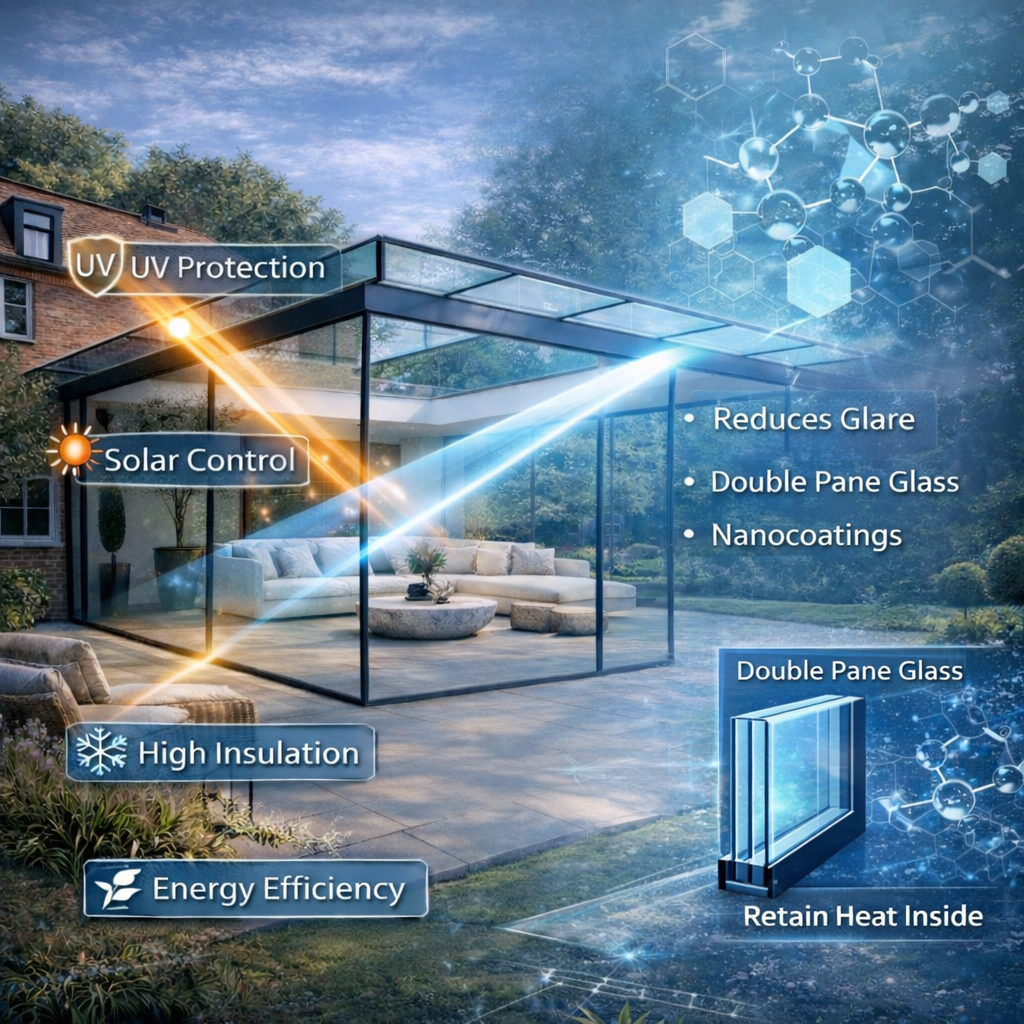
Traditional conservatory glass lets solar heat pour in during summer and loses warmth during colder months. The result is often a room that sits empty for long stretches of the year.
Four common conservatory problems addressed with one glazing upgrade.
Designed to help reflect up to 86% of the sun’s heat in summer, helping keep interiors more comfortable without blocking the view.
A U-value under 1.0 W/m²K helps retain warmth and reduce the cold spots associated with standard conservatory glazing.
Blocks virtually all harmful UV rays, helping protect furniture, flooring and soft furnishings from fading over time.
An optional polymeric treatment creates a non-stick surface that helps rain wash away dirt and keeps the glass cleaner for longer.
Every pane combines warm-edge spacing, Low-E coatings and argon gas filling to improve comfort and performance.
A specialist Low-E coating is designed to help reflect solar heat back outwards in summer.
The right configuration can support a U-value under 1.0 W/m²K for strong thermal insulation.
Warm-edge spacer bars reduce thermal bridging around the perimeter of the sealed unit.
Blocks over 99% of harmful UV rays to help protect people and interiors.
A specialist treatment can help the glass stay cleaner for longer with less manual cleaning.
Argon gas inside the sealed cavity improves insulation compared with ordinary air-filled units.
This is engineered into the glass unit from the start, rather than being a film or coating applied afterwards.
The spacer bar helps reduce cold spots around glass edges and improves insulation across the sealed unit.
A microscopically thin coating helps reflect heat back to its source while allowing natural light through.
The sealed cavity is filled with argon gas, which is denser than air and helps improve thermal performance.
This side-by-side comparison places standard conservatory glass and New Generation Glass under the same controlled heat source. The difference in heat transmission through each pane is visible and measurable.
Room Outside uses this demonstration during consultations to help homeowners understand why glass specification makes such a difference to conservatory comfort.
Standard double glazing allows more heat to pass through. New Generation Glass is designed to help reflect solar heat before it enters the room, and the same technology helps retain warmth during colder months.
A practical specification guide for homeowners comparing conservatory roof and wall glazing.
New Generation Glass is Room Outside’s temperature-control glazing specification for conservatories, orangeries and highly glazed extensions. It combines solar-control and Low-E coatings with an argon-filled cavity and warm-edge spacer technology. The goal is not to make glass behave like an opaque wall; it is to reduce the two weaknesses that make older conservatories uncomfortable: excessive solar gain in summer and rapid heat loss in winter.
Suitable configurations can also provide over 99% UV protection. An optional exterior polymeric resin treatment creates a non-stick, low-maintenance surface that helps resist staining and keeps roof glass cleaner for longer. It reduces cleaning effort rather than eliminating maintenance altogether.
The solar-control layer reflects and absorbs a greater proportion of incoming solar energy before it enters the room. In winter, the Low-E coating reflects long-wave heat back towards the interior. Argon gas inside the sealed cavity conducts less heat than ordinary air, while the warm-edge spacer reduces the cold bridge around the perimeter of each unit.
These functions are passive: they do not require electricity. Final room temperature still depends on orientation, roof area, wall glass, ventilation, shading, floor insulation, seals and how the conservatory connects to the house.
Standard double glazing can insulate reasonably well but may admit too much solar energy for a glass-roofed room. Old polycarbonate is often worse for winter heat loss and can lose clarity as it ages. New Generation Glass combines insulation and solar control in the same sealed unit.
| Performance measure | New Generation Glass | Standard double glazing | Old polycarbonate roof |
|---|---|---|---|
| U-value | Under 1.0 W/m²K available | Often around 1.4–2.0 W/m²K | Approximately 2.9 W/m²K for older panels |
| g-value / solar factor | Configuration-specific; up to 86% solar-heat rejection is available | Often around 0.70–0.78 for clear units | Varies widely with panel build-up, tint and age |
| Light transmission | Configuration-specific; confirm on the final glass schedule | Typically high for clear glass | Highly variable; yellowing and surface wear reduce light |
| UV protection | Over 99% available | Limited unless laminated or specially coated | Product- and age-dependent |
| Low-maintenance surface | Optional polymeric treatment | Usually not included | No comparable glass treatment |
Figures are indicative comparison values, not a substitute for the selected unit’s declaration of performance. New Generation Glass does not have one universal g-value or light-transmission figure because coatings, tints, cavities and pane build-ups vary. Require the final U-value, g-value and light transmission in writing for the exact specification quoted.
Room Outside publishes that U-values under 1.0 W/m²K are available with the right configuration. U-value measures heat transfer: the lower the number, the slower heat escapes. Compare like with like—whole sealed-unit values should not be confused with centre-pane or whole-roof values.
The written quotation should identify the exact glass build-up and declared U-value. Roof bars, frame edges, opening vents and installation junctions also influence the performance of the completed conservatory.
It can make a major difference. Suitable specifications are designed to reject up to 86% of solar heat, reducing the greenhouse effect before heat enters the room. “Stop” should not be read as a guarantee of one indoor temperature: a large south-west roof, limited ventilation or unshaded wall glass can still create warm conditions during extreme weather.
The supplied project record describes a 4 m × 4 m south-west-facing conservatory upgraded from 2010 standard double glazing to New Generation Glass in March 2025.
Heating use for December–February was recorded as 1,200 kWh before and 680 kWh after, a 43% reduction. One project is evidence of that installation, not a universal guarantee; orientation, occupancy, weather and the rest of the building envelope change results.
It reduces the rate at which warmth escapes through the glass. Low-E coating reflects room heat inwards, while argon gas and warm-edge spacing reduce conduction through the unit and its perimeter. That raises internal surface temperatures and can reduce condensation risk at cold edges.
Glazing cannot compensate for failed seals, an uninsulated floor, draughty doors or permanently open access to the house. A health check should assess the complete structure before glass is specified.
Yes—this is one of its most important uses. A suitable existing conservatory can have roof glass, wall glass or both replaced without rebuilding the entire room. The survey checks the roof bars, frame condition, drainage, seals, geometry and supporting structure, then confirms whether they can accept the size and weight of the new sealed units.
See the dedicated glass upgrade service for the retrofit route.
For early planning, a roof-glass upgrade commonly falls around £6,000–£15,000. Roof area, shaped units, access, roof height, existing bars, replacement seals and remedial work all affect the final quotation. Upgrading wall glass as well as the roof increases the scope but may be worthwhile when side elevations remain a major source of heat or glare.
Warranty terms should be itemised with the price. Depending on product and location, Room Outside offers a 10-year structural guarantee backed by independent UK insurers, alongside separate product-specific warranties for glass units and components. The written quotation—not a general webpage—defines coverage, exclusions, maintenance duties and duration.
A straightforward roof-only glass upgrade is often completed in two to five working days after survey and manufacture. Larger conservatories, difficult access, complex shaped panes, wall-glass replacement or frame repairs can take longer. The room must remain weather-safe throughout the changeover, so installation sequencing is planned around forecast conditions.
Manufacturing lead time happens before those installation days. The project programme should distinguish survey, technical confirmation, production and work on site.
Book a health check if you are unsure what is failing, or request a glass upgrade quotation if you already know the roof or wall glazing needs replacement.
Real feedback from homeowners who chose Room Outside glazing upgrades and New Generation Glass specifications.
“Great work thanks to all the team. Love the New Generation Glass, works fantastic in the sun. Would definitely recommend.”Harry Standing
“We are happy with our new glass roof and warm weather this week will hopefully demonstrate that the new generation glass protects us from the heat.”Emmanuelle Dehon
“I can highly recommend the solar glass that Richard suggested. The room remains cool despite the recent blistering conditions.”Steve Cox
Common questions about Room Outside New Generation Glass and conservatory glazing upgrades.
New Generation Glass uses a specially developed Low-E coating and argon gas filling designed to help reflect heat back to its source. It can reflect up to 86% of the sun’s rays in summer and helps retain interior warmth in winter, with U-values under 1.0 W/m²K available depending on specification.
Yes. A specialist polymeric resin treatment can be applied to exterior surfaces. This creates a non-stick, low-maintenance surface that stays cleaner for longer and helps resist staining.
Yes. New Generation Glass blocks virtually all harmful UV rays, helping to protect people, furniture, flooring and soft furnishings from fading and sun damage.
Depending on the configuration selected by the Room Outside design team, New Generation Glass can achieve a U-value under 1.0 W/m²K, providing strong thermal insulation for conservatories and glass extensions.
Yes. New Generation Glass is available as an upgrade on Room Outside glass extensions, orangeries and conservatories. A designer can advise whether it is suitable for a new project or an existing conservatory upgrade.
Depending on product and location, Room Outside offers a 10-year structural guarantee backed by independent UK insurers, alongside separate product-specific warranties. Exact terms are confirmed in the written quotation.
A health check identifies whether the existing roof bars, frames, seals and drainage are suitable for a targeted New Generation Glass upgrade.
Prefer to talk? Call 01243 538999.