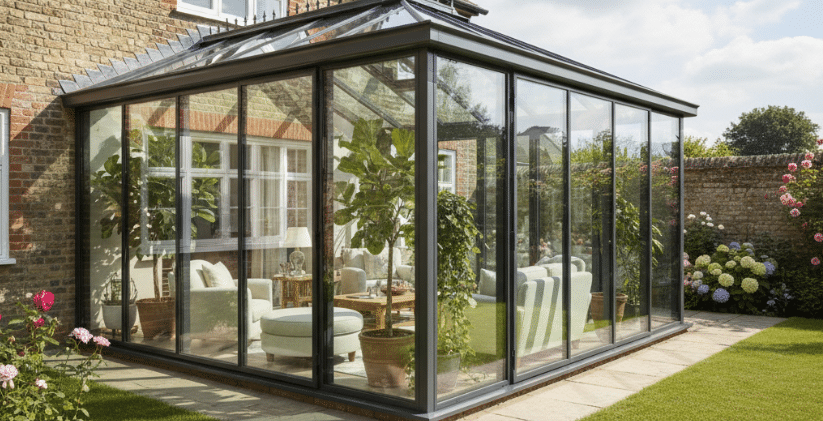
The Complete Conservatory Maintenance Guide: Seasonal Checklist for Longevity
The Complete Conservatory Maintenance Guide: Seasonal Checklist for Longevity | Room Outside
Maintenance Guides
The Complete Conservatory Maintenance Guide: Seasonal Checklist for Longevity
Protect your investment with our expert seasonal maintenance checklist. Prevent costly repairs and extend your conservatory’s lifespan by years with proper preventative care.
12 min read
Updated January 2026
South East Focus
Quick Answer: Essential Maintenance Tasks
Regular conservatory maintenance can extend its lifespan by 5-10 years and prevent costly repairs. The most critical tasks are: cleaning gutters quarterly, inspecting seals biannually, cleaning the roof twice yearly, and checking for structural issues annually. A £15,000-£25,000 conservatory can lose 20-40% of its value within 5 years without proper maintenance.
Follow our seasonal checklist to protect your investment: Spring cleaning removes winter debris, summer inspection catches heat damage, autumn preparation prevents winter leaks, and winter protection maintains thermal efficiency.
5-10 yrs
Extended lifespan with maintenance
75%
Leaks prevented by seal maintenance
£500-£2k
Annual repair savings
2x/year
Optimal roof cleaning frequency
A conservatory is a significant investment that enhances your living space and property value. Like any valuable asset, it requires regular maintenance to preserve its beauty, functionality, and structural integrity. Neglected maintenance leads to leaks, drafts, condensation issues, and costly repairs that can diminish your enjoyment and the conservatory’s value. This comprehensive guide provides a seasonal maintenance checklist developed from over 50 years of expertise in conservatory care across Kent, Surrey, Sussex, and London. For complete peace of mind, consider our professional conservatory maintenance service.
Why Regular Maintenance Matters
Conservatories face unique challenges due to their extensive glazing and exposure to the elements. The UK’s variable climate—with its rain, wind, temperature fluctuations, and seasonal debris—takes a toll on even the highest-quality installations. Regular maintenance isn’t just about cleanliness; it’s about preserving the structural integrity, thermal efficiency, and longevity of your investment.
The Cost of Neglect: Real-World Examples
Based on our service records across the South East, common issues from poor maintenance include:
Blocked gutters: £800-£1,500 water damage repairs to frames and interiors
Failed seals: £300-£800 per window for resealing and potential water damage
Algae buildup: £400-£700 for professional roof cleaning and seal restoration
Frame corrosion: £1,500-£3,000 for section replacement or full refinishing
Thermal inefficiency: £200-£500 annual energy loss from poor seals
Preventative maintenance costs a fraction of these repairs while extending your conservatory’s lifespan.
Preserving Property Value
A well-maintained conservatory adds 5-10% to property value, while a neglected one can actually detract from value. During property viewings, potential buyers immediately notice issues like condensation between panes, water stains, algae growth, or rotting frames. Regular maintenance ensures your conservatory remains a selling point rather than a liability.
Energy Efficiency & Comfort
Properly maintained seals and gaskets maintain thermal efficiency, keeping your conservatory comfortable year-round and reducing heating costs. A single 5mm gap in seals can increase heat loss by 15%, significantly impacting energy bills during winter months.
The Complete Seasonal Maintenance Checklist
Follow this comprehensive seasonal checklist to protect your conservatory investment throughout the year:
Spring
Spring Cleaning & Post-Winter Inspection
After winter’s harsh conditions, spring is ideal for thorough cleaning and damage assessment. Focus on removing winter debris and preparing for increased usage.
Clean roof panels inside and outEssential
Clear gutters and drainage channels of winter debrisCritical
Inspect and clean all window and door sealsImportant
Check for cracks in glass or polycarbonate panelsEssential
Test opening mechanisms on windows and doorsImportant
Clean and lubricate door hinges and locksRecommended
Inspect for water stains or condensation between panesCritical
Check exterior frame for signs of corrosion or rotEssential
Summer
Summer Ventilation & Heat Protection
Summer brings heat and intense sunlight. Focus on ventilation, UV protection, and preparing for potential heat-related issues.
Clean and check operation of ventilation systemsImportant
Inspect and clean blinds or shading systemsRecommended
Check for signs of heat damage to sealsEssential
Ensure drainage channels are clear for summer stormsImportant
Inspect for algae or moss growth in shaded areasRecommended
Test thermal controls and sensors if installedOptional
Clean interior surfaces and treat any water marksImportant
Check exterior for any vegetation growth against framesEssential
Autumn
Autumn Preparation & Leaf Management
Prepare for winter by addressing autumn leaf fall and ensuring your conservatory is sealed against colder weather.
Clear leaves and debris from roof and guttersCritical
Inspect and replace any worn weather sealsEssential
Check heating systems and thermostatsImportant
Ensure all windows and doors close properlyCritical
Clean exterior to remove autumn dirt and pollutionRecommended
Inspect roof for any loose panels or fixingsEssential
Check for any gaps where draughts could enterImportant
Apply protective treatment to wooden frames if neededSeasonal
Winter
Winter Protection & Cold Weather Care
Winter requires special attention to thermal efficiency, condensation management, and protection from ice damage.
Monitor for condensation and improve ventilationEssential
Check gutters for ice dams and clear carefullyCritical
Inspect for any leaks during heavy rainImportant
Ensure heating systems are functioning efficientlyEssential
Check door and window seals for cold draughtsImportant
Remove snow from roof carefully to avoid damageAs needed
Inspect interior for mould or damp patchesEssential
Test emergency drainage in case of ice blockageRecommended
Critical Maintenance Tasks Explained
Gutter & Drainage Maintenance
Blocked gutters are the leading cause of conservatory water damage. Leaves, debris, and even bird nests can block drainage, causing water to overflow and damage frames, foundations, and interior finishes. In winter, blocked gutters can lead to ice dams that force water under roof panels.
⚠️ Safety Warning: Roof Access
Never attempt to clean conservatory roofs without proper safety equipment. Conservatory roofs are not designed to support human weight. Use telescopic cleaning tools from the ground or hire professionals with appropriate access equipment and insurance. Falls from roofs cause serious injuries annually.
Seal & Gasket Maintenance
Seals and gaskets around windows, doors, and roof panels degrade over time due to UV exposure, temperature fluctuations, and general wear. Cracked or hardened seals allow water ingress, draughts, and thermal inefficiency. Inspect seals biannually and replace at the first signs of deterioration.
Glass & Panel Cleaning
Regular cleaning maintains light transmission and prevents permanent staining. Use only conservatory-safe cleaning products—avoid harsh chemicals, abrasive cleaners, or pressure washers that can damage seals and coatings.
✅ Professional Cleaning Recommendation
For optimal results and safety, professional conservatory cleaning services are recommended every 6-12 months. Professionals use appropriate equipment, conservatory-safe cleaning solutions, and can identify potential issues before they become serious problems. A professional clean typically costs £150-£300 but can prevent £1,000+ in repairs. Our comprehensive maintenance service includes thorough cleaning as part of the package.
Structural Inspection
Annually inspect the conservatory structure for: movement cracks at joins, corrosion on metal frames, rot on wooden frames, secure fixings, and proper alignment of opening mechanisms. Early detection of structural issues prevents major repairs.
Maintenance Task Priority Guide
This table helps prioritize maintenance tasks based on urgency and potential impact:
Maintenance Task
Frequency
Time Required
Priority Level
DIY or Professional
Gutter Cleaning
Quarterly
30-60 mins
High
DIY (with care)
Seal Inspection
Biannually
15-30 mins
High
DIY
Roof Cleaning
Twice yearly
1-2 hours
Medium
Professional Recommended
Frame Inspection
Annually
30-45 mins
High
DIY
Glass Cleaning
Monthly
20-40 mins
Medium
DIY
Ventilation Check
Seasonally
15-20 mins
Medium
DIY
Structural Assessment
Annually
45-60 mins
High
Professional
Drainage Testing
Quarterly
10-15 mins
Medium
DIY
Seal Replacement
As needed
1-3 hours
High
Professional Recommended
Interior Deep Clean
Biannually
2-3 hours
Medium
DIY
High Priority Tasks
Gutter CleaningQuarterly • 30-60 mins • DIY (with care)
Seal InspectionBiannually • 15-30 mins • DIY
Frame InspectionAnnually • 30-45 mins • DIY
Professional Recommended
Roof CleaningTwice yearly • 1-2 hours • Professional
Structural AssessmentAnnually • 45-60 mins • Professional
Seal ReplacementAs needed • 1-3 hours • Professional
Professional Conservatory Maintenance Service
Our comprehensive Groom Service includes all essential maintenance tasks performed by certified technicians. Protect your investment with professional care that extends lifespan and prevents costly repairs.
Complete Inspection
130-point checklist covering structure, seals, drainage, and safety
Thorough Cleaning
Professional cleaning of roof, frames, glass, and drainage systems
Preventative Maintenance
Seal conditioning, lubrication, and minor repairs to prevent issues
Common Problems & Prevention Tips
Condensation Issues
Condensation between panes indicates seal failure and requires professional attention. Surface condensation can be managed with proper ventilation, dehumidifiers, and avoiding drying clothes indoors.
Algae & Moss Growth
Common on north-facing roofs and shaded areas. Prevent with regular cleaning and consider installing zinc or copper strips along the ridge to inhibit growth.
Frame Corrosion or Rot
Early detection is key. For uPVC frames, check for discoloration or brittleness. For aluminum, look for white powder (oxidation). For wood, probe for soft spots with a screwdriver.
DIY vs Professional: When to Call Experts
DIY appropriate: Regular cleaning, seal inspections, gutter cleaning (ground floor), minor lubrication. Professional required: Roof access, seal replacement, structural repairs, electrical issues, complex drainage problems, or if you’re unsure about safety or correct procedure. For these tasks, our expert maintenance team is equipped to handle all aspects safely and efficiently.
Preventing Costly Repairs
The most cost-effective maintenance strategy is prevention. Addressing small issues promptly prevents them from becoming major repairs. Budget approximately 1-2% of your conservatory’s original cost annually for maintenance—this is significantly less than major repair costs.
Regional Considerations for the South East
Conservatory maintenance in Kent, Surrey, Sussex, and London has unique considerations due to local environmental factors:
Coastal Areas (Sussex, Kent Coast)
Salt spray accelerates corrosion on metal components. Increase inspection frequency for aluminum frames and hardware. Rinse frames with fresh water quarterly to remove salt deposits.
Wooded Areas (Surrey, Kent)
Increased leaf fall requires more frequent gutter cleaning—monthly during autumn. Check for overhanging branches that could damage roofs during storms.
Urban Areas (London, Town Centers)
Air pollution deposits require more frequent cleaning. Check seals more often as pollution can accelerate degradation. Consider anti-pollution coatings for glass.
Historical & Conservation Areas
Specialist cleaning products and techniques may be required. Consult local conservation officers before making changes to listed property conservatories.
Creating Your Maintenance Schedule
Develop a personalized maintenance schedule based on your conservatory’s age, materials, and location. For busy homeowners or those preferring professional assurance, our scheduled maintenance plans provide regular, worry-free care.
For New Conservatories (0-5 years)
Focus on establishing good habits. Clean quarterly, inspect seals biannually, and schedule professional inspection annually. Consider our annual maintenance package to protect your warranty and ensure proper care from the start.
For Mid-Life Conservatories (5-15 years)
Increase vigilance. Inspect seals quarterly, monitor for wear on moving parts, and budget for potential seal replacement or minor repairs. This is when professional maintenance becomes particularly valuable for extending lifespan.
For Older Conservatories (15+ years)
Consider more frequent professional assessments. Plan for potential component replacement (seals, gaskets, drainage systems) and monitor structural integrity closely. Our specialist maintenance service includes assessment of older structures and recommendations for preservation.
Maintenance Calendar Template
Download our free printable maintenance calendar from the Room Outside website. Includes seasonal checklists, space for notes, and reminders for critical tasks. Keeping records helps track issues over time and provides valuable documentation if warranty claims or insurance issues arise. For a hands-off approach, our maintenance service includes detailed documentation of all work completed.
Room Outside Maintenance Team
Certified Conservatory Maintenance Specialists
With over 50 years of experience maintaining conservatories, orangeries, and glass rooms across the South East, our certified technicians understand the unique challenges of UK conservatory care. Our Groom Service follows a 130-point checklist developed from thousands of maintenance visits, ensuring your conservatory receives the expert care needed to protect your investment and extend its lifespan.
Areas We Serve
Room Outside provides professional conservatory maintenance services across the South East of England. Our Groom Service is available to homeowners throughout the region.
Glass and Glazing Federation Maintenance Guidelines; Building Research Establishment Conservatory Performance Studies; Checkatrade Maintenance Cost Surveys 2025; Room Outside Service Records 2020-2025; UK Climate Impact on Building Materials Research; Property Valuation Impact Studies; Health & Safety Executive Roof Access Guidelines.
Frequently Asked Questions
How often should I clean my conservatory roof?
Clean your conservatory roof at least twice a year – ideally in spring and autumn. Regular cleaning prevents algae and moss buildup that can damage seals and glass, and ensures optimal light transmission. In areas with heavy tree cover or pollution, consider quarterly cleaning.
What is the most important maintenance task for conservatories?
Gutter cleaning is the most critical maintenance task. Blocked gutters cause water damage to frames, foundations, and interior spaces. Check and clean gutters quarterly, especially after autumn leaf fall. Even small blockages can lead to significant water damage over time.
How do I maintain conservatory seals and gaskets?
Inspect seals biannually for cracks or hardening. Clean with mild soapy water, avoid harsh chemicals. Replace worn seals promptly to prevent leaks – this small investment prevents major water damage. Professional seal conditioning during maintenance services can extend seal lifespan.
Should I pressure wash my conservatory?
Never use a pressure washer on conservatories. High-pressure water can damage seals, force water into frames, and crack glass. Use gentle cleaning with soft brushes and mild detergent instead. Professional conservatory cleaners use specialized low-pressure systems designed for glass structures.
How can I prevent conservatory condensation?
Ensure proper ventilation year-round, maintain seals and gaskets, use dehumidifiers in winter, and avoid drying clothes indoors. Regularly clean trickle vents and ensure drainage channels are clear. For persistent condensation between panes, contact professionals as this indicates seal failure.
When should I call professional conservatory maintenance services?
Contact professionals for: structural issues, persistent leaks, sealant replacement, roof panel cracks, electrical problems, or if you’re unsure about safety. Professional maintenance services typically extend conservatory lifespan by 5-10 years and prevent costly emergency repairs.
How much does professional conservatory maintenance cost?
Professional maintenance typically costs £150-£300 depending on conservatory size and condition. This includes thorough cleaning, inspection, and minor adjustments. Compared to repair costs for neglected issues (often £800-£3,000+), professional maintenance offers excellent value and protection.
Can I maintain my conservatory myself?
Yes for basic tasks: regular cleaning, gutter clearing (ground level), seal inspections, and lubrication. No for tasks requiring roof access, structural assessment, or complex repairs. Always prioritize safety – if in doubt, consult professionals. Even with DIY maintenance, annual professional inspection is recommended.
What cleaning products should I use?
Use conservatory-specific or mild, non-abrasive cleaners. Avoid harsh chemicals, abrasive pads, or vinegar-based solutions that can damage seals and glass coatings. For uPVC frames, use specialized uPVC cleaners. For glass, use streak-free glass cleaners or mild soapy water.
How does maintenance affect my conservatory warranty?
Most warranties require regular maintenance as a condition of coverage. Document all maintenance activities, especially professional services. Neglecting maintenance can void warranties for issues that could have been prevented. Check your specific warranty terms for maintenance requirements.
What are the signs my conservatory needs immediate attention?
Visible water leaks, condensation between glass panes, cracking sounds from roof, noticeable frame movement, pooling water on roof, or difficulty opening/closing doors/windows. Address these issues promptly to prevent further damage and higher repair costs.
How long should a well-maintained conservatory last?
With proper maintenance: uPVC conservatories 25-35 years, aluminum 30-40+ years, hardwood 40-50+ years. Neglected conservatories may need major repairs or replacement within 15-20 years. Regular maintenance is the most significant factor determining lifespan.
Our professional Groom Service extends your conservatory’s lifespan by 5-10 years while preventing costly repairs. Certified technicians follow our 130-point checklist to ensure comprehensive care for your valuable glass extension.
Room Outside Groom Service: Professional conservatory maintenance since 1973.
Serving West Sussex, Surrey, Kent, Essex, Hampshire, Dorset, Berkshire, Greater London & East Sussex.
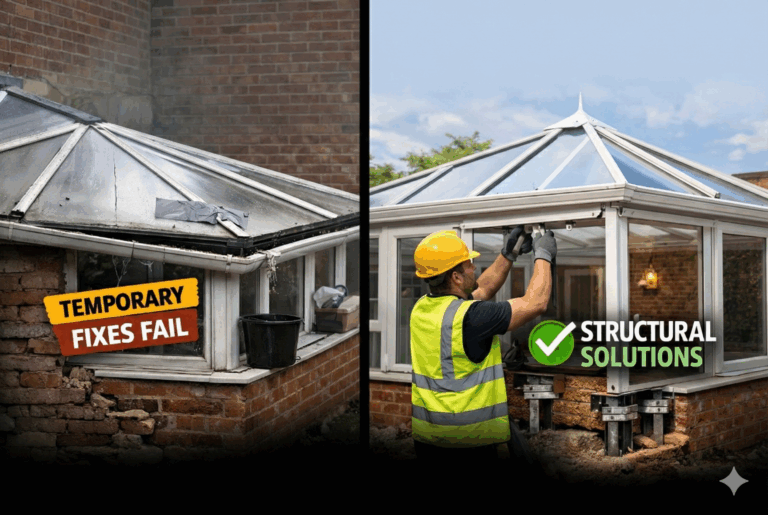
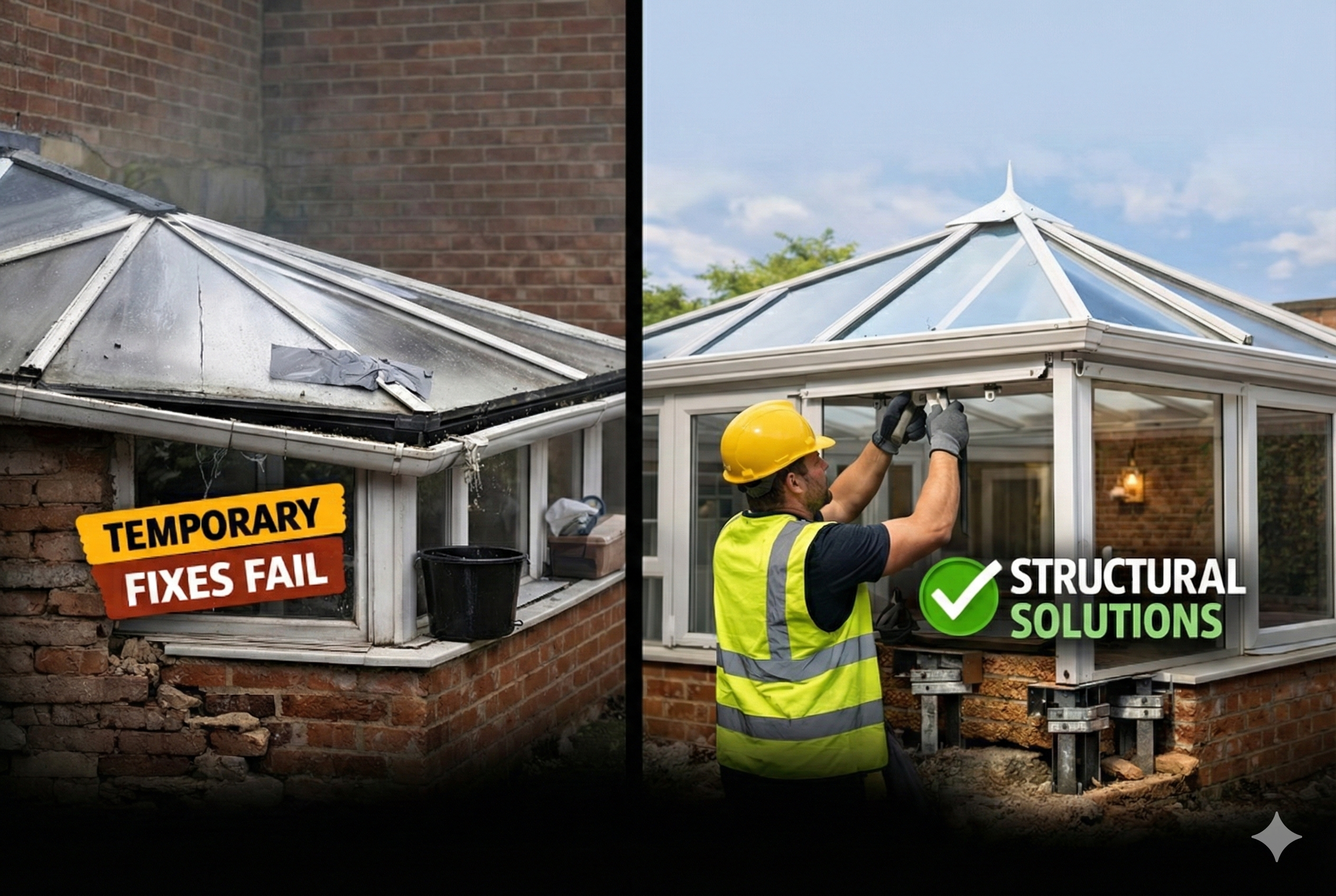
Sagging Conservatory Roof? Structural Solutions vs Cosmetic Fixes
Why temporary repairs fail and what actually works. Expert guide to diagnosing foundation issues, frame deterioration, and choosing between structural repairs or full refurbishment.
Service: Refurbishment
Kent, Surrey, Sussex
Quick Answer: Why Is My Conservatory Roof Sagging?
A sagging conservatory roof typically indicates underlying structural problems—not just cosmetic wear. While temporary fixes like sealants or new panels might mask the issue, genuine structural repairs or full conservatory refurbishment are usually necessary to resolve foundation issues, frame deterioration, or inadequate original construction. Cosmetic fixes typically fail within 6-18 months, while proper structural solutions last 20-30+ years.
6-18
Months before cosmetic fixes fail
70%
Of sagging caused by foundation issues
20-30
Years lifespan with structural repairs
£4,600
Average wasted on repeated fixes
A sagging conservatory roof is a warning sign of deeper structural problems that require professional assessment
When homeowners notice their conservatory roof beginning to sag, the instinct is often to search for quick, affordable fixes. However, a sagging conservatory is rarely a surface-level problem. The visible dip in your roof is typically the symptom of deeper structural failures that demand professional assessment and proper remediation. Understanding the difference between cosmetic patches and genuine structural repairs can save you thousands of pounds and years of frustration. This comprehensive guide explains why conservatory roofs sag, why temporary fixes fail, and what solutions actually work for homeowners across Kent, Surrey, Sussex, and London.
Understanding Why Conservatory Roofs Sag
Structural issues in conservatories develop gradually over years, often going unnoticed until the problem becomes severe. Unlike a sudden leak or broken window, sagging happens incrementally—a few millimetres each year—until one day you realise something is seriously wrong.
The sagging you see on your roof is almost never the actual problem. Instead, it is the visible consequence of failures happening elsewhere in the structure: beneath the floor in the foundations, within the frame connections, or in the roof support system itself. Understanding the root cause is essential before committing to any repair strategy—otherwise, you risk spending money on cosmetic fixes that fail within months while the underlying damage continues to worsen.
Research from the Glass and Glazing Federation indicates that approximately 70% of conservatory structural failures originate from foundation or base issues, with frame deterioration accounting for 20% and roof-specific problems causing just 10% of sagging cases. This means that in seven out of ten cases, the roof sag you see is actually being caused by problems at ground level.
Common Causes of a Sagging Conservatory
Before you can fix a sagging conservatory, you need to understand what is causing it. Here are the three primary categories of structural failure that lead to visible roof sagging.
🏗️
Foundation & Base Issues
Ground movement, subsidence, inadequate original foundations, and drainage problems causing settlement
🔩
Frame Deterioration
Aluminium fatigue, timber rot, uPVC degradation, and connection joint failures over time
🏠
Roof Structure Failure
Glazing bar breakdown, ring beam problems, and damage from excessive snow or debris loading
Foundation and Base Issues
The most serious cause of conservatory sagging relates to foundation problems. Conservatory foundations can fail for several reasons, and without addressing these underlying issues, any repairs to the visible structure will ultimately fail.
Ground Movement and Subsidence
Clay soils—common across Kent, Surrey, and Sussex—expand and contract with moisture changes, causing gradual foundation movement. During dry summers, clay shrinks; during wet winters, it expands. This constant cycle creates stress on conservatory foundations that were often not designed to accommodate such movement. Trees planted too close to the structure can draw moisture from the soil, accelerating subsidence. Properties in areas with historic mining activity may also experience ground instability that affects conservatory foundations.
Inadequate Original Foundations
Many conservatories—particularly those built before 2000—were constructed on foundations that do not meet modern building standards. Shallow footings, insufficient concrete depth, or poor-quality materials can all contribute to foundation settlement over time. In some cases, conservatories were built on simple concrete slabs without proper strip foundations, making them vulnerable to any ground movement whatsoever.
Drainage Problems
Poor drainage around your conservatory base allows water to pool, saturating the soil and potentially washing away supporting material beneath the foundations. In winter, freeze-thaw cycles can crack inadequate foundations as trapped water expands when it freezes. Over years, this repeated damage compounds until the foundation can no longer support the structure properly.
Related Reading
For a deeper understanding of how conservatory structures work and why they fail, read our comprehensive guide: Understanding Conservatory Structural Integrity. This article explains the engineering principles behind conservatory construction and helps you recognise early warning signs.
Structural Frame Deterioration
Even if your foundations are sound, the frame itself can deteriorate over time, losing its ability to support the roof structure.
Aluminium Frame Fatigue
Older aluminium frames can develop stress fractures at connection points, particularly where the frame meets the roof structure. Years of thermal expansion and contraction—the frame expands in summer heat and contracts in winter cold—weaken these joints progressively. Eventually, the connections fail to hold the frame rigid, allowing the roof to sag under its own weight.
Timber Frame Rot
Wooden conservatory frames are vulnerable to moisture ingress, particularly at joints and connection points where water can penetrate protective coatings. Once rot takes hold in structural timbers, the frame loses its load-bearing capacity relatively quickly. Unlike surface decay that can be treated, structural rot often requires complete section replacement to restore integrity.
uPVC Frame Degradation
While uPVC is marketed as low-maintenance, it does degrade over 20-25 years. UV exposure causes brittleness, making the material prone to cracking under stress. More critically, the steel reinforcement within uPVC frames can corrode if moisture penetrates through cracks or seal failures in the plastic sheathing. Once the internal steel weakens, the frame cannot maintain its structural role.
Roof Structure Failure
In some cases, the roof structure itself is the source of the problem, though this is less common than foundation or frame issues.
Glazing Bar Breakdown
The bars that support your roof panels can bend, crack, or pull away from their fixings over time. This is especially common in polycarbonate roofs where the lightweight material does not provide much structural resistance to help the glazing bars maintain their position. Thermal movement, wind loading, and the weight of accumulated debris all stress these components.
Ring Beam Problems
The ring beam—the structural element connecting your roof to the walls—is a common failure point. If this component becomes compromised through rot, corrosion, or joint failure, the entire roof structure loses its integrity. Ring beam problems often manifest as the roof appearing to separate from the walls or visible gaps appearing at the junction.
Excessive Loading Damage
Conservatory roofs are not designed to bear significant weight. Repeated heavy snow loads or accumulated debris—leaves, branches, moss—can permanently deform roof components. A single extreme winter can cause damage that only becomes apparent months later as the deformed components continue to settle.
Foundation Assessment
Frame Inspection
After Refurbishment
Quality Structural Work
Cosmetic Fixes: Why They Usually Fail
When faced with a sagging conservatory, many homeowners understandably look for the quickest, cheapest solution. Unfortunately, cosmetic fixes almost always fail—and often make the situation worse.
What Counts as a Cosmetic Fix?
Cosmetic approaches to a sagging conservatory typically include:
Resealing joints and gaps with silicone or mastic
Replacing individual roof panels without addressing the frame
Adding extra sealant or flashing around problem areas
Painting or refinishing frames to hide deterioration
Installing trim pieces to cover gaps between panels
❌ Cosmetic Fixes
Cost £200-800 per application
Typically last 6-18 months
Do not address root causes
Can mask worsening damage
Often create secondary problems
Waste money over time
✓ Structural Solutions
Cost £2,000-25,000 depending on scope
Last 20-30+ years
Fix underlying problems
Prevent future deterioration
Add value to property
One-time investment
The Problem with Surface-Level Solutions
They Do Not Address Root Causes
If your foundation is settling, no amount of sealant will prevent continued movement. The sagging will return—often worse than before—within months of a cosmetic repair. You cannot fix a structural problem with a non-structural solution.
They Can Mask Worsening Damage
Cosmetic fixes hide warning signs that would otherwise alert you to deteriorating conditions. By the time the problem resurfaces, structural damage may have progressed significantly. What might have been a moderate repair becomes a major refurbishment.
They Are Often False Economy
Spending £500-1,000 on temporary fixes every year or two quickly exceeds the cost of proper structural repairs. Many homeowners discover they have spent more on repeated cosmetic treatments than a full refurbishment would have cost—and they still have a failing conservatory.
They Can Create Secondary Problems
Poorly applied sealants can trap moisture within the structure, accelerating rot and corrosion that would not otherwise have occurred. New panels fitted to a warped frame will stress and crack prematurely, potentially causing leaks that damage your home’s interior. Sometimes, doing nothing is better than doing the wrong thing.
When Cosmetic Fixes Might Be Appropriate
Cosmetic approaches may be suitable only when:
The sagging is extremely minor (less than 5mm deviation)
A structural survey confirms no underlying issues
The conservatory is relatively new (under 10 years old)
You are addressing purely aesthetic concerns, not functional problems
In all other cases, a proper structural assessment should precede any repair work.
Structural Solutions That Actually Work
Unlike cosmetic patches, structural solutions address the underlying causes of your sagging conservatory. While they require greater initial investment, they provide lasting results and genuine value for money.
Professional Structural Assessment
Before any repair work begins, commission a proper structural survey. A qualified surveyor will examine:
Foundation condition and soil stability
Frame integrity at all connection points
Roof structure alignment and component condition
Evidence of water damage or material degradation
Overall structural calculations for the original design
This assessment typically costs £200-400 but provides essential information for planning effective repairs. It may reveal that problems are less severe than feared—or more serious than the visible symptoms suggest.
1
Foundation Remediation
£3,000 – £10,00025+ years
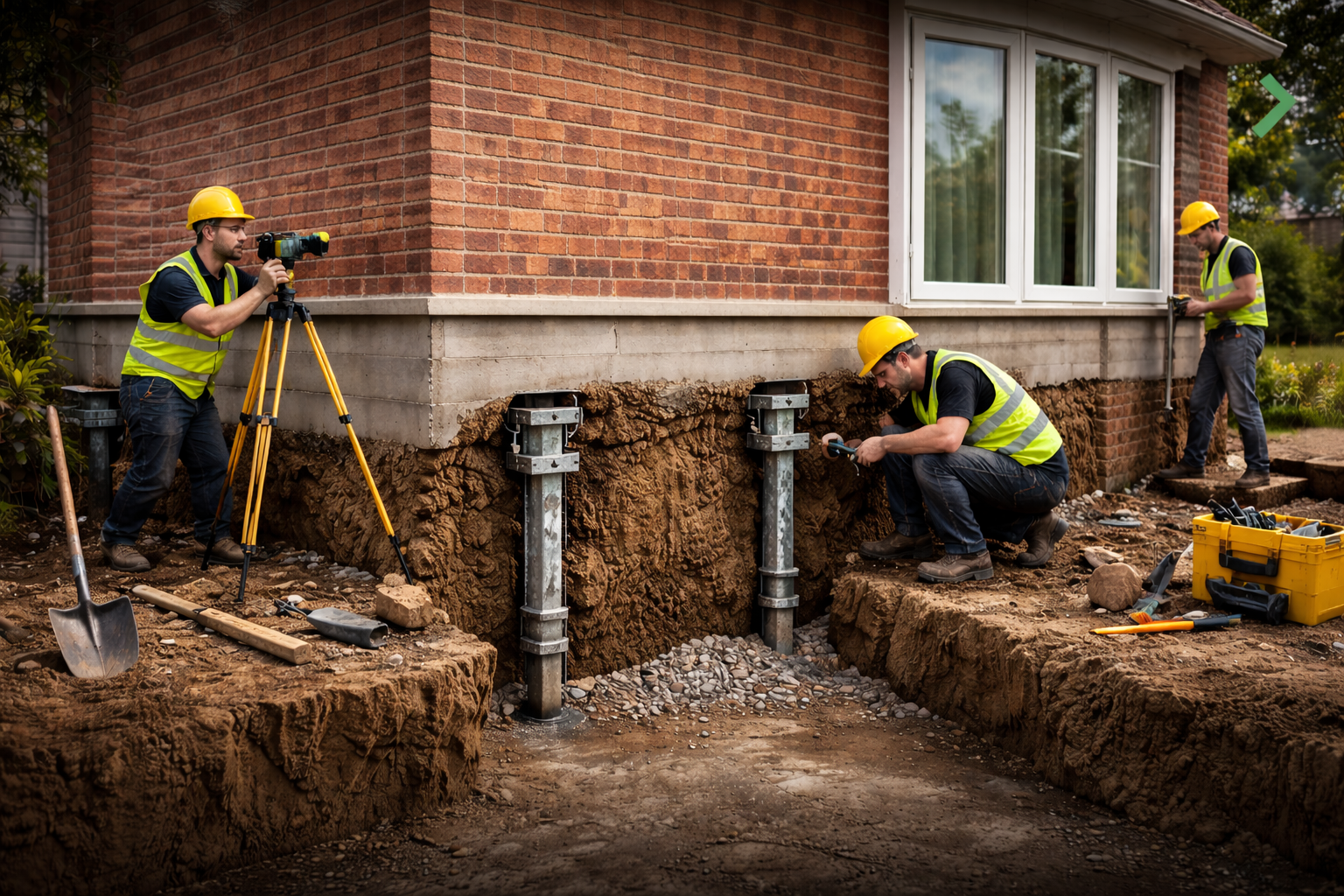
For conservatories with subsidence or settlement issues, foundation work is essential before any other repairs can succeed.
Underpinning: Extends foundations to more stable ground by excavating beneath existing footings and pouring new concrete to greater depth
Mini-Piling: Drives piles to load-bearing strata for superior stability in poor ground conditions
Resin Injection: Modern technique that stabilises foundations without extensive excavation by injecting expanding resin to compact loose soil
2
Structural Frame Repairs
£2,000 – £6,00015-20+ years
Once foundations are stable, frame issues can be addressed to restore structural integrity.
Steel Reinforcement: Additional steel supports integrated into existing frames where joints have weakened
Complete Frame Replacement: New frame fitted to existing base when deterioration is too extensive for repair
3
Roof Structure Restoration
£4,000 – £12,00025-30 years
With foundation and frame secured, roof-specific problems can be definitively resolved.
Ring Beam Replacement: New ring beam installed with temporary propping of existing structure
Upgraded Glazing Bars: Heavier-duty modern profiles replacing original bars for improved rigidity
Solid Roof Conversion: Complete replacement with insulated, tiled roof system eliminating future glazing issues
4
Full Conservatory Refurbishment
£8,000 – £25,00030+ years
When multiple systems are failing, comprehensive refurbishment offers the best long-term value.
New or reinforced foundations to current building regulations
Modern frame system with improved thermal performance
Engineered roof structure calculated for appropriate loading
Integrated heating, ventilation, and electrical systems
Full warranty coverage on all components
Cost Comparison: Cosmetic vs Structural Solutions
Understanding the true cost of different approaches helps you make an informed decision. While cosmetic fixes appear cheaper initially, the long-term mathematics often favour structural solutions.
Real-World Example: The True Cost of Cosmetic Fixes
Consider a homeowner facing a sagging conservatory with moderate frame deterioration and minor foundation settlement:
Cosmetic Approach Over 3 Years:
Initial repairs: £600
Repeat repairs at 12 months: £800
Further repairs at 24 months: £1,200
Emergency repairs at 30 months (leak damage): £2,000
Total: £4,600—with problems continuing to worsen
Structural Approach (One-Time Investment):
Professional assessment: £350
Foundation stabilisation: £4,000
Frame reinforcement: £2,500
Total: £6,850—with 20+ year solution
The structural approach costs more initially but proves significantly more economical over time while actually resolving the problem.
Warning Signs You Should Not Ignore
Knowing when to act can prevent small problems becoming expensive emergencies. Here are the warning signs that indicate your conservatory needs professional attention.
🚨 Emergency Indicators
Contact a structural engineer immediately if you observe:
Visible cracks in the conservatory base or dwarf walls
Doors or windows that suddenly will not open or close
Gaps appearing between the conservatory and main house
Cracking sounds from the structure
Rapid progression of visible sagging (changes over days or weeks)
Standing water that will not drain from the roof
⚠️ Progressive Warning Signs
Schedule an assessment soon if you notice:
Gradual difficulty with door or window operation
Condensation patterns suggesting frame distortion
Panels that no longer sit flush in their frames
Increasing draughts despite intact seals
Mould or damp patches on internal surfaces
Guttering that has separated from the structure
How to Choose the Right Approach for Your Situation
Making the right decision requires balancing immediate needs against long-term value. Here is a framework to help you decide.
Step 1: Get a Professional Assessment
Never attempt to self-diagnose structural problems. What appears to be a simple sagging roof may involve foundation issues invisible from the surface, or the reverse—dramatic-looking problems may have straightforward solutions. Seek assessments from:
A structural engineer (for foundation and frame concerns)
A specialist conservatory company with refurbishment experience
An independent building surveyor (for an unbiased opinion)
Step 2: Understand the Full Scope
Ask your assessors to explain:
All identified structural issues
Which problems are primary (causative) and which are secondary (symptoms)
The consequences of leaving various issues unaddressed
Multiple options at different price points
Step 3: Consider Your Timeline
How long do you plan to stay in your property? If you are moving within 2-3 years, cost-effective structural repairs might be appropriate. For a forever home, investing in comprehensive refurbishment makes sense.
Step 4: Evaluate Total Value
Factor in:
Energy efficiency improvements from modern construction
Increased usable space from a properly functioning conservatory
Property value impact of a well-maintained structure
Multiple structural systems are failing simultaneously
The original construction quality was poor
Repair costs approach or exceed 50% of replacement value
You want to upgrade the conservatory’s specification significantly
The existing structure is more than 25 years old
Areas We Serve
Room Outside provides conservatory structural assessments, repairs, and full refurbishment services across the South East of England. Our experienced teams work throughout:
Glass and Glazing Federation: Conservatory Construction Standards; Building Research Establishment: Foundation Design Guidelines; Institution of Structural Engineers: Domestic Structure Assessment Protocols; Planning Portal UK: Building Regulations Part A (Structure); Room Outside: Internal Project Data 2018-2025.
Frequently Asked Questions
Can I fix a sagging conservatory roof myself?
DIY repairs are not recommended for structural sagging. While you might address minor seal failures, sagging indicates underlying problems requiring professional diagnosis and repair. Incorrect DIY interventions can worsen structural issues and create safety hazards.
How long does structural conservatory repair take?
Timelines vary significantly based on the work required: frame repairs take 2-5 days, foundation work takes 1-3 weeks including curing time, and full refurbishment takes 2-4 weeks. Your contractor should provide a detailed schedule during the quotation process.
Will my conservatory need to be demolished?
Not necessarily. Many structural problems can be resolved while retaining significant portions of the existing structure. Complete demolition is typically only required when foundation problems are severe or when the homeowner chooses to change the conservatory’s footprint or design.
Does a sagging conservatory affect property value?
Yes. Surveyors routinely identify conservatory defects during property valuations, and structural issues can reduce offers or cause sales to fall through. Conversely, a properly refurbished conservatory adds genuine value to your property.
Are structural repairs covered by insurance?
Standard home insurance typically covers sudden structural damage (storm, impact) but not gradual deterioration. If your conservatory was damaged in a specific event, contact your insurer. For age-related decline, repairs are generally the homeowner’s responsibility.
How do I know if my foundation is failing?
Signs of foundation problems include cracks in dwarf walls (especially diagonal cracks), the conservatory pulling away from the main house, doors and windows binding in their frames, uneven floor surfaces, and gaps at skirting board level.
What is the difference between underpinning and resin injection?
Underpinning physically extends foundations deeper into stable ground using concrete—more invasive but proven over decades. Resin injection stabilises existing ground through chemical expansion—less disruptive but not suitable for all soil types or settlement causes.
How much does it cost to fix a sagging conservatory?
Costs vary widely: cosmetic repairs cost £200-800 but typically fail within 18 months. Structural frame repairs cost £2,000-6,000 and last 15-20+ years. Foundation remediation costs £3,000-10,000. Full refurbishment costs £8,000-25,000 but provides a 30+ year solution.
Should I repair or replace my conservatory?
Consider replacement when repair costs exceed 50% of replacement value, multiple systems are failing, or the conservatory is over 25 years old. For newer structures with isolated problems, targeted repairs often provide better value.
How can I get a structural assessment?
Contact a specialist conservatory company or structural engineer. Room Outside offers free initial consultations across Kent, Surrey, Sussex, and London. Call 01243 538999 to arrange an assessment at your property.
Concerned about your sagging conservatory? Call our structural team on 01243 538999 for a free assessment
Stop Wasting Money on Temporary Fixes
Get a proper structural assessment and discover the real solution for your sagging conservatory. Our expert team provides honest advice and lasting repairs across Kent, Surrey, Sussex, and London.
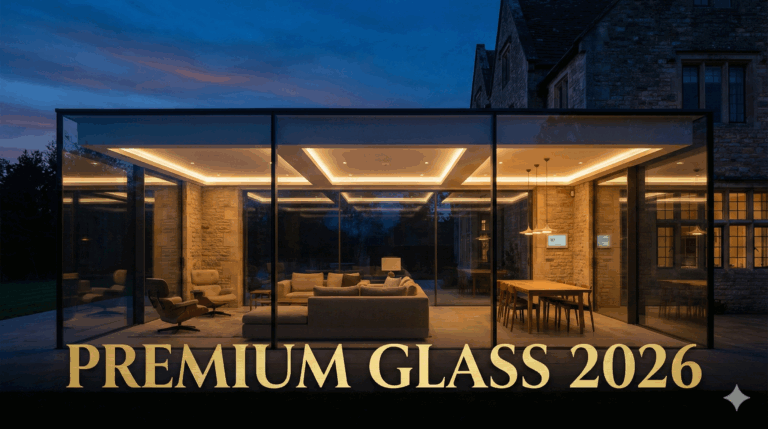
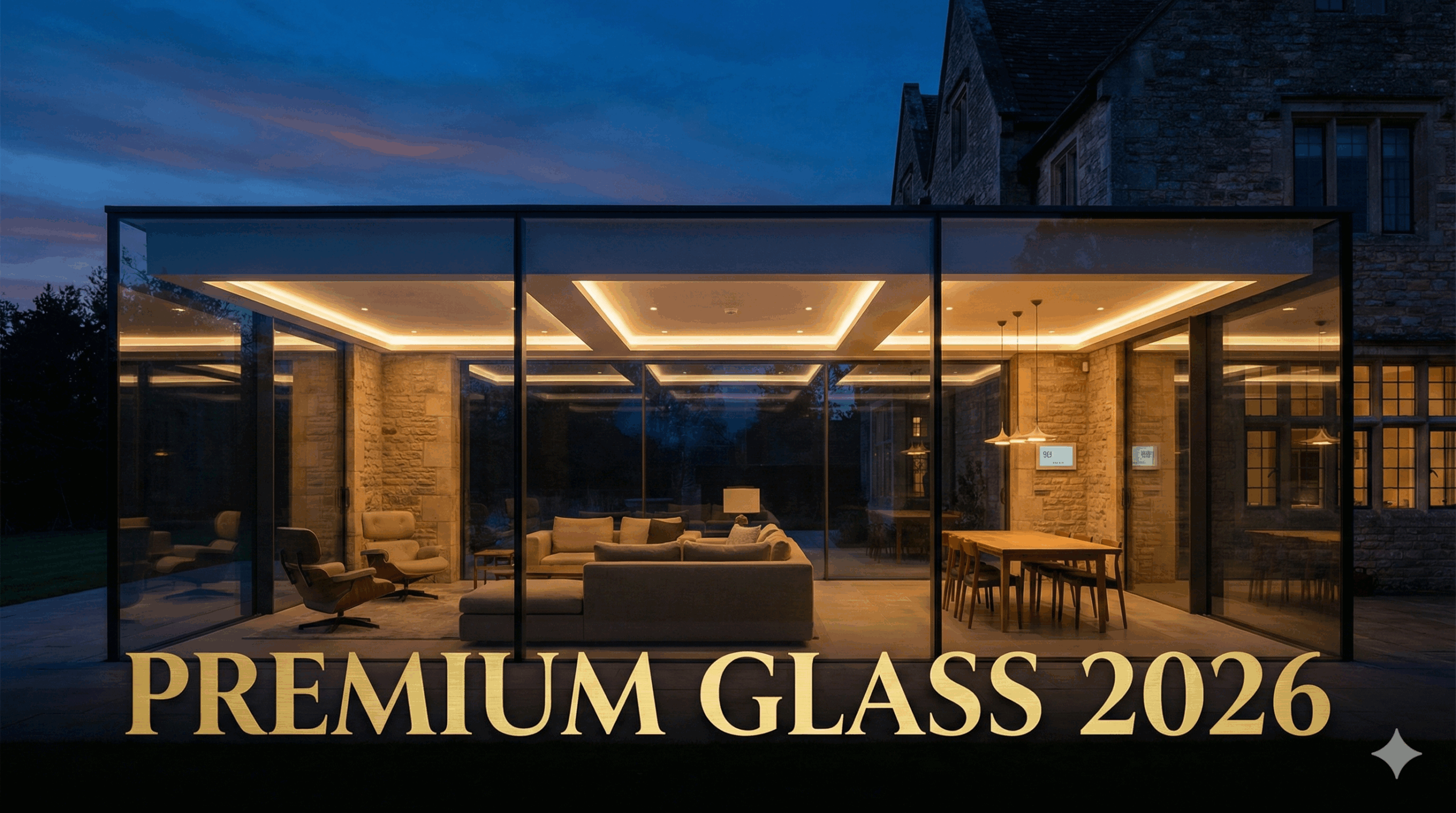
£100k+ Glass Rooms: What Premium Actually Buys (Exclusive Features Breakdown)
£100k+ Glass Rooms: What Premium Actually Buys | Room Outside
★ Premium Glass Extensions 2026
£100k+ Glass Rooms: What Premium Actually Buys (Exclusive Features Breakdown)
Expert guide to structural glazing, smart glass technology, climate control systems, and the premium features that distinguish six-figure installations from standard conservatories.
28 min read
Up to 7% Property Value Increase
40+ Year Lifespan
What Premium Really Means
At the £100,000+ level, you are commissioning a bespoke architectural structure, not purchasing a product from a catalogue. Premium glass rooms feature structural glazing where glass becomes load-bearing, U-values as low as 0.8 W/m²K (versus 1.4 for standard), and sight lines as narrow as 17mm.
The investment delivers: 40+ year lifespan, up to 7% property value increase, year-round climate control, and smart glass technology that eliminates the need for blinds entirely. Quality installations outperform brick extensions (6%) and standard conservatories (5%) for return on investment.
0.8
Premium U-value (W/m²K)
7%
Property value increase
40+
Years lifespan
17mm
Minimum sight lines
When it comes to extending your home with glass, there is a significant difference between a standard conservatory and a truly premium glass room. While a well-built conservatory might cost between £15,000 and £40,000, stepping into the £100,000+ territory opens the door to an entirely different category of design, engineering, and craftsmanship. According to the UK House Price Index for June 2025, average property values reached £269,000 with an annual price rise of 3.7%, making high-quality home improvements an increasingly attractive investment.
The Premium Glass Room Market in 2026
Research from the Squared Money Home Improvement Index reveals that the average renovation adds approximately 9% to a home’s value, with homeowners typically recouping around 50% return on investment. However, premium glass extensions consistently outperform this average. According to Checkatrade and industry analysis, well-designed glass extensions can increase property values by up to 7%, outperforming brick extensions at 6% and conservatories at 5%.
Over 70% of homebuyers now say a property’s energy efficiency is important in their purchasing decision. Furthermore, 59% would pay extra for a home with strong environmental credentials. Premium glass rooms, with their advanced thermal performance and sustainable features, align perfectly with these buyer priorities.
Key Market Statistics for 2026
Average UK property value: £269,000 (3.7% annual increase)
Premium glass extension ROI: Up to 7% property value increase
Willing to pay premium for green features: 59% of buyers
Quality installations lifespan: 40+ years with standard maintenance
Beyond Standard: Understanding the Premium Difference
At the £100k+ level, you are no longer purchasing a product from a catalogue. You are commissioning a bespoke architectural structure designed specifically for your property, lifestyle, and aesthetic preferences. Every element is engineered to order, from the foundation design to the final glass specification.
Premium glass rooms at this price point typically feature structural glazing systems where the glass itself becomes a load-bearing element rather than simply filling a frame. This engineering approach allows for minimal visible framework, creating that seamless, floating appearance that defines contemporary architectural design.
The difference extends beyond aesthetics. These structures are designed by architects and structural engineers working together to create spaces that perform as well as they look, delivering year-round comfort regardless of external conditions. Quality installations are built to last 40+ years with standard maintenance.
🏗️
Structural Engineering
Glass becomes load-bearing, enabling minimal frames and maximum views. Engineering calculations ensure structures handle wind loads, snow loads, and glass weight.
🔬
Advanced Glass Technology
Smart glass, self-cleaning coatings, solar control, and heated glass options that simply were not available to previous generations.
🌡️
Climate Control Integration
Invisible underfloor heating, concealed ventilation, and automated systems maintain comfort without compromising aesthetics.
🏠
Architectural Design
Bespoke solutions tailored to your property, lifestyle, and preferences. Every detail considered from foundation to finish.
Structural Glass Technology
Standard conservatories rely on visible frames to support the glass panels. Premium glass rooms employ structural silicone glazing (SSG), where glass panels are bonded directly to a concealed supporting structure. This technique allows for:
Floor to ceiling glass panels reaching heights of 4 metres or more
Sight lines as narrow as 17mm where frames are visible
Corner glazing without visible supports, creating uninterrupted panoramic views
Glass beams that span openings without steel headers interrupting the roofline
The glass specification itself differs substantially. While standard double glazing offers U-values around 1.4 W/m²K (the Building Regulations minimum), premium installations achieve values as low as 0.8 W/m²K using triple glazing with warm edge spacer technology and argon or krypton gas filling.
Engineering Requirements
Engineering calculations are necessary to ensure that the glass and supporting structure can handle all forces exerted on the building, including wind loads, snow loads, and the considerable weight of the glazing itself. Lower Uw values (for example, 1.1 W/m²K or lower) are advisable for better insulation and energy efficiency.
Premium Glass Options and Their Benefits
At this investment level, the glass itself becomes a sophisticated technology platform:
Solar Control Glazing
Solar control glazing manages heat gain, preventing the space from overheating in summer whilst maintaining clarity and natural light transmission. The solar heat gain coefficient (SHGC) on premium installations typically ranges from 0.25 to 0.4, meaning the glass blocks 60% to 75% of solar heat. Low-E coatings are applied to reduce heat transfer, helping regulate indoor temperatures whilst blocking harmful UV rays that cause furniture and fabrics to fade.
Electrochromic Smart Glass
Electrochromic smart glass transforms from clear to opaque at the touch of a button, eliminating the need for blinds or curtains entirely. This technology is particularly valuable for bedrooms, bathrooms, or any space requiring privacy on demand. You can change from a clear view to frosted with just a switch.
Self-Cleaning Glass
Self-cleaning glass incorporates a photocatalytic coating that breaks down organic dirt when exposed to daylight. This technology reduces maintenance requirements by 50% to 70%, representing significant long-term savings on cleaning costs.
Acoustic Laminated Glass
Acoustic laminated glass provides sound insulation for properties near busy roads or flight paths, creating a peaceful interior environment regardless of external noise. This is essential for locations in areas with heavy traffic.
Heated Glass
Heated glass incorporates a transparent conductive layer that warms the glass surface, eliminating condensation and cold spots near the glazing. This technology transforms floor to ceiling windows from a potential thermal weakness into an active heating element.
Glass Type
Key Benefit
Performance
Best Application
Solar Control
Heat management
Blocks 60-75% solar heat
South-facing rooms
Electrochromic Smart
Privacy on demand
Clear to opaque instantly
Bedrooms, bathrooms
Self-Cleaning
Reduced maintenance
50-70% less cleaning
Hard-to-reach areas
Acoustic Laminated
Sound insulation
Significant noise reduction
Near roads, flight paths
Heated Glass
Eliminates cold spots
Active heating element
Floor to ceiling glazing
Solar Control Glass
Key BenefitHeat management
PerformanceBlocks 60-75% solar heat ★ Premium
Best ApplicationSouth-facing rooms
Electrochromic Smart Glass
Key BenefitPrivacy on demand
PerformanceClear to opaque instantly ★ Premium
Best ApplicationBedrooms, bathrooms
Self-Cleaning Glass
Key BenefitReduced maintenance
Performance50-70% less cleaning ★ Premium
Best ApplicationHard-to-reach areas
Acoustic Laminated Glass
Key BenefitSound insulation
PerformanceSignificant noise reduction
Best ApplicationNear roads, flight paths
Heated Glass
Key BenefitEliminates cold spots
PerformanceActive heating element ★ Premium
Best ApplicationFloor to ceiling glazing
Frame Materials and Finishes
The framework in premium glass rooms serves both structural and aesthetic purposes. Options at this level include:
Slim Profile Aluminium
Slim profile aluminium with thermal breaks, available in virtually any RAL colour or specialist finishes including bronze effect, Cor-Ten steel appearance, and anodised aluminium. Frame profiles as narrow as 35mm create a minimalist aesthetic whilst meeting all structural requirements. Aluminium is lightweight, low maintenance, and ideal for modern minimalist designs.
Hardwood Timber Frames
Hardwood timber frames crafted from oak, iroko, or accoya offer a traditional appearance that suits period properties. These frames require periodic maintenance but deliver unmatched character and warmth. Timber frames are approximately 50% more expensive than uPVC but provide superior aesthetics for heritage buildings.
Composite Systems
Composite systems combine the low maintenance benefits of aluminium externally with the warmth of timber internally, offering the best characteristics of both materials.
Steel Framing
Steel framing, often specified for industrial or contemporary designs, allows for larger spans and more dramatic architectural statements. Crittall-style frames have seen renewed popularity for their heritage aesthetic combined with modern thermal performance.
Climate Control Systems
A £100k+ glass room includes integrated environmental management as standard. This ensures the space remains comfortable throughout all seasons without visible heating or cooling equipment compromising the design.
Underfloor Heating
Underfloor heating, either electric or wet systems connected to your central heating, provides invisible warmth across the entire floor area. Premium installations use zoned controls for different areas of larger spaces. Research shows that underfloor heating combined with efficient glazing creates optimal thermal comfort.
Concealed Ventilation
Concealed ventilation systems manage air quality and prevent condensation without visible grilles or ducts. Natural ventilation through automated roof vents or louvres responds to temperature sensors, opening and closing without manual intervention. Proper airflow is essential for comfort, condensation control, and temperature regulation.
Infrared Heating Panels
Infrared heating panels mounted discreetly within the roof structure provide rapid, energy-efficient warmth when needed. Unlike conventional radiators, these systems heat objects and people directly rather than warming the air.
Integrated Air Conditioning
Integrated air conditioning, concealed within the roof void or floor structure, manages summer temperatures in south-facing installations. Modern systems offer both heating and cooling from a single unit.
Year-Round Comfort Guaranteed
Premium glass rooms achieve comfortable temperatures in all conditions. Solar control glazing with low SHGC values (0.25 to 0.4) blocks 60% to 75% of solar heat whilst maintaining natural light transmission. Automated external blinds provide additional solar control. Motorised roof vents and louvres enable natural ventilation. These combined systems ensure comfortable temperatures even during summer heatwaves.
Roof Systems and Options
The roof is often where premium glass rooms truly distinguish themselves. Options include:
Structural Glass Roofs
Structural glass roofs using toughened, laminated panels that span significant distances without visible framework. Low-iron glass eliminates the green tint visible in standard glazing, providing crystal-clear overhead views.
Retractable Roofs
Retractable roofs transform the space entirely, opening to the sky in fine weather whilst providing full protection when closed. These motorised systems operate silently and include rain sensors for automatic closure.
Louvred Roofs
Louvred roofs with motorised aluminium blades adjust from fully closed to fully open, controlling sunlight and ventilation with precision. The blades rotate to any angle, allowing dappled light or complete shade as conditions require.
Lantern Roofs
Lantern roofs with architectural detailing add height and drama to the space whilst flooding the interior with natural light from above.
Integrated Technology and Smart Features
Premium glass rooms function as smart spaces with comprehensive home automation integration:
Automated shading systems, either internal or external, respond to sun position, temperature, or manual control. External options provide superior solar control whilst internal systems offer privacy and light management. Motorised blinds vary depending on size and style, with large external systems for full-length glass walls ranging between £2,500 and £5,000 including VAT.
Integrated LED lighting designed into the roof structure or frame elements provides ambient illumination without visible fixtures. Colour temperature adjustment creates different atmospheres from cool, productive daylight tones to warm, relaxing evening settings. LEDs are extremely energy-efficient, consuming a fraction of the electricity of older bulbs and lasting for years without replacement.
Hidden drainage channels within the frame profiles eliminate visible guttering, maintaining clean architectural lines whilst managing rainwater effectively.
Embedded electrical systems provide power, data, and audio connections without surface-mounted cables or sockets disrupting the glass walls.
Smart glass controls, environmental sensors, and lighting all connect to home automation platforms, allowing complete control via smartphone, voice commands, or programmed schedules.
The Design and Build Process
Commissioning a premium glass room follows a structured process quite different from ordering a standard conservatory:
1. Initial Consultation
Establish your requirements, lifestyle needs, and design preferences. An architect or senior designer visits your property to understand the site, orientation, and relationship with existing structures.
Week 1-2
2. Concept Design
Review initial ideas through sketches, renders, and 3D visualisations. See and experience the proposed design before committing, with opportunities to refine every aspect.
Week 3-6
3. Structural Engineering
Engineering calculations ensure the glass and supporting structure handle all loading requirements, including wind loads, snow loads, and the considerable weight of the glazing itself.
Week 7-8
4. Planning Assessment
Determine whether your project falls within permitted development or requires formal planning permission. Properties in conservation areas or listed buildings typically need approval. The typical fee for a householder planning application is around £206.
Week 9-16 (if required)
5. Material Selection
Finalise every specification, from glass type and frame finish to heating systems and automation features. Sample materials allow you to see and touch the actual finishes.
Week 17-18
6. Manufacturing
Made-to-measure components manufactured to tolerances measured in millimetres. Premium glass rooms use bespoke components engineered to order.
Week 19-24
7. Installation
Specialist teams complete installation over three to six weeks depending on complexity. Premium providers manage every aspect, from groundworks and foundations through to final commissioning and handover.
Week 25-30
Property Value and Return on Investment
At this investment level, a well-designed glass extension adds genuine value to your property. Industry data confirms that glass extensions can increase property values by up to 7%, with premium installations delivering even stronger returns in desirable locations.
The Squared Money Home Improvement Index notes that while construction costs have risen significantly (pre-cast concrete products increased 59% since 2020 and construction wages rose 4.7% year-on-year), quality improvements continue to deliver solid returns. The key is investing in features that buyers actively seek, particularly energy efficiency and modern design.
Up to 7%
Glass extension value increase
6%
Brick extension comparison
5%
Standard conservatory
70%+
Buyers prioritise efficiency
Beyond financial return, these spaces transform how you live in and enjoy your home. The connection between inside and outside, the flood of natural light, and the year-round usability create a lifestyle enhancement that justifies the investment for many homeowners.
Research suggests that exposure to natural light and visual connections with nature provide measurable benefits to physical and mental health. This concept, now central to biophilic design, explains why premium glass rooms have become increasingly popular among discerning homeowners.
2026 Cost Summary
Based on current market data from multiple UK sources, here is what homeowners can expect to pay for different premium glass room options in 2026:
Project Type
Cost Range
U-Value Achieved
Lifespan
Key Features
Standard Glass Room
£30,000 – £50,000
1.0 – 1.2 W/m²K
30+ years
Quality materials, good performance
Architectural Glass Box
£40,000 – £80,000
0.8 – 1.0 W/m²K
40+ years
Structural glazing, minimal frames
High-End Orangery
£45,000 – £60,000
0.8 – 1.0 W/m²K
40+ years
Traditional aesthetics, modern performance
Premium Bespoke
£100,000+
0.8 W/m²K or lower
40+ years
Smart glass, full climate control, custom engineering
Standard Glass Room
Cost Range£30,000 – £50,000
U-Value1.0 – 1.2 W/m²K
Lifespan30+ years
Key FeaturesQuality materials, good performance
Architectural Glass Box
Cost Range£40,000 – £80,000
U-Value0.8 – 1.0 W/m²K
Lifespan40+ years
Key FeaturesStructural glazing, minimal frames
High-End Orangery
Cost Range£45,000 – £60,000
U-Value0.8 – 1.0 W/m²K
Lifespan40+ years
Key FeaturesTraditional aesthetics, modern performance
Premium Bespoke
Cost Range£100,000+ ★ Premium
U-Value0.8 W/m²K or lower ★ Best
Lifespan40+ years ★ Premium
Key FeaturesSmart glass, full climate control, custom engineering
What Separates Good from Exceptional
The difference between a competent glass extension and an exceptional one often lies in the details invisible to the casual observer:
Precision engineering that ensures panels align perfectly, with consistent shadow gaps and flush surfaces across every junction.
Weather performance that maintains comfort through the worst British weather without draughts, leaks, or condensation.
Thermal bridging elimination through carefully designed details that prevent cold spots where different materials meet.
Longevity built into every component, from marine-grade fixings to UV-stable seals, ensuring the structure performs as well in twenty years as it does on completion.
Choosing the Right Provider
Selecting a provider for a premium glass room requires careful consideration. Look for:
Extensive portfolios demonstrating experience with high-specification projects
In-house design and engineering capabilities rather than reliance on third-party suppliers
Strong warranties and post-completion support
Transparent pricing that includes all groundworks, installation, and VAT
Positive testimonials and reviews from previous clients
Professional memberships and accreditations
Is Premium Worth the Investment?
For many homeowners, a standard conservatory or mid-range orangery provides excellent value and years of enjoyment. The decision to invest at the premium level reflects different priorities:
Architectural ambition for a truly distinctive space that makes a statement
Maximum glass, minimum frame for uninterrupted views and light
Complete climate control for genuine year-round living
Integration with existing architecture in a seamless, considered manner
Future-proofed technology with smart systems and sustainable features
Long-term value from materials and engineering that endure
The Bottom Line
Premium glass rooms represent a significant investment, but they deliver proportionate value. With property value increases of up to 7%, lifespans exceeding 40 years, and year-round comfort regardless of external conditions, these structures justify their cost for homeowners seeking the very best. The key is working with experienced specialists who understand both the engineering requirements and the aesthetic possibilities of contemporary architectural glazing.
📚 Sources
UK House Price Index June 2025; Squared Money Home Improvement Index 2024-2025; Checkatrade Glass Extension Cost Guide 2026; MyBuilder Glass Extension Guide; GlasSpace Structural Glazing; Finepoint Glass; Glass House Architecture; ODC Glass; Atelier BDB Contemporary Glass Extensions; Bespoke Glass Rooms; UK Glassrooms; Ultraframe.
Frequently Asked Questions
What is the typical cost range for a premium glass room in the UK?
Premium glass rooms typically start at £40,000 for smaller architectural projects and range up to £80,000 or more for larger installations. At the £100,000+ level, you enter the territory of fully bespoke architectural structures with advanced features including smart glass, integrated climate control, and custom engineering.
How long does a premium glass room take to design and build?
The complete process typically takes between four and eight months from initial consultation to completion. Design and planning usually require eight to twelve weeks, manufacturing takes four to six weeks, and installation requires three to six weeks depending on complexity.
Do I need planning permission for a glass room extension?
Many projects fall under permitted development rights, meaning planning permission is not required. However, restrictions apply to size, height, and proximity to boundaries. Properties in conservation areas or listed buildings typically need approval. The typical fee is around £206.
What U-values should I expect from premium glazing?
Standard double glazing achieves U-values around 1.4 W/m²K. Premium installations using triple glazing with warm edge spacer technology achieve values as low as 0.8 W/m²K, representing significantly better thermal performance and lower energy bills.
How does smart glass work?
Electrochromic smart glass uses a transparent conductive layer that changes opacity when an electrical current is applied. This allows the glass to switch from clear to opaque at the touch of a button, eliminating the need for blinds or curtains entirely.
What maintenance does a premium glass room require?
Premium glass rooms are designed for minimal maintenance. Self-cleaning glass reduces cleaning requirements by 50% to 70%. Aluminium frames require only occasional cleaning. Automated systems should be serviced annually. Quality installations last 40+ years with standard maintenance.
Can a glass room be used as a kitchen?
Yes. Modern structural glass allows for full-height windows and glass roofs whilst maintaining comfortable indoor temperatures. Premium installations include integrated heating, ventilation, extraction, and electrical systems designed to meet kitchen requirements.
How much value does a glass room add to my property?
Well-designed glass extensions can increase property values by up to 7%, outperforming brick extensions at 6% and conservatories at 5%. The exact value depends on location, quality of installation, and design integration.
What is the difference between a glass room and a conservatory?
Conservatories feature visible framing with glass panels and often a brick base. Glass rooms use structural glazing with minimal visible framework, creating seamless indoor-outdoor connections. Glass rooms are generally more thermally efficient and designed for year-round use.
What heating options are available?
Premium installations offer underfloor heating (electric or wet systems), infrared heating panels, heated glass, and integrated air conditioning. These systems are designed to be invisible whilst providing efficient climate control with zoned temperature management.
How do premium glass rooms perform in hot weather?
Solar control glazing blocks 60% to 75% of solar heat whilst maintaining light transmission. Automated external blinds, motorised roof vents, and integrated air conditioning ensure comfortable temperatures even during summer heatwaves.
What guarantees should I expect?
Reputable installers offer comprehensive guarantees typically covering ten years or more on structure and components. This includes protection against discolouration, warping, seal failure, and workmanship defects, plus post-completion support and maintenance services.
Ready to Explore Premium Glass Room Options?
Whether you are considering an architectural glass box or a bespoke luxury installation, our team has completed hundreds of premium projects across Kent, Surrey, Sussex, and London. Get a free, no-obligation design consultation and discover what is possible for your property.
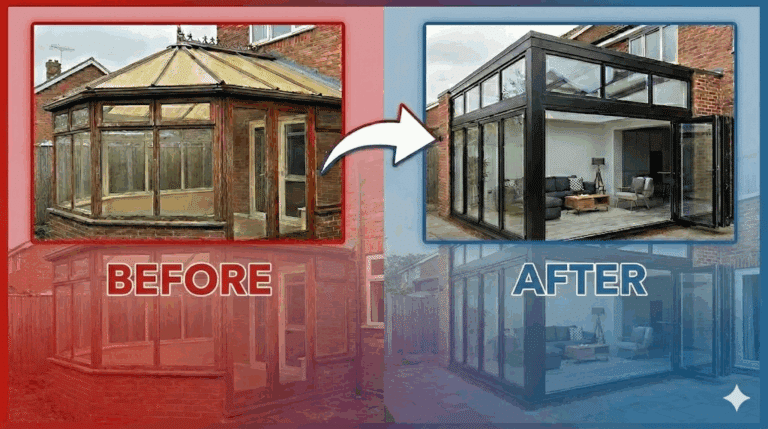
1990s Conservatory Revival: Modern Upgrades That Transform Old Structures
1990s Conservatory Revival: Modern Upgrades | Room Outside
🏠 Conservatory Refurbishment 2026
1990s Conservatory Revival: Modern Upgrades That Transform Old Structures
A complete guide to refurbishment and replacement options for aging conservatories—backed by independent research and real data.
25 min read
18% of UK Homes Have Conservatories
Save £200-£500/Year
The Bottom Line
53% of conservatory owners cite temperature problems as their biggest complaint. Up to 80% of heat loss in a traditional conservatory occurs through the roof alone.
The good news: Modern upgrades can reduce heat loss by up to 90% and cut heating energy consumption by 32%. A polycarbonate to glass conversion costs £3,000-£8,000, while solid roofs (£5,000-£15,000) achieve U-values of 0.15-0.18 W/m²K—matching new-build extension standards.
Key stat: Typical payback period is 3-7 years through energy savings alone, with potential property value increases of 5-15%.
80%
Heat loss through old roofs
90%
Heat loss reduction possible
£200-£500
Annual energy savings
3-7 yrs
Typical payback period
According to government statistics, approximately 18% of households in England have a conservatory, with the vast majority built during the construction boom of the late 1980s and 1990s. If you own one of these structures, you’re not alone in noticing the toll that three decades have taken. A 2024 survey by Eurocell found that 53% of conservatory owners cite temperature problems as their biggest complaint—spaces that are too hot in summer and too cold in winter. The good news is that 2026 brings more options than ever for breathing new life into these aging spaces.
Understanding the Problems with 1990s Conservatories
Before exploring solutions, it helps to understand exactly why conservatories from this era have become problematic. Independent testing at Salford University’s Energy House 2.0 facility has provided detailed data on just how much energy older conservatories waste, finding that proper insulation can reduce heat loss by up to 90% and lower heating energy consumption by up to 32%.
Polycarbonate Roofing Issues
The single biggest complaint from owners of 1990s conservatories centres on polycarbonate roofing. According to research published by Ideal Home, polycarbonate roofs typically degrade within 10 to 20 years, showing clear signs of wear including leaks, cracks, and thermal failure.
The material offers a U-value of around 4.0 W/m²K or higher, compared to modern building regulations that require windows to achieve 1.4 W/m²K or lower. This means heat escapes at nearly three times the rate considered acceptable by current standards. The Eurocell Conservatory Census also found that 12% of owners specifically cite rain noise on polycarbonate roofs as a major issue, making the space unusable during wet weather.
Glazing Deficiencies
Early double-glazed units from the 1990s typically achieved U-values of 2.8 to 3.0 W/m²K—well below today’s standards. Modern double glazing with Low-E coatings achieves 1.0 to 1.1 W/m²K, while triple glazing can reach 0.6 to 0.8 W/m²K. Single-glazed panels, still found in many economy conservatories from the era, have U-values as high as 5.0 to 6.0 W/m²K, offering almost no insulation.
⚠️ The Hidden Problem: Failed Seals
Failed seals in older double-glazed units result in condensation between panes, reducing both visibility and thermal performance. If you see misting inside your glass units, the insulating gas has escaped and the unit has effectively become single-glazed in terms of thermal performance.
Structural Wear and Tear
Aluminium frames from the 1990s often lack thermal breaks, creating cold bridges that lead to condensation and heat loss. Research shows that thermally broken frames can improve overall window U-values by 0.2 to 0.3 W/m²K compared to non-broken alternatives.
uPVC frames, while more thermally efficient, can become discoloured, warped, or brittle after decades of UV exposure. Foundation and base issues also emerge over time, with some conservatories showing signs of subsidence or poor drainage.
The Scale of the Problem: UK Statistics
Understanding the scale of the issue helps put individual upgrade decisions into context. The Energy Follow-Up Survey conducted for the Department for Business, Energy and Industrial Strategy found that conservatory ownership correlates with larger homes (median floor area of 94m² compared to 77m² for homes without conservatories). The survey also revealed that households with conservatories use measurably more gas for heating.
The Numbers That Matter
A typical 12m² conservatory with poor insulation can leak 420 to 480 watts of heat per hour when outside temperatures drop just 10°C below inside temperatures. Over a 180-day heating season, this wastes over 1,500 kWh of energy. At current energy prices, that translates to hundreds of pounds in unnecessary heating costs each year.
The Polycarbonate to Glass Upgrade
One of the most popular and effective upgrades for 1990s conservatories is the polycarbonate to glass roof conversion. According to 2026 pricing data from multiple UK sources, glass roof replacements typically cost between £3,000 and £8,000 for an average-sized conservatory of around 16m². Checkatrade reports average costs of £9,450 for a 3m x 3.5m glass conservatory roof, with larger structures reaching £22,500 for 5m x 5m installations.
What Modern Glass Offers
Modern glass roof panels designed for conservatory use include multiple technologies that simply weren’t available thirty years ago:
Solar control glass reflects unwanted heat in summer
Low-emissivity coatings retain warmth during winter months
U-values of 1.0 to 1.2 W/m²K compared to 4.0+ for polycarbonate
Acoustic interlayers cut rain noise substantially
Glass roofs also offer a longer lifespan than polycarbonate. While polycarbonate typically lasts 10 to 20 years, glass roofs can last 30 years or more with proper maintenance, making them a better long-term investment despite higher upfront costs.
Solid Roof Conversions: The Premium Option
For homeowners seeking the best possible thermal performance, solid roof conversions represent the premium old conservatory upgrade option. According to MyJobQuote’s 2026 pricing guide, solid conservatory roofs cost between £5,000 and £12,000 for average-sized structures, with tiled systems commanding £6,000 to £15,000 depending on specification and structural requirements.
0.15-0.18
Solid roof U-value (W/m²K)
4.0+
Old polycarbonate U-value
£200
Average annual savings
50+ yrs
Solid roof lifespan
Solid roof conversions achieve U-values of 0.15 to 0.18 W/m²K, bringing your conservatory in line with modern building regulations for new extensions. Independent research by AECOM for Guardian Building Systems found that solid roof conversions save homeowners an average of £200 per year on energy bills. The visual change is equally striking, with the finished result appearing more like a traditional extension than a conservatory.
⚠️ Structural Considerations
Solid roof conversions require careful structural assessment. The additional weight, while minimal compared to traditional roofing, may exceed what 1990s conservatory frames were designed to support. Converting from glass or polycarbonate to a solid roof typically adds £1,500 to £3,000 to the project cost for necessary structural reinforcement—a 30% to 40% premium over like-for-like replacement.
Real Energy Savings: What the Research Shows
Independent testing provides concrete data on what homeowners can expect from conservatory upgrades. Research conducted at Salford University’s Energy House 2.0 found that insulating a conservatory roof can reduce heat loss by up to 90% and lower heating energy consumption by up to 32%. This translates to annual savings of £200 to £500 depending on conservatory size, heating system, and usage patterns.
The Glass and Glazing Federation notes that a well-designed conservatory can act as a thermal buffer zone between indoor and outdoor areas. Heat that escapes through house walls into an insulated conservatory helps warm that space, and can then re-heat the main building when doors are opened. This passive solar gain effect was largely impossible with poorly insulated 1990s structures but becomes achievable with modern upgrades.
CosyPanels Research Findings
CosyPanels research indicates that modern insulated roofs reduce heat loss from 54% to just 10%—an 80% improvement that cuts heating bills proportionally. Their data suggests typical payback periods of 3 to 7 years depending on conservatory size and usage, making upgrades a financially sound decision rather than just a comfort improvement.
Impact on Property Value
The relationship between conservatories and property value is nuanced. According to the Nationwide Building Society, a high-quality conservatory can add between 5% and 15% to overall property value. Property expert Phil Spencer has stated that conservatories add an average of 7% to property value when they feel like part of the house rather than something “bolted on the back.”
❌ Poor Condition = Value Reduction
Outdated conservatory impact-£15,000
27% of owners unsure about valueRisk
Unusable space perceptionNegative
Net impact on saleLiability
✓ Upgraded = Value Added
Quality upgrade impact+5-15%
Year-round usabilityAsset
Energy efficiency appealPositive
Net impact on sale+£20,000+
However, quality matters enormously. Recent reports cited by Eurocell reveal that older conservatories with poor insulation can actually reduce home value by up to £15,000. The Eurocell Conservatory Census found that 60% of respondents believed their conservatory added value, but 27% were unsure—suggesting many owners recognise their structures may not be assets in their current condition.
2026 Cost Summary
Based on current market data from multiple UK sources, here’s what homeowners can expect to pay for different old conservatory upgrade options in 2026:
Upgrade Option
Cost Range
U-Value Achieved
Lifespan
Best For
Polycarbonate Replacement
£2,000 – £5,000
1.6 – 2.4 W/m²K
10-15 years
Budget option
Polycarbonate to Glass
£3,000 – £8,000
1.0 – 1.2 W/m²K
30+ years
Best balance
Solid/Tiled Roof
£5,000 – £15,000
0.15 – 0.18 W/m²K
50+ years
Maximum performance
Complete Refurbishment
£8,000 – £25,000
Varies
30-50 years
Multiple issues
Full Replacement
£15,000 – £40,000+
0.8 – 1.2 W/m²K
40+ years
Structural problems
Polycarbonate Replacement
Cost Range£2,000 – £5,000 ✓ Cheapest
U-Value Achieved1.6 – 2.4 W/m²K ✗ Poorest
Lifespan10-15 years
Best ForBudget option, quick fix
Polycarbonate to Glass
Cost Range£3,000 – £8,000
U-Value Achieved1.0 – 1.2 W/m²K
Lifespan30+ years
Best ForBest balance of cost & performance ✓ Popular
Solid/Tiled Roof
Cost Range£5,000 – £15,000
U-Value Achieved0.15 – 0.18 W/m²K ✓ Best
Lifespan50+ years ✓ Best
Best ForMaximum thermal performance
Complete Refurbishment
Cost Range£8,000 – £25,000
U-Value AchievedVaries by specification
Lifespan30-50 years
Best ForMultiple issues to address
Full Replacement
Cost Range£15,000 – £40,000+
U-Value Achieved0.8 – 1.2 W/m²K
Lifespan40+ years
Best ForStructural problems, complete redesign
Labour costs typically account for £150 to £300 per day for a roofer, with most roof replacements requiring a two-person team for one to three days. Installation-only costs start at approximately £2,500 including the base for standard builds.
Complete 1990s Conservatory Refurbishment
When the roof alone isn’t the only issue, a complete 1990s conservatory refurbishment addresses multiple parts at once. Based on 2026 market pricing, complete refurbishment projects commonly fall between £8,000 and £25,000 for work including roof, glazing, and frame upgrades. This compares favourably to full replacement costs, which typically start around £15,000 for modest structures and can exceed £40,000 for larger, premium installations.
What Complete Refurbishment Includes
Roof upgrade: Polycarbonate to glass or solid roofing
Glazing replacement: Modern triple-glazed units (U-values of 0.6 to 0.8 W/m²K)
Frame repairs: Eliminate thermal bridges
Base insulation: Complete the thermal envelope
Updated doors: Thermally efficient access points
Modern ventilation: Maintain air quality without compromising thermal performance
When Replacement Makes More Sense
While refurbishment offers excellent value in many situations, some circumstances point clearly toward complete replacement. According to cost comparison data, a traditional brick extension costs £1,800 to £3,500 per m², compared to £1,300 to £1,500 per m² for a new conservatory. This means a conservatory remains a more affordable way to add living space, even accounting for full replacement costs.
🔧 Choose Refurbishment If:
Foundations are stable with no subsidence
Frame structure is sound (no major rot or corrosion)
Current footprint and design work for your needs
Budget is £8,000-£25,000
You want to preserve the existing character
✓ Choose Replacement If:
Foundations show signs of failure
Frame has major corrosion or rot
You want to change footprint or design
Multiple structural issues exist
Budget allows for £15,000-£40,000+
Planning Permission and Building Regulations
Understanding regulatory requirements helps avoid costly mistakes. Like-for-like repairs and maintenance—including glass-to-glass or polycarbonate-to-polycarbonate roof replacements—typically don’t require planning permission or building regulations approval.
Building Regulations for Solid Roofs
Solid roof conversions are more complex. Many approved lightweight systems fall under Permitted Development, but almost all solid and tiled roofs require Building Regulations approval, costing £200 to £800+. Properties in conservation areas, listed buildings, or those that have exhausted permitted development allowances will need specific planning consent for any external changes.
Conservatory Exemptions
Conservatories can be exempt from building regulations if they meet specific criteria:
Floor area less than 30m²
Physically separated from the main property by an external wall or door
Not heated by the main heating system
Has independent temperature control
Upgrading an existing conservatory may affect these exemptions, so check requirements before work begins.
Project Timelines
A polycarbonate to glass roof conversion can often complete within two to three days for standard-sized conservatories. According to MyJobQuote, a typical two-person team can complete most roof replacements within this timeframe, with polycarbonate installations slightly faster than glass due to lighter weight and easier handling.
Solid roof conversions typically take one to two weeks depending on complexity, particularly if structural reinforcement is required. Industry sources note that insulated roof panels can often be fitted in just a few days as they slot into existing frames, while full tiled systems requiring new structures may take a week or longer.
Full refurbishments or replacements naturally take longer, with larger projects potentially spanning several weeks including foundation work if required. Spring and autumn typically offer the best conditions for conservatory work, though experienced contractors work year-round with appropriate weather protection.
Making Your Decision
The 1990s conservatory serving your home has likely provided years of enjoyment despite its limitations. With 65% of conservatory owners using their space daily according to the Eurocell survey, these structures remain valued parts of UK homes. The question is whether to refurbish or replace.
The Financial Case
If your frame and base remain sound, refurbishment offers excellent value. The polycarbonate to glass conversion alone can reduce U-values from 4.0+ to around 1.0 W/m²K—a fourfold improvement in thermal performance. Combined with energy savings of £200 to £500 annually and potential property value increases of 5% to 7%, the financial case for upgrading is strong.
When serious structural issues exist or when your needs have grown beyond what refurbishment can address, replacement delivers a fresh start with contemporary performance. Either path leads to the same destination: a comfortable, efficient, and attractive space that extends your living area throughout the year.
📚 Sources
Department for Energy Security and Net Zero Energy Follow-Up Survey; Salford University Energy House 2.0 research; Eurocell Conservatory Census 2024; Nationwide Building Society; Checkatrade; MyJobQuote; AECOM/Guardian Building Systems research; Glass and Glazing Federation; CosyPanels industry data; Squared Money Home Improvement Index.
Frequently Asked Questions
How do I know if my 1990s conservatory can be refurbished or needs replacing?
Start by checking the frame and base. If the frame is structurally sound without major rot, warping, or corrosion, and the base shows no signs of subsidence or cracking, refurbishment is usually viable. A professional survey will confirm whether your existing structure can support upgrades like a glass or solid roof.
Is a polycarbonate to glass roof conversion worth the money?
For most homeowners, yes. The upgrade typically costs between £3,000 and £8,000, with immediate improvements in temperature control, noise reduction, and appearance. Modern glass achieves U-values of 1.0 to 1.2 W/m²K compared to 4.0+ W/m²K for polycarbonate—a fourfold improvement in thermal performance.
Do I need planning permission to upgrade my conservatory roof?
For like-for-like replacements such as swapping polycarbonate for glass panels, planning permission usually isn’t required. Solid roof conversions are more complex—almost all solid and tiled roofs require Building Regulations approval, costing £200 to £800+. Properties in conservation areas will likely need planning consent.
How much could I save on energy bills after upgrading?
Research from Salford University shows insulation can reduce heating energy consumption by up to 32%. Industry sources cite typical annual savings of £200 to £500. Heat loss reduction from 54% to 10% cuts heating bills proportionally. Typical payback periods range from 3 to 7 years.
What’s the difference between a glass roof and a solid roof conversion?
Glass roofs maintain the light, airy feel of a traditional conservatory while offering much better thermal performance (U-values around 1.0-1.2 W/m²K) and can last 30+ years. Solid roofs achieve U-values of 0.15-0.18 W/m²K—comparable to traditional extensions—but change the character to feel more like a room.
How long does a conservatory refurbishment take?
A polycarbonate to glass roof conversion typically takes 2-3 days with a two-person team. Solid roof conversions usually require 1-2 weeks. Full refurbishments including glazing, frames, and other components can take 2-4 weeks depending on the scope of work.
Will upgrading my conservatory add value to my home?
A well-executed conservatory upgrade can add 5% to 15% to property value. However, older conservatories with poor insulation can reduce home value by up to £15,000. The key is ensuring year-round usability and thermal efficiency—making upgrades essential for protecting your investment.
What U-values should I look for in conservatory glazing?
Current Building Regulations require windows to achieve maximum U-values of 1.4 W/m²K, with the Future Homes Standard requiring 1.2 W/m²K or lower. For year-round comfort, aim for 1.2 W/m²K or lower. Premium options achieve 0.8-1.0 W/m²K using triple glazing and thermally broken frames.
Ready to Revive Your 1990s Conservatory?
Whether you need a simple roof upgrade or a complete refurbishment, our team has completed hundreds of conservatory projects across Kent and the South East. Get a free, no-obligation assessment of your structure and personalised recommendations.
Planning Your 2026 Home Extension | Start in January | Room Outside
Planning Your 2026 Home Extension | Start in January | Room Outside
🎯 Planning Guide 2026
New Year, New Space: Why January Is the Smart Time to Start Planning
Seven million UK homeowners plan to renovate. January is the ideal time to start planning your conservatory or orangery for summer completion.
14 min read
January 2026
South East England
Why January Matters
Almost seven million UK homeowners plan to renovate, with an average intended spend of over £14,000. Starting in January gives you time for proper design development, planning permissions if needed, and booking quality installers for spring/summer completion—ready to enjoy by next Christmas.
The Post-Christmas Realisation
The house feels smaller after Christmas. Not literally, obviously, but somehow the walls seem closer together than they did in November. The presents have been unwrapped. The relatives have gone home. And you are left with the memory of how cramped things felt when everyone was here.
Maybe it was trying to seat fourteen people in a dining room designed for six. Maybe it was children with nowhere to play except underfoot. Maybe it was that awkward moment when someone wanted quiet and there was not a single room free.
January is when many homeowners decide they need more space. The timing is not coincidental. The festive period stress-tests our homes in ways ordinary life does not. And if your home failed that test, January is when you know it.
7m
UK homeowners planning to renovate
£14k+
Average intended renovation spend
73%
Gen Z homeowners planning work
51%
Of homeowners renovated in 2024
According to Aviva’s 2025 How We Live report, almost seven million UK homeowners plan to renovate their homes, with an average intended spend of over £14,000 over the next two years. Renovation plans are particularly popular among younger age groups, with 73% of Generation Z and 65% of Millennial homeowners planning work.
What happens next matters. Some people vow to do something about it, then let the momentum fade as February passes and normal routines reassert themselves. By summer, the resolution is forgotten. By next Christmas, the same cramped scene plays out again.
Others act. January becomes the start of a planning process that leads to a completed extension before the next festive season arrives.
The 2026 Home Improvement Landscape
Before we discuss timelines and planning, let us understand the context. The UK home improvement market is substantial and growing.
£16.67bn
Projected UK home improvement market value by 2033
Source: IMARC Group projections (48% increase from 2024)
The UK home improvement market was valued at £11.3 billion in 2024 and is expected to reach £16.67 billion by 2033. That is a 48% increase in nine years, reflecting sustained demand for better living spaces.
The 2025 UK Houzz & Home Study provides more detail. More than half of homeowners (51%) renovated in 2024, up from 48% in 2023. The median spend increased 26% year-on-year to £21,440. The top 10% of renovating homeowners spent £169,000.
What’s Driving This Demand?
Ageing Housing Stock
53% of renovating homeowners live in homes built in 1940 or earlier. Nearly 2 in 5 homeowners undertook home repairs in 2024. Old houses need updating.
Working Patterns
Among homeowners planning to extend, a quarter attribute their plans to home working practices. 15% want to create a home office.
Multigenerational Living
More than one in ten UK adults live with their parents. This is driving demand for extensions that provide space, privacy, and flexible accommodation.
Cost of Moving
One in six homeowners choose to improve rather than move because moving is too expensive. Stamp duty, legal fees, and estate agent costs make renovation attractive by comparison.
The pattern is clear: homeowners who need more space are choosing to create it rather than search for it elsewhere.
The January Advantage: Why Timing Matters
Starting your planning in January offers several practical advantages that people often overlook.
Design Time Without Pressure
Good design takes time. Ideas need to develop. Options need to be compared. Decisions need to be made carefully rather than hastily. Starting in January gives you the luxury of that time.
By contrast, people who start thinking about extensions in April or May often find themselves rushing through design stages to catch the summer building season, then either accepting compromises or pushing the project into the following year anyway.
Planning Permission Timelines
If your extension requires planning permission, the process typically takes eight to twelve weeks from submission to decision. For properties in conservation areas or those that are listed, it often takes longer. The Planning Portal provides detailed guidance on requirements.
Historic England data shows that only 71% of Listed Building Consent decisions were made within the statutory timeframe in 2022/23, compared to 81% for standard planning decisions. Heritage applications take longer.
Starting in January means you can have permissions in place by spring, ready for construction during the better weather months. For detailed guidance on what you can build without planning permission, see our comprehensive guide to permitted development.
Builder and Installer Availability
Quality builders and installers get booked up. This is simply a fact of the construction industry. Companies with strong reputations and reliable workforces plan their schedules months in advance.
Approaching builders in January for a summer installation gives them (and you) options. Approaching the same builders in May for a summer installation may find them already committed through to autumn.
My suggestion: Early engagement gives you access to better options. According to Rated People research, 45% of UK homeowners struggled to find a tradesperson for home renovation in 2021. While availability has improved, demand remains strong.
Budget Planning and Financing
January is traditionally when people review their finances. If your extension will require financing, early planning gives you time to explore options, compare rates, and make arrangements without time pressure.
Four-fifths of UK households plan to use their savings to fund home improvement projects. If you are among them, January is when you can assess what you have available and what you might need to save in the coming months.
📅 A Realistic 2026 Timeline
January – February
Design Development
Initial consultations, site surveys, design development. Multiple conversations as ideas crystallise. Explore options, understand constraints, and begin to see what is possible.
March
Final Design & Commitment
Final design agreed, building regulations submission (where required), deposit and scheduling. Commitment is made. Dates go in diaries.
April – May
Manufacturing & Preparation
For factory-built extensions, your structure takes shape off-site in controlled conditions. For traditional builds, materials are ordered and groundwork is planned.
June – July
Installation
Groundwork, construction, finishing. The dust settles. The space becomes real.
Summer Onwards
Enjoyment
Enjoying your new space. Using it. Living in it. Wondering why you did not do this years ago. Ready for Christmas with room for everyone.
For projects requiring planning permission, add eight to twelve weeks to the front end. For listed buildings or conservation areas, potentially more.
The point is clear: if you want to enjoy a new extension next Christmas, the time to start planning is now, not next spring.
The Budget Conversation: What Extensions Actually Cost
New Year is the traditional time for financial stocktaking. How much can we afford? What does an extension actually cost? Is this the right year to commit?
The honest answer is that costs vary significantly depending on specification, size, and complexity.
Extension Budget Ranges
Basic conservatory: From around £15,000
Mid-range projects: £30,000 to £60,000
Premium orangery: £50,000 to over £100,000
Average extension budget (2023): £27,157
In 2023, homeowners budgeted an average of £27,157 for extensions, the highest intended spend of any home improvement category. For detailed guidance on orangery investment levels and what different budgets deliver, see our comprehensive orangery guide.
What matters more than the absolute number is value: what you get for your investment, how it affects your daily life, what it adds to your property.
My suggestion: Be honest with potential builders about your budget from the start. A good company will design to your financial constraints rather than presenting an ideal scheme you cannot afford. It is better to have those conversations early than to fall in love with a design that proves unattainable.
The Return on Investment Question
Let us talk about what the data shows regarding home improvement returns.
According to Zopa’s Home Improvement Index, conservatories delivered approximately 100% ROI in 2024, meaning homeowners typically recoup the full cost in added property value. Nationwide’s 2023 analysis found that a well-done extension can nearly increase a home’s value proportionately to the floor area added.
100%
ROI typically delivered by conservatories in 2024
Source: Zopa Home Improvement Index
The calculation is not purely financial, though. Consider:
How many years will you enjoy the space before selling?
What is the value of the daily quality of life improvement?
What would it cost to move to a larger property instead?
For many homeowners, the answer is clear: extending makes more sense than moving, both financially and practically.
Making 2026 Different: The Action Steps
Resolutions fade. We all know this. The gym membership purchased in January goes unused by March. The diet abandoned after two weeks. The promise to learn a language quietly forgotten.
Home improvement resolutions can go the same way, but they do not have to. The difference lies in taking concrete action rather than remaining in the realm of intention.
Your January Action Plan
This week: Write down what you want from an extension. More dining space? A year-round garden room? A kitchen that flows to outdoors? Clarity about purpose guides everything else.
Next week: Research companies in your area. Look at portfolios. Read reviews. Create a shortlist of three to five potential partners.
By end of January: Make contact with at least two companies. Arrange consultations. Start the conversation.
February: Site visits, initial designs, preliminary quotes. Compare approaches and philosophies as much as prices.
March: Make your decision. Commission detailed design. Set the project in motion.
You do not have to commit to anything by having that first conversation. But without it, next January will likely find you in the same position, looking at the same cramped rooms, making the same resolution for the following year.
Next Christmas Could Be Different
Think forward twelve months. Christmas 2026. The family has gathered again. But this time, there is space. There is light. There is a room that works for the occasion rather than against it.
The children have somewhere to play. The adults have somewhere to talk. The cook has somewhere to work without feeling isolated. The view through the glass shows the winter garden, perhaps strung with lights, perhaps frosted, perhaps simply beautiful in its December bare-bones honesty.
That future is available. It starts with a decision made in January, while the memory of cramped Christmas past is still fresh.
At Room Outside, we are ready to have those conversations whenever you are. We understand that January is a time for thinking and planning rather than rushing into decisions. We will give you the information you need to decide whether an extension is right for you, and if so, what kind of extension and at what investment level.
Next Christmas could be different. The choice is yours, and it starts with a conversation.
Frequently Asked Questions About Extension Planning
How long does it take to plan and build an extension?
For straightforward conservatories and orangeries within permitted development, expect 4-6 months from first enquiry to completion. Projects requiring planning permission add 2-3 months. Listed buildings or complex projects may take longer.
When is the best time to start planning an extension?
January is ideal. Early planning allows time for design development, planning applications if needed, and booking installers for spring/summer work. Starting in spring often means completion is pushed to the following year.
How much should I budget for a conservatory or orangery?
Basic conservatories start around £15,000. Mid-range projects typically fall between £30,000 and £60,000. Premium orangeries can exceed £100,000. Budget depends on size, materials, specification, and complexity.
Do extensions add value to my home?
Yes. Conservatories typically deliver around 100% ROI. Well-designed extensions can add up to 25% to property value. The value added depends on quality, design, and local market conditions.
Should I improve or move?
Financial analysis often favours improving. Moving costs (stamp duty, fees, costs) can exceed £20,000. An extension that adds space and value may cost similar money but leave you in a home and area you already know and love.
Christmas Entertaining in Your Conservatory or Orangery | Room Outside
Christmas Entertaining in Your Conservatory or Orangery | Room Outside
🎄 Seasonal Guide 2025
Why Your Glass Room Might Be the Best Christmas Gift You Already Own
Transform your conservatory or orangery into the perfect festive entertaining space with expert tips on heating, lighting, and winter comfort.
12 min read
92% of UK Households
South East England
The Christmas Space Solution
92% of UK households celebrate Christmas, with millions facing the same challenge: where will everyone sit? If your glass room has adequate heating and modern glazing, it could be the star of your festive entertaining—offering space, light, and that magical connection between cosy indoors and crisp winter outdoors.
The Annual December Panic (And How to Avoid It)
It happens every year, usually around the second week of December. You are mentally counting chairs. You are measuring the dining table. You are wondering whether Aunt Margaret will notice if she has to sit on a folding chair borrowed from the garage.
Where will everyone sit? Can we fit twelve people in a dining room designed for six? Should we use the extension? The kitchen feels cramped. The living room is already full of presents and wrapping paper and a tree that seemed smaller in the garden centre.
And all the while, the conservatory or orangery sits there. Overlooked. Possibly storing the artificial tree you have not unpacked yet.
92%
UK households celebrate Christmas
94%
Will eat Christmas dinner
84%
Will put up a tree
2pm
Most popular dinner time
I understand the hesitation about using your glass room in winter. Older conservatories with polycarbonate roofs or single glazing can be genuinely uncomfortable in cold weather. At best, as one industry observer noted, some conservatories serve as “an extra refrigerator” during the festive period, which is fine for keeping the champagne cold but less ideal for keeping Grandma warm.
But here is what many people do not realise: if your glass room has been built or upgraded in the last decade, with proper glazing specification and adequate heating, there is no reason it cannot be the star of your Christmas entertaining. In fact, it might be the best room in the house for the job.
Why Your Glass Room Is Actually Perfect for Christmas
Think about what makes Christmas special. The lights. The sense of occasion. The connection between cosy indoors and crisp outdoors. The magical quality of twilight on a December afternoon.
Now think about what a well-designed conservatory or orangery offers. Abundant natural light during the short December days. Garden views that become magical when dusted with frost or strung with outdoor lights. A sense of space that traditional dining rooms cannot match. The feeling of being connected to outside while remaining perfectly warm inside.
The Victorians understood this. Orangeries were originally designed for growing citrus fruits, but they quickly became prized entertaining spaces. Winter parties in lamp-lit orangeries were the height of sophistication. There was something thrilling about gathering in a warm, glazed room while frost formed on the outside of the windows.
That same magic is available to you, with the added benefit of glazing technology like New Generation Glass that the Victorians could not have imagined.
Making It Work: The Practical Guide
Let us be practical. A glass room in December presents specific challenges. Here is how to address each one.
The Heat Challenge (And Why It Is Solvable)
The key to winter comfort in a glass room is not just generating heat, but keeping it. Modern conservatories and orangeries with high-performance glazing and proper insulation maintain stable temperatures through the coldest months. If yours does not, the problem is likely the building envelope rather than your heating system. The Energy Saving Trust provides guidance on improving home thermal performance, while the British Standards Institution sets glazing performance standards.
According to industry analysis, a conservatory with an older polycarbonate roof can lose heat up to five times faster than one with modern insulated roofing. Upgrading the roof alone can transform winter usability.
For existing conservatories, several heating options work well:
Underfloor Heating
Provides even, gentle warmth without taking up wall space. Pairs beautifully with tiled or stone floors, which retain heat and distribute it evenly. Heat rises naturally, warming the entire space from the ground up.
Electric Radiators
Smart thermostats can pre-warm the space before guests arrive. Many modern units include app-controlled features, allowing you to heat the room remotely so it is warm when you need it.
Central Heating Extension
If your system has capacity, extending radiators into the conservatory provides consistent, controllable warmth integrated with your whole-house heating.
Portable Heaters
Provide a quick and convenient way to inject heat. Works best as supplementary warmth rather than primary heating for larger gatherings.
My suggestion: Run your heating for a couple of hours before you need the space. Glass rooms warm up efficiently once the structure itself has reached temperature. Trying to heat a cold conservatory while guests are already shivering in it is a losing battle, and not the Christmas memory you want to create.
If your conservatory struggles to hold heat, the problem might be the structure rather than the heating. For guidance on whether your roof needs replacement, see our guide to conservatory repairs and maintenance.
The Lighting Opportunity (Your Secret Weapon)
Christmas entertaining happens largely after dark, which means your conservatory’s greatest asset (natural light) is temporarily unavailable. This is actually an opportunity in disguise.
The glazing that floods the space with daylight during summer becomes reflective in winter evenings, multiplying the effect of interior lights and candles. A single string of fairy lights looks like three. Candlelight creates pools of warmth that multiply in the glass. The effect is genuinely magical.
Layer your lighting for maximum impact:
Overhead fixtures for general illumination when you need to see what you are eating
Table lamps and candles for intimate warmth during the meal itself (battery-operated candles work well if you are worried about fire risk with excitable children around)
Fairy lights strung along frame members, wound through plants, or draped over the inside of the roof lantern—the reflections in the glass create a sparkling effect that no other room can match
Garden lighting visible through the glass adds another dimension entirely, extending the sense of celebration beyond the walls of your home
One family I worked with strings solar lights through their winter garden every November. They told me it transforms their orangery into “basically living inside a Christmas card.” I am not sure that is architecturally precise, but I understood what they meant.
The Layout Question (More Flexible Than You Think)
Christmas gatherings require different spatial arrangements than everyday use. You might need seating for more people than usual. You probably want a clear route between kitchen and dining area. You definitely want somewhere for drinks that does not require guests to navigate through food preparation.
Think about circulation. Where will people naturally stand with drinks before sitting down? Is there space for children to play without disrupting adult conversation? Can you open up fully to the main house, or do you want the conservatory to feel like a separate, special space?
The beauty of a glass room for Christmas is flexibility. Unlike a traditional dining room with fixed furniture, you can rearrange a conservatory to suit the occasion. Push furniture to the edges for a drinks party. Set up a long table for Christmas dinner. Create intimate seating clusters for Boxing Day lounging.
The Orangery Advantage for Christmas Entertaining
If you have an orangery rather than a traditional conservatory, Christmas entertaining becomes even more natural. The solid roof perimeter with central lantern provides a sense of enclosure that feels room-like rather than temporary. The brick or stone pillars ground the space architecturally.
Orangery kitchen extensions are particularly suited to festive hosting. Cooking no longer means disappearing into a separate room while conversation continues elsewhere. Everything happens in one connected space: food preparation, drinks, catching up with family, keeping an eye on excited children opening presents.
The Orangery Entertaining Advantage
When the design is shaped around the way you host, and the glazing supports warmth and atmosphere, the entire dining experience becomes calmer and more enjoyable. You can prepare food, warm dishes, pour drinks, and chat to your guests without missing the moment.
The thermal performance of orangeries also tends to exceed traditional conservatories, with less glazed surface area meaning better heat retention in winter. Less glass means lower heat loss, but you still get the light from the roof lantern and the garden connection from the glazed doors.
If Your Glass Room Is Not Up to It (Yet)
Perhaps you have tried using your conservatory at Christmas and found it wanting. Perhaps the heating bills were alarming and the results still disappointing. Perhaps condensation streaming down the windows made the space feel cold even when the temperature said otherwise.
These problems are solvable. Roof replacement can transform an older conservatory’s thermal performance. Upgraded glazing reduces heat loss dramatically. Proper ventilation controls condensation. The technology has advanced significantly in recent years. The Met Office provides winter weather guidance that can help you plan for the season.
At Room Outside, we regularly help homeowners across the South Easttransform underperforming glass rooms into spaces they can use year-round. Sometimes this means full refurbishment. Sometimes it means targeted upgrades that address specific weaknesses. The right approach depends on your existing structure and how you want to use it.
If this Christmas is another year of crowding into the dining room while your conservatory sits empty and cold, perhaps it is time to think about what next Christmas could look like instead.
🎄 Your Christmas Glass Room Checklist
Two Weeks Before
Check heating system is working properly
Run heating for an hour to test warm-up
Clean glazing inside and out
Check seals and weatherstripping
Address any draughts
One Week Before
Arrange furniture for your gathering
Test the layout and adjust
Install fairy lights
Test all lighting
Set up garden lighting
Christmas Eve
Pre-heat from early morning
Final clean and dust
Add table settings
Position plants and decorations
Enjoy your magical space!
Making This Christmas Different
Every year, millions of British families celebrate Christmas in spaces that are too small, too cramped, or too disconnected from the magic of winter outside.
This year could be different. If you have a conservatory or orangery that is currently underused in winter, you have an opportunity. With the right preparation, that glass room could become the heart of your Christmas celebration.
Imagine Christmas dinner with garden views, fairy lights multiplied in glass, the warmth of family gathered in a space that feels both connected and special.
That is not a fantasy. That is what a well-designed glass room offers. You might already own it.
Frequently Asked Questions About Christmas Conservatory Use
Can I use my conservatory in winter?
Yes, provided it has adequate heating and reasonable thermal performance. Modern conservatories with high-performance glazing maintain comfortable temperatures through winter. Older conservatories may need upgrades to the roof, glazing, or heating system.
How do I heat a conservatory for Christmas entertaining?
Options include underfloor heating (ideal for new or renovated spaces), electric radiators with smart controls, connection to central heating (if possible), or portable heaters as supplementary warmth. Pre-heat the space for several hours before guests arrive.
Why is my conservatory cold even with heating?
The most common cause is heat loss through an inadequate roof. Older polycarbonate roofs have poor thermal performance. Upgrading to a solid or high-performance glass roof can transform winter usability.
How do I prevent condensation in my conservatory at Christmas?
Ensure adequate ventilation, maintain even heating, and address any failed glazing seals. Condensation typically indicates that warm, moist air is meeting cold surfaces. Improving the thermal performance of those surfaces reduces condensation.
Make Next Christmas Magical
If your conservatory or orangery is not delivering year-round comfort, we can help transform it into a space you will actually use—this Christmas and beyond.
Aluminium vs Timber vs uPVC Frames: 2025 UK Data & Guide | Room Outside
Aluminium, Timber or uPVC: 10 Years of Performance Data | Room Outside
Technical Analysis 2025
Aluminium, Timber or uPVC: 10 Years of Performance Data from Our Installation Teams
2025 UK data reveals how your frame choice impacts energy bills by £120-£395 annually and property value by 5-10%. 50+ years expertise analysing aluminium vs timber vs uPVC performance.
25 min read
South East England
50+ Years Expertise
Quick Answer
Aluminium lasts longest (40-50 years) with minimal maintenance and the slimmest sightlines (35mm). Best for: contemporary designs, coastal locations, large-span glazing.
Timber offers the best thermal performance (U-values 1.2-1.4 W/m²K) and natural beauty. Hardwood lasts 50-60 years. Best for: listed buildings, conservation areas, period properties.
uPVC is most affordable with excellent thermal efficiency (1.2-1.4 W/m²K), lasting 20-35 years. Best for: budget-conscious projects, practical applications. Planning a new glass extension? Explore our bespoke Orangery extensions for more inspiration.
⚡ WHY THIS MATTERS RIGHT NOW:
• UK homes lose heat 3x faster than German homes (tado° research)
• 25-30% of your heating escapes through windows and doors
• Average UK energy bill: £1,755/year (Ofgem Q4 2025 price cap)
• A-rated windows can save £120-£395 annually (Energy Saving Trust)
• Quality conservatories add 5-10% to property value (RICS, Savills)
Stand in front of three identical conservatories—aluminium, timber, uPVC—and they might look similar. But over 10, 20, 30 years? The differences become staggering. We’re talking £10,000+ in energy bills, maintenance costs, and property value impact.
Here’s a number that should stop you in your tracks: 55% of UK homes only meet insulation standards set in 1976 or earlier, according to a recent EDF study of 25 million properties. That means if you’re planning a conservatory or glass extension, the frame material you choose today will determine whether you join the majority wasting money on heating, or become one of the smart minority enjoying lower bills and higher property values.
The financial stakes are significant. With the Ofgem price cap currently at £1,755 annually for a typical household (Q4 2025), and energy bills still 45% higher than pre-crisis 2021 levels according to the House of Commons Library, every percentage of heat loss matters. Research from the Glass and Glazing Federation shows that replacing pre-2002 double glazing with current standards could save up to £395 per year.
At Room Outside, we’ve installed thousands of glass extensions across Surrey, Kent, West Sussex, Hampshire, and London over four decades. This guide distils that experience into actionable guidance, backed by current UK market data and Building Regulations requirements.
UK Glazing Market: The Numbers That Matter
UK Market Data
Figure
Annual glazing installations (UK)
1.9 million
Homes with full double glazing
88% (up from 79% in 2012)
uPVC market share
75%
Pre-2002 glazing still installed
23% of housing stock
Heat loss through windows
18-30% of total
Double glazing heat loss reduction
Up to 60% vs single glazing
UK homes requiring retrofit by 2035
25 million (£12bn opportunity)
Property value increase (quality conservatory)
5-10%
Sources: English Housing Survey 2022-23, GGF Heat Loss Report 2023, Energy Saving Trust, Ofgem, RICS, Savills
The Retrofit Imperative
With 25 million UK homes requiring retrofit by 2035 to meet net-zero targets, your frame choice isn’t just about today—it’s about future-proofing. Properties with poor thermal performance face declining value as energy efficiency becomes increasingly important to buyers and mortgage lenders.
Building Regulations: What You Must Know
The regulatory landscape is tightening. Part L of the Building Regulations, updated in 2022, already requires replacement windows to achieve U-values of 1.4 W/m²K or better. The Future Homes Standard, taking effect from 2025, will push new-build requirements even further—with U-value targets potentially dropping to 0.8-1.2 W/m²K.
Current Requirements
Replacement windows: 1.4 W/m²K maximum
New-build windows: 1.2 W/m²K recommended
Conservatories: Thermally separated from house
Glass extensions: Full Building Regs compliance
Future Requirements (2025+)
Future Homes Standard: 0.8-1.2 W/m²K for new builds
Rental properties: Minimum EPC Band C from 2026
Existing homes: Increasing pressure to retrofit
Potential triple glazing requirement for some areas
For homeowners planning a conservatory, this means your frame choice must support glazing that meets or exceeds these thresholds. According to the GGF, modern windows to current standards perform 50% better than pre-2002 double glazing and 70% better than single glazing.
Critical consideration: While conservatories are often exempt from full Building Regulations when thermally separated from the main house, glass extensions always require full compliance. Many homeowners don’t realise their “conservatory” is actually a glass extension requiring Building Control approval.
Aluminium Frames: The Premium Choice for Longevity
Modern thermally broken aluminium has transformed what was once a material known for cold bridging into a high-performance option. For homeowners prioritising aesthetics and longevity, aluminium delivers.
40-50+ yrs
Expected lifespan
1.6 W/m²K
Thermal performance
35mm
Minimum sightline width
Lifespan: 40-50+ Years
Aluminium consistently outperforms other frame materials for longevity. The material will not warp, swell, crack, or become brittle regardless of temperature extremes. For coastal properties in Kent or West Sussex, where salt air accelerates degradation of other materials, aluminium’s corrosion resistance proves particularly valuable when specified with marine-grade powder coating.
Thermal Performance: 1.6 W/m²K (Thermally Broken)
Contemporary thermally broken aluminium frames achieve U-values around 1.6 W/m²K, meeting Building Regulations. The thermal break—a polyamide barrier between inner and outer profiles—prevents the cold bridging that plagued earlier aluminium systems. Premium systems approach 1.4 W/m²K.
Sightlines: The Slimmest Available (35mm+)
Aluminium’s strength-to-weight ratio allows for profiles as slim as 35mm, compared to 70mm or more for uPVC. This translates directly into more glass and less frame. For contemporary glass box extensions or large-span glazing, this difference is significant—potentially 20% more visible glass area.
Cost & Value: £17,500-£33,300
Aluminium commands approximately 25% premium over uPVC. However, calculated over a 40-year service life rather than 25 years, the cost-per-year often favours aluminium. A typical aluminium conservatory costs £17,500-£33,300 depending on size and specification.
Sustainability Factor: 95% Recyclable
Recycling aluminium requires only 5% of the energy needed to produce virgin material. Industry estimates suggest up to 75% of all aluminium ever produced remains in use today. For environmentally conscious homeowners in South East England, this represents significant lifecycle advantages.
Timber Frames: Natural Beauty, Natural Insulation
Timber occupies a unique position in the UK market. For period properties, listed buildings, and conservation areas across London and the South East, timber often represents not merely a preference but a planning requirement.
30-60+ yrs
Species-dependent lifespan
1.2-1.4 W/m²K
Best thermal performance
4-7 years
Repainting cycle
Lifespan: 30-60+ Years (Species Dependent)
Softwood frames without regular treatment may last 25-35 years. Hardwood species (oak, mahogany, teak) can last 50-60 years or more with proper maintenance. Oak-framed windows from the Middle Ages survive in historic buildings across Britain.
Thermal Performance: 1.2-1.4 W/m²K (Best in Class)
Wood is a natural insulator. Softwood timber frames typically achieve U-values between 1.2 and 1.4 W/m²K—the best of any frame material. Timber frames feel warm to the touch even in winter.
Maintenance: High (Repainting Every 4-7 Years)
Timber demands commitment. Repainting every 4-7 years is essential to prevent moisture ingress and UV damage. Over 40 years, this represents 6-10 maintenance cycles—significant time and cost investment.
Cost & Value: £20,925-£39,975
Timber conservatories cost approximately 50% more than uPVC equivalents. However, for period properties in the South East, timber may be the only option that satisfies planning requirements and maintains property character.
Planning reality check: Many conservation areas across Surrey, Kent, and West Sussex explicitly require timber frames for extensions. Attempting to use uPVC or aluminium in these areas often results in planning refusal, regardless of thermal performance.
uPVC Frames: The Value Proposition
Unplasticised polyvinyl chloride dominates the UK market with approximately 75% market share. It offers a compelling balance of performance, cost, and convenience.
20-35 yrs
Typical lifespan
1.2-1.4 W/m²K
Excellent thermal efficiency
Minimal
Maintenance requirements
Lifespan: 20-35 Years
Quality uPVC frames typically last 20-35 years. Modern formulations resist discolouration and brittleness better than earlier generations. However, uPVC cannot match the multi-decade longevity of aluminium or hardwood timber.
Thermal Performance: 1.2-1.4 W/m²K (Excellent)
Modern multi-chambered uPVC profiles achieve excellent U-values of 1.2-1.4 W/m²K. The multiple internal chambers trap air, creating effective insulation. Contemporary uPVC systems routinely achieve A+ energy ratings.
Maintenance: Minimal
An occasional wipe with soapy water maintains appearance; no painting required. This practical advantage appeals to many homeowners.
Cost & Value: £13,950-£26,650 (Baseline)
uPVC offers the most accessible price point. The bulkier 70mm+ frame profiles and shorter lifespan should be factored into value assessments, but for budget-conscious projects, uPVC remains compelling.
The Recycling Reality
According to BRE, uPVC can be recycled over 10 times without degradation—a potential useful life of 400 years through recycling. Many manufacturers now use 30-60% recycled content in new profiles, significantly reducing environmental impact.
Complete Comparison: All Three Materials at a Glance
Factor
Aluminium
Timber
uPVC
Typical U-Value
1.6 W/m²K
1.2-1.4 W/m²K
1.2-1.4 W/m²K
Expected Lifespan
40-50+ years
30-60 years*
20-35 years
Maintenance
Minimal
High (4-7yr cycle)
Minimal
Frame Width
35mm+ (slimmest)
55mm+
70mm+ (widest)
Typical Cost Range
£17.5k-£33k
£21k-£40k
£14k-£27k
Best For
Contemporary, coastal, large-span
Listed, conservation, period
Budget-conscious, practical
*Timber lifespan varies by species: softwood 25-35 years, hardwood 50-60+ years
The Hidden Cost Calculation
When comparing costs, consider the total cost of ownership over 30 years:
The “cheapest” option today might be the most expensive over your property’s lifetime.
How Your Frame Choice Impacts Property Value
The data on property values is compelling. According to research from Nationwide, RICS, Savills, and Checkatrade:
💰
Value Increase
Quality conservatory adds 5-10% to property value (RICS estimates 5%, Savills up to 10%)
📈
EPC Premium
Properties with EPC ratings A/B command up to £57,000 more than lower-rated homes (Uswitch analysis)
🏠
Buyer Preference
74% of prospective buyers find properties with A/B EPC ratings more attractive (Mortgage Advice Bureau)
The Warning Signal
Poor-quality conservatories with inadequate thermal performance can actually devalue your property. Estate agents report that old polycarbonate-roofed conservatories that are unusable in summer and winter are increasingly seen as a liability rather than an asset. For more on creating a comfortable, year-round space, see expert tips on conservatory interiors.
Value Destroyers
Seasonal conservatories (too hot/cold for 4-6 months)
Poor-quality uPVC with discolouration or warping
Inappropriate materials for property type/area
Dated designs with polycarbonate roofs
Non-compliant structures requiring remediation
Value Enhancers
Year-round usable spaces with advanced glazing
Material-appropriate for property and location
Architecturally integrated design
High EPC performance ratings
Quality materials with long warranties
In the South East: An A/B EPC rating adds £112,000+ to property value. Moving from EPC D to C can add 3% (£9,000) to property value. Your frame choice directly contributes to these ratings.
How to Choose: A Decision Framework
Choose ALUMINIUM when:
1. Maximum glass area is priority
You want minimal frame intrusion and maximum visible glass area, particularly for contemporary glass box extensions or large-span glazing.
2. Coastal or exposed location
You’re in Kent, West Sussex, or other coastal areas where salt air accelerates degradation of other materials.
3. Low maintenance and long life are essential
You value minimal upkeep and want a structure that will last 40-50+ years without significant maintenance.
4. Contemporary aesthetic required
Your property has modern architecture that suits clean lines and minimal profiles.
Choose TIMBER when:
1. Listed building or conservation area
Planning regulations require traditional materials, particularly in South East conservation areas and listed properties.
2. Period property character preservation
You’re extending a Victorian, Edwardian, or Georgian property where timber maintains architectural integrity.
3. Natural warmth and character are priorities
You value the natural beauty of wood and its warm aesthetic qualities.
4. You’re committed to regular maintenance
You understand and accept the 4-7 year repainting cycle required to maintain timber’s longevity and appearance.
Choose uPVC when:
1. Initial budget is primary constraint
You need the most cost-effective solution that still delivers excellent thermal performance.
2. Low maintenance is essential
You want a “fit and forget” solution with minimal ongoing upkeep requirements.
3. Proven performance at competitive cost
You value uPVC’s track record of delivering excellent thermal efficiency at accessible price points.
4. Practical application over aesthetic perfection
Functionality and value are more important than achieving the absolute finest architectural details.
The 30-Year Financial Analysis: What the Numbers Really Say
Let’s translate these technical specifications into real financial impact over a 30-year period—the typical timeframe homeowners consider when investing in their property.
Cost Category
Aluminium
Timber (Hardwood)
uPVC
Initial Cost (15m²)
£25,500
£30,450
£20,300
Maintenance (30 years)
£1,500
£12,000 (5 cycles)
£500
Energy Savings (vs single glazing)
£11,850
£12,825
£12,825
Replacement Cost (if needed)
£0
£0
£30,450 (year 25)
Property Value Increase
£25,000
£30,000
£20,000
NET 30-YEAR POSITION
+£60,850
+£60,375
+£22,575
The Surprising Reality
While uPVC appears cheapest initially, the requirement for complete replacement around year 25 transforms the financial picture. Over 30 years, aluminium and timber deliver 2-3x better net financial position despite higher initial costs.
Key assumption: 5% property value uplift for quality conservatory, £395 annual energy savings (Energy Saving Trust maximum), maintenance costs based on Room Outside installation data across Surrey, Kent, and West Sussex.
Regional variation: In South East England, where property values are higher and planning restrictions stricter, timber and aluminium often deliver even greater value uplift compared to national averages.
Begin Your Frame Selection Journey
Your conservatory frame choice isn’t just about aesthetics or initial cost. It’s a 30-year commitment that impacts your energy bills, maintenance schedule, property value, and daily living experience.
Your Next Steps
Step 1: Assess Your Context
Check planning restrictions (conservation area?)
Evaluate property style and architectural character
Consider location (coastal, rural, urban?)
Review budget for total 30-year ownership
Step 2: Consult Experts
Discuss with Room Outside’s installation teams
Review case studies from similar properties
Get site-specific technical advice
Understand planning implications for your area
The Room Outside Advantage
With 50+ years installing across South East England, we understand not just the technical specifications but the practical realities of each material in different contexts. We’ve seen aluminium frames weathering coastal storms in Kent, timber aging gracefully in Surrey conservation areas, and uPVC delivering value in practical applications across London. Looking for inspiration? View our project gallery to see completed projects.
Our advice always begins with understanding your property, your lifestyle, and your long-term objectives—not with product recommendations.
Frame material selection rarely has a single correct answer. The optimal choice emerges from your property’s character, your lifestyle, your budget, and your priorities for the decades ahead.
At Room Outside, we work with all three frame materials because each serves different requirements. Whether you’re considering an orangery in Kent, a contemporary glass extension in Surrey, or a refurbishment anywhere across the South East, our teams have decades of combined experience to guide your decision.
FAQ: Frame Materials for Conservatories and Glass Extensions
Which conservatory frame material lasts the longest?
Aluminium offers the longest expected lifespan at 40-50+ years with minimal maintenance. Hardwood timber can match this (50-60 years) but requires repainting every 4-7 years. uPVC typically lasts 20-35 years before requiring replacement.
How much can new windows save on energy bills?
A-rated windows can save £120-£395 annually depending on property type and existing glazing. The Energy Saving Trust estimates £195/year for a semi-detached home. Over 25 years, total savings can exceed £4,875 against pre-2002 double glazing.
Is aluminium or uPVC better for thermal efficiency?
uPVC marginally outperforms standard aluminium, achieving U-values of 1.2-1.4 W/m²K versus 1.6 W/m²K for thermally broken aluminium. Both meet current Building Regulations. Timber achieves the best thermal performance at 1.2-1.4 W/m²K.
Do conservatories add value to UK properties?
A well-built conservatory can add 5-10% to property value according to RICS, Savills, and Checkatrade. However, poor-quality builds with inadequate thermal performance can actually devalue properties, particularly old polycarbonate-roofed structures unusable for 4-6 months yearly.
What U-value do windows need for Building Regulations 2025?
Replacement windows require 1.4 W/m²K or better under Part L Building Regulations. New-build targets are 1.2 W/m²K. Future Homes Standard 2025 may require 0.8-1.2 W/m²K for new builds, potentially requiring triple glazing in some applications.
Which frame material has the slimmest sightlines?
Aluminium provides the slimmest profiles at 35mm or less, compared to 55mm+ for timber and 70mm+ for uPVC. This means up to 20% more visible glass area, particularly important for contemporary glass box extensions and large-span glazing.
Ready to Discuss Your Frame Options?
Work with conservatory specialists who understand not just materials specifications, but how they perform across different South East locations—from coastal Kent to conservation areas in Surrey and contemporary London extensions.
Why Your Conservatory is Uncomfortable: A Complete UK Diagnosis Guide | Room Outside
Why Your Conservatory is Uncomfortable: A Complete UK Diagnosis Guide | Room Outside
2025 Diagnostic Guide
Why Your Conservatory Feels Uncomfortable: The Complete Diagnostic Guide for UK Homeowners
The physics, the failures, and the data behind why your conservatory sits empty for 248 days a year—and how to transform it into a usable, valuable living space.
14 min read • 3,450 words
West Sussex & South East
50+ Years Thermal Expertise
Quick Diagnosis Summary
Your conservatory’s discomfort stems from three physics failures: conductive failure (cold frames stealing warmth), radiative failure (unmanaged greenhouse effects), and convective failure (drafts and temperature stratification). These create an average 68% annual comfort deficit—meaning your conservatory lies unused for roughly 248 days each year. The problem isn’t your home; it’s the outdated technology encasing it.
The Unspoken Truth About Your Glass Room: You envisioned a sun-drenched lounge, a serene garden-view breakfast room, or a bright space that blended indoor comfort with outdoor beauty. The reality is often starkly different: a room that sits empty for months, a source of drafts and damp, or a thermal rollercoaster that defies control. This gap between expectation and reality is not a failure of your home, but a fundamental failure of the technology encasing it.
For decades, homeowners across Surrey, West Sussex, and Hampshire have accepted a flawed premise: that a structure made primarily of glass must inherently be uncomfortable. This was the unavoidable compromise for light and views. Today, that compromise is obsolete. The discomfort you experience is not a condition to be endured; it is a series of specific, diagnosable engineering failures. At Room Outside, with five decades of experience re-engineering glass spaces for the British climate, we have moved from simply building conservatories to clinically diagnosing and solving their failures. This guide provides you with the framework to understand precisely what has gone wrong in your space.
The Physics of Failure: A System-Wide Breakdown
A traditional conservatory fails as a living space because every component, from roof to frame, is engineered to minimum standards that prioritise cost and light admission over climate control. The entire structure acts as a leaky, inefficient shell. Our thermal performance audits of over 200 pre-2010 installations reveal a consistent pattern: these rooms operate with an average annual comfort deficit of 68%, lying unused due to temperature extremes for roughly 248 days of the year.
The root cause is a triple-failure in managing the three methods of heat transfer. Understanding these is key to diagnosing your specific problem.
❄️
1
Conductive Failure
The Cold Bridge Effect
Conduction is the direct flow of heat through a solid material. In a building, materials with high thermal conductivity (like metals) create “thermal bridges” that shortcut insulation.
The Diagnosis in Your Home:
🔍
The Frames: Place your hand on the frame on a 5°C winter day. If it feels cold to the touch, you are feeling conductive heat loss in real-time. Traditional aluminium frames have a thermal conductivity of 160 W/mK. They act as a superhighway for warmth to escape from your home’s interior to the exterior.
🔍
The Spacer Bar: The thin metal bar sealed between the glass panes at the edge of the window is a critical weak point. Old aluminium spacers conduct external cold directly to the interior glass edge.
🔍
The Glazing Bars: The network of bars holding roof panels in place are often unbroken metal, creating a grid of cold bridges across your ceiling.
🔥
2
Radiative Failure
The Unmanaged Greenhouse
Radiant heat travels as electromagnetic waves (infrared radiation). Standard glass is transparent to short-wave solar radiation but acts as a barrier to long-wave heat radiation, causing entrapment.
The Diagnosis in Your Home:
🔍
Summer Solar Gain: The often-cited “greenhouse effect” is, in your conservatory, a sign of radiative management failure. Uncoated glass transmits up to 84% of solar infrared energy. Our data logs show south-facing rooms can reach 38-45°C on a 25°C day.
🔍
Winter Radiant Heat Loss: At night, especially under clear skies, your warm room surfaces radiate heat directly out through the glass to the colder outdoors. This is why you feel a penetrating “radiant chill” even when the air temperature is stable.
💨
3
Convective Failure
The Draft and Stratification Cycle
Convection is heat transfer through fluid movement—in your room, this means air.
The Diagnosis in Your Home:
🔍
Cold Downdraught: This is the palpable chill you feel when sitting near the glass. Air molecules in contact with the cold interior surface of the glass cool, become denser, and sink rapidly.
🔍
Air Infiltration: Research from the Building Research Establishment (BRE) identifies uncontrolled air leakage as a major contributor to heat loss and discomfort. This can account for 15-30% of the total heat loss.
🔍
Thermal Stratification: Hot air rises and gets trapped at the apex of your conservatory roof—often 10-15°C hotter than the air at floor level.
Why Single Components Fail Entire Systems
The spacer bar between glass panes can degrade overall window performance by up to 20%. The glazing bars on roofs create a grid of cold bridges. Air infiltration through poor seals accounts for 15-30% of the total heat loss. Each component failure compounds the others, creating a system-wide breakdown that makes your conservatory unusable for most of the year.
Component-Level Diagnosis: Your Interactive Inspection Checklist
Move from understanding the principles to identifying the exact faulty components in your conservatory. Perform this inspection with a notepad and a thermometer.
❶
Diagnose the Roof – The Primary Culprit
The roof is responsible for over 60% of a conservatory’s thermal problems due to its large surface area and typically poor specification.
Material Identification:
Poor
Polycarbonate: Often multi-walled and hollow. It will feel like plastic, may have yellowed, and provides negligible insulation (U-value ~3.5-4.5 W/m²K).
Poor
Single-Pane Glass: Thin (3-4mm), often installed in older lean-to designs. It will feel cold, condense heavily, and have very high U-values (~5.0 W/m²K).
Basic
Basic Double Glazed Roof Panels: May have a visible, thick spacer bar and no discernible coating. Performance is often below modern building regulation standards.
🔍
Symptom Check: On a sunny day, place your hand 30cm below the roof interior. Can you feel radiant heat? On a cold day, is condensation dripping or pooling on the roof?
❷
Diagnose the Wall Glazing & Frames
The Glass Test:
Hold a lit match or smartphone torch close to the glass at night and look for the reflection. You should see four distinct flame/torch reflections (two from each pane). If you only see two, you have single glazing. Check the reflection’s colour: a faint green/grey tint indicates no Low-E coating; a slight silvery-blue hue suggests a modern coating may be present.
The Frame Test:
Use an infrared thermometer (or carefully use your hand) on a cold day. A temperature difference of more than 4°C between the frame and the internal room air indicates a significant thermal bridge. Construction: Can you see a continuous line of metal from the inside to the outside? If yes, it is not thermally broken.
The Seal and Spacer Test:
Examine the very edge of the glass unit, where it meets the frame. Is there a line of black mould or persistent condensation? This is the tell-tale sign of spacer bar failure and cold-edge transfer.
❸
Assess Ventilation and Airflow
Draught Detection:
On a windy day, use a lit incense stick. Hold it near frame joints, vents, and where the conservatory meets the house. A wavering smoke trail pinpoints infiltration leaks.
Stratification Check:
Measure the air temperature at ankle height (30cm) and again at head height (180cm). A difference greater than 5°C indicates poor air circulation and stratification, a common flaw in conservatory design.
⚠️
Professional Insight: While ventilation is crucial for managing humidity, it is a supporting actor, not the lead. Adding more vents to a space that is fundamentally leaky and poorly insulated addresses only moisture and some summer overheating. It does nothing to solve the core conductive and radiative heat losses that cause winter cold and high energy bills.
The Regulatory Gap: Quantifying How Far Your Conservatory Falls Short
The UK Building Regulations, specifically Part L (Conservation of Fuel and Power), provide a stark benchmark that highlights the inadequacy of older structures. The 2022 update set significantly higher standards as a step toward the Future Homes Standard 2025.
Application
Current Part L (2022) Minimum Standard
Typical Pre-2010 Conservatory Specification
Performance Deficit
Replacement Windows/Doors
U-value ≤ 1.4 W/m²K (or Window Energy Rating B)
U-value ~ 2.8 – 3.5 W/m²K
100-150% worse
New Build Rooflights
U-value ≤ 1.4 W/m²K
Polycarbonate Roof: U-value ~ 4.0 W/m²K
185% worse
New Build Rooflights
U-value ≤ 1.4 W/m²K
Single Glass Roof: U-value ~ 5.0 W/m²K
257% worse
Air Permeability
Target for good practice: <5.0 m³/(h·m²)
Often unmeasured, with significant leakage at junctions
Can account for >25% of heat loss
What This Data Means for You
This table is not just technical data; it is the quantitative explanation for your high energy bills and discomfort. A conservatory performing 150% worse than the modern standard is not just “a bit draughty”—it is structurally unfit for purpose as a year-round living space. Understanding UK Building Regulations Part L helps you appreciate how far technology has advanced since your conservatory was built.
The Compounding Cost of Failure: Energy, Comfort, and Asset Value
The impact of these failures extends far beyond occasional discomfort. It has measurable financial and lifestyle consequences.
1-2 Bands
EPC Rating Drop due to inefficient conservatory
£3,500/yr
Heating cost for 25m² conservatory with polycarbonate roof
£2,700/yr
Potential annual saving with New Generation Glass refurbishment
1. Energy Performance Certificate (EPC) Impact
A poorly performing conservatory is a major thermal liability. Data from the Energy Saving Trust shows that inefficient glazing and thermal bridges can lower a property’s EPC rating by 1-2 full bands (e.g., from a C to an E). The Department for Levelling Up, Housing and Communities notes that homes with higher EPC ratings (A-C) command a tangible price premium and are increasingly favoured in the market.
2. Direct Energy Cost Analysis
Consider a 25m² conservatory with a polycarbonate roof (U=4.0) and basic glazing (U=2.9):
Estimated Annual Heat Loss: Approximately 12,500 kWh
Annual Cost to Offset Losses (at 28p/kWh): ~£3,500
This represents a potential £2,700 annual saving on energy for this single room—a figure that will only grow as energy prices rise.
3. Asset Value & Usability Depreciation
A conservatory that is cold, damp, or unusable for most of the year is not an asset; it is a designated liability. RICS surveyors frequently note such spaces as “requiring significant upgrading” in homebuyer reports, which can negatively affect saleability and value. Conversely, a refurbished, thermally competent space that serves as a genuine, year-round living area consistently adds value that significantly exceeds the refurbishment cost, often by a factor of 1.5x to 2.5x.
Longitudinal Case Study: A Victorian Terrace in Guildford, Surrey
Property: 1920s terrace with 22m² south-west facing conservatory added circa 2001
Refurbished 2022 • Monitored 2023
Pre-Intervention Diagnosis (2021)
Usage Pattern: Used sporadically from late May to mid-September (~110 days/year). Owners described it as “the best view in the house from October to April.”
Thermal Performance: Winter internal temperatures averaged 7.8°C with a 2kW fan heater running 8 hours daily. Summer peak temperatures reached 41°C.
Condensation: Present for 178 days of the year, with persistent black mould on north-facing reveals.
Energy Data: Meter sub-logging showed the conservatory’s electric heating consumed 3,200 kWh/year.
Air-filled double glazing with minimal Low-E performance (U-value: 3.1 W/m²K)
Non-thermally broken aluminium frames and roof glazing bars
High air infiltration rate measured at 12.5 m³/(h·m²) at 50Pa
Prescribed Solution & Implementation (2022)
Roof: Full replacement with planar glazing system using 6mm laminated outer pane with a solar control Low-E coating (SHGC 0.22), 16mm argon-filled cavity, and 4mm inner pane. U-value: 0.9 W/m²K.
Walls: New thermally broken aluminium frames (Uf 1.6 W/m²K) fitted with triple-glazed NGG units (U-value 0.7 W/m²K).
Airtightness: Comprehensive sealing of all perimeter junctions and installation of compression-sealed doors.
Post-Refurbishment Outcome (2023 Monitoring)
Usage: Transformed into a daily-use family room and home office—365 days/year.
Thermal Stability: Winter temperature maintained at 19.5°C with minimal input from the home’s central heating system. Summer peaks capped at 25.5°C.
Condensation: Zero incidents recorded outside of two extreme frost events (-8°C).
Energy Consumption: Supplemental heating demand reduced to 850 kWh/year, a 73% reduction.
Financial Outcome
Project Investment: £26,800 • Annual Energy Saving: £658 (based on 28p/kWh) • RICS Retrospective Valuation: Added value estimated at £52,000 – £60,000
The transformation from seasonal liability to year-round asset delivered both lifestyle enhancement and substantial property value increase.
Frequently Asked Questions: Direct Answers to Common Concerns
I’ve been told my conservatory just needs better ventilation. Is that true?
While ventilation is crucial for managing humidity, it is a supporting actor, not the lead. Adding more vents to a space that is fundamentally leaky and poorly insulated addresses only moisture and some summer overheating. It does nothing to solve the core conductive and radiative heat losses that cause winter cold and high energy bills. It is like opening a window to cool a room while the heating is on full blast—ineffective and wasteful.
Can I just replace the polycarbonate roof with glass to solve the problem?
Replacing a polycarbonate roof with basic glass is a step in the right direction but is often an incomplete solution. If the new glass roof lacks a spectrally selective Low-E coating, you may simply trade excessive winter heat loss for excessive summer solar gain. The key is installing the right glass—engineered to manage energy transfer in both seasons—and ensuring it is supported by thermally broken framing. A partial upgrade often yields disappointing results.
My conservatory is an extension of my kitchen. Could that be causing the damp?
A kitchen introduces significant moisture vapour from cooking, boiling kettles, and dishwashers. When this warm, humid air migrates into a conservatory with cold surfaces (especially at the critical dew point at the glazing edges), condensation is inevitable. This highlights a systemic failure: a properly engineered glass room should maintain interior surface temperatures above the dew point of the internal air, preventing condensation regardless of the adjacent room’s use.
How does the UK’s unpredictable weather affect this diagnosis?
The UK’s climate, characterised by low-angle winter sun, high humidity, and rapidly changing conditions, is precisely what exposes these flaws so severely. The Met Office’s UK Climate Projections (UKCP18) predict warmer, wetter winters and hotter, drier summers. This means the overheating problem will intensify, and increased winter rainfall will test failing seals more aggressively. Diagnosing and fixing these issues now is an essential step in climate-proofing your home against future conditions.
Is a complete refurbishment really necessary, or can I upgrade in stages?
The physics of thermal performance demand a systematic approach. The components work as an interdependent system. Installing high-performance glass in a leaky, conductive frame is like fitting a sports car engine into a chassis with square wheels—the weak point defines the limit. While a staged approach is sometimes logistically necessary, the design must be planned as a complete system from the outset to ensure all elements—glass, frame, spacers, seals—are compatible and work together to eliminate all thermal bridges and leaks.
What about health implications of mould and damp?
Persistent condensation and mould aren’t just comfort issues—they’re health concerns. The UK Health Security Agency notes damp, mouldy environments can exacerbate respiratory conditions. Proper conservatory refurbishment eliminates these conditions at their source.
From Diagnosis to Transformation: The Path Forward
This diagnostic journey illuminates a crucial truth: your conservatory’s discomfort is not a mysterious, unfixable flaw. It is the predictable outcome of outdated materials and poor thermal engineering. Each symptom—the cold spot by the frame, the dripping condensation, the oppressive summer heat—points directly to a failed component or principle.
Armed with this knowledge, you can move beyond temporary, costly fixes like oversized heaters or constant dehumidifiers. You can engage with specialists from an informed perspective, asking the right questions about U-values, thermal breaks, spacer bars, and airtightness testing.
The Solution for Discerning Homeowners
The solution for a discerning homeowner in West Sussex, Surrey, or Hampshire is not to abandon the dream of a light-filled living space, but to re-engineer it. A professional conservatory refurbishment that addresses every failure point with integrated New Generation Glass technology can transform your problematic room into the comfortable, beautiful, and efficient space you originally envisioned—a true year-round asset to your home and lifestyle.
Next Steps: Ready to move from diagnosis to solution? Explore the engineering behind the fix in our detailed guide: The Science Behind Year-Round Comfort: How New Generation Glass Transforms Living Spaces, or contact us to arrange a professional thermal diagnostic survey of your conservatory.
Ready to Transform Your Uncomfortable Conservatory?
Stop tolerating temperature extremes and start enjoying year-round comfort. Book a professional thermal diagnostic survey with our experts and discover how New Generation Glass technology can transform your conservatory into a valuable, usable living space within 4-6 weeks.
Bespoke Conservatory Design: Creating Spaces That Transform How You Live
Learn what genuine bespoke design means, why New Generation Glass creates conservatories you’ll love year-round, and how to find true specialists who protect your investment.
25 min read
South East England
50+ Years Expertise
Quick Answer
True bespoke conservatory design means creating an architectural masterpiece engineered specifically for your property using premium materials like hardwood or aluminium, advanced temperature-control glazing such as New Generation Glass, and individual design that respects your home’s character. The difference between bespoke design and standard conservatories isn’t just quality; it’s the difference between a space you’ll treasure for generations and one you’ll tolerate for a decade.
For over 50 years, Room Outside, based in West Sussex, has been designing and building luxury bespoke conservatories, orangeries and glass extensions across the South East of England, including Surrey, Hampshire, Sussex, Kent and Greater London. That experience means we know exactly what works for UK homes and UK weather.
Stand in any beautifully designed conservatory on a crisp January morning, sunlight streaming through perfectly engineered glass, warmth enveloping you despite the frost outside. This isn’t luck. It’s not even expensive heating. It’s what happens when genuine architectural expertise meets advanced glazing technology.
Yet most UK homeowners will never experience this. They’ll settle for spaces that feel like greenhouses in July and ice boxes in December, wondering why their £20,000 investment only gets used six months of the year.
The difference? Understanding what “bespoke” actually means, and why it matters far more than most conservatory companies will ever admit.
Why Most “Bespoke” Conservatories Aren’t Actually Bespoke At All
Walk into most conservatory showrooms and you’ll hear the word “bespoke” within the first five minutes. They’ll show you Victorian styles, Edwardian options, perhaps a contemporary lean-to. You’ll pick your size from a measuring tape, your colour from a chart, maybe some decorative glazing bars from a catalogue.
They’ll call this “bespoke.”
It isn’t.
What’s really happening: You’re selecting from pre-engineered modular systems, choosing options like ordering from a menu. Made-to-measure? Yes. Custom colours and features? Certainly. But individually designed for your specific property’s architecture, orientation, and your lifestyle? Not remotely.
The Suit Analogy
Think of it like buying a suit. Most high street shops offer “made-to-measure” services. They’ll adjust standard patterns for your measurements, perhaps offer fabric choices. That’s what most conservatory companies provide.
True bespoke is what happens when a master tailor studies your build, your posture, how you move, what you’ll wear it for, and creates something that exists nowhere else in the world. Every seam, every dart, every detail considered specifically for you.
That’s the difference we’re talking about with conservatory design.
The Three Critical Elements That Define Genuine Bespoke Design
Room Outside brings over 50 years of expertise to the art of designing and building bespoke glass extensions, creating structures that blend timeless elegance with innovative functionality.
Real bespoke design begins with architectural analysis. The designer studies your property like an art historian examining a painting. What period is it? What are the proportions telling us? How do the roof lines interact? What’s the rhythm of the windows? What materials create the character?
Then they look at you. How do you live? When do you use spaces? Do you entertain? Work from home? Have small children or grandchildren visiting? Love gardening? Read for hours? Cook elaborate meals?
Only then does design begin. Not selecting from templates, but creating something unique that:
Respects your property’s architectural DNA
Enhances rather than compromises its character
Works specifically for your lifestyle patterns
Responds to your site’s unique orientation and microclimate
Creates proportions and rhythms that feel inevitable, as if it was always meant to be there
The tell-tale sign you’re not getting bespoke design: The conversation focuses on style selection (“Victorian or Edwardian?”) rather than architectural analysis of your specific property.
2. Advanced Glazing Technology (Not Just “Energy-Efficient” Glass)
Here’s where most conservatory companies lose the plot entirely. They’ll talk about “energy-efficient glass” or “solar control glazing” as if it’s all basically the same thing with minor variations.
It categorically isn’t.
Standard double glazing insulates. That’s useful, but it doesn’t solve the fundamental problem: glass conducts temperature. Traditional conservatories experience wild temperature swings because the glass transmits solar heat in summer and radiates heat out in winter.
Room Outside pioneered the introduction of New Generation Glass from the USA over 20 years ago, further developing it to suit the British climate, enabling structures that provide unmatched comfort and usability all year round.
Advanced temperature-control glazing like New Generation Glass does something entirely different. It actively manages solar radiation, selectively filtering wavelengths that create heat whilst maintaining visible light transmission. It’s not just thicker or better insulated; it’s fundamentally different technology.
What This Means in Practice
Summer afternoon, blazing sunshine: your neighbour’s conservatory reads 38°C and is unusable. Yours? A comfortable 23°C. No air conditioning. No giant fans. Just intelligent glazing working exactly as engineered.
January evening, frost forming outside: you’re sitting in your conservatory reading without a jumper because the combination of advanced glazing and modest heating creates comfortable, stable temperatures that traditional conservatories simply cannot achieve regardless of how much you spend heating them.
15-25°C
Temperature variation with standard conservatory
5-8°C
Temperature variation with advanced glazing
20+ yrs
UK development of New Generation Glass
That’s not marginal improvement. That’s the difference between a space you occasionally tolerate and one you genuinely live in daily.
The tell-tale sign you’re not getting advanced glazing: They talk about glass thickness and insulation but can’t explain how solar heat gain is actively managed or provide specific performance data for your orientation.
Premium aluminium: Custom extrusions, ultra-fine sightlines (as low as 20mm), exceptional strength for larger glass spans
Visual Character
uPVC: Always looks like uPVC, regardless of colour or woodgrain effects
Hardwood: Warmth, depth, grain character that improves with age
Premium aluminium: Clean, precise, contemporary aesthetic impossible with other materials
For properties where architectural integrity matters, material selection isn’t about budget. It’s about whether the conservatory enhances or compromises your property’s character for the next half-century.
The tell-tale sign you’re not getting premium materials: The conversation focuses primarily on uPVC with hardwood positioned as an expensive upgrade rather than the appropriate choice for your property’s architectural quality.
What’s the Difference Between an Orangery, a Conservatory and a Glass Extension?
Quick Answer
An orangery is a more solid, room-like structure with brick or stone pillars and a solid roof with a central lantern. A conservatory is usually more than 75% glass in the roof and walls, with a lighter, more transparent feel. A glass extension is a fully integrated building extension that moves the home’s thermal envelope, meeting much higher insulation standards than a traditional conservatory.
What Makes an Orangery Different (And Why It Matters)
Orangeries have a solid roof with less than 75% glazing and feature substantial masonry construction with brick or stone pillars, creating more solid structure than conservatories which typically have over 75% roof glazing.
Think of orangeries as proper rooms with exceptional natural light rather than glass structures with some solid elements.
The solid roof perimeter creates an internal plastered pelmet running around the room’s edge. This provides:
Space for downlighting creating proper room ambiance (impossible with all-glass roofs)
Visual weight and enclosure making it feel like a room, not a greenhouse
Superior thermal performance through insulation mass
Architectural presence that brick or stone pillars reinforce
Walk into a well-designed orangery and you don’t think “conservatory.” You think “beautiful room with extraordinary light.”
When Orangeries Make Sense
You want proper room character, not indoor-outdoor transitional space
Year-round thermal comfort is non-negotiable
Your property’s architecture has sufficient presence
Extending kitchen or dining space where room character matters
Privacy from neighbours or overlooking is important
When Conservatories Work Better
Maximum connection to garden is priority
You love the light, transparent character of glass structures
Your property’s style suits lighter architectural language
You want that magical indoor-outdoor blurred boundary
Budget favours predominantly-glazed structures
Neither is inherently “better.” They’re different architectural responses to different requirements and properties.
Glass Extensions: The Contemporary Alternative That Changes Everything
A glass extension is a true building extension that’s fully open to the existing house. It moves the external thermal envelope, so it has to meet much higher insulation standards than a thermally separated glass conservatory with doors between the house and the structure.
The critical distinction: Building Regulations classify conservatories as thermally-separated structures (doors between conservatory and house). Glass extensions are fully-integrated, meaning they must meet full extension thermal performance standards.
What This Enables
Glass extensions can incorporate advanced technologies that conservatories often don’t:
Triple glazing as standard (U-values as low as 0.5 W/m²K)
Heated glass technology
Full integration with home heating systems
Contemporary architectural language
The Structural Glass Revolution
Contemporary frameless glass extensions use structural glass technology completely different from traditional conservatories. Laminated glass beams and fins create self-supporting structures with minimal visible framework. We’re talking 20-40mm ultra-fine profiles versus 100-150mm traditional conservatory frames.
Visual impact? Completely different. Where traditional conservatories have substantial framework creating that recognisable “conservatory” aesthetic, structural glass extensions achieve near-frameless transparency.
Why Premium Bespoke Orangeries Outperform Kit-Built Systems
The orangery market has exploded over the past decade. Unfortunately, so has confusion about what constitutes quality orangery design.
Most “orangery systems” offered by conservatory companies are pre-engineered modular kits with standard column spacing, predetermined lantern sizes, and generic architectural detailing. You’re selecting configurations, not commissioning design.
What Genuine Bespoke Orangery Design Delivers Differently
Architectural Integration
The designer studies your property’s existing architecture. If it’s Victorian, what are the typical Victorian orangery proportions? What column spacing and heights create appropriate rhythm? What cornice profiles and architectural details complement your existing mouldings?
If contemporary, how do we create an orangery interpretation that feels current rather than pastiche? What materials bridge traditional orangery form with modern architectural language?
This level of analysis simply doesn’t happen with kit systems.
Structural Sophistication
The insulated roof structure, column dimensions, load distribution, and foundation engineering are all designed specifically for your project’s requirements and soil conditions.
Kit systems use standardised engineering applied broadly. Usually adequate, but not optimised for your specific context.
Material Quality
True bespoke specialists offer luxury hardwood timber, aluminium, and masonry materials selected and specified specifically for each project, not predetermined system components.
The brickwork matches your property’s existing brick. The timber species, profiles, and finishes are selected for your architectural context. The lantern design is proportioned specifically for your orangery’s dimensions.
The Investment Perspective
Yes, genuinely bespoke orangery design requires substantially more investment than kit systems. But we’re talking about structures designed to enhance your property for 50+ years, not 20.
The question isn’t cost; it’s value over the genuine lifespan.
How Frameless Glass Extensions Differ From Everything Else
If you’ve only seen traditional conservatories, encountering a frameless glass extension is revelatory.
The fundamental difference: Instead of glass panels held in metal frames, structural glass units support themselves using laminated glass beams, glass fins, and structural silicone bonding. The glass is the structure.
This enables architectural possibilities impossible with conventional framing:
Corner glazing without vertical posts (uninterrupted 90-degree glass corners)
Cantilever sections
Asymmetric geometries
Continuous glass runs uninterrupted by visible framework
Walk into a frameless glass extension and the sensation is completely different from traditional conservatories. The transparency is extraordinary. Sightlines remain unbroken. Connection to landscape becomes immersive rather than merely visual.
When Frameless Glass Extensions Excel
Contemporary architectural aesthetic speaks to you
Maximum transparency is priority
Your property or project suits cutting-edge design
Garden or landscape has exceptional visual appeal
You want something architecturally distinctive
When Traditional Framing Works Better
Period property where contemporary materials feel inappropriate
Budget favours conventional construction
You prefer warmer visual character of timber frameworks
Traditional architectural language suits your property better
Neither approach is superior. They’re different architectural responses to different contexts and preferences.
The New Generation Glass Difference: Why 20 Years of UK Development Matters
Room Outside was the first company in England to introduce New Generation Glass from the USA over 20 years ago and further developed it to suit the British climate.
Let’s talk about what that actually means and why it matters for anyone considering a serious conservatory investment.
Standard “energy-efficient” glazing insulates. Multiple glass layers with gas-filled cavities reduce heat transfer. That’s useful, particularly for windows in solid walls.
But conservatories are predominantly glass. Insulation alone doesn’t solve the fundamental challenge: managing solar heat gain whilst maintaining transparency and insulation performance.
What Temperature-Control Glazing Does Differently
Sophisticated coatings applied to glass surfaces selectively filter solar radiation. Infrared wavelengths that create heat are reflected or absorbed, whilst visible light passes through relatively unimpeded.
The result: A conservatory roof can receive full summer sun without the interior becoming unbearably hot, because the heat component of sunlight is being filtered before it enters the space.
Why UK Climate Development Matters
USA and UK have fundamentally different climate challenges:
USA (particularly southern states): Extreme summer heat, solar gain management paramount
UK: Moderate summers but significant heating season, balance between solar control and heat retention crucial
Room Outside’s development of New Generation Glass for British climate means optimising this balance specifically for UK conditions:
Summer: Sufficient solar control to prevent overheating
Winter: Optimal light transmission and insulation to minimise heating requirements
Spring/Autumn: Passive solar heat gain that’s welcome, but controlled so the room doesn’t overheat
This climate-specific optimisation is why 20+ years of UK development matters. It’s not just licensing American technology; it’s adapting and refining it for genuinely different climate requirements.
How You Experience This
Your conservatory becomes a space you instinctively use year-round without thinking about temperature. No longer “should I turn the heating up?” or “it’s too hot in here.” Just comfortable space that works throughout the seasons.
That unconscious usability is the point. The best design becomes invisible; you simply live in beautiful, comfortable space without constantly managing its shortcomings.
What Truly Sets Bespoke Specialists Apart From Standard Conservatory Companies
After 50+ years in this industry, certain patterns become crystal clear about what distinguishes genuine specialists from companies offering standard products with “bespoke options.”
Operational Longevity Proves Sustained Excellence
Room Outside has spanned over 5 decades in business, offering expert experience designing and building bespoke glass extensions throughout the South East of England and further afield.
Half a century is a long time in any industry. Companies don’t achieve that longevity through marketing. They achieve it through:
Consistently delivering quality that generates referrals
Adapting to changing technologies whilst maintaining craft excellence
Building reputations that architects and construction professionals trust
Creating structures that still delight homeowners decades later
Why This Matters for You
When you invest in genuine bespoke design, you’re not just buying a structure. You’re starting a relationship with a company you’ll potentially work with again (repairs, maintenance, future projects) over decades.
Established specialists will still be there in 15 years when you want that roof panel replaced. They’ll still have craftspeople who understand their structures. Their reputation still depends on your satisfaction.
New entrants? Who knows.
Technology Leadership Versus Technology Following
Being the first company in England to introduce New Generation Glass over 20 years ago demonstrates genuine innovation leadership rather than following market trends.
Most conservatory companies adopt technologies once they’re mainstream and proven. Nothing wrong with that for standard products, but it reveals their market position.
True specialists invest in emerging technologies years before mainstream adoption. They develop relationships with innovative manufacturers globally. They’re willing to be pioneers because they’re genuinely focused on technical excellence, not just selling products.
Professional Specification Recognition
Award-winning Room Outside products have been specified for some of the most iconic buildings in the UK, earning an enviable reputation among the UK’s leading architectural practices and construction companies.
Architects and construction professionals don’t specify conservatory suppliers based on consumer advertising. They specify based on:
Technical competence and reliability
Quality consistency
Ability to deliver complex projects successfully
Responsiveness to design requirements
Problem-solving capability when challenges arise
Professional specification is the strongest indicator of genuine technical credibility.
Listed Building and Conservation Expertise
Specialists demonstrate capability across luxury hardwood timber, aluminium, and frameless glass extensions for grade one and grade two listed buildings and properties in National Parks and areas of outstanding natural beauty.
Securing Listed Building consent or planning approval in conservation areas requires:
Deep understanding of architectural heritage
Ability to design additions that conservation officers accept
Respect for historical architecture without pastiche
This expertise proves a level of architectural sophistication that standard conservatory companies rarely possess.
Even if your property isn’t listed: Companies with listed building expertise bring that same architectural sensitivity to all projects. They understand proportion, detail, materials, and integration in ways that benefit any property where quality matters.
Finding True Bespoke Conservatory Specialists: What to Look For
Most conservatory shopping focuses on wrong indicators. People compare prices across similar-seeming quotes, not realising they’re comparing fundamentally different quality levels.
The Design Consultation Reveals Everything
Quality designers work closely with clients from start to finish, exploring ideas and taking inspiration from the architecture of your home and your lifestyle.
In your first meeting, are they:
Studying your property’s architecture in detail?
Walking around examining roof lines, proportions, materials, existing architectural features?
Asking extensive questions about how you live, what matters to you, your long-term plans?
Or are they quickly measuring up and pulling out standard design catalogues?
The quality of that initial consultation tells you everything about whether you’re talking to a designer or a salesperson.
Portfolio Quality Over Portfolio Size
Don’t just count completed projects. Look at them critically:
Do the conservatories look architecturally integrated with their properties? Each should feel like it belongs, not like it was added. If everything looks similar regardless of property type, that’s a red flag.
Is there genuine design variety? You should see different architectural responses to different contexts. Similar-looking projects across different properties reveal predetermined solutions, not bespoke design.
Are there challenging projects? Listed buildings? Awkward sites? Unique architectural contexts? Complex requirements? These reveal problem-solving capability.
Technology Specificity Versus Generic Claims
“We use energy-efficient glass” means nothing. Every conservatory company says that.
What reveals genuine technology expertise:
Can they explain specific glazing specifications for your project?
Discuss U-values, solar heat gain coefficients, light transmission ratios?
Explain why they’d recommend particular glazing for your orientation and microclimate?
Articulate advanced systems like New Generation Glass and explain specifically how temperature-control glazing differs from standard insulation?
Generic descriptions like “keeps you cooler in summer and warmer in winter” are sales-speak. Technical specificity reveals genuine understanding.
Material Options Indicate Company Focus
If the conversation defaults to uPVC with hardwood positioned as expensive premium upgrade, that tells you where their focus lies.
Quality specialists discuss materials as architectural choices appropriate for different contexts, not budget tiers.
For many properties, hardwood is simply the right material regardless of cost. For contemporary projects, premium aluminium might be optimal. The conversation should be about what’s appropriate for your property and project, not what’s cheapest or most profitable.
Project Management Approach
True specialists take responsibility for planning and installation, providing complete peace of mind with comprehensive project management.
Who’s managing:
Planning applications if needed?
Building Regulations approval?
Foundation contractor coordination?
Construction timeline?
Problem resolution?
Final commissioning?
With quality specialists: They manage everything. Single point of accountability.
With component suppliers: You coordinate multiple contractors yourself.
The difference matters enormously for stress levels and ultimate quality.
The Questions That Reveal Everything
Want to know instantly whether you’re talking to genuine specialists? Ask these questions and pay attention to how they answer.
Ask These Before Committing
1. “How do you approach designing for properties like mine?”
Quality answer: Discusses architectural analysis, understanding your specific property’s character, how they develop individual design responses.
Red flag answer: Talks about selecting from their range of styles.
2. “What proportion of your projects are genuinely bespoke versus standard designs adapted by size?”
Quality answer: Honest about their focus. True specialists will say 80-100% genuinely individual design.
Red flag answer: Vague about the distinction or defensive about the question.
3. “What glazing would you specify for my project and why?”
Quality answer: Discusses specific technologies, your orientation, microclimate factors, performance expectations with technical specificity. Should mention advanced options like New Generation Glass.
Red flag answer: Generic “energy-efficient glass” without technical details.
4. “How long have you been designing and building bespoke conservatories specifically?”
Quality answer: 25+ years ideally, with consistent focus on quality glass extensions.
Red flag answer: Recent entrant or conservatories as recent addition to general building/windows business.
5. “Can you show me projects on listed buildings or in conservation areas?”
Red flag answer: Limited or no listed building experience.
6. “Who would design my conservatory and how does that process work?”
Quality answer: Named designer with architectural background, describes collaborative design development process.
Red flag answer: Vague about designer identity or process jumps from initial meeting to quotation without design development.
7. “Can you provide customer references for similar projects?”
Quality answer: Readily provides multiple contacts with similar property types and project scales.
Red flag answer: Reluctant to provide references or only offers vastly different project types.
Their comfort answering these questions tells you whether they’re confident in their expertise or hoping you won’t dig too deep.
Modern Design Ideas That Show What’s Possible in 2025
Let’s get specific about what exceptional bespoke design can achieve for different property types and lifestyle requirements.
Contemporary Side-Return Extensions for Urban Living
Victorian and Edwardian terraced houses throughout UK cities have narrow side-return spaces that traditionally house bins and bikes. Barely functional, often eyesores.
Clever glass extension design transforms these spaces into light-filled kitchen or living extensions that revolutionise how you use your ground floor.
Design approach: Full-height glazing on side elevation and rear, maximising light in inherently narrow, shaded positions. Flat glass roof carefully detailed to meet party wall and boundary constraints. Integration with large-span sliding doors opening to garden.
The challenge: Achieving comfortable thermal performance in highly-glazed urban positions where neighbouring properties limit ventilation.
Solution: Advanced solar control glazing preventing overheating, sophisticated artificial lighting design for evening use, careful ventilation strategy using automated rooflights.
Result: Previously wasted space becomes your favourite room. Natural light floods into previously dark side-return corridors. Kitchen expands into bright, usable space. Property value increases dramatically.
Structural Glass Boxes for Contemporary Properties
If your property’s architecture is contemporary or you’re adding contemporary extension to traditional home, frameless structural glass offers architectural possibilities unachievable with traditional conservatories.
Design concept: Glass beams and fins creating self-supporting structure with minimal visible framework. Corner glazing without vertical posts creates uninterrupted 90-degree glass corners. Ultra-fine profiles (20-30mm) appearing almost invisible.
Walk inside and the effect is extraordinary. Traditional conservatories, even nice ones, have framework interrupting sightlines. Structural glass extensions achieve near-transparency. It feels like inhabiting outdoor space whilst being comfortably protected.
Contemporary Orangeries with Clean Architectural Lines
Traditional Victorian or Georgian orangery styling feels wrong on many properties. But the orangery form itself—solid perimeter roof with central glazed lantern, brick or stone elements—remains architecturally excellent.
Modern interpretation: Clean-lined brick or rendered pillars without decorative mouldings. Flat super-insulated roof with contemporary aluminium lantern featuring minimal profiles. Floor-to-ceiling glazing between solid elements. Internal plastered pelmet providing downlighting locations.
Result: Orangery thermal comfort and room character without pastiche period styling. Works beautifully on contemporary properties or as clearly-contemporary addition to traditional homes. The visual language says “this is now” whilst respecting orangery architectural principles developed over centuries.
Garden Room Conservatories with Horizontal Emphasis
Traditional pitched-roof conservatory forms don’t suit every property or preference. Low-pitch or flat glass roofs create dramatically different aesthetic.
Design approach: Wide, low proportions emphasising horizontal lines rather than vertical pitch. Glass roof at 5-15 degrees or completely flat with concealed edge detailing. Large-span doors (4-6 metres) opening entire wall to garden.
Critical requirement: Excellent solar control glazing preventing overheating in low-pitch configurations. Standard glass in shallow-pitch roofs creates furnace conditions in summer.
Result: Contemporary garden room aesthetic distinct from traditional conservatory forms. Particularly appropriate for bungalows or single-storey extensions where restricted height requires low-pitch solutions.
Timber-Framed Extensions with Exposed Structure
For properties where natural materials and craft aesthetic matter, exposed hardwood timber structural framework creates warmth impossible with aluminium or uPVC.
Design concept: Substantial timber posts and beams (150-200mm sections) creating visible architectural structure. Timber rafters expressed internally rather than hidden. Large glass panels between timber framework. Natural timber finishes or contemporary painted colours.
Result: Architectural character and material warmth distinct from both ultra-minimal glass boxes and traditional conservatories. Particularly appropriate for rural properties, period homes where quality materials matter, or anyone who simply loves natural materials and visible craftsmanship.
Why Year-Round Comfort Matters More Than You Might Think
Here’s something most people don’t consider until it’s too late: conservatory usability determines whether your investment genuinely enhances your lifestyle or becomes expensive disappointment.
Standard Conservatory Reality
Summer: Too hot June through August unless you install expensive cooling or live with closed blinds defeating the purpose
Winter: Too cold November through February despite significant heating costs
Spring/Autumn: Generally pleasant but temperature still requires management
Practical result: You use it comfortably about 6-7 months per year. The other 5-6 months it’s either uncomfortably hot or prohibitively expensive to heat adequately.
The Hidden Cost
£20,000 investment divided by 50% usability = £40,000 per genuinely usable space.
Advanced Glazing Reality
Structures with New Generation Glass or equivalent temperature-control glazing provide unmatched comfort and usability all year round.
Summer: Comfortable even during heatwaves because solar heat gain is actively managed, not just insulated against
Winter: Comfortable with reasonable heating because excellent insulation and passive solar heat gain (when welcome) reduce heating requirements dramatically
Practical result: Genuine daily use throughout the year. Not a seasonal space requiring temperature management but true living space you instinctively use like any other room.
The Lifestyle Impact
When conservatory becomes genuinely usable year-round, it transforms how you inhabit your property. Morning coffee space regardless of season. Home office that actually works in August and January. Dining area you can rely on. Reading room you gravitate toward naturally.
This isn’t marginal benefit. It’s the difference between spending £50,000 on a space you love and use daily versus spending £25,000 on a space you tolerate seasonally.
The Multi-Generational Durability Question Nobody Asks
Here’s the conversation almost never happening in conservatory showrooms: how long will this actually last?
Sales focus on guarantees (10 years, 15 years) creating impression these timeframes matter. They don’t, really.
What Actually Matters
Will your conservatory still be beautiful and functional in 30 years? 50 years?
Standard Conservatory Over 50 Years
Initial installation cost
Plus complete replacement at 20-25 years
Plus ongoing maintenance
= Two complete conservatories worth of investment
Bespoke Conservatory Over 50 Years
Single installation investment
Regular professional maintenance
= One conservatory worth of investment
Plus vastly superior experience throughout
Over realistic property ownership periods, genuine quality costs similar to repeatedly replacing cheaper options whilst providing vastly superior experience throughout.
The Sustainability Question
Replacing entire structures after 20-25 years generates massive material waste and carbon impact. Structures designed for 50+ year lifespans align with genuine sustainability principles.
Begin Your Bespoke Conservatory Journey
Your conservatory will either enhance your property architecturally and provide genuinely year-round comfortable space for generations, or it’ll be a structure you tolerate for a decade before facing expensive problems.
The designer you select determines which outcome you achieve.
What to Prioritise
Established expertise over marketing: Companies with 50+ years designing and building bespoke glass extensions have proven capability through sustained excellence, not advertising claims
Advanced glazing technology over standard glass: Temperature-control glazing like New Generation Glass fundamentally differs from standard double glazing, enabling genuine year-round comfort versus seasonal use
Individual architectural design over style selection: Bespoke means designed specifically for your property and lifestyle, not choosing from predetermined templates
Premium materials over mass-produced: Hardwood timber or high-specification aluminium provide multi-generational durability impossible with standard materials
Comprehensive service over component supply: Professional project management from design through completion versus coordinating multiple contractors yourself
The Investment Difference
The investment difference between standard conservatories and genuinely bespoke design reflects fundamental quality distinctions: architectural design versus product selection, advanced technology versus standard glazing, 50+ year lifespan versus 20-25 year expectancy.
For properties where architectural quality matters and spaces you’ll genuinely treasure for decades, bespoke design represents appropriate investment. The question isn’t cost but value over the genuine lifespan and whether anything less will truly satisfy.
Begin by identifying specialists demonstrating proven capability through operational longevity, technology innovation, professional recognition, and comprehensive service delivery. Your conservatory journey starts with the right designer. Choose wisely.
FAQ: Bespoke Conservatories, Orangeries and Glass Extensions
What is a truly bespoke conservatory?
A truly bespoke conservatory is individually designed for your specific property and lifestyle, not chosen from a standard range. It combines architectural design, advanced temperature-control New Generation Glass, and premium materials such as hardwood or aluminium to create a room you can use comfortably all year.
How long should a high-quality bespoke conservatory last?
With premium materials such as hardwood or high-specification aluminium, and correct maintenance, a bespoke conservatory or orangery can be designed for a 50-year plus lifespan. Standard uPVC systems typically need major replacement after 20–25 years.
Why is New Generation Glass better than standard “energy-efficient” glass?
Standard double glazing mainly insulates. New Generation Glass uses advanced coatings to actively manage solar heat gain – keeping spaces cooler in summer and warmer in winter, so your conservatory feels like a proper room instead of a space you can only tolerate in certain seasons.
Do bespoke conservatories meet UK Building Regulations?
Conservatories are normally classed as thermally separated structures with doors between the house and the conservatory. Fully open glass extensions, however, must comply with full extension standards. A genuine specialist will design and specify the right solution and handle Building Regulations on your behalf.
What’s the difference between an orangery, a conservatory and a glass extension?
An orangery is a more solid, room-like structure with brick or stone pillars and a solid roof with a central lantern. A conservatory is usually more than 75% glass in the roof and walls, with a lighter, more transparent feel. A glass extension is a fully integrated building extension that moves the home’s thermal envelope, meeting much higher insulation standards than a traditional conservatory.
Where does Room Outside work?
Room Outside designs and builds luxury bespoke conservatories, orangeries and glass extensions from its base in West Sussex, covering the South East of England, including Surrey, Hampshire, Sussex, Kent, Essex, Dorset, Berkshire and Greater London.
Ready to Create Your Bespoke Conservatory?
Work with established conservatory specialists with over 50 years of experience designing and building luxury bespoke conservatories, orangeries and glass extensions across the South East of England.