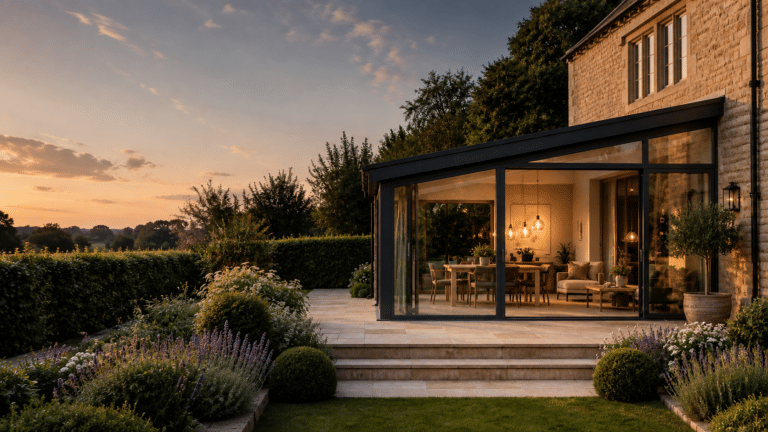


Is a Glass Veranda Right for You? An All-Glass Room Buyer’s Guide
A practical, honest guide to who a glass veranda suits, the problems it solves, how it compares with a full extension, what it costs, and the planning and next steps.
A glass veranda is right for you if you want a stylish, sheltered way to enjoy your patio and garden for more of the year — without the cost, scale or disruption of a full extension.
It’s a single-glazed outdoor room for spring, summer and autumn, rather than a heated, year-round space. If that matches how you’d actually use it, this guide will help you decide with confidence. If you need a warm room for everyday winter use, we’ll point you towards better options along the way.
The aim here isn’t to sell you one; it’s to help you work out honestly whether it suits your home, your habits and your budget — so you only move forward if it’s genuinely the right fit.
What a glass veranda is, in brief
Contemporary, open, seasonal shelter.
A glass veranda is a contemporary outdoor living room built from a slim aluminium frame, a glass roof and sliding glass walls. Open the walls to the garden on a warm day, or slide them closed for shelter from wind and rain. Room Outside’s version is the All-Glass Room glass veranda, where you’ll find the full specification, finishes and design features set out in detail.
For the purposes of deciding, the most important thing to hold onto is this: a glass veranda is a sheltered outdoor space, not an insulated extension of the house. It’s single-glazed and designed for seasonal use. That single fact shapes almost every other decision you’ll make — who it suits, what it costs, how you’ll use it and what to expect from it.
The clearest expectation to set
Think of it as a premium way to make the patio more usable, rather than a replacement for a heated room inside the home.
The big question: how will you actually use it?
The honest answer tells you more than any specification sheet.
Before comparing products or prices, picture how the space would fit into a typical week. The honest answer to “how will I use it?” tells you more than any specification sheet.
Think about the moments you’d want it for — morning coffee with the garden in view, long summer dinners that currently get cut short by a breeze, a sheltered spot for guests when the weather is unpredictable, or a calm place to read on a mild autumn afternoon. These are exactly the moments a glass veranda is built for: times when an open patio feels a little too exposed, but you don’t want to retreat fully indoors.
Now think about the moments it isn’t built for — a warm home office you’ll use every day through January, a heated playroom for young children in mid-winter, or a dining room you want to feel exactly like an indoor room all year. If your honest list leans towards those, an insulated extension will serve you better, and it’s worth knowing that now rather than later.
Where a glass veranda earns its place
Most homeowners find their real answer sits in between. If the bulk of how you’d use the space is across spring, summer and autumn, with shelter rather than central heating, you’re looking at the right product.
Who a glass veranda is right for
Honest signals, real scenarios, and where it isn’t the answer.
A glass veranda tends to suit you if several of the following ring true:
- You have a patio or terrace that sits unused for much of the year because it’s too exposed to wind, rain or low sun.
- You love dining, entertaining or simply relaxing with a strong, uninterrupted connection to the garden.
- You want the light and openness of glass without the budget, timescale and building work of a full extension.
- You’d prefer a designed, professionally installed structure with proper aftercare, rather than a flat-pack kit you assemble yourself.
- You’re looking to add genuinely usable outdoor months and a premium finish to your home.
- You value a clear, open view of the garden and want minimal framing in the way of it.
The more of these that describe you, the stronger the fit. Sometimes it’s easier to recognise yourself in a scenario than a checklist:
The entertainer
You host regularly and the British weather keeps letting you down. A glass veranda gives you a sheltered, lit space where guests stay comfortable whatever the sky decides — open to the garden when it’s warm, closed against the breeze when it isn’t.
EntertainingThe garden-lover
Your garden is your pride and joy, and you want to be in it, not just looking at it through a window. Slim framing keeps the view clear, so you feel part of the garden even when the weather isn’t quite cooperating.
ConnectionThe downsizer or later-life mover
You’ve moved somewhere more manageable but still want a bright, comfortable spot to enjoy the outdoors without the upkeep or expense of a large extension. A low-maintenance outdoor room that’s easy to live with.
Easy livingThe young family
Somewhere the children can spill out to on a damp morning, a sheltered place for paddling-pool afternoons, and a spot for relaxed family meals without trailing everything indoors at the first cloud.
Family spaceThe remote-but-seasonal worker
Not a heated, year-round office — you have that already — but a bright, calm place to take a call or work for a couple of hours on a fine day, through the warmer months.
FlexibilityWho a glass veranda isn’t right for
It’s worth being honest about where a glass veranda isn’t the answer, because choosing the wrong product is an expensive mistake. Single-glazed and built for seasonal shelter, it won’t suit you if you need:
- A warm room you’ll use every day through winter, like a heated living or dining room.
- An insulated home office, studio or gym you rely on year-round.
- A room that forms a fully integrated, heated part of the house.
- A space you expect to feel exactly like an indoor room in December.
There’s no shame in any of those needs — they’re common and entirely reasonable. They simply point to a different product, and the steer below will help you find the right alternative.
The problems a glass veranda solves
More usable outdoor months, less weather friction.
In the UK, a patio is often only comfortable for a handful of weeks a year. A breeze, a passing shower or a cool evening sends everyone back indoors, and a lovely outdoor space goes to waste for months at a time. Many homeowners have spent real money on landscaping, furniture and planting, only to use the result far less than they’d hoped.
A glass veranda solves that mismatch. It gives you shelter without losing the view or the outdoor feel. Closed, it protects you from wind and rain; open, it becomes part of the garden again. The glass roof keeps the space bright and the sliding walls let you tune the level of enclosure to the day. The result is a genuinely usable outdoor room and more outdoor months — without the budget, timescale and groundwork of a brick-and-glass extension.
The real value
It also keeps you connected to the garden in the shoulder seasons, when it looks its best but the weather can’t quite be trusted. For many people that’s the real return — not just extra space, but extra time enjoying the home and garden they already have.
Glass veranda or full extension?
It comes down to one thing — insulation, and how often you’ll use it.
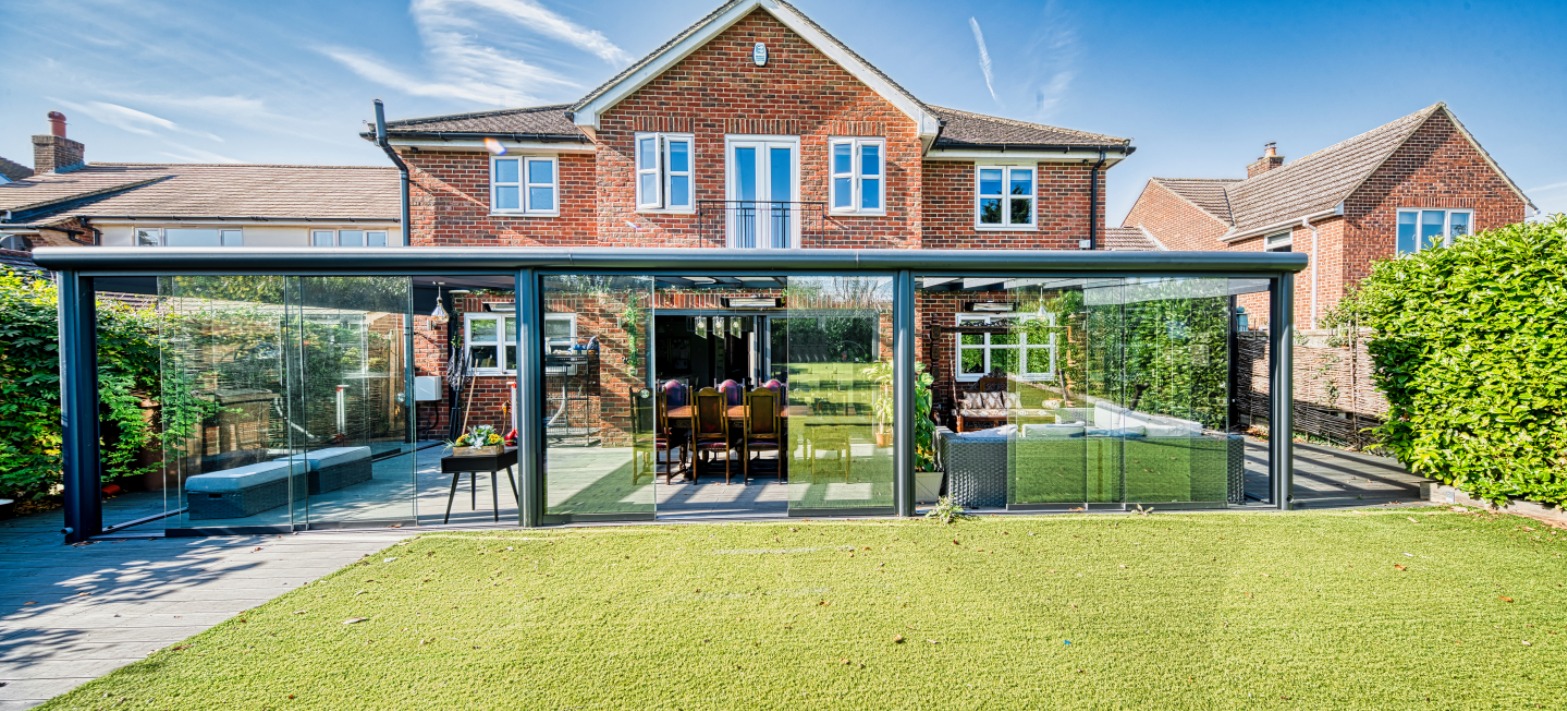
Open to the garden, sheltered from weather
Single-glazed, bright and seasonal. Best for extending patio use while preserving the outdoor feel.
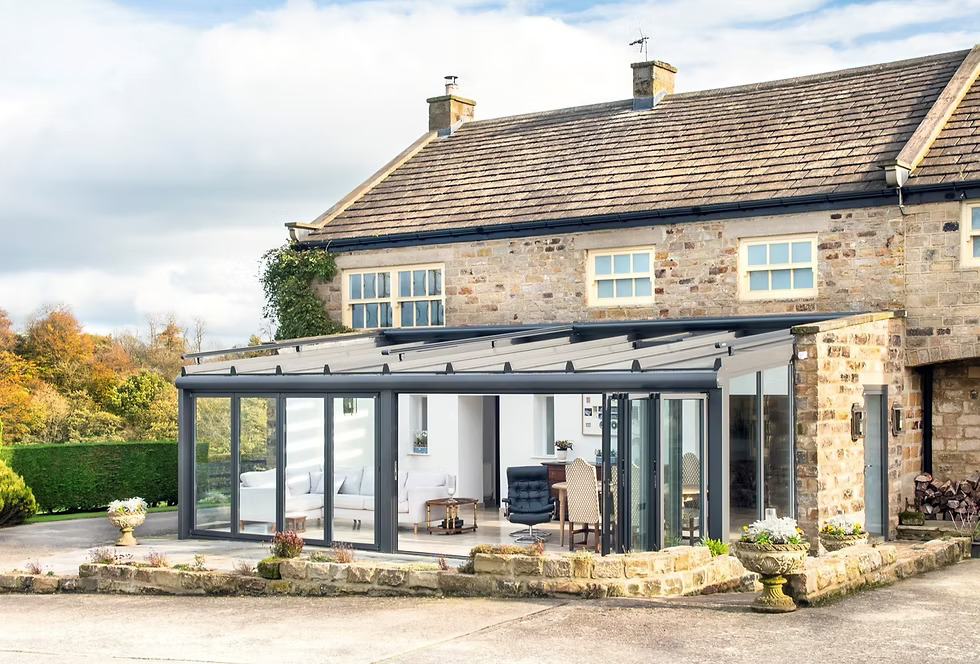
A permanent heated room for daily use
Higher budget and more building work, but better if winter comfort and everyday indoor use are essential.
If, on reflection, you want a warm, everyday room, an insulated extension is the better route — and it’s worth choosing it deliberately rather than asking a veranda to do more than it can.
For sheltered, seasonal outdoor living
If you need year-round warmth
- Glass veranda — for sheltered, seasonal outdoor living and an open connection to the garden.
- Room Outside conservatories — a fully glazed, insulated room you can use all year.
- Orangeries — a more substantial brick-and-glass room with a glazed lantern and a stronger sense of being part of the house.
- Frameless glass box extension — the most architectural, all-glass year-round statement.
The key difference across all of these is insulation and use. A glass veranda is single-glazed and seasonal; the others are insulated, heated rooms built for everyday, year-round living. Once you know which of those two camps you’re really in, the decision narrows quickly.
Assessing your own space and garden
The site shapes both the design and the experience.
Even when a glass veranda is the right type of product, it pays to look honestly at your own space. A few practical things to consider before you enquire:
- Orientation and light. A south or west-facing aspect catches plenty of warmth and evening light; a north-facing spot stays cooler and softer. Neither is wrong — it just affects how and when you’ll most enjoy the space.
- Size and proportion. Think about how much of your patio you’re willing to give over, and how the veranda sits against the house and the boundary. Wide spans are possible with minimal posts, but the proportions still want to feel right for the property.
- Access and flow. A veranda that links naturally to a kitchen, dining room or living room tends to get used far more than one that feels separate.
- Ground and base. Your existing patio may be perfect, or it may need preparation for a level, stable base with proper drainage. Worth flagging early, as it can affect both the design and the cost.
- How you’ll open it. Picture how often you’ll want the sliding walls fully open versus closed. Living with them open most of the summer and closed on cooler or wetter days is exactly the point of the product.
None of this needs to be worked out perfectly on your own — a good survey will cover it — but having thought it through means a much more useful first conversation.
Cost and value: what to think about
A lifestyle investment first, with a clear specification behind it.
A glass veranda is a more accessible route to the glass look than a full insulated extension, but “accessible” still means a considered purchase, so it helps to understand what moves the price. The main factors are size, the level of enclosure (open-sided is the simplest; full sliding glass walls add cost), the glazing and frame specification, and any groundwork your patio needs.
Because every project is shaped around the home, the figure for your space depends on your design rather than a single list price. For broader context on glazed-structure pricing, the glass extensions price guide is a useful reference, and a tailored quote will give you the exact cost for your home.
On value, be measured
A well-designed glass veranda adds usable living space and can make a home more appealing to live in and, often, to prospective buyers — but any effect on resale value depends on the property and the market, so it’s best treated as a lifestyle investment first. The clearest return is the one you feel: more time spent enjoying your home and garden across more of the year.
Planning and practical points to check
Often permitted development — but check, don’t assume.
Many glass verandas fall within permitted development, but this isn’t guaranteed. Whether you need planning permission depends on your property’s size, height and position, and how close the structure sits to a boundary. Listed buildings, conservation areas, areas of outstanding natural beauty and certain designated land can all change what’s allowed, and flats and maisonettes follow different rules.
The sensible approach is to check rather than assume. The government’s Planning Portal is a good place to understand the rules, and Room Outside will help you understand the likely position for your property before you commit. Building regulations are usually less involved for a single-glazed outdoor veranda than for an insulated extension, but your installer will confirm exactly what applies to your build.
It’s also worth thinking about the practical side: where services run, how rainwater will drain, and whether any trees, slopes or neighbouring structures affect the design. These are routine considerations, but raising them early keeps the project smooth.
Living with a glass veranda: the practical realities
The good, and the things to be aware of.
- Light and brightness. The part most people love. A glass roof floods the space with daylight and keeps it connected to the garden in a way a solid-roofed structure never quite manages.
- Sound in the rain. A glass roof means rain is audible. Many people find the sound genuinely pleasant — part of being sheltered but outside — but it’s worth knowing if you’re particularly sensitive to noise.
- Warmth in summer. Like any glass structure, it can warm up in direct summer sun. The advantage is that the sliding walls open fully, so you can ventilate easily, and shading or blinds help on the hottest days. It won’t have the controlled climate of an insulated, specified-glass room, and it isn’t meant to.
- Comfort in cooler weather. Closed up, the veranda shelters you from wind and rain, which extends comfortable use well into spring and autumn. It won’t feel like a heated indoor room in deep winter, and that’s by design.
- Upkeep. Aluminium is low-maintenance and stays looking crisp with little effort. In practice, an occasional wipe of the frame and keeping the gutter clear of leaves is usually all that’s needed, with the glass cleaned now and then like any glazing.
- Lighting and evenings. Integrated lighting means the space works after dark as well as during the day — often when verandas get the most use in summer.
Common mistakes and misconceptions
Clearing these up helps you choose well.
- Expecting it to be a year-round room. The most common mistake is hoping a single-glazed veranda will behave like an insulated extension in winter. Keep its seasonal purpose front of mind and you’ll be delighted; expect winter warmth and you’ll be disappointed.
- Confusing it with a glass box extension. Both feature lots of glass, but one is a seasonal outdoor room and the other an insulated, year-round extension. Mixing them up leads to budgeting for the wrong thing.
- Underestimating the base. A level, well-drained base matters. It’s better to plan for it than to discover it late.
- Choosing on price alone. The cheapest verandas are often self-assembly kits with thinner glazing and no installation. They can work out more expensive over time and rarely deliver the finish or longevity of a surveyed, professionally installed structure.
- Buying for now, not for how you’ll live. Choose around how you’ll really use the space over the years, not just the sunny week you happen to be planning in.
A simple “is it right for me?” checklist
The more you tick, the better the fit.
How to read your answers
If most of these sound like you, a glass veranda is likely a strong fit. If you found yourself wanting winter warmth or an everyday insulated room, an extension is the better choice — and that’s a perfectly good outcome to reach, too.
Frequently asked questions
Common questions about glass verandas, answered honestly.
Who is a glass veranda best suited to?
Homeowners who want to enjoy their patio and garden for more of the year — for dining, entertaining or relaxing — without the cost and building work of a full extension. It suits seasonal, sheltered use rather than everyday winter living.
Is a glass veranda worth it?
If you’ll use the extra outdoor months it gives you, yes. It adds usable space and a premium finish at a more accessible price than an insulated extension. If you need a warm, year-round room, an extension offers better value for that purpose.
What problems does a glass veranda solve?
It turns an exposed, underused patio into a sheltered outdoor room — protecting you from wind and rain while keeping the garden view and light, and extending your outdoor season.
Should I choose a glass veranda or a full extension?
Choose a glass veranda for sheltered, seasonal outdoor living. Choose a conservatory, orangery or glass box extension if you need an insulated room you’ll use every day, including in winter.
How do I know if my garden suits a glass veranda?
Most patios and gardens can accommodate one, but it helps to consider orientation, how much space you’ll give over, access from the house, and whether the existing base is level and well-drained. A survey will confirm what works for your specific site.
How is a glass veranda different from a pergola or canopy?
A pergola or simple canopy mainly provides overhead cover. A glass veranda is a more designed structure with a glass roof and sliding glass walls, so it offers a brighter, more enclosed and more weather-protected outdoor room.
Will a glass veranda add value to my home?
Many homeowners find a well-designed glass veranda adds usable living space and makes a home more appealing to live in, which can also appeal to buyers. Any effect on resale value depends on the property and market, so it’s best seen as a lifestyle investment first.
Is a glass veranda noisy when it rains?
A glass roof means rain is audible. Many people enjoy the sound as part of being sheltered but outside, though it’s worth being aware of if you’re particularly sensitive to noise.
Does a glass veranda get too hot in summer?
Like any glass structure, it can warm up in direct summer sun. Because the sliding walls open fully, the space is easy to ventilate, and shading or blinds can help on the hottest days. It doesn’t have the controlled climate of an insulated, specified-glass room.
How much maintenance does a glass veranda need?
Very little. Aluminium is low-maintenance, so an occasional wipe of the frame, keeping the gutter clear of leaves, and cleaning the glass now and then is usually all that’s required.
Can I add heating, blinds or furniture later?
Yes. Many homeowners add furniture, soft furnishings, blinds and portable or infrared heaters to suit how they use the space. These can extend comfortable use into cooler evenings, though they don’t turn a single-glazed veranda into an insulated room.
Can I use a glass veranda in winter?
It offers shelter when the sliding walls are closed, but as a single-glazed space it won’t feel as warm as a heated room in deep winter. For everyday winter use, choose an insulated option.
Your next step
The easiest way to picture it for your home is to explore the All-Glass Room and its designs, finishes and layouts at your own pace. When you’re ready, request a tailored quote and our team will shape an All-Glass Room around your space, your garden and the way you want to use it — backed by more than 50 years’ experience and Room Outside aftercare.
01243 538999 | Surrey | West Sussex | East Sussex | Hampshire | Kent | Essex | London | Dorset | Berkshire