


Conservatory care guide
Conservatory condensation: why it happens, how to fix it — and when it’s a warning sign.
Sometimes it’s harmless physics. Sometimes it’s failed glazing quietly costing you heat all winter. The finger test below tells you which kind you’re looking at — and what to do about each.
Quick answer
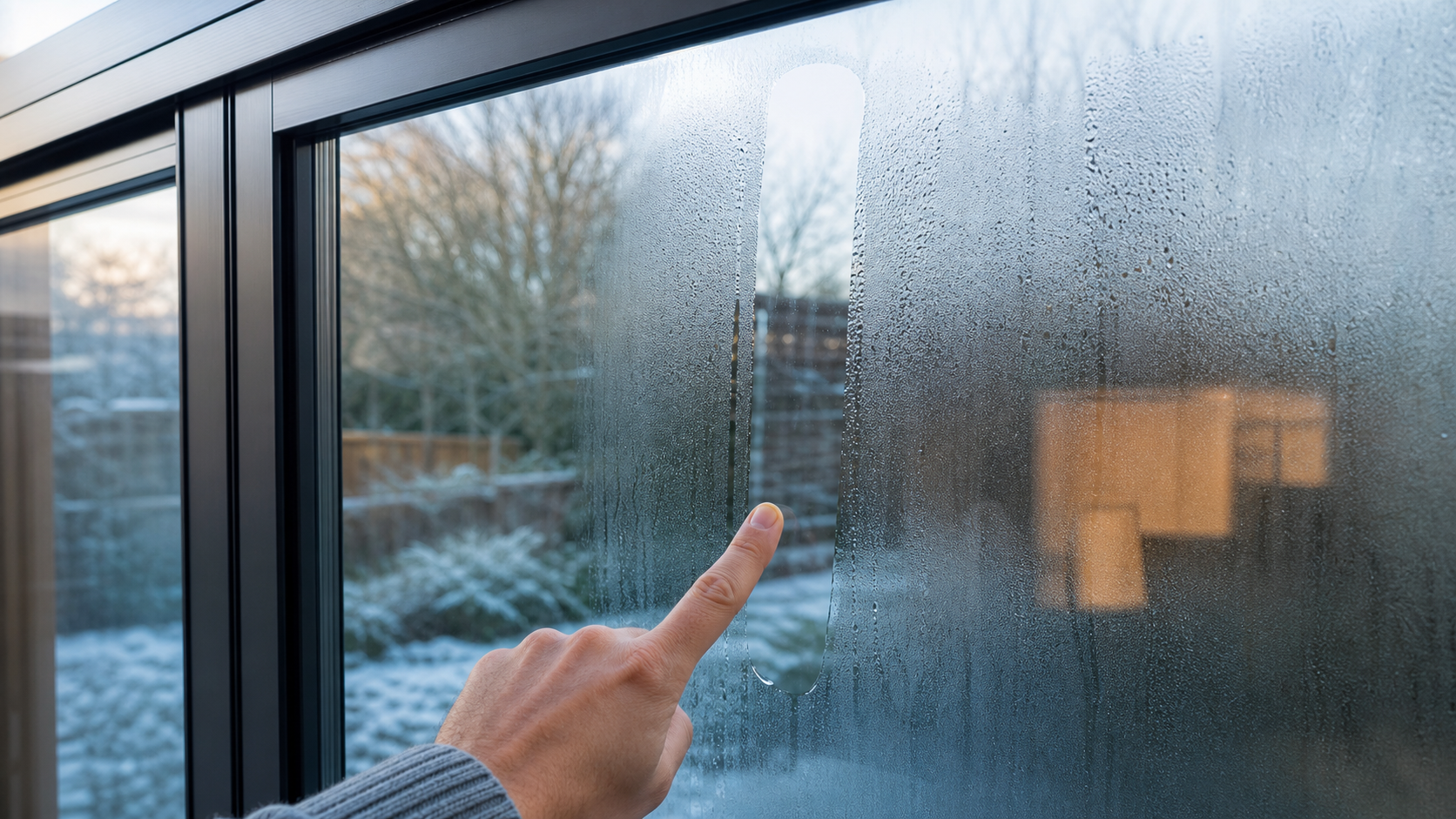
Run a finger over the misted glass. The answer tells you almost everything.
There are three types of conservatory condensation, with completely different causes and completely different fixes. Inside surface (wipes away): warm, moist indoor air meeting glass that’s too cold — a ventilation, heating and glazing issue. Outside surface (gone by mid-morning): dew on high-performance glass, and counterintuitively a good sign. Between the panes (can’t be wiped from either side): the sealed unit has failed and needs replacing.
If you can wipe it, fix it with moisture control, background heat and ventilation. If you can’t wipe it from either side, no amount of ventilation will help — the glass unit itself has failed.
Conservatory condensation is usually caused by warm, humid indoor air touching cold glass. Internal condensation can often be reduced with ventilation, moisture control and background heat. External morning dew can mean the glass is insulating well. Condensation trapped between panes means the sealed glazing unit has failed and normally needs replacing.
Waking up to a conservatory dripping with condensation is one of the most common complaints we hear — and one of the most misunderstood.
Sometimes it’s harmless physics. Sometimes it’s a symptom of failed glazing or a specification problem that’s quietly costing you heat all winter. The key is knowing which kind of condensation you’re looking at, because the three types have completely different causes and completely different fixes.
01 / First, diagnose
Where is the condensation?
Run a finger over the misted glass. Where the moisture sits tells you which of three problems you have.
On the inside surface
Your finger wipes it away. Warm, moist indoor air is meeting glass that’s too cold. This is the everyday type — a ventilation, heating and glazing-specification issue, and it responds to the three levers below.
On the outside surface
Visible in the morning, gone by mid-morning, and it can’t be wiped from indoors. This is dew forming on high-performance glass — and counterintuitively, it’s a good sign. More on this below.
Between the panes
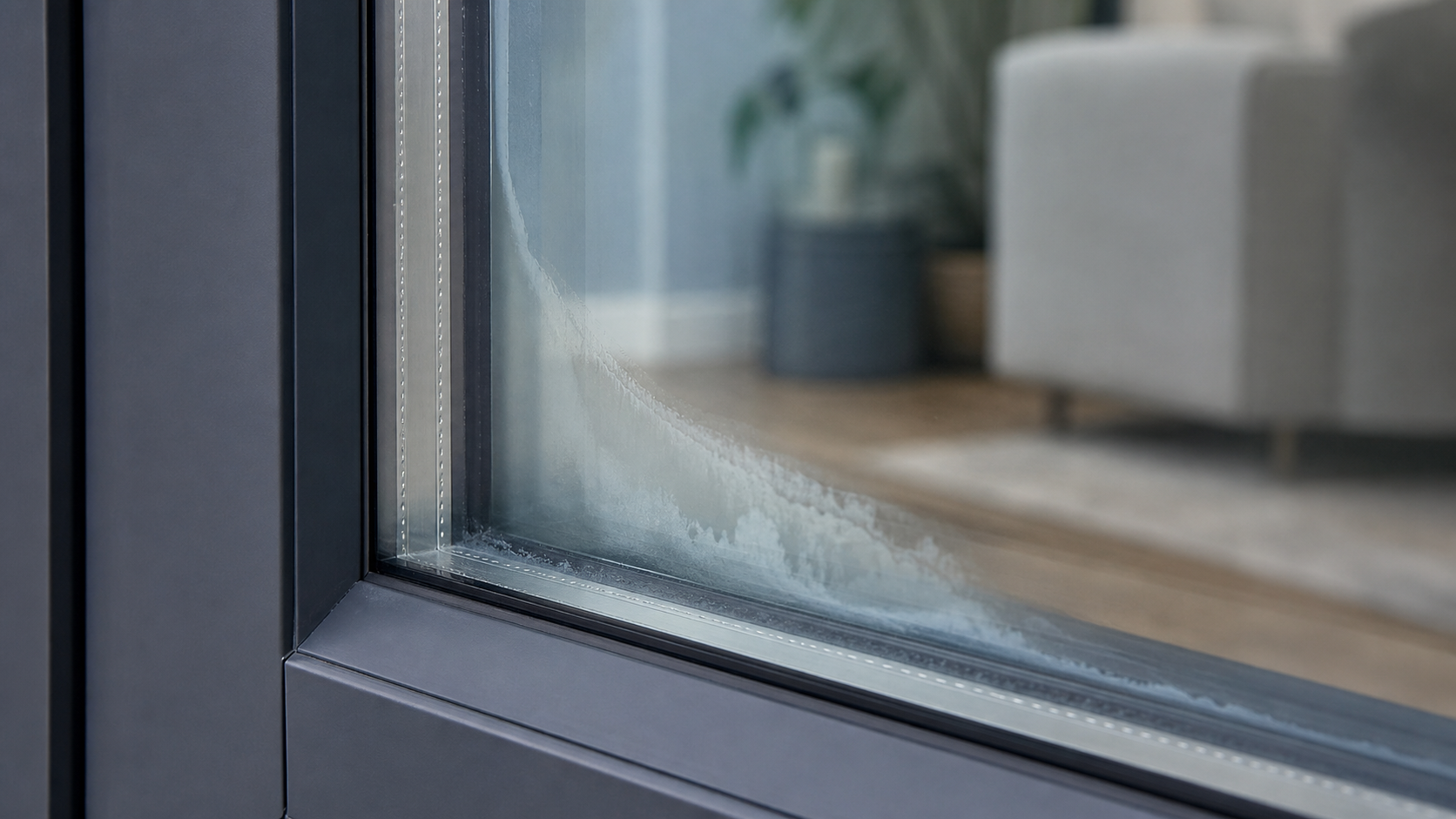
Can’t be wiped from either side. The sealed unit has failed. No amount of ventilation will fix this — the glass unit needs replacing.
02 / The everyday type
Internal condensation: the physics and the fixes.
Air holds moisture in proportion to its temperature. When indoor air touches a surface below its dew point, the moisture condenses.
Conservatories are the perfect storm for this: lots of glass (the coldest surfaces in any home), often unheated overnight, and frequently used for exactly the activities that pump moisture into the air — drying laundry, keeping plants, morning coffee from a steaming kettle next door in the kitchen.
Three levers control it:
- 1
Reduce the moisture
Don’t dry laundry in the conservatory in winter — a single load releases litres of water into the air. Keep kitchen and bathroom doors closed with extractors running. Be realistic about how many plants share the space. A dehumidifier is a blunt but effective instrument in problem rooms.
- 2
Raise the surface temperature of the glass
This is where glazing specification shows its worth. Old glazing with high U-values has cold internal surfaces that sit below dew point for much of the winter; modern high-performance units keep the inner pane close to room temperature, so moisture never reaches its condensation threshold. Warm-edge spacer bars matter too — the tell-tale band of condensation around the perimeter of each pane is the signature of old aluminium spacers acting as a cold bridge. Background heating helps for the same reason: a conservatory allowed to plunge overnight will always mist at dawn. Gentle low-level warmth keeps surfaces above dew point, and trench heating along glazed elevations is the premium solution because it washes the coldest surface with warm air directly.
- 3
Ventilate
Moist air needs an exit. Trickle vents, cracked-open roof vents and a daily air change cost almost nothing and often transform a problem room. Automated roof vents that respond to humidity take the discipline out of it.
Persistent internal condensation isn’t just a squeegee chore. Water pooling on cills rots timber frames, corrodes hardware, stains plaster on dwarf walls, and sustained damp breeds black mould — a genuine health concern. If your conservatory mists heavily every winter morning despite sensible ventilation, the message is that the glazing is running too cold, and the fabric — not your lifestyle — is the problem.

03 / The good sign
External condensation: the counterintuitive good sign.
If you’ve recently upgraded to high-performance glazing and now find dew on the outside of the glass on clear autumn mornings, nothing is wrong — quite the opposite.
The insulation is working so well that almost no heat escapes to warm the outer pane, so on still, clear nights the external surface cools below the outdoor dew point — exactly like a car windscreen. It burns off as the morning warms and is most common in spring and autumn.
“External dew is the visible proof your heating money is staying indoors.”

04 / The warning sign
Between-pane misting: the unit has failed.
Double and triple glazed units are hermetically sealed, with a desiccant in the spacer bar absorbing any trace moisture. Over the years, seals age; when a seal fails, humid air is drawn into the cavity with every temperature cycle, the desiccant saturates, and mist appears between the panes — often as a milky cloud or tide marks that come and go with the weather.
No quick fix
It can’t be fixed with ventilation or heating
The moisture is trapped inside the unit. “Drill-and-dry” repair services exist, but they don’t restore the gas fill or the original thermal performance — they treat the symptom.
Hidden cost
Performance is gone, not just clarity
A failed unit has lost its argon fill and much of its insulating value, so it’s leaking heat as well as looking foggy.
The economical fix
Replacement is unit-by-unit, not roof-by-roof
Individual sealed units can usually be replaced within existing frames — and a wholesale glass upgrade to modern high-performance units often transforms an older conservatory’s comfort out of proportion to its cost, which is exactly what our glass upgrade and refurbishment service is designed for. If several units have failed within a few years of each other, the rest of the batch is usually not far behind, and upgrading the set is more economical than piecemeal swaps.
05 / Read the signal
When condensation is telling you something bigger.
Treat condensation as a diagnostic. A conservatory that mists persistently despite good habits is reporting one or more of: glazing running far below room temperature (old units, high U-values), cold bridging at frames and spacers, inadequate ventilation design, or no background heat.
In a structure that’s otherwise tired — draughts, leaks, discoloured polycarbonate — condensation is usually the first symptom homeowners notice of a specification that has reached the end of its life. The economical response is rarely more wiping and more gadgets; it’s a proper assessment of the glazing and ventilation, then targeted upgrading.
The rule of thumb
If good habits haven’t fixed it after one winter, the fabric — not your lifestyle — is the problem. Get the glazing assessed before spending on gadgets.

Frequently asked questions
Condensation questions, answered.
How do I stop condensation on my conservatory roof?
Combine the three levers: cut moisture sources, add background heat so the glass never plunges below dew point, and ventilate daily. If the roof is old polycarbonate or early double glazing, upgrading the roof glazing addresses the root cause — a warm inner surface can’t collect condensation.
Is condensation between panes covered by guarantee?
Sealed units typically carry manufacturer guarantees of 5–10 years (sometimes longer on premium units). Check your installation paperwork — failure within the guarantee period should be a free replacement.
Does condensation mean my conservatory is damp or leaking?
Usually no — condensation is airborne moisture, not water ingress. But the damage it does when persistent (rot, mould, corrosion) is real, and a genuine leak can hide behind a condensation problem. If water appears in the same place after rain rather than on cold mornings, investigate as a leak.
Will a dehumidifier solve it permanently?
It will manage the symptom, and in a rarely used room that may be enough. It won’t change the fact that cold glass condenses moisture — the permanent fixes are warmer glass surfaces and ventilation.
Why does my new glazing get condensation on the outside?
Because it’s excellent. External dew on high-performance glazing means heat is no longer escaping to warm the outer pane. It clears naturally as the day warms.
Continue your research
Three types of misting. Three useful next steps.
Get the root cause assessed
Misted every morning? Find out what your conservatory is telling you.
If your conservatory mists every morning, has failed units, or simply runs cold and damp all winter, a health check will tell you whether the answer is ventilation tweaks, unit replacement or a glass upgrade — usually in a single visit.
This guide is general information. Every conservatory is different — a survey will confirm the cause of persistent condensation and whether your existing frames are suitable for a glass upgrade.