


Boundary building guide
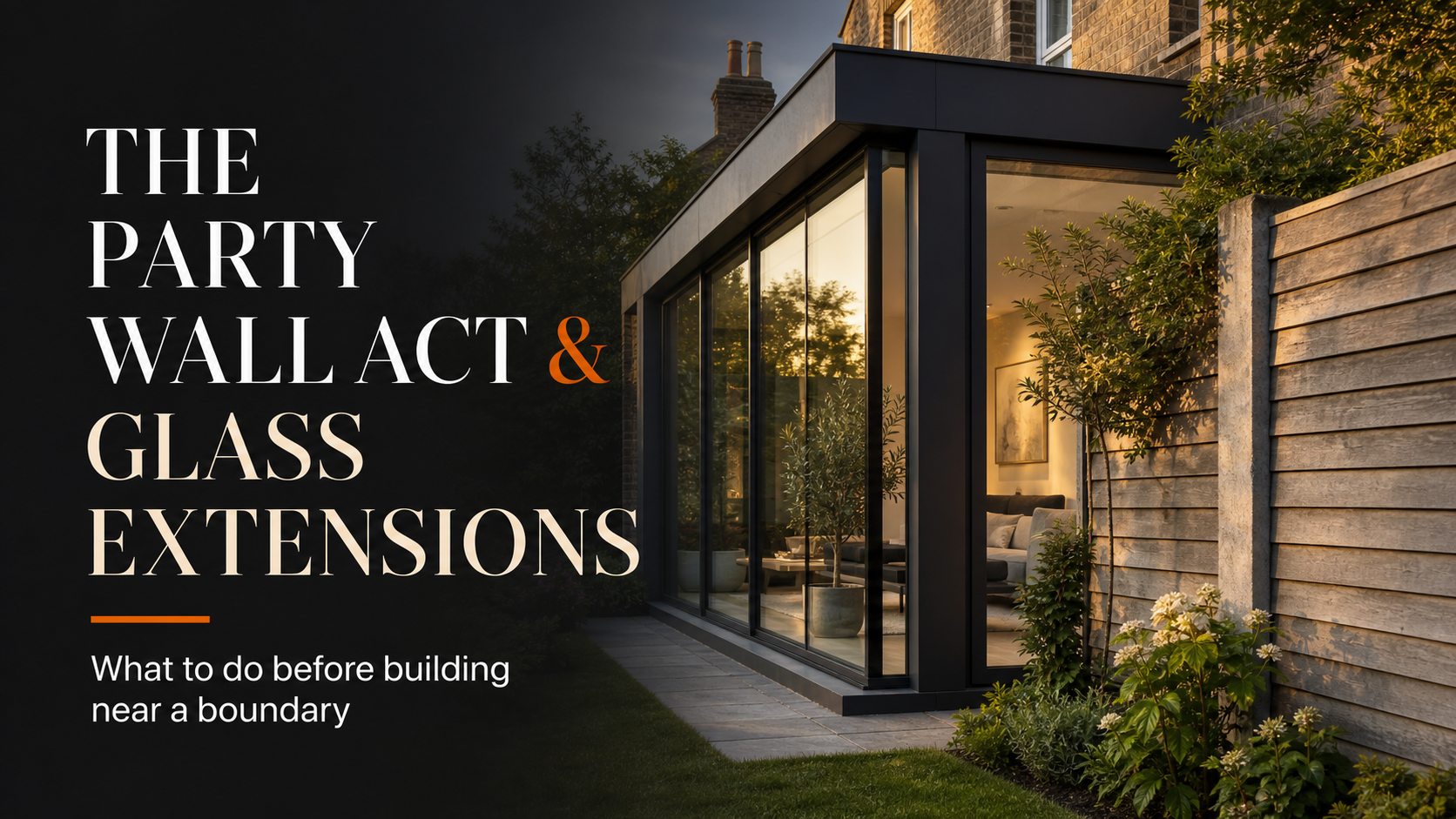
The Party Wall Act and glass extensions: what you must do before building near a boundary.
The practical guide to the 3-metre and 6-metre rules, serving notice, Party Wall Awards, costs and timescales—and why handling it early protects you as much as your neighbour.
Quick answer
If your foundations are close to next door, check the Act before you dig.
The Party Wall etc. Act 1996 is a private legal process between neighbouring owners. It commonly applies when extension foundations are within 3 metres of a neighbouring structure and go deeper than its foundations, when deeper excavations trigger the 6-metre rule, or when work touches the boundary or a shared wall.
Talk to your neighbour, confirm whether the work is notifiable, serve the correct notice early, and do not begin notifiable work until consent or a Party Wall Award is in place.
You have checked planning permission. You have read up on building regulations. But there is a third legal process that catches out more extension projects than either—and it has nothing to do with the council.
The Party Wall etc. Act 1996 governs building work on or near the boundary with your neighbour, and for many glass extensions built close to a fence line, it applies.
Unlike planning and building control, no authority polices the Party Wall Act for you. It is a private legal process between you and your neighbours—which is exactly why it gets forgotten until a neighbour objects mid-build. Here is how it works and how to keep it painless.
01 / Separate approvals
Planning, building regulations and party wall: three separate boxes.
These three regimes are independent. Satisfying one does not satisfy the others.
Planning permission
Governs what you may build and where it may be positioned.
Building regulations
Govern how the extension must be designed and constructed.
The Party Wall Act
Governs your legal relationship with adjoining owners while you build near the boundary.
Your extension can be permitted development, fully building-regulations compliant and still put you in breach of the Party Wall Act. All three boxes need ticking.
02 / The trigger points
When the Act applies to a glass extension.
Three types of work are particularly relevant to glazed extensions, orangeries and conservatories.
Excavating within 3 metres
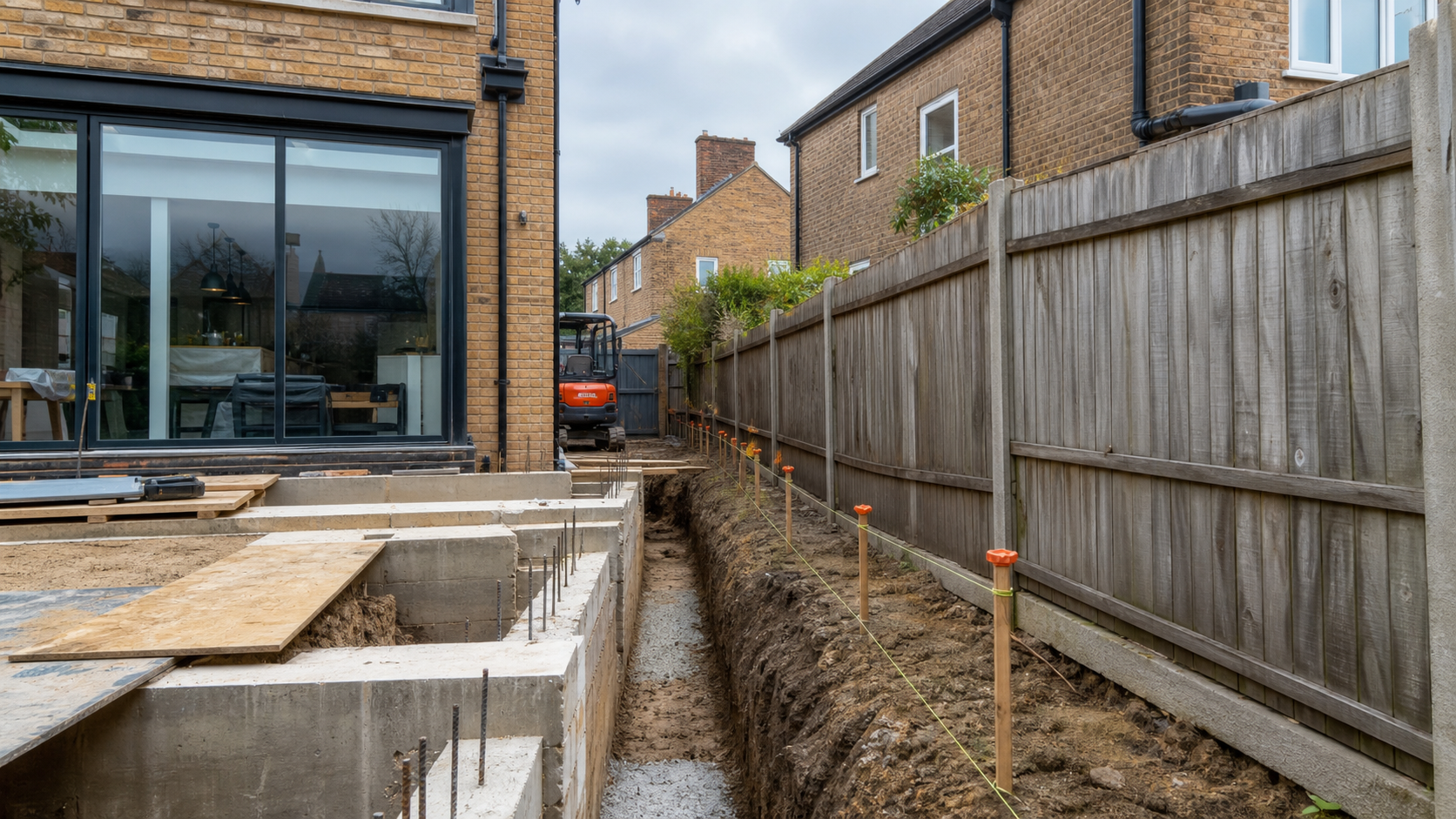
Notice is required when you excavate within 3 metres of a neighbouring building and go deeper than its foundations. Almost every glass extension needs foundations, and this is the most common trigger in semi-detached and terraced gardens. Older properties often have surprisingly shallow footings.
The 6-metre rule
Notice may also be required when excavation is within 6 metres and cuts below a line drawn at 45° downwards from the bottom of the neighbouring foundations. This mainly affects deep foundations, piling or basements.
Building on or up to the boundary
Building astride the boundary, cutting into an existing party wall, inserting steels or tying a lean-to structure into a shared flank wall can also require notice.
What usually does not trigger the Act?
An extension built wholly on your own land, more than 3 metres from any neighbouring structure, with no work to a shared wall. Detached homes with generous side gaps may escape the process entirely.
03 / From notice to award
The process, step by step.
Good timing and a friendly conversation can turn a formal obligation into a straightforward piece of paperwork.
- 1
Serve notice
Notify every adjoining owner in writing: at least 1 month before excavation work under Section 6, or 2 months before work to a party wall under Section 3. Notices must describe the work, and excavation notices require plans showing the proposed foundation depth. “Every adjoining owner” can include freeholders and leaseholders.
- 2
The neighbour responds
Written consent within 14 days satisfies the Act. Dissent—or no reply within 14 days—creates a formal dispute and surveyors must be appointed. Silence is not consent.
- 3
Surveyors prepare the Award
Both owners may use one agreed surveyor or appoint one each. The Party Wall Award records the condition of the neighbouring property before work starts, permitted methods and hours, and responsibility for costs.
- 4
Build with protection in place
The schedule of condition protects you too. If damage is alleged later, it provides clear evidence of what existed before work began.
04 / Budget and programme
Costs and timescales.
The cheapest and quickest path is early written consent. The expensive path is discovering the issue after work starts.
If neighbours consent
Minimal cost · 14-day response window
Talk early, show the drawings and serve the correct notice as a formality. You still need to respect the statutory notice period before beginning notifiable work.
If surveyors are appointed
Allow several hundred pounds upward · often 4–8 weeks
The building owner normally pays all reasonable fees, including their surveyor and the neighbour’s. A single agreed surveyor is generally faster and less expensive than two separately appointed surveyors.
If you skip the process
Risk of injunction, delay and an unprotected damage claim
A neighbour may seek a court injunction to stop work. Without a schedule of condition, it may also be harder to distinguish new damage from pre-existing defects. Unauthorised work can also surface during conveyancing when you sell.
Costs vary by project, location, complexity and professional. Treat these figures as a planning guide and obtain project-specific advice.
05 / Glazed structures
Why glass extensions deserve extra care here.
Foundations near trees and boundaries often need to go deeper than a neighbour’s older footings—exactly the situation the 3-metre rule targets.
Glass extensions are also commonly built tight to the boundary to maximise internal width. Eaves-height limits may already push the design close to next door, and a build that close makes a pre-work schedule of condition particularly valuable for both sides.
“Party wall implications should be identified at survey stage—never discovered through an unhappy neighbour after work begins.”
A specialist installer can identify potentially notifiable work early and either guide the notice process or introduce a suitably experienced party wall surveyor.
Frequently asked questions
Party wall questions, answered.
Do I need a party wall agreement for a conservatory?
If its foundations are dug within 3 metres of a neighbouring building and deeper than that building’s foundations, or it is built on or into the boundary wall, notice is required. A conservatory in the middle of a large garden may not trigger the Act.
My neighbour ignored my notice. Can I just start?
No. Silence for 14 days counts as dissent under the Act, not consent. The surveyor process then applies, and the Award it produces protects both owners.
Can my neighbour stop my extension using the Party Wall Act?
No. The Act regulates how notifiable work proceeds; it does not give neighbours a veto over lawful development. Objections to the extension itself belong to the planning process.
Does the Act apply if their conservatory is close but their house is far away?
Yes. The 3-metre rule measures to any neighbouring building or structure, including an extension, conservatory or garage—not just the main house.
Who pays the surveyor fees?
The person doing the work normally pays all reasonable fees. Budget for this if written consent looks unlikely.
Continue your research
Three legal boxes. Three useful next steps.
Plan it properly
Get the boundary question answered early.
Every project close to a boundary should be assessed at survey stage alongside planning and building regulations—so notices go out early and the build never waits on paperwork.
This guide is general information, not legal advice. For project-specific guidance, consult a qualified party wall surveyor or solicitor.