
roomoutsideuk
20th January, 2026

Sagging Conservatory Roof? Structural Solutions vs Cosmetic Fixes

Sagging Conservatory Roof? Structural Solutions vs Cosmetic Fixes | Room Outside

Sagging Conservatory Roof? Structural Solutions vs Cosmetic Fixes

Why temporary repairs fail and what actually works. Expert guide to diagnosing foundation issues, frame deterioration, and choosing between structural repairs or full refurbishment.

Quick Answer: Why Is My Conservatory Roof Sagging?

A sagging conservatory roof typically indicates underlying structural problems—not just cosmetic wear. While temporary fixes like sealants or new panels might mask the issue, genuine structural repairs or full conservatory refurbishment are usually necessary to resolve foundation issues, frame deterioration, or inadequate original construction. Cosmetic fixes typically fail within 6-18 months, while proper structural solutions last 20-30+ years.

6-18
Months before cosmetic fixes fail
70%
Of sagging caused by foundation issues
20-30
Years lifespan with structural repairs
£4,600
Average wasted on repeated fixes
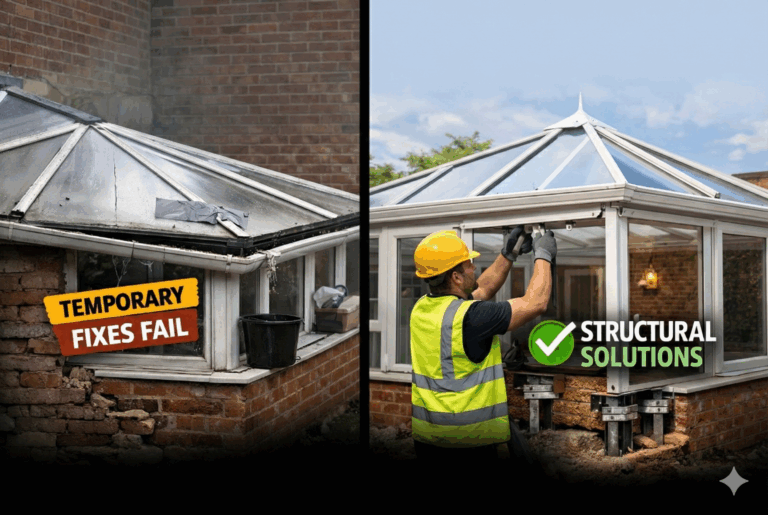
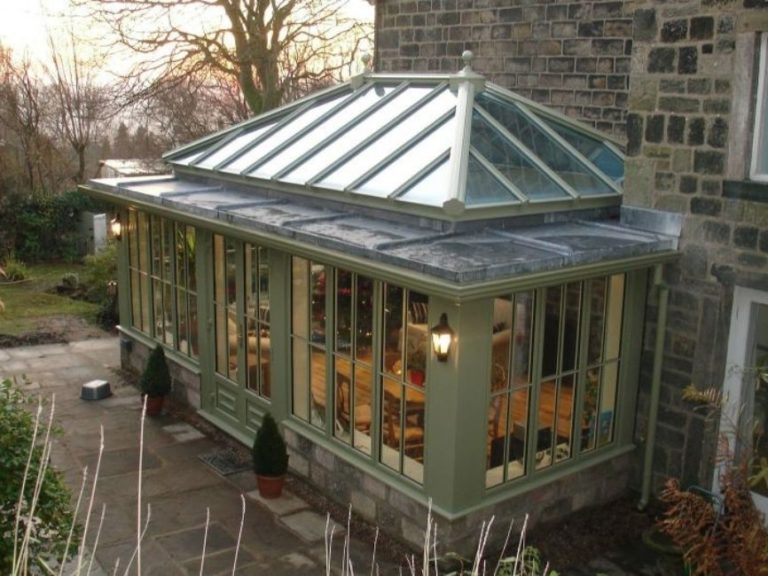
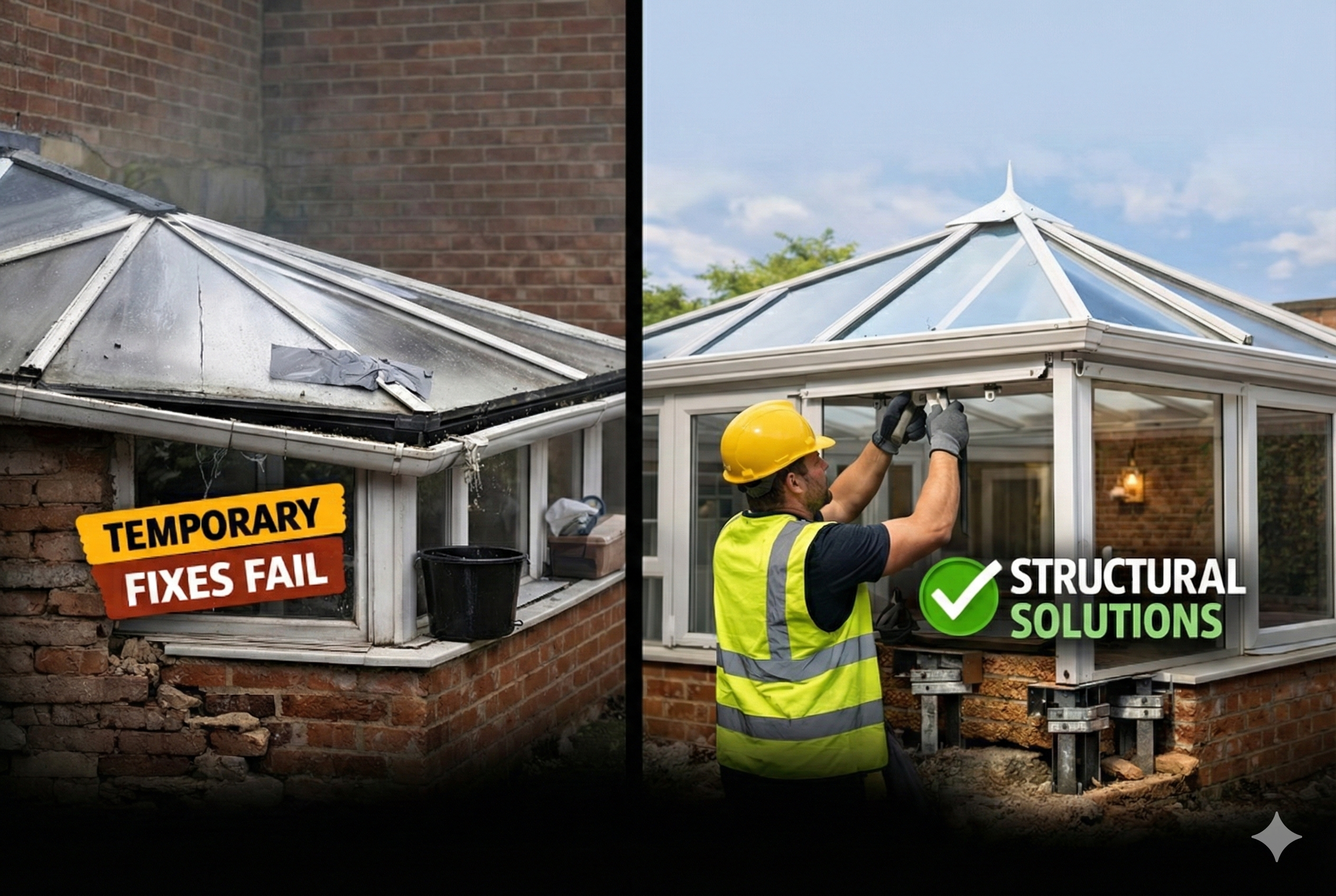
Conservatory with visible structural issues showing sagging roof panels requiring professional assessment
A sagging conservatory roof is a warning sign of deeper structural problems that require professional assessment
When homeowners notice their conservatory roof beginning to sag, the instinct is often to search for quick, affordable fixes. However, a sagging conservatory is rarely a surface-level problem. The visible dip in your roof is typically the symptom of deeper structural failures that demand professional assessment and proper remediation. Understanding the difference between cosmetic patches and genuine structural repairs can save you thousands of pounds and years of frustration. This comprehensive guide explains why conservatory roofs sag, why temporary fixes fail, and what solutions actually work for homeowners across Kent, Surrey, Sussex, and London.

Understanding Why Conservatory Roofs Sag

Structural issues in conservatories develop gradually over years, often going unnoticed until the problem becomes severe. Unlike a sudden leak or broken window, sagging happens incrementally—a few millimetres each year—until one day you realise something is seriously wrong.

The sagging you see on your roof is almost never the actual problem. Instead, it is the visible consequence of failures happening elsewhere in the structure: beneath the floor in the foundations, within the frame connections, or in the roof support system itself. Understanding the root cause is essential before committing to any repair strategy—otherwise, you risk spending money on cosmetic fixes that fail within months while the underlying damage continues to worsen.

Research from the Glass and Glazing Federation indicates that approximately 70% of conservatory structural failures originate from foundation or base issues, with frame deterioration accounting for 20% and roof-specific problems causing just 10% of sagging cases. This means that in seven out of ten cases, the roof sag you see is actually being caused by problems at ground level.

Common Causes of a Sagging Conservatory

Before you can fix a sagging conservatory, you need to understand what is causing it. Here are the three primary categories of structural failure that lead to visible roof sagging.

🏗️

Foundation & Base Issues

Ground movement, subsidence, inadequate original foundations, and drainage problems causing settlement

🔩

Frame Deterioration

Aluminium fatigue, timber rot, uPVC degradation, and connection joint failures over time

🏠

Roof Structure Failure

Glazing bar breakdown, ring beam problems, and damage from excessive snow or debris loading

Foundation and Base Issues

The most serious cause of conservatory sagging relates to foundation problems. Conservatory foundations can fail for several reasons, and without addressing these underlying issues, any repairs to the visible structure will ultimately fail.

Ground Movement and Subsidence

Clay soils—common across Kent, Surrey, and Sussex—expand and contract with moisture changes, causing gradual foundation movement. During dry summers, clay shrinks; during wet winters, it expands. This constant cycle creates stress on conservatory foundations that were often not designed to accommodate such movement. Trees planted too close to the structure can draw moisture from the soil, accelerating subsidence. Properties in areas with historic mining activity may also experience ground instability that affects conservatory foundations.

Inadequate Original Foundations

Many conservatories—particularly those built before 2000—were constructed on foundations that do not meet modern building standards. Shallow footings, insufficient concrete depth, or poor-quality materials can all contribute to foundation settlement over time. In some cases, conservatories were built on simple concrete slabs without proper strip foundations, making them vulnerable to any ground movement whatsoever.

Drainage Problems

Poor drainage around your conservatory base allows water to pool, saturating the soil and potentially washing away supporting material beneath the foundations. In winter, freeze-thaw cycles can crack inadequate foundations as trapped water expands when it freezes. Over years, this repeated damage compounds until the foundation can no longer support the structure properly.

Related Reading

For a deeper understanding of how conservatory structures work and why they fail, read our comprehensive guide: Understanding Conservatory Structural Integrity. This article explains the engineering principles behind conservatory construction and helps you recognise early warning signs.

Structural Frame Deterioration

Even if your foundations are sound, the frame itself can deteriorate over time, losing its ability to support the roof structure.

Aluminium Frame Fatigue

Older aluminium frames can develop stress fractures at connection points, particularly where the frame meets the roof structure. Years of thermal expansion and contraction—the frame expands in summer heat and contracts in winter cold—weaken these joints progressively. Eventually, the connections fail to hold the frame rigid, allowing the roof to sag under its own weight.

Timber Frame Rot

Wooden conservatory frames are vulnerable to moisture ingress, particularly at joints and connection points where water can penetrate protective coatings. Once rot takes hold in structural timbers, the frame loses its load-bearing capacity relatively quickly. Unlike surface decay that can be treated, structural rot often requires complete section replacement to restore integrity.

uPVC Frame Degradation

While uPVC is marketed as low-maintenance, it does degrade over 20-25 years. UV exposure causes brittleness, making the material prone to cracking under stress. More critically, the steel reinforcement within uPVC frames can corrode if moisture penetrates through cracks or seal failures in the plastic sheathing. Once the internal steel weakens, the frame cannot maintain its structural role.

Roof Structure Failure

In some cases, the roof structure itself is the source of the problem, though this is less common than foundation or frame issues.

Glazing Bar Breakdown

The bars that support your roof panels can bend, crack, or pull away from their fixings over time. This is especially common in polycarbonate roofs where the lightweight material does not provide much structural resistance to help the glazing bars maintain their position. Thermal movement, wind loading, and the weight of accumulated debris all stress these components.

Ring Beam Problems

The ring beam—the structural element connecting your roof to the walls—is a common failure point. If this component becomes compromised through rot, corrosion, or joint failure, the entire roof structure loses its integrity. Ring beam problems often manifest as the roof appearing to separate from the walls or visible gaps appearing at the junction.

Excessive Loading Damage

Conservatory roofs are not designed to bear significant weight. Repeated heavy snow loads or accumulated debris—leaves, branches, moss—can permanently deform roof components. A single extreme winter can cause damage that only becomes apparent months later as the deformed components continue to settle.
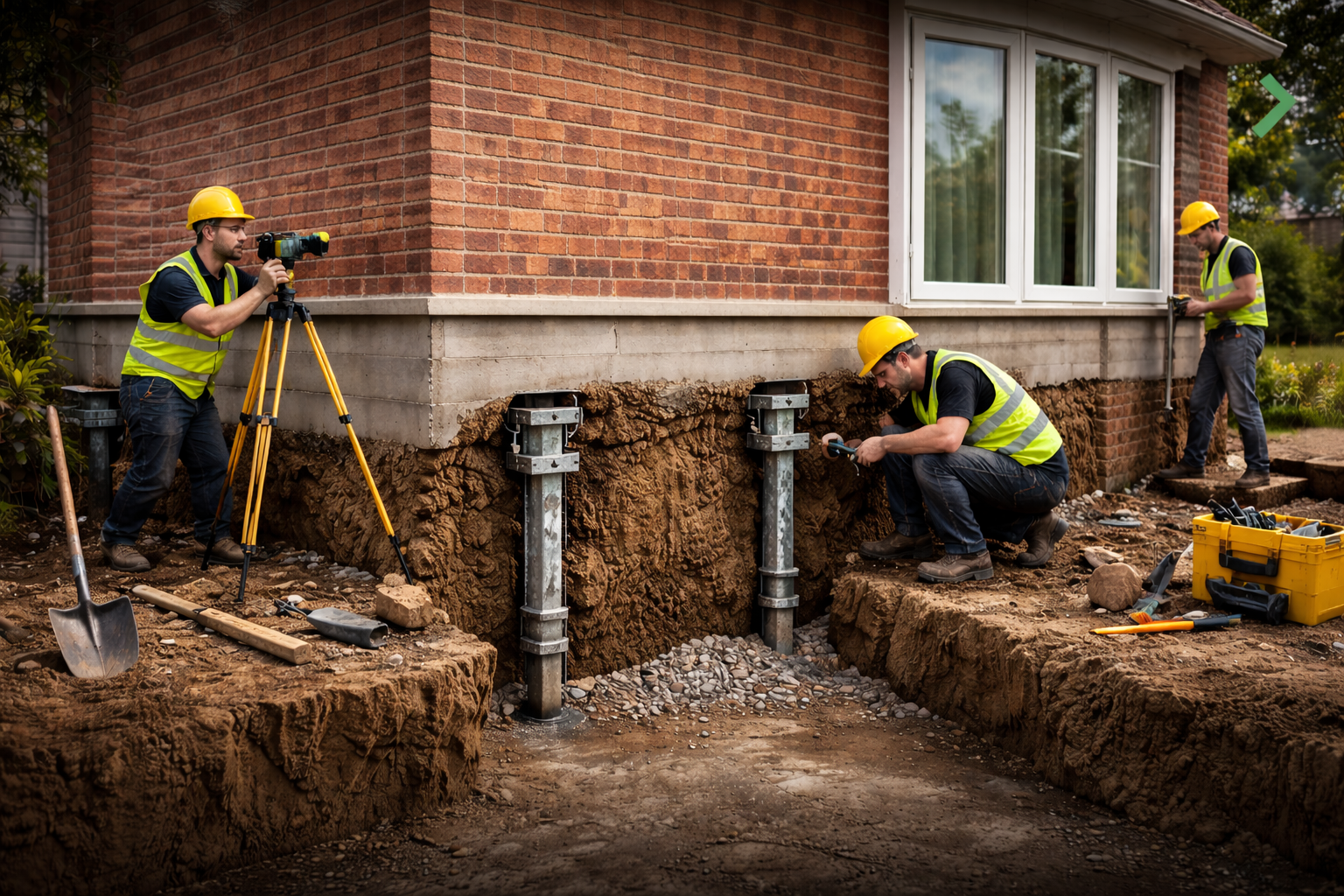
Foundation work showing proper structural support
Foundation Assessment
Frame inspection during conservatory refurbishment
Frame Inspection
Modern conservatory after successful refurbishment
After Refurbishment
Quality structural repairs completed
Quality Structural Work

Cosmetic Fixes: Why They Usually Fail

When faced with a sagging conservatory, many homeowners understandably look for the quickest, cheapest solution. Unfortunately, cosmetic fixes almost always fail—and often make the situation worse.

What Counts as a Cosmetic Fix?

Cosmetic approaches to a sagging conservatory typically include:

  • Resealing joints and gaps with silicone or mastic
  • Replacing individual roof panels without addressing the frame
  • Adding extra sealant or flashing around problem areas
  • Painting or refinishing frames to hide deterioration
  • Installing trim pieces to cover gaps between panels

❌ Cosmetic Fixes

  • Cost £200-800 per application
  • Typically last 6-18 months
  • Do not address root causes
  • Can mask worsening damage
  • Often create secondary problems
  • Waste money over time

✓ Structural Solutions

  • Cost £2,000-25,000 depending on scope
  • Last 20-30+ years
  • Fix underlying problems
  • Prevent future deterioration
  • Add value to property
  • One-time investment

The Problem with Surface-Level Solutions

They Do Not Address Root Causes

If your foundation is settling, no amount of sealant will prevent continued movement. The sagging will return—often worse than before—within months of a cosmetic repair. You cannot fix a structural problem with a non-structural solution.

They Can Mask Worsening Damage

Cosmetic fixes hide warning signs that would otherwise alert you to deteriorating conditions. By the time the problem resurfaces, structural damage may have progressed significantly. What might have been a moderate repair becomes a major refurbishment.

They Are Often False Economy

Spending £500-1,000 on temporary fixes every year or two quickly exceeds the cost of proper structural repairs. Many homeowners discover they have spent more on repeated cosmetic treatments than a full refurbishment would have cost—and they still have a failing conservatory.

They Can Create Secondary Problems

Poorly applied sealants can trap moisture within the structure, accelerating rot and corrosion that would not otherwise have occurred. New panels fitted to a warped frame will stress and crack prematurely, potentially causing leaks that damage your home’s interior. Sometimes, doing nothing is better than doing the wrong thing.

When Cosmetic Fixes Might Be Appropriate

Cosmetic approaches may be suitable only when:

  • The sagging is extremely minor (less than 5mm deviation)
  • A structural survey confirms no underlying issues
  • The conservatory is relatively new (under 10 years old)
  • You are addressing purely aesthetic concerns, not functional problems

In all other cases, a proper structural assessment should precede any repair work.

Structural Solutions That Actually Work

Unlike cosmetic patches, structural solutions address the underlying causes of your sagging conservatory. While they require greater initial investment, they provide lasting results and genuine value for money.

Professional Structural Assessment

Before any repair work begins, commission a proper structural survey. A qualified surveyor will examine:

  • Foundation condition and soil stability
  • Frame integrity at all connection points
  • Roof structure alignment and component condition
  • Evidence of water damage or material degradation
  • Overall structural calculations for the original design

This assessment typically costs £200-400 but provides essential information for planning effective repairs. It may reveal that problems are less severe than feared—or more serious than the visible symptoms suggest.

1

Foundation Remediation

£3,000 – £10,000 25+ years

For conservatories with subsidence or settlement issues, foundation work is essential before any other repairs can succeed.

  • Underpinning: Extends foundations to more stable ground by excavating beneath existing footings and pouring new concrete to greater depth
  • Mini-Piling: Drives piles to load-bearing strata for superior stability in poor ground conditions
  • Resin Injection: Modern technique that stabilises foundations without extensive excavation by injecting expanding resin to compact loose soil
2

Structural Frame Repairs

£2,000 – £6,000 15-20+ years

Once foundations are stable, frame issues can be addressed to restore structural integrity.

  • Steel Reinforcement: Additional steel supports integrated into existing frames where joints have weakened
  • Section Replacement: Individual frame sections replaced while maintaining overall structural continuity
  • Complete Frame Replacement: New frame fitted to existing base when deterioration is too extensive for repair
3

Roof Structure Restoration

£4,000 – £12,000 25-30 years

With foundation and frame secured, roof-specific problems can be definitively resolved.

  • Ring Beam Replacement: New ring beam installed with temporary propping of existing structure
  • Upgraded Glazing Bars: Heavier-duty modern profiles replacing original bars for improved rigidity
  • Solid Roof Conversion: Complete replacement with insulated, tiled roof system eliminating future glazing issues
4

Full Conservatory Refurbishment

£8,000 – £25,000 30+ years

When multiple systems are failing, comprehensive refurbishment offers the best long-term value.

  • New or reinforced foundations to current building regulations
  • Modern frame system with improved thermal performance
  • Engineered roof structure calculated for appropriate loading
  • Integrated heating, ventilation, and electrical systems
  • Full warranty coverage on all components

Cost Comparison: Cosmetic vs Structural Solutions

Understanding the true cost of different approaches helps you make an informed decision. While cosmetic fixes appear cheaper initially, the long-term mathematics often favour structural solutions.

Approach Typical Cost Expected Lifespan 10-Year Total Cost
Cosmetic repairs (sealant, patches) £200 – £800 6-18 months £4,000 – £8,000+
Individual panel replacement £300 – £1,500 2-5 years* £1,500 – £4,500
Structural frame repairs £2,000 – £6,000 15-20+ years £2,000 – £6,000
Foundation remediation £3,000 – £10,000 25+ years £3,000 – £10,000
Full roof replacement £4,000 – £12,000 25-30 years £4,000 – £12,000
Complete refurbishment £8,000 – £25,000 30+ years £8,000 – £25,000
Cosmetic Repairs
Typical Cost £200 – £800
Expected Lifespan 6-18 months
10-Year Total £4,000 – £8,000+
Structural Frame Repairs
Typical Cost £2,000 – £6,000
Expected Lifespan 15-20+ years
10-Year Total £2,000 – £6,000
Complete Refurbishment
Typical Cost £8,000 – £25,000
Expected Lifespan 30+ years
10-Year Total £8,000 – £25,000

*When underlying structural issues remain unaddressed, panel lifespan is significantly reduced.

Real-World Example: The True Cost of Cosmetic Fixes

Consider a homeowner facing a sagging conservatory with moderate frame deterioration and minor foundation settlement:

Cosmetic Approach Over 3 Years:

  • Initial repairs: £600
  • Repeat repairs at 12 months: £800
  • Further repairs at 24 months: £1,200
  • Emergency repairs at 30 months (leak damage): £2,000
  • Total: £4,600—with problems continuing to worsen

Structural Approach (One-Time Investment):

  • Professional assessment: £350
  • Foundation stabilisation: £4,000
  • Frame reinforcement: £2,500
  • Total: £6,850—with 20+ year solution

The structural approach costs more initially but proves significantly more economical over time while actually resolving the problem.

Warning Signs You Should Not Ignore

Knowing when to act can prevent small problems becoming expensive emergencies. Here are the warning signs that indicate your conservatory needs professional attention.

🚨 Emergency Indicators

Contact a structural engineer immediately if you observe:

  • Visible cracks in the conservatory base or dwarf walls
  • Doors or windows that suddenly will not open or close
  • Gaps appearing between the conservatory and main house
  • Cracking sounds from the structure
  • Rapid progression of visible sagging (changes over days or weeks)
  • Standing water that will not drain from the roof

⚠️ Progressive Warning Signs

Schedule an assessment soon if you notice:

  • Gradual difficulty with door or window operation
  • Condensation patterns suggesting frame distortion
  • Panels that no longer sit flush in their frames
  • Increasing draughts despite intact seals
  • Mould or damp patches on internal surfaces
  • Guttering that has separated from the structure

How to Choose the Right Approach for Your Situation

Making the right decision requires balancing immediate needs against long-term value. Here is a framework to help you decide.

Step 1: Get a Professional Assessment

Never attempt to self-diagnose structural problems. What appears to be a simple sagging roof may involve foundation issues invisible from the surface, or the reverse—dramatic-looking problems may have straightforward solutions. Seek assessments from:

  • A structural engineer (for foundation and frame concerns)
  • A specialist conservatory company with refurbishment experience
  • An independent building surveyor (for an unbiased opinion)

Step 2: Understand the Full Scope

Ask your assessors to explain:

  • All identified structural issues
  • Which problems are primary (causative) and which are secondary (symptoms)
  • The consequences of leaving various issues unaddressed
  • Multiple options at different price points

Step 3: Consider Your Timeline

How long do you plan to stay in your property? If you are moving within 2-3 years, cost-effective structural repairs might be appropriate. For a forever home, investing in comprehensive refurbishment makes sense.

Step 4: Evaluate Total Value

Factor in:

  • Energy efficiency improvements from modern construction
  • Increased usable space from a properly functioning conservatory
  • Property value impact of a well-maintained structure
  • Reduced stress from ending the repair cycle

When Full Refurbishment Is the Right Choice

Consider complete conservatory refurbishment when:

  • Multiple structural systems are failing simultaneously
  • The original construction quality was poor
  • Repair costs approach or exceed 50% of replacement value
  • You want to upgrade the conservatory’s specification significantly
  • The existing structure is more than 25 years old

Areas We Serve

Room Outside provides conservatory structural assessments, repairs, and full refurbishment services across the South East of England. Our experienced teams work throughout:

Kent Surrey Sussex Hampshire London Sevenoaks Guildford Chichester Brighton Tunbridge Wells Canterbury Maidstone

Not sure if we cover your area? Check our full coverage map or call us on 01243 538999 to confirm.

Sources and References

Glass and Glazing Federation: Conservatory Construction Standards; Building Research Establishment: Foundation Design Guidelines; Institution of Structural Engineers: Domestic Structure Assessment Protocols; Planning Portal UK: Building Regulations Part A (Structure); Room Outside: Internal Project Data 2018-2025.

Frequently Asked Questions

Can I fix a sagging conservatory roof myself?

DIY repairs are not recommended for structural sagging. While you might address minor seal failures, sagging indicates underlying problems requiring professional diagnosis and repair. Incorrect DIY interventions can worsen structural issues and create safety hazards.

How long does structural conservatory repair take?

Timelines vary significantly based on the work required: frame repairs take 2-5 days, foundation work takes 1-3 weeks including curing time, and full refurbishment takes 2-4 weeks. Your contractor should provide a detailed schedule during the quotation process.

Will my conservatory need to be demolished?

Not necessarily. Many structural problems can be resolved while retaining significant portions of the existing structure. Complete demolition is typically only required when foundation problems are severe or when the homeowner chooses to change the conservatory’s footprint or design.

Does a sagging conservatory affect property value?

Yes. Surveyors routinely identify conservatory defects during property valuations, and structural issues can reduce offers or cause sales to fall through. Conversely, a properly refurbished conservatory adds genuine value to your property.

Are structural repairs covered by insurance?

Standard home insurance typically covers sudden structural damage (storm, impact) but not gradual deterioration. If your conservatory was damaged in a specific event, contact your insurer. For age-related decline, repairs are generally the homeowner’s responsibility.

How do I know if my foundation is failing?

Signs of foundation problems include cracks in dwarf walls (especially diagonal cracks), the conservatory pulling away from the main house, doors and windows binding in their frames, uneven floor surfaces, and gaps at skirting board level.

What is the difference between underpinning and resin injection?

Underpinning physically extends foundations deeper into stable ground using concrete—more invasive but proven over decades. Resin injection stabilises existing ground through chemical expansion—less disruptive but not suitable for all soil types or settlement causes.

How much does it cost to fix a sagging conservatory?

Costs vary widely: cosmetic repairs cost £200-800 but typically fail within 18 months. Structural frame repairs cost £2,000-6,000 and last 15-20+ years. Foundation remediation costs £3,000-10,000. Full refurbishment costs £8,000-25,000 but provides a 30+ year solution.

Should I repair or replace my conservatory?

Consider replacement when repair costs exceed 50% of replacement value, multiple systems are failing, or the conservatory is over 25 years old. For newer structures with isolated problems, targeted repairs often provide better value.

How can I get a structural assessment?

Contact a specialist conservatory company or structural engineer. Room Outside offers free initial consultations across Kent, Surrey, Sussex, and London. Call 01243 538999 to arrange an assessment at your property.

Concerned about your sagging conservatory? Call our structural team on 01243 538999 for a free assessment

Stop Wasting Money on Temporary Fixes

Get a proper structural assessment and discover the real solution for your sagging conservatory. Our expert team provides honest advice and lasting repairs across Kent, Surrey, Sussex, and London.
roomoutsideuk
12th January, 2026

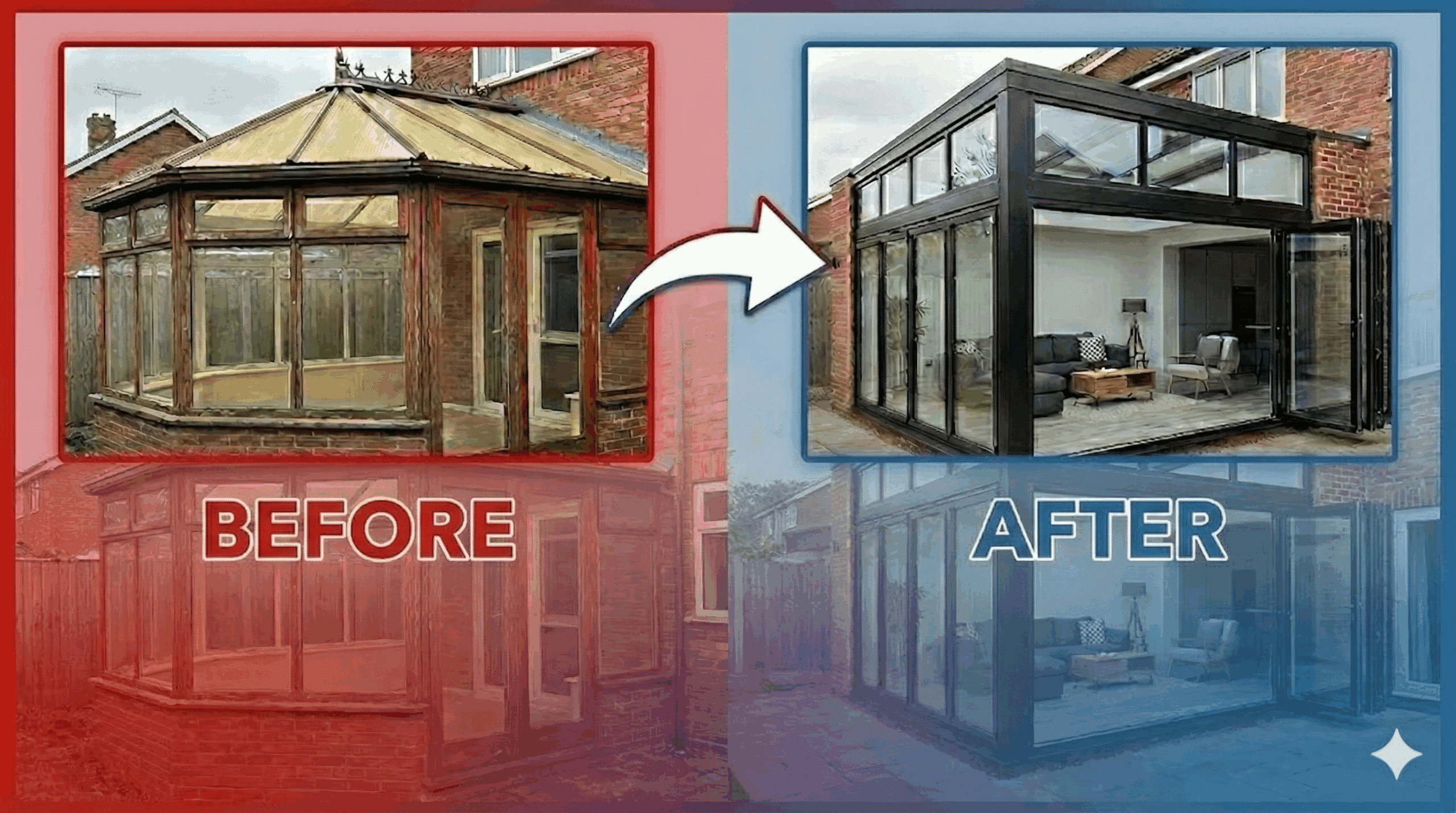
1990s Conservatory Revival: Modern Upgrades That Transform Old Structures

1990s Conservatory Revival: Modern Upgrades | Room Outside

1990s Conservatory Revival: Modern Upgrades That Transform Old Structures

A complete guide to refurbishment and replacement options for aging conservatories—backed by independent research and real data.

The Bottom Line

53% of conservatory owners cite temperature problems as their biggest complaint. Up to 80% of heat loss in a traditional conservatory occurs through the roof alone.

The good news: Modern upgrades can reduce heat loss by up to 90% and cut heating energy consumption by 32%. A polycarbonate to glass conversion costs £3,000-£8,000, while solid roofs (£5,000-£15,000) achieve U-values of 0.15-0.18 W/m²K—matching new-build extension standards.

Key stat: Typical payback period is 3-7 years through energy savings alone, with potential property value increases of 5-15%.

80%
Heat loss through old roofs
90%
Heat loss reduction possible
£200-£500
Annual energy savings
3-7 yrs
Typical payback period
According to government statistics, approximately 18% of households in England have a conservatory, with the vast majority built during the construction boom of the late 1980s and 1990s. If you own one of these structures, you’re not alone in noticing the toll that three decades have taken. A 2024 survey by Eurocell found that 53% of conservatory owners cite temperature problems as their biggest complaint—spaces that are too hot in summer and too cold in winter. The good news is that 2026 brings more options than ever for breathing new life into these aging spaces.

Understanding the Problems with 1990s Conservatories

Before exploring solutions, it helps to understand exactly why conservatories from this era have become problematic. Independent testing at Salford University’s Energy House 2.0 facility has provided detailed data on just how much energy older conservatories waste, finding that proper insulation can reduce heat loss by up to 90% and lower heating energy consumption by up to 32%.

Polycarbonate Roofing Issues

The single biggest complaint from owners of 1990s conservatories centres on polycarbonate roofing. According to research published by Ideal Home, polycarbonate roofs typically degrade within 10 to 20 years, showing clear signs of wear including leaks, cracks, and thermal failure.

The material offers a U-value of around 4.0 W/m²K or higher, compared to modern building regulations that require windows to achieve 1.4 W/m²K or lower. This means heat escapes at nearly three times the rate considered acceptable by current standards. The Eurocell Conservatory Census also found that 12% of owners specifically cite rain noise on polycarbonate roofs as a major issue, making the space unusable during wet weather.

Glazing Deficiencies

Early double-glazed units from the 1990s typically achieved U-values of 2.8 to 3.0 W/m²K—well below today’s standards. Modern double glazing with Low-E coatings achieves 1.0 to 1.1 W/m²K, while triple glazing can reach 0.6 to 0.8 W/m²K. Single-glazed panels, still found in many economy conservatories from the era, have U-values as high as 5.0 to 6.0 W/m²K, offering almost no insulation.

⚠️ The Hidden Problem: Failed Seals

Failed seals in older double-glazed units result in condensation between panes, reducing both visibility and thermal performance. If you see misting inside your glass units, the insulating gas has escaped and the unit has effectively become single-glazed in terms of thermal performance.

Structural Wear and Tear

Aluminium frames from the 1990s often lack thermal breaks, creating cold bridges that lead to condensation and heat loss. Research shows that thermally broken frames can improve overall window U-values by 0.2 to 0.3 W/m²K compared to non-broken alternatives.

uPVC frames, while more thermally efficient, can become discoloured, warped, or brittle after decades of UV exposure. Foundation and base issues also emerge over time, with some conservatories showing signs of subsidence or poor drainage.

The Scale of the Problem: UK Statistics

Understanding the scale of the issue helps put individual upgrade decisions into context. The Energy Follow-Up Survey conducted for the Department for Business, Energy and Industrial Strategy found that conservatory ownership correlates with larger homes (median floor area of 94m² compared to 77m² for homes without conservatories). The survey also revealed that households with conservatories use measurably more gas for heating.

The Numbers That Matter

A typical 12m² conservatory with poor insulation can leak 420 to 480 watts of heat per hour when outside temperatures drop just 10°C below inside temperatures. Over a 180-day heating season, this wastes over 1,500 kWh of energy. At current energy prices, that translates to hundreds of pounds in unnecessary heating costs each year.

The Polycarbonate to Glass Upgrade

One of the most popular and effective upgrades for 1990s conservatories is the polycarbonate to glass roof conversion. According to 2026 pricing data from multiple UK sources, glass roof replacements typically cost between £3,000 and £8,000 for an average-sized conservatory of around 16m². Checkatrade reports average costs of £9,450 for a 3m x 3.5m glass conservatory roof, with larger structures reaching £22,500 for 5m x 5m installations.

What Modern Glass Offers

Modern glass roof panels designed for conservatory use include multiple technologies that simply weren’t available thirty years ago:

  • Self-cleaning coatings reduce maintenance requirements
  • Solar control glass reflects unwanted heat in summer
  • Low-emissivity coatings retain warmth during winter months
  • U-values of 1.0 to 1.2 W/m²K compared to 4.0+ for polycarbonate
  • Acoustic interlayers cut rain noise substantially

Glass roofs also offer a longer lifespan than polycarbonate. While polycarbonate typically lasts 10 to 20 years, glass roofs can last 30 years or more with proper maintenance, making them a better long-term investment despite higher upfront costs.

Solid Roof Conversions: The Premium Option

For homeowners seeking the best possible thermal performance, solid roof conversions represent the premium old conservatory upgrade option. According to MyJobQuote’s 2026 pricing guide, solid conservatory roofs cost between £5,000 and £12,000 for average-sized structures, with tiled systems commanding £6,000 to £15,000 depending on specification and structural requirements.

0.15-0.18
Solid roof U-value (W/m²K)
4.0+
Old polycarbonate U-value
£200
Average annual savings
50+ yrs
Solid roof lifespan

Solid roof conversions achieve U-values of 0.15 to 0.18 W/m²K, bringing your conservatory in line with modern building regulations for new extensions. Independent research by AECOM for Guardian Building Systems found that solid roof conversions save homeowners an average of £200 per year on energy bills. The visual change is equally striking, with the finished result appearing more like a traditional extension than a conservatory.

⚠️ Structural Considerations

Solid roof conversions require careful structural assessment. The additional weight, while minimal compared to traditional roofing, may exceed what 1990s conservatory frames were designed to support. Converting from glass or polycarbonate to a solid roof typically adds £1,500 to £3,000 to the project cost for necessary structural reinforcement—a 30% to 40% premium over like-for-like replacement.

Real Energy Savings: What the Research Shows

Independent testing provides concrete data on what homeowners can expect from conservatory upgrades. Research conducted at Salford University’s Energy House 2.0 found that insulating a conservatory roof can reduce heat loss by up to 90% and lower heating energy consumption by up to 32%. This translates to annual savings of £200 to £500 depending on conservatory size, heating system, and usage patterns.

The Glass and Glazing Federation notes that a well-designed conservatory can act as a thermal buffer zone between indoor and outdoor areas. Heat that escapes through house walls into an insulated conservatory helps warm that space, and can then re-heat the main building when doors are opened. This passive solar gain effect was largely impossible with poorly insulated 1990s structures but becomes achievable with modern upgrades.

CosyPanels Research Findings

CosyPanels research indicates that modern insulated roofs reduce heat loss from 54% to just 10%—an 80% improvement that cuts heating bills proportionally. Their data suggests typical payback periods of 3 to 7 years depending on conservatory size and usage, making upgrades a financially sound decision rather than just a comfort improvement.

Impact on Property Value

The relationship between conservatories and property value is nuanced. According to the Nationwide Building Society, a high-quality conservatory can add between 5% and 15% to overall property value. Property expert Phil Spencer has stated that conservatories add an average of 7% to property value when they feel like part of the house rather than something “bolted on the back.”

❌ Poor Condition = Value Reduction

Outdated conservatory impact -£15,000
27% of owners unsure about value Risk
Unusable space perception Negative
Net impact on sale Liability

✓ Upgraded = Value Added

Quality upgrade impact +5-15%
Year-round usability Asset
Energy efficiency appeal Positive
Net impact on sale +£20,000+

However, quality matters enormously. Recent reports cited by Eurocell reveal that older conservatories with poor insulation can actually reduce home value by up to £15,000. The Eurocell Conservatory Census found that 60% of respondents believed their conservatory added value, but 27% were unsure—suggesting many owners recognise their structures may not be assets in their current condition.

2026 Cost Summary

Based on current market data from multiple UK sources, here’s what homeowners can expect to pay for different old conservatory upgrade options in 2026:

Upgrade Option Cost Range U-Value Achieved Lifespan Best For
Polycarbonate Replacement £2,000 – £5,000 1.6 – 2.4 W/m²K 10-15 years Budget option
Polycarbonate to Glass £3,000 – £8,000 1.0 – 1.2 W/m²K 30+ years Best balance
Solid/Tiled Roof £5,000 – £15,000 0.15 – 0.18 W/m²K 50+ years Maximum performance
Complete Refurbishment £8,000 – £25,000 Varies 30-50 years Multiple issues
Full Replacement £15,000 – £40,000+ 0.8 – 1.2 W/m²K 40+ years Structural problems
Polycarbonate Replacement
Cost Range £2,000 – £5,000 ✓ Cheapest
U-Value Achieved 1.6 – 2.4 W/m²K ✗ Poorest
Lifespan 10-15 years
Best For Budget option, quick fix
Polycarbonate to Glass
Cost Range £3,000 – £8,000
U-Value Achieved 1.0 – 1.2 W/m²K
Lifespan 30+ years
Best For Best balance of cost & performance ✓ Popular
Solid/Tiled Roof
Cost Range £5,000 – £15,000
U-Value Achieved 0.15 – 0.18 W/m²K ✓ Best
Lifespan 50+ years ✓ Best
Best For Maximum thermal performance
Complete Refurbishment
Cost Range £8,000 – £25,000
U-Value Achieved Varies by specification
Lifespan 30-50 years
Best For Multiple issues to address
Full Replacement
Cost Range £15,000 – £40,000+
U-Value Achieved 0.8 – 1.2 W/m²K
Lifespan 40+ years
Best For Structural problems, complete redesign

Labour costs typically account for £150 to £300 per day for a roofer, with most roof replacements requiring a two-person team for one to three days. Installation-only costs start at approximately £2,500 including the base for standard builds.

Complete 1990s Conservatory Refurbishment

When the roof alone isn’t the only issue, a complete 1990s conservatory refurbishment addresses multiple parts at once. Based on 2026 market pricing, complete refurbishment projects commonly fall between £8,000 and £25,000 for work including roof, glazing, and frame upgrades. This compares favourably to full replacement costs, which typically start around £15,000 for modest structures and can exceed £40,000 for larger, premium installations.

What Complete Refurbishment Includes

  • Roof upgrade: Polycarbonate to glass or solid roofing
  • Glazing replacement: Modern triple-glazed units (U-values of 0.6 to 0.8 W/m²K)
  • Frame repairs: Eliminate thermal bridges
  • Base insulation: Complete the thermal envelope
  • Updated doors: Thermally efficient access points
  • Modern ventilation: Maintain air quality without compromising thermal performance

When Replacement Makes More Sense

While refurbishment offers excellent value in many situations, some circumstances point clearly toward complete replacement. According to cost comparison data, a traditional brick extension costs £1,800 to £3,500 per m², compared to £1,300 to £1,500 per m² for a new conservatory. This means a conservatory remains a more affordable way to add living space, even accounting for full replacement costs.

🔧 Choose Refurbishment If:

  • Foundations are stable with no subsidence
  • Frame structure is sound (no major rot or corrosion)
  • Current footprint and design work for your needs
  • Budget is £8,000-£25,000
  • You want to preserve the existing character

✓ Choose Replacement If:

  • Foundations show signs of failure
  • Frame has major corrosion or rot
  • You want to change footprint or design
  • Multiple structural issues exist
  • Budget allows for £15,000-£40,000+

Planning Permission and Building Regulations

Understanding regulatory requirements helps avoid costly mistakes. Like-for-like repairs and maintenance—including glass-to-glass or polycarbonate-to-polycarbonate roof replacements—typically don’t require planning permission or building regulations approval.

Building Regulations for Solid Roofs

Solid roof conversions are more complex. Many approved lightweight systems fall under Permitted Development, but almost all solid and tiled roofs require Building Regulations approval, costing £200 to £800+. Properties in conservation areas, listed buildings, or those that have exhausted permitted development allowances will need specific planning consent for any external changes.

Conservatory Exemptions

Conservatories can be exempt from building regulations if they meet specific criteria:

  • Floor area less than 30m²
  • Physically separated from the main property by an external wall or door
  • Not heated by the main heating system
  • Has independent temperature control

Upgrading an existing conservatory may affect these exemptions, so check requirements before work begins.

Project Timelines

A polycarbonate to glass roof conversion can often complete within two to three days for standard-sized conservatories. According to MyJobQuote, a typical two-person team can complete most roof replacements within this timeframe, with polycarbonate installations slightly faster than glass due to lighter weight and easier handling.

Solid roof conversions typically take one to two weeks depending on complexity, particularly if structural reinforcement is required. Industry sources note that insulated roof panels can often be fitted in just a few days as they slot into existing frames, while full tiled systems requiring new structures may take a week or longer.

Full refurbishments or replacements naturally take longer, with larger projects potentially spanning several weeks including foundation work if required. Spring and autumn typically offer the best conditions for conservatory work, though experienced contractors work year-round with appropriate weather protection.

Making Your Decision

The 1990s conservatory serving your home has likely provided years of enjoyment despite its limitations. With 65% of conservatory owners using their space daily according to the Eurocell survey, these structures remain valued parts of UK homes. The question is whether to refurbish or replace.

The Financial Case

If your frame and base remain sound, refurbishment offers excellent value. The polycarbonate to glass conversion alone can reduce U-values from 4.0+ to around 1.0 W/m²K—a fourfold improvement in thermal performance. Combined with energy savings of £200 to £500 annually and potential property value increases of 5% to 7%, the financial case for upgrading is strong.

When serious structural issues exist or when your needs have grown beyond what refurbishment can address, replacement delivers a fresh start with contemporary performance. Either path leads to the same destination: a comfortable, efficient, and attractive space that extends your living area throughout the year.

📚 Sources

Department for Energy Security and Net Zero Energy Follow-Up Survey; Salford University Energy House 2.0 research; Eurocell Conservatory Census 2024; Nationwide Building Society; Checkatrade; MyJobQuote; AECOM/Guardian Building Systems research; Glass and Glazing Federation; CosyPanels industry data; Squared Money Home Improvement Index.

Frequently Asked Questions

How do I know if my 1990s conservatory can be refurbished or needs replacing?

Start by checking the frame and base. If the frame is structurally sound without major rot, warping, or corrosion, and the base shows no signs of subsidence or cracking, refurbishment is usually viable. A professional survey will confirm whether your existing structure can support upgrades like a glass or solid roof.

Is a polycarbonate to glass roof conversion worth the money?

For most homeowners, yes. The upgrade typically costs between £3,000 and £8,000, with immediate improvements in temperature control, noise reduction, and appearance. Modern glass achieves U-values of 1.0 to 1.2 W/m²K compared to 4.0+ W/m²K for polycarbonate—a fourfold improvement in thermal performance.

Do I need planning permission to upgrade my conservatory roof?

For like-for-like replacements such as swapping polycarbonate for glass panels, planning permission usually isn’t required. Solid roof conversions are more complex—almost all solid and tiled roofs require Building Regulations approval, costing £200 to £800+. Properties in conservation areas will likely need planning consent.

How much could I save on energy bills after upgrading?

Research from Salford University shows insulation can reduce heating energy consumption by up to 32%. Industry sources cite typical annual savings of £200 to £500. Heat loss reduction from 54% to 10% cuts heating bills proportionally. Typical payback periods range from 3 to 7 years.

What’s the difference between a glass roof and a solid roof conversion?

Glass roofs maintain the light, airy feel of a traditional conservatory while offering much better thermal performance (U-values around 1.0-1.2 W/m²K) and can last 30+ years. Solid roofs achieve U-values of 0.15-0.18 W/m²K—comparable to traditional extensions—but change the character to feel more like a room.

How long does a conservatory refurbishment take?

A polycarbonate to glass roof conversion typically takes 2-3 days with a two-person team. Solid roof conversions usually require 1-2 weeks. Full refurbishments including glazing, frames, and other components can take 2-4 weeks depending on the scope of work.

Will upgrading my conservatory add value to my home?

A well-executed conservatory upgrade can add 5% to 15% to property value. However, older conservatories with poor insulation can reduce home value by up to £15,000. The key is ensuring year-round usability and thermal efficiency—making upgrades essential for protecting your investment.

What U-values should I look for in conservatory glazing?

Current Building Regulations require windows to achieve maximum U-values of 1.4 W/m²K, with the Future Homes Standard requiring 1.2 W/m²K or lower. For year-round comfort, aim for 1.2 W/m²K or lower. Premium options achieve 0.8-1.0 W/m²K using triple glazing and thermally broken frames.

Ready to Revive Your 1990s Conservatory?

Whether you need a simple roof upgrade or a complete refurbishment, our team has completed hundreds of conservatory projects across Kent and the South East. Get a free, no-obligation assessment of your structure and personalised recommendations.

roomoutsideuk
29th December, 2025

Why Condensation Appears in Glass Rooms

Why Condensation Appears in Glass Rooms And the Engineering Solutions That Eliminate It
Why Condensation Appears in Glass Rooms | Room Outside

Why Condensation Appears in Glass Rooms

And the engineering solutions that eliminate it permanently.

The Quick Science

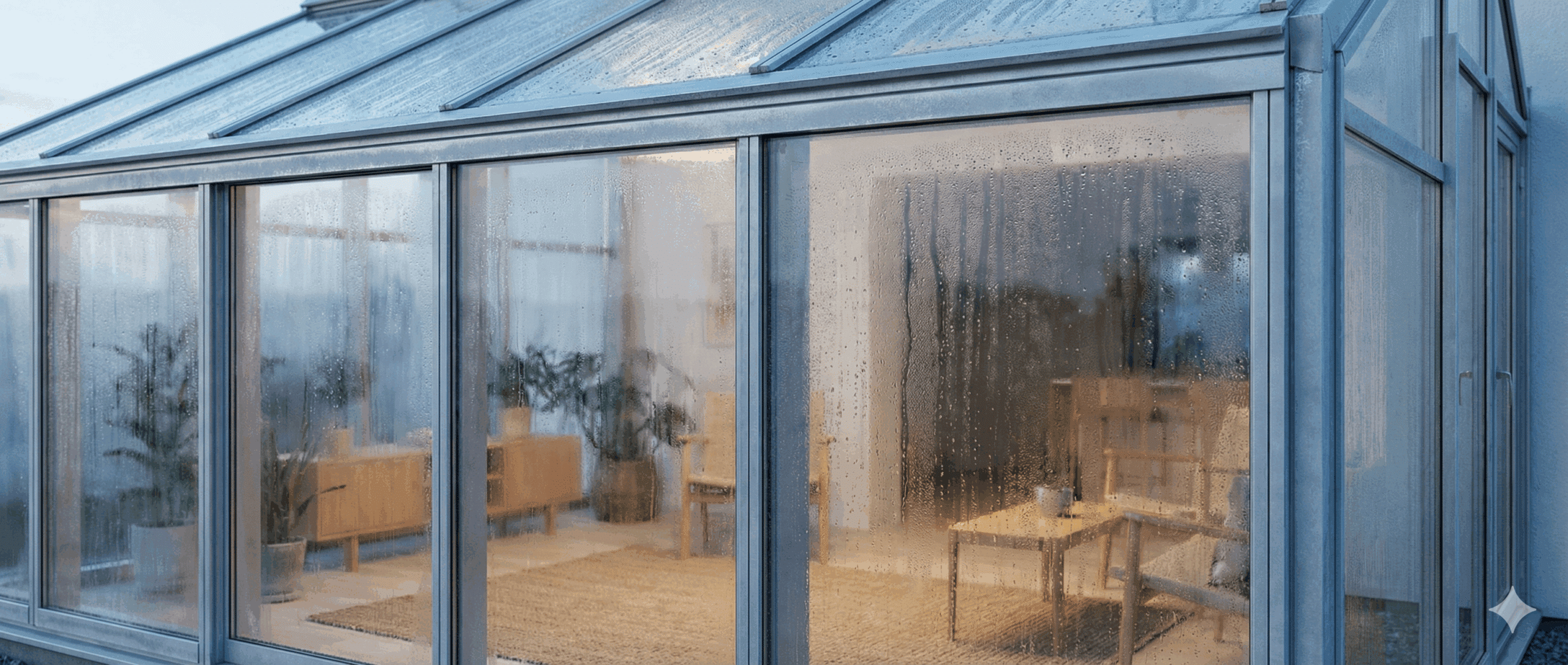
Condensation is not water leaking through windows. It’s water that was already in your room’s air, changing from invisible vapour to visible liquid when it touches a cold surface.

The dew point is the temperature at which condensation begins. At 21°C and 60% humidity, the dew point is approximately 13°C. Any surface below 13°C will collect moisture.

The solution: Keep glass surfaces above the dew point (better glazing), reduce moisture levels (ventilation), or both. Modern high-performance glazing keeps surfaces 5-10°C warmer than old double glazing.

13°C
Dew point at 21°C/60% humidity
5°C
Single glazing surface temp (winter)
16°C+
Modern glazing surface temp
40-60%
Ideal indoor humidity range
You walk into your conservatory on a winter morning and cannot see the garden. Every window is streaming with water. Droplets run down the glass and pool on the frames. The cushions feel damp. This is not a design flaw you have to accept. It is a physics problem with engineering solutions.

The Science: Why Water Appears on Glass

Condensation is water that was already in the air inside your room, changing from invisible vapour to visible liquid when it touches a cold surface. The physics are straightforward once you understand three concepts: relative humidity, dew point, and surface temperature.

Relative Humidity and Water Vapour

Air holds water vapour. Warm air holds more than cold air. Relative humidity measures how much water vapour the air currently contains compared to the maximum it could hold at that temperature.

Here is the critical point: when air temperature drops, its capacity to hold moisture drops too. If you have air at 21°C with 60% relative humidity and cool it down, the relative humidity rises even though you haven’t added any moisture. Cool it enough and the relative humidity reaches 100%. Cool it further and the excess moisture has to go somewhere. It condenses.

Dew Point: The Critical Temperature

The dew point is the temperature at which air becomes saturated and condensation begins. It depends on both the air temperature and how much moisture the air contains. Higher moisture content means a higher dew point.

Why Glass Is the Problem Surface

Glass is typically the coldest surface in any room. In a conservatory with large glazed areas, you have many square metres of potential condensation surface. A single pane of glass with 0°C outside and 21°C inside will have an internal surface temperature of only about 5°C—well below the dew point of any normally occupied room.

Dew Point at Common Indoor Conditions

Room Temperature Relative Humidity Dew Point
21°C 50% 10°C
21°C 60% 13°C ⚠️
21°C 70% 15°C ⚠️
18°C 60% 10°C
21°C Room Temperature
50% Humidity Dew Point: 10°C
60% Humidity Dew Point: 13°C ⚠️ Risk
70% Humidity Dew Point: 15°C ⚠️ High Risk
18°C Room Temperature
60% Humidity Dew Point: 10°C

Any glass surface below the dew point temperature will collect condensation. In a conservatory with poor glazing, surface temperatures of 5-8°C are common in winter, guaranteeing condensation at any normal humidity level.

The Real Culprits: What Causes Condensation

Condensation forms when moisture meets cold surfaces. Solving it requires addressing one or both factors. Most older glass rooms fail on both counts: they allow surfaces to get too cold and they trap moisture inside.

Cold Surfaces: The Glazing Problem

❄️

Single Glazing

Offers almost no insulation. Internal glass surface drops to around 5°C in winter—below the dew point of any normally humid room. Single glazed conservatories will always suffer severe condensation in cold weather.

🔲

Aluminium Spacers

Double glazing from the 1980s/90s used aluminium spacer bars. Aluminium conducts heat rapidly, creating a thermal bridge. Glass edge temperatures drop 15-20°C below centre pane—causing characteristic edge condensation.

🏠

Polycarbonate Roofing

Lightweight and inexpensive but degrades over time. Older polycarbonate has internal condensation trapped within its cellular structure, reducing insulating properties. The underside becomes cold enough to collect moisture.

🌡️

Temperature Swings

Glass rooms experience extreme temperature swings. Solar gain pushes temperatures to 25°C+ during the day; poor insulation allows rapid heat loss at night. Warm air absorbs moisture by day, releases it as temperatures plummet overnight.

Trapped Moisture: The Ventilation Problem

A conservatory designed to be airtight has no natural ventilation. Every activity that adds moisture raises humidity with nowhere for it to escape.

  • Breathing: A single person exhales approximately 200ml of water vapour per hour
  • Drying laundry: A typical wash load releases 2-3 litres of water as it dries
  • Plants: Houseplants transpire significant moisture, especially in warm, sunny conditions
  • Cooking and hot drinks: Kettles, cooking pots, and hot beverages all release steam
  • Open doors to the house: Moisture migrates from kitchens and bathrooms into the conservatory

Why Condensation Cannot Be Ignored

Condensation is not merely an inconvenience. Persistent moisture causes real damage to your structure and can affect your health.

⚠️ The Real Costs of Condensation

Structural Damage: Water pooling on frames promotes rot in timber and corrosion in metal. Seals around glazing units deteriorate faster when constantly wet. Gaskets can fail, allowing moisture between panes and causing the characteristic cloudy appearance of failed double glazing.

Mould Growth: Mould thrives in damp conditions. Beyond unsightly black marks, mould releases spores that can trigger respiratory problems, allergic reactions, and asthma symptoms. Vulnerable individuals are particularly at risk.

Unusable Space: A conservatory too damp to use for half the year delivers poor value. Furniture deteriorates, books become mildewed, and the room feels cold and unwelcoming.

Engineering Solutions That Actually Work

Eliminating condensation requires raising surface temperatures above the dew point, reducing moisture levels, or both. Effective solutions address the physics directly rather than masking symptoms.

Glazing Upgrades: Warmer Surfaces

🔷

High-Performance Double & Triple Glazing

Modern sealed units use Low-E coatings and argon gas fill to dramatically reduce heat transfer. Where old double glazing achieves 2.8 W/m²K, current high-performance units reach 1.0-1.2 W/m²K. Triple glazing can achieve 0.6-0.8 W/m²K. Internal glass surfaces stay at 16°C or higher—above the dew point in most circumstances.

🔲

Warm Edge Spacer Technology

Warm edge spacers replace aluminium bars with materials that conduct far less heat—stainless steel (one-tenth the conductivity), polymer composites, or hybrids. This raises glass edge temperatures by 5-12°C compared to aluminium spacers, eliminating characteristic edge condensation. Products like Swisspacer and SuperSpacer can improve overall U-values by 5-15%.

🏗️

Thermally Broken Frames

Aluminium frames without thermal breaks conduct heat rapidly and become condensation sites themselves. Modern aluminium systems incorporate polyamide thermal breaks that interrupt the heat path, keeping frame surfaces warmer. Timber and composite frames naturally provide better insulation.

Ventilation: Controlling Moisture

💨

Trickle Ventilation

Small, adjustable openings built into window frames or roof systems allow continuous air exchange even when windows are closed. Prevents moisture accumulation without significant heat loss. Modern conservatory roofing systems incorporate patented trickle ventilation as standard.

🔼

Roof Vents

Since warm, moist air rises, roof vents are particularly effective. A single roof vent provides equivalent ventilation to approximately four window openings. Options range from manual pole-operated vents to electric versions with thermostats and rain sensors that open/close automatically.

⚙️

Mechanical Ventilation

For persistent humidity issues, mechanical ventilation provides controlled air exchange. Heat recovery ventilation systems extract stale air while recovering its warmth to pre-heat incoming fresh air. Particularly valuable when the glass room connects to moisture-producing areas like kitchens.

Heating: Raising Surface Temperatures

Maintaining warmth keeps surfaces above the dew point. The challenge is doing so efficiently given the thermal characteristics of glazed structures.

  • Underfloor heating: Provides even, gentle warmth that rises through the space. Minimises air movement that can carry moisture to cold surfaces. Warms the lowest part of the room first.
  • Perimeter heating: Low-level heating at the base of windows creates a rising curtain of warm air that helps keep glass surfaces above the dew point.
  • Dehumidifiers: Extract moisture from the air, lowering the dew point. Desiccant dehumidifiers outperform compressor models below 10°C. Running costs: 3-5p per hour.

What Does Not Work

Some commonly suggested remedies address symptoms without tackling causes. Understanding their limitations helps you invest in solutions that actually resolve the problem.

🪟
Opening Windows in Winter

Reduces humidity but lets all your heat escape, making the room uncomfortable and expensive to use. Background trickle ventilation achieves the same air exchange without massive heat loss.

🔥
Heating Alone

With poor glazing, heating creates bigger temperature differences between warm air and cold glass. You may reduce centre-of-glass condensation while worsening edge condensation. Energy bills will be substantial.

📦
Moisture Absorbers

Small moisture absorbing products (silica gel, salt-based absorbers) capture minor amounts. Completely inadequate for the volumes involved—a conservatory may contain 100 cubic metres of air needing litres of water removed.

🪞
Blinds As Prevention

Blinds don’t prevent condensation. Closing blinds against cold glass can actually create a pocket of stagnant air where condensation may increase. Thermal blinds help regulate temperature but are not a solution on their own.

Refurbishment: Transforming Problem Conservatories

For conservatories suffering chronic condensation, targeted refurbishment can transform performance. Our conservatory refurbishment service addresses the specific weaknesses causing moisture problems.

Glazing Replacement

Replacing failed or underperforming sealed units with modern high-performance glazing is often the most impactful single intervention. Where existing frames are sound, new glass units with warm edge spacers, Low-E coatings, and argon fill can be installed without replacing the entire structure. The improvement is immediate and dramatic.

Roof Upgrades

Polycarbonate roofs that have degraded can be replaced with modern glass or solid options. Lightweight insulated roof panels combine thermal performance with natural light through integrated glazed sections. These replacement systems typically include integral trickle ventilation.

Ventilation Retrofitting

Adding ventilation to existing structures is usually straightforward. Trickle vents can be fitted to most window and door frames. Roof vents can be integrated into glazed or solid roof sections. The cost is modest relative to the improvement.

Complete Replacement

Where multiple elements have failed or the original structure was fundamentally compromised, complete replacement may prove more cost-effective than piecemeal repairs. Modern glass rooms engineered as integrated systems deliver performance that older structures simply cannot match, regardless of modifications.

Taking Control of Your Glass Room Environment

Condensation is not a mystery once you understand the physics. Warm, moist air meeting cold surfaces releases its moisture as liquid water. The solution is straightforward in principle: keep surfaces warm enough and manage moisture levels to stay above the dew point.

For older conservatories built before modern glazing standards, this often requires intervention. Upgrading to high-performance glass with warm edge spacers transforms surface temperatures. Adding proper ventilation prevents moisture accumulation. Appropriate heating maintains comfort without excessive energy consumption.

Across Kent and the surrounding areas we serve, we have helped hundreds of homeowners transform problem conservatories into comfortable, year-round living spaces. Whether through targeted glazing upgrades, comprehensive refurbishment, or complete replacement with modern engineered structures, the solutions exist to eliminate condensation permanently.

The Bottom Line

The choice is not between accepting condensation or abandoning your glass room. With proper engineering, you can enjoy clear glass, dry surfaces, and comfortable conditions throughout the year.

Further Reading

For technical information on condensation and glazing performance, see the Glass and Glazing Federation guidance and the National Physical Laboratory for dew point resources.

Frequently Asked Questions

Why does condensation appear on the inside of my windows?

Interior condensation forms when warm, moist indoor air contacts glass that has cooled below the dew point. It indicates that your glazing surface temperature is too low, your indoor humidity is too high, or both. The solution involves improving glazing performance, increasing ventilation, or both.

Is condensation between double glazing panes different?

Yes. Condensation between the panes indicates seal failure. The sealed unit has lost its integrity, allowing moist air to enter the cavity. No amount of ventilation or heating will fix this. The affected sealed units must be replaced.

Why is condensation worse at the edges of my windows?

Edge condensation typically indicates aluminium spacer bars in your sealed units. Aluminium conducts heat rapidly, creating a thermal bridge that cools the glass edge far below the centre-of-pane temperature. Warm edge spacer technology eliminates this problem.

Will a dehumidifier solve my condensation problem?

A dehumidifier can help manage symptoms by reducing indoor humidity. However, it doesn’t address underlying issues with glazing performance or ventilation. For older conservatories with poor thermal performance, dehumidification works best alongside glazing upgrades.

What humidity level should I aim for?

Indoor relative humidity between 40% and 60% is generally comfortable and healthy. Below 40% can cause dry skin and irritated airways. Above 60% increases condensation risk and supports mould growth. A simple hygrometer (£10-£20) lets you monitor conditions.

Can I retrofit warm edge spacers to existing windows?

Not directly. The spacer bar is integral to the sealed unit. However, you can replace existing sealed units with new ones incorporating warm edge technology, often without replacing the entire frame. This targeted upgrade addresses edge condensation specifically.

How much difference does modern glazing make?

Substantial. Where old double glazing achieves 2.8 W/m²K, modern high-performance units reach 1.0-1.2 W/m²K. The internal glass surface stays 5-10°C warmer, often enough to eliminate condensation entirely under normal conditions.

Should I keep my conservatory heated overnight?

Maintaining some warmth overnight helps prevent the temperature drop that triggers condensation. However, with poor glazing this becomes expensive. Improving thermal performance first, then providing modest background heating, is more cost-effective.

Is condensation in a new conservatory normal?

Some condensation during the first winter is common as construction moisture dries out. This should diminish as the structure settles. Persistent condensation in a new build suggests design or specification issues—modern conservatories with high-performance glazing should not suffer significant condensation.

What about exterior condensation on windows?

Condensation on the outside of glass is actually a sign of good thermal performance. It occurs when highly insulating glazing keeps the outer pane cold enough to fall below the outdoor dew point on humid mornings. It evaporates as the day warms and causes no problems.

How do I know if my conservatory needs refurbishment?

Signs include persistent condensation even with ventilation, visible seal failure between panes, draughts around frames, difficulty maintaining comfortable temperatures, and visible deterioration. If your conservatory is over 15-20 years old with these issues, refurbishment is typically more economical than ongoing management.

Will plants make condensation worse?

Yes. Plants transpire water continuously, releasing moisture through their leaves. A conservatory full of houseplants will have measurably higher humidity. If condensation is a problem, reduce the plant population or ensure adequate ventilation to compensate.

Can I dry laundry in my conservatory?

A typical wash load releases 2-3 litres of water as it dries. In a poorly ventilated conservatory, this dramatically increases humidity and guarantees condensation. If you must dry laundry indoors, do so with windows open or a dehumidifier running.

What is the best long-term solution?

The most effective long-term approach combines high-performance glazing (raising surface temperatures above the dew point) with adequate ventilation (preventing moisture accumulation). Modern glass rooms engineered as integrated systems achieve both, delivering condensation-free performance.

Ready to Eliminate Condensation Permanently?

Our specialists transform problem conservatories across Kent, Surrey, Sussex, Hampshire and the South East.

roomoutsideuk
15th December, 2025

Why Your Conservatory is Uncomfortable: A Complete UK Diagnosis Guide | Room Outside

Why Your Conservatory is Uncomfortable: A Complete UK Diagnosis Guide | Room Outside

Why Your Conservatory Feels Uncomfortable: The Complete Diagnostic Guide for UK Homeowners

The physics, the failures, and the data behind why your conservatory sits empty for 248 days a year—and how to transform it into a usable, valuable living space.

Quick Diagnosis Summary

Your conservatory’s discomfort stems from three physics failures: conductive failure (cold frames stealing warmth), radiative failure (unmanaged greenhouse effects), and convective failure (drafts and temperature stratification). These create an average 68% annual comfort deficit—meaning your conservatory lies unused for roughly 248 days each year. The problem isn’t your home; it’s the outdated technology encasing it.

The Unspoken Truth About Your Glass Room: You envisioned a sun-drenched lounge, a serene garden-view breakfast room, or a bright space that blended indoor comfort with outdoor beauty. The reality is often starkly different: a room that sits empty for months, a source of drafts and damp, or a thermal rollercoaster that defies control. This gap between expectation and reality is not a failure of your home, but a fundamental failure of the technology encasing it.

For decades, homeowners across Surrey, West Sussex, and Hampshire have accepted a flawed premise: that a structure made primarily of glass must inherently be uncomfortable. This was the unavoidable compromise for light and views. Today, that compromise is obsolete. The discomfort you experience is not a condition to be endured; it is a series of specific, diagnosable engineering failures. At Room Outside, with five decades of experience re-engineering glass spaces for the British climate, we have moved from simply building conservatories to clinically diagnosing and solving their failures. This guide provides you with the framework to understand precisely what has gone wrong in your space.

The Physics of Failure: A System-Wide Breakdown

A traditional conservatory fails as a living space because every component, from roof to frame, is engineered to minimum standards that prioritise cost and light admission over climate control. The entire structure acts as a leaky, inefficient shell. Our thermal performance audits of over 200 pre-2010 installations reveal a consistent pattern: these rooms operate with an average annual comfort deficit of 68%, lying unused due to temperature extremes for roughly 248 days of the year.

The root cause is a triple-failure in managing the three methods of heat transfer. Understanding these is key to diagnosing your specific problem.

❄️
1
Conductive Failure
The Cold Bridge Effect

Conduction is the direct flow of heat through a solid material. In a building, materials with high thermal conductivity (like metals) create “thermal bridges” that shortcut insulation.

The Diagnosis in Your Home:

🔍
The Frames: Place your hand on the frame on a 5°C winter day. If it feels cold to the touch, you are feeling conductive heat loss in real-time. Traditional aluminium frames have a thermal conductivity of 160 W/mK. They act as a superhighway for warmth to escape from your home’s interior to the exterior.
🔍
The Spacer Bar: The thin metal bar sealed between the glass panes at the edge of the window is a critical weak point. Old aluminium spacers conduct external cold directly to the interior glass edge.
🔍
The Glazing Bars: The network of bars holding roof panels in place are often unbroken metal, creating a grid of cold bridges across your ceiling.
🔥
2
Radiative Failure
The Unmanaged Greenhouse

Radiant heat travels as electromagnetic waves (infrared radiation). Standard glass is transparent to short-wave solar radiation but acts as a barrier to long-wave heat radiation, causing entrapment.

The Diagnosis in Your Home:

🔍
Summer Solar Gain: The often-cited “greenhouse effect” is, in your conservatory, a sign of radiative management failure. Uncoated glass transmits up to 84% of solar infrared energy. Our data logs show south-facing rooms can reach 38-45°C on a 25°C day.
🔍
Winter Radiant Heat Loss: At night, especially under clear skies, your warm room surfaces radiate heat directly out through the glass to the colder outdoors. This is why you feel a penetrating “radiant chill” even when the air temperature is stable.
💨
3
Convective Failure
The Draft and Stratification Cycle

Convection is heat transfer through fluid movement—in your room, this means air.

The Diagnosis in Your Home:

🔍
Cold Downdraught: This is the palpable chill you feel when sitting near the glass. Air molecules in contact with the cold interior surface of the glass cool, become denser, and sink rapidly.
🔍
Air Infiltration: Research from the Building Research Establishment (BRE) identifies uncontrolled air leakage as a major contributor to heat loss and discomfort. This can account for 15-30% of the total heat loss.
🔍
Thermal Stratification: Hot air rises and gets trapped at the apex of your conservatory roof—often 10-15°C hotter than the air at floor level.

Why Single Components Fail Entire Systems

The spacer bar between glass panes can degrade overall window performance by up to 20%. The glazing bars on roofs create a grid of cold bridges. Air infiltration through poor seals accounts for 15-30% of the total heat loss. Each component failure compounds the others, creating a system-wide breakdown that makes your conservatory unusable for most of the year.

Component-Level Diagnosis: Your Interactive Inspection Checklist

Move from understanding the principles to identifying the exact faulty components in your conservatory. Perform this inspection with a notepad and a thermometer.

Diagnose the Roof – The Primary Culprit

The roof is responsible for over 60% of a conservatory’s thermal problems due to its large surface area and typically poor specification.

Material Identification:

Poor
Polycarbonate: Often multi-walled and hollow. It will feel like plastic, may have yellowed, and provides negligible insulation (U-value ~3.5-4.5 W/m²K).
Poor
Single-Pane Glass: Thin (3-4mm), often installed in older lean-to designs. It will feel cold, condense heavily, and have very high U-values (~5.0 W/m²K).
Basic
Basic Double Glazed Roof Panels: May have a visible, thick spacer bar and no discernible coating. Performance is often below modern building regulation standards.
🔍
Symptom Check: On a sunny day, place your hand 30cm below the roof interior. Can you feel radiant heat? On a cold day, is condensation dripping or pooling on the roof?
Diagnose the Wall Glazing & Frames

The Glass Test:

Hold a lit match or smartphone torch close to the glass at night and look for the reflection. You should see four distinct flame/torch reflections (two from each pane). If you only see two, you have single glazing. Check the reflection’s colour: a faint green/grey tint indicates no Low-E coating; a slight silvery-blue hue suggests a modern coating may be present.

The Frame Test:

Use an infrared thermometer (or carefully use your hand) on a cold day. A temperature difference of more than 4°C between the frame and the internal room air indicates a significant thermal bridge. Construction: Can you see a continuous line of metal from the inside to the outside? If yes, it is not thermally broken.

The Seal and Spacer Test:

Examine the very edge of the glass unit, where it meets the frame. Is there a line of black mould or persistent condensation? This is the tell-tale sign of spacer bar failure and cold-edge transfer.

Assess Ventilation and Airflow

Draught Detection:

On a windy day, use a lit incense stick. Hold it near frame joints, vents, and where the conservatory meets the house. A wavering smoke trail pinpoints infiltration leaks.

Stratification Check:

Measure the air temperature at ankle height (30cm) and again at head height (180cm). A difference greater than 5°C indicates poor air circulation and stratification, a common flaw in conservatory design.

⚠️
Professional Insight: While ventilation is crucial for managing humidity, it is a supporting actor, not the lead. Adding more vents to a space that is fundamentally leaky and poorly insulated addresses only moisture and some summer overheating. It does nothing to solve the core conductive and radiative heat losses that cause winter cold and high energy bills.

The Regulatory Gap: Quantifying How Far Your Conservatory Falls Short

The UK Building Regulations, specifically Part L (Conservation of Fuel and Power), provide a stark benchmark that highlights the inadequacy of older structures. The 2022 update set significantly higher standards as a step toward the Future Homes Standard 2025.

Application Current Part L (2022) Minimum Standard Typical Pre-2010 Conservatory Specification Performance Deficit
Replacement Windows/Doors U-value ≤ 1.4 W/m²K (or Window Energy Rating B) U-value ~ 2.8 – 3.5 W/m²K 100-150% worse
New Build Rooflights U-value ≤ 1.4 W/m²K Polycarbonate Roof: U-value ~ 4.0 W/m²K 185% worse
New Build Rooflights U-value ≤ 1.4 W/m²K Single Glass Roof: U-value ~ 5.0 W/m²K 257% worse
Air Permeability Target for good practice: <5.0 m³/(h·m²) Often unmeasured, with significant leakage at junctions Can account for >25% of heat loss

What This Data Means for You

This table is not just technical data; it is the quantitative explanation for your high energy bills and discomfort. A conservatory performing 150% worse than the modern standard is not just “a bit draughty”—it is structurally unfit for purpose as a year-round living space. Understanding UK Building Regulations Part L helps you appreciate how far technology has advanced since your conservatory was built.

The Compounding Cost of Failure: Energy, Comfort, and Asset Value

The impact of these failures extends far beyond occasional discomfort. It has measurable financial and lifestyle consequences.

1-2 Bands
EPC Rating Drop due to inefficient conservatory
£3,500/yr
Heating cost for 25m² conservatory with polycarbonate roof
£2,700/yr
Potential annual saving with New Generation Glass refurbishment

1. Energy Performance Certificate (EPC) Impact

A poorly performing conservatory is a major thermal liability. Data from the Energy Saving Trust shows that inefficient glazing and thermal bridges can lower a property’s EPC rating by 1-2 full bands (e.g., from a C to an E). The Department for Levelling Up, Housing and Communities notes that homes with higher EPC ratings (A-C) command a tangible price premium and are increasingly favoured in the market.

2. Direct Energy Cost Analysis

Consider a 25m² conservatory with a polycarbonate roof (U=4.0) and basic glazing (U=2.9):

  • Estimated Annual Heat Loss: Approximately 12,500 kWh
  • Annual Cost to Offset Losses (at 28p/kWh): ~£3,500
  • Comparative Cost with New Generation Glass Refurbishment (U=0.9): ~£800

This represents a potential £2,700 annual saving on energy for this single room—a figure that will only grow as energy prices rise.

3. Asset Value & Usability Depreciation

A conservatory that is cold, damp, or unusable for most of the year is not an asset; it is a designated liability. RICS surveyors frequently note such spaces as “requiring significant upgrading” in homebuyer reports, which can negatively affect saleability and value. Conversely, a refurbished, thermally competent space that serves as a genuine, year-round living area consistently adds value that significantly exceeds the refurbishment cost, often by a factor of 1.5x to 2.5x.

Longitudinal Case Study: A Victorian Terrace in Guildford, Surrey

Property: 1920s terrace with 22m² south-west facing conservatory added circa 2001

Refurbished 2022 • Monitored 2023

Pre-Intervention Diagnosis (2021)

  • Usage Pattern: Used sporadically from late May to mid-September (~110 days/year). Owners described it as “the best view in the house from October to April.”
  • Thermal Performance: Winter internal temperatures averaged 7.8°C with a 2kW fan heater running 8 hours daily. Summer peak temperatures reached 41°C.
  • Condensation: Present for 178 days of the year, with persistent black mould on north-facing reveals.
  • Energy Data: Meter sub-logging showed the conservatory’s electric heating consumed 3,200 kWh/year.

Structural Diagnosis

  • Multi-wall polycarbonate roof (U-value estimate: 3.8 W/m²K)
  • Air-filled double glazing with minimal Low-E performance (U-value: 3.1 W/m²K)
  • Non-thermally broken aluminium frames and roof glazing bars
  • High air infiltration rate measured at 12.5 m³/(h·m²) at 50Pa

Prescribed Solution & Implementation (2022)

  • Roof: Full replacement with planar glazing system using 6mm laminated outer pane with a solar control Low-E coating (SHGC 0.22), 16mm argon-filled cavity, and 4mm inner pane. U-value: 0.9 W/m²K.
  • Walls: New thermally broken aluminium frames (Uf 1.6 W/m²K) fitted with triple-glazed NGG units (U-value 0.7 W/m²K).
  • Airtightness: Comprehensive sealing of all perimeter junctions and installation of compression-sealed doors.

Post-Refurbishment Outcome (2023 Monitoring)

  • Usage: Transformed into a daily-use family room and home office—365 days/year.
  • Thermal Stability: Winter temperature maintained at 19.5°C with minimal input from the home’s central heating system. Summer peaks capped at 25.5°C.
  • Condensation: Zero incidents recorded outside of two extreme frost events (-8°C).
  • Energy Consumption: Supplemental heating demand reduced to 850 kWh/year, a 73% reduction.

Financial Outcome

Project Investment: £26,800 • Annual Energy Saving: £658 (based on 28p/kWh) • RICS Retrospective Valuation: Added value estimated at £52,000 – £60,000

The transformation from seasonal liability to year-round asset delivered both lifestyle enhancement and substantial property value increase.

Frequently Asked Questions: Direct Answers to Common Concerns

I’ve been told my conservatory just needs better ventilation. Is that true?

While ventilation is crucial for managing humidity, it is a supporting actor, not the lead. Adding more vents to a space that is fundamentally leaky and poorly insulated addresses only moisture and some summer overheating. It does nothing to solve the core conductive and radiative heat losses that cause winter cold and high energy bills. It is like opening a window to cool a room while the heating is on full blast—ineffective and wasteful.

Can I just replace the polycarbonate roof with glass to solve the problem?

Replacing a polycarbonate roof with basic glass is a step in the right direction but is often an incomplete solution. If the new glass roof lacks a spectrally selective Low-E coating, you may simply trade excessive winter heat loss for excessive summer solar gain. The key is installing the right glass—engineered to manage energy transfer in both seasons—and ensuring it is supported by thermally broken framing. A partial upgrade often yields disappointing results.

My conservatory is an extension of my kitchen. Could that be causing the damp?

A kitchen introduces significant moisture vapour from cooking, boiling kettles, and dishwashers. When this warm, humid air migrates into a conservatory with cold surfaces (especially at the critical dew point at the glazing edges), condensation is inevitable. This highlights a systemic failure: a properly engineered glass room should maintain interior surface temperatures above the dew point of the internal air, preventing condensation regardless of the adjacent room’s use.

How does the UK’s unpredictable weather affect this diagnosis?

The UK’s climate, characterised by low-angle winter sun, high humidity, and rapidly changing conditions, is precisely what exposes these flaws so severely. The Met Office’s UK Climate Projections (UKCP18) predict warmer, wetter winters and hotter, drier summers. This means the overheating problem will intensify, and increased winter rainfall will test failing seals more aggressively. Diagnosing and fixing these issues now is an essential step in climate-proofing your home against future conditions.

Is a complete refurbishment really necessary, or can I upgrade in stages?

The physics of thermal performance demand a systematic approach. The components work as an interdependent system. Installing high-performance glass in a leaky, conductive frame is like fitting a sports car engine into a chassis with square wheels—the weak point defines the limit. While a staged approach is sometimes logistically necessary, the design must be planned as a complete system from the outset to ensure all elements—glass, frame, spacers, seals—are compatible and work together to eliminate all thermal bridges and leaks.

What about health implications of mould and damp?

Persistent condensation and mould aren’t just comfort issues—they’re health concerns. The UK Health Security Agency notes damp, mouldy environments can exacerbate respiratory conditions. Proper conservatory refurbishment eliminates these conditions at their source.

From Diagnosis to Transformation: The Path Forward

This diagnostic journey illuminates a crucial truth: your conservatory’s discomfort is not a mysterious, unfixable flaw. It is the predictable outcome of outdated materials and poor thermal engineering. Each symptom—the cold spot by the frame, the dripping condensation, the oppressive summer heat—points directly to a failed component or principle.

Armed with this knowledge, you can move beyond temporary, costly fixes like oversized heaters or constant dehumidifiers. You can engage with specialists from an informed perspective, asking the right questions about U-values, thermal breaks, spacer bars, and airtightness testing.

The Solution for Discerning Homeowners

The solution for a discerning homeowner in West Sussex, Surrey, or Hampshire is not to abandon the dream of a light-filled living space, but to re-engineer it. A professional conservatory refurbishment that addresses every failure point with integrated New Generation Glass technology can transform your problematic room into the comfortable, beautiful, and efficient space you originally envisioned—a true year-round asset to your home and lifestyle.

Next Steps: Ready to move from diagnosis to solution? Explore the engineering behind the fix in our detailed guide: The Science Behind Year-Round Comfort: How New Generation Glass Transforms Living Spaces, or contact us to arrange a professional thermal diagnostic survey of your conservatory.

Ready to Transform Your Uncomfortable Conservatory?

Stop tolerating temperature extremes and start enjoying year-round comfort. Book a professional thermal diagnostic survey with our experts and discover how New Generation Glass technology can transform your conservatory into a valuable, usable living space within 4-6 weeks.