

roomoutsideuk
03rd February, 2026

The Complete Conservatory Maintenance Guide: Seasonal Checklist for Longevity

The Complete Conservatory Maintenance Guide: Seasonal Checklist for Longevity | Room Outside

The Complete Conservatory Maintenance Guide: Seasonal Checklist for Longevity

Protect your investment with our expert seasonal maintenance checklist. Prevent costly repairs and extend your conservatory’s lifespan by years with proper preventative care.

Quick Answer: Essential Maintenance Tasks

Regular conservatory maintenance can extend its lifespan by 5-10 years and prevent costly repairs. The most critical tasks are: cleaning gutters quarterly, inspecting seals biannually, cleaning the roof twice yearly, and checking for structural issues annually. A £15,000-£25,000 conservatory can lose 20-40% of its value within 5 years without proper maintenance.

Follow our seasonal checklist to protect your investment: Spring cleaning removes winter debris, summer inspection catches heat damage, autumn preparation prevents winter leaks, and winter protection maintains thermal efficiency.

5-10 yrs
Extended lifespan with maintenance
75%
Leaks prevented by seal maintenance
£500-£2k
Annual repair savings
2x/year
Optimal roof cleaning frequency
A conservatory is a significant investment that enhances your living space and property value. Like any valuable asset, it requires regular maintenance to preserve its beauty, functionality, and structural integrity. Neglected maintenance leads to leaks, drafts, condensation issues, and costly repairs that can diminish your enjoyment and the conservatory’s value. This comprehensive guide provides a seasonal maintenance checklist developed from over 50 years of expertise in conservatory care across Kent, Surrey, Sussex, and London. For complete peace of mind, consider our professional conservatory maintenance service.

Why Regular Maintenance Matters

Conservatories face unique challenges due to their extensive glazing and exposure to the elements. The UK’s variable climate—with its rain, wind, temperature fluctuations, and seasonal debris—takes a toll on even the highest-quality installations. Regular maintenance isn’t just about cleanliness; it’s about preserving the structural integrity, thermal efficiency, and longevity of your investment.

The Cost of Neglect: Real-World Examples

Based on our service records across the South East, common issues from poor maintenance include:

  • Blocked gutters: £800-£1,500 water damage repairs to frames and interiors
  • Failed seals: £300-£800 per window for resealing and potential water damage
  • Algae buildup: £400-£700 for professional roof cleaning and seal restoration
  • Frame corrosion: £1,500-£3,000 for section replacement or full refinishing
  • Thermal inefficiency: £200-£500 annual energy loss from poor seals

Preventative maintenance costs a fraction of these repairs while extending your conservatory’s lifespan.

Preserving Property Value

A well-maintained conservatory adds 5-10% to property value, while a neglected one can actually detract from value. During property viewings, potential buyers immediately notice issues like condensation between panes, water stains, algae growth, or rotting frames. Regular maintenance ensures your conservatory remains a selling point rather than a liability.

Energy Efficiency & Comfort

Properly maintained seals and gaskets maintain thermal efficiency, keeping your conservatory comfortable year-round and reducing heating costs. A single 5mm gap in seals can increase heat loss by 15%, significantly impacting energy bills during winter months.

The Complete Seasonal Maintenance Checklist

Follow this comprehensive seasonal checklist to protect your conservatory investment throughout the year:

Spring

Spring Cleaning & Post-Winter Inspection

After winter’s harsh conditions, spring is ideal for thorough cleaning and damage assessment. Focus on removing winter debris and preparing for increased usage.

  • Clean roof panels inside and outEssential
  • Clear gutters and drainage channels of winter debrisCritical
  • Inspect and clean all window and door sealsImportant
  • Check for cracks in glass or polycarbonate panelsEssential
  • Test opening mechanisms on windows and doorsImportant
  • Clean and lubricate door hinges and locksRecommended
  • Inspect for water stains or condensation between panesCritical
  • Check exterior frame for signs of corrosion or rotEssential
Summer

Summer Ventilation & Heat Protection

Summer brings heat and intense sunlight. Focus on ventilation, UV protection, and preparing for potential heat-related issues.

  • Clean and check operation of ventilation systemsImportant
  • Inspect and clean blinds or shading systemsRecommended
  • Check for signs of heat damage to sealsEssential
  • Ensure drainage channels are clear for summer stormsImportant
  • Inspect for algae or moss growth in shaded areasRecommended
  • Test thermal controls and sensors if installedOptional
  • Clean interior surfaces and treat any water marksImportant
  • Check exterior for any vegetation growth against framesEssential
Autumn

Autumn Preparation & Leaf Management

Prepare for winter by addressing autumn leaf fall and ensuring your conservatory is sealed against colder weather.

  • Clear leaves and debris from roof and guttersCritical
  • Inspect and replace any worn weather sealsEssential
  • Check heating systems and thermostatsImportant
  • Ensure all windows and doors close properlyCritical
  • Clean exterior to remove autumn dirt and pollutionRecommended
  • Inspect roof for any loose panels or fixingsEssential
  • Check for any gaps where draughts could enterImportant
  • Apply protective treatment to wooden frames if neededSeasonal
Winter

Winter Protection & Cold Weather Care

Winter requires special attention to thermal efficiency, condensation management, and protection from ice damage.

  • Monitor for condensation and improve ventilationEssential
  • Check gutters for ice dams and clear carefullyCritical
  • Inspect for any leaks during heavy rainImportant
  • Ensure heating systems are functioning efficientlyEssential
  • Check door and window seals for cold draughtsImportant
  • Remove snow from roof carefully to avoid damageAs needed
  • Inspect interior for mould or damp patchesEssential
  • Test emergency drainage in case of ice blockageRecommended

Critical Maintenance Tasks Explained

Gutter & Drainage Maintenance

Blocked gutters are the leading cause of conservatory water damage. Leaves, debris, and even bird nests can block drainage, causing water to overflow and damage frames, foundations, and interior finishes. In winter, blocked gutters can lead to ice dams that force water under roof panels.

⚠️ Safety Warning: Roof Access

Never attempt to clean conservatory roofs without proper safety equipment. Conservatory roofs are not designed to support human weight. Use telescopic cleaning tools from the ground or hire professionals with appropriate access equipment and insurance. Falls from roofs cause serious injuries annually.

Seal & Gasket Maintenance

Seals and gaskets around windows, doors, and roof panels degrade over time due to UV exposure, temperature fluctuations, and general wear. Cracked or hardened seals allow water ingress, draughts, and thermal inefficiency. Inspect seals biannually and replace at the first signs of deterioration.

Glass & Panel Cleaning

Regular cleaning maintains light transmission and prevents permanent staining. Use only conservatory-safe cleaning products—avoid harsh chemicals, abrasive cleaners, or pressure washers that can damage seals and coatings.

✅ Professional Cleaning Recommendation

For optimal results and safety, professional conservatory cleaning services are recommended every 6-12 months. Professionals use appropriate equipment, conservatory-safe cleaning solutions, and can identify potential issues before they become serious problems. A professional clean typically costs £150-£300 but can prevent £1,000+ in repairs. Our comprehensive maintenance service includes thorough cleaning as part of the package.

Structural Inspection

Annually inspect the conservatory structure for: movement cracks at joins, corrosion on metal frames, rot on wooden frames, secure fixings, and proper alignment of opening mechanisms. Early detection of structural issues prevents major repairs.

Maintenance Task Priority Guide

This table helps prioritize maintenance tasks based on urgency and potential impact:

Maintenance Task Frequency Time Required Priority Level DIY or Professional
Gutter Cleaning Quarterly 30-60 mins High DIY (with care)
Seal Inspection Biannually 15-30 mins High DIY
Roof Cleaning Twice yearly 1-2 hours Medium Professional Recommended
Frame Inspection Annually 30-45 mins High DIY
Glass Cleaning Monthly 20-40 mins Medium DIY
Ventilation Check Seasonally 15-20 mins Medium DIY
Structural Assessment Annually 45-60 mins High Professional
Drainage Testing Quarterly 10-15 mins Medium DIY
Seal Replacement As needed 1-3 hours High Professional Recommended
Interior Deep Clean Biannually 2-3 hours Medium DIY
High Priority Tasks
Gutter Cleaning Quarterly • 30-60 mins • DIY (with care)
Seal Inspection Biannually • 15-30 mins • DIY
Frame Inspection Annually • 30-45 mins • DIY
Professional Recommended
Roof Cleaning Twice yearly • 1-2 hours • Professional
Structural Assessment Annually • 45-60 mins • Professional
Seal Replacement As needed • 1-3 hours • Professional

Professional Conservatory Maintenance Service

Our comprehensive Groom Service includes all essential maintenance tasks performed by certified technicians. Protect your investment with professional care that extends lifespan and prevents costly repairs.

Complete Inspection

130-point checklist covering structure, seals, drainage, and safety

Thorough Cleaning

Professional cleaning of roof, frames, glass, and drainage systems

Preventative Maintenance

Seal conditioning, lubrication, and minor repairs to prevent issues

Common Problems & Prevention Tips

Condensation Issues

Condensation between panes indicates seal failure and requires professional attention. Surface condensation can be managed with proper ventilation, dehumidifiers, and avoiding drying clothes indoors.

Algae & Moss Growth

Common on north-facing roofs and shaded areas. Prevent with regular cleaning and consider installing zinc or copper strips along the ridge to inhibit growth.

Frame Corrosion or Rot

Early detection is key. For uPVC frames, check for discoloration or brittleness. For aluminum, look for white powder (oxidation). For wood, probe for soft spots with a screwdriver.

DIY vs Professional: When to Call Experts

DIY appropriate: Regular cleaning, seal inspections, gutter cleaning (ground floor), minor lubrication.
Professional required: Roof access, seal replacement, structural repairs, electrical issues, complex drainage problems, or if you’re unsure about safety or correct procedure. For these tasks, our expert maintenance team is equipped to handle all aspects safely and efficiently.

Preventing Costly Repairs

The most cost-effective maintenance strategy is prevention. Addressing small issues promptly prevents them from becoming major repairs. Budget approximately 1-2% of your conservatory’s original cost annually for maintenance—this is significantly less than major repair costs.

Regional Considerations for the South East

Conservatory maintenance in Kent, Surrey, Sussex, and London has unique considerations due to local environmental factors:

Coastal Areas (Sussex, Kent Coast)

Salt spray accelerates corrosion on metal components. Increase inspection frequency for aluminum frames and hardware. Rinse frames with fresh water quarterly to remove salt deposits.

Wooded Areas (Surrey, Kent)

Increased leaf fall requires more frequent gutter cleaning—monthly during autumn. Check for overhanging branches that could damage roofs during storms.

Urban Areas (London, Town Centers)

Air pollution deposits require more frequent cleaning. Check seals more often as pollution can accelerate degradation. Consider anti-pollution coatings for glass.

Historical & Conservation Areas

Specialist cleaning products and techniques may be required. Consult local conservation officers before making changes to listed property conservatories.

Creating Your Maintenance Schedule

Develop a personalized maintenance schedule based on your conservatory’s age, materials, and location. For busy homeowners or those preferring professional assurance, our scheduled maintenance plans provide regular, worry-free care.

For New Conservatories (0-5 years)

Focus on establishing good habits. Clean quarterly, inspect seals biannually, and schedule professional inspection annually. Consider our annual maintenance package to protect your warranty and ensure proper care from the start.

For Mid-Life Conservatories (5-15 years)

Increase vigilance. Inspect seals quarterly, monitor for wear on moving parts, and budget for potential seal replacement or minor repairs. This is when professional maintenance becomes particularly valuable for extending lifespan.

For Older Conservatories (15+ years)

Consider more frequent professional assessments. Plan for potential component replacement (seals, gaskets, drainage systems) and monitor structural integrity closely. Our specialist maintenance service includes assessment of older structures and recommendations for preservation.

Maintenance Calendar Template

Download our free printable maintenance calendar from the Room Outside website. Includes seasonal checklists, space for notes, and reminders for critical tasks. Keeping records helps track issues over time and provides valuable documentation if warranty claims or insurance issues arise. For a hands-off approach, our maintenance service includes detailed documentation of all work completed.

Room Outside Maintenance Team

Certified Conservatory Maintenance Specialists

With over 50 years of experience maintaining conservatories, orangeries, and glass rooms across the South East, our certified technicians understand the unique challenges of UK conservatory care. Our Groom Service follows a 130-point checklist developed from thousands of maintenance visits, ensuring your conservatory receives the expert care needed to protect your investment and extend its lifespan.

Areas We Serve

Room Outside provides professional conservatory maintenance services across the South East of England. Our Groom Service is available to homeowners throughout the region.

England Kent Surrey Sussex Hampshire London Sevenoaks Guildford Chichester Brighton Tunbridge Wells

Need professional conservatory maintenance? Book our Groom Service or call us on 01243 538999 for expert care. Our team provides comprehensive maintenance solutions tailored to your conservatory’s specific needs.

Sources and References

Glass and Glazing Federation Maintenance Guidelines; Building Research Establishment Conservatory Performance Studies; Checkatrade Maintenance Cost Surveys 2025; Room Outside Service Records 2020-2025; UK Climate Impact on Building Materials Research; Property Valuation Impact Studies; Health & Safety Executive Roof Access Guidelines.

Frequently Asked Questions

How often should I clean my conservatory roof?

Clean your conservatory roof at least twice a year – ideally in spring and autumn. Regular cleaning prevents algae and moss buildup that can damage seals and glass, and ensures optimal light transmission. In areas with heavy tree cover or pollution, consider quarterly cleaning.

What is the most important maintenance task for conservatories?

Gutter cleaning is the most critical maintenance task. Blocked gutters cause water damage to frames, foundations, and interior spaces. Check and clean gutters quarterly, especially after autumn leaf fall. Even small blockages can lead to significant water damage over time.

How do I maintain conservatory seals and gaskets?

Inspect seals biannually for cracks or hardening. Clean with mild soapy water, avoid harsh chemicals. Replace worn seals promptly to prevent leaks – this small investment prevents major water damage. Professional seal conditioning during maintenance services can extend seal lifespan.

Should I pressure wash my conservatory?

Never use a pressure washer on conservatories. High-pressure water can damage seals, force water into frames, and crack glass. Use gentle cleaning with soft brushes and mild detergent instead. Professional conservatory cleaners use specialized low-pressure systems designed for glass structures.

How can I prevent conservatory condensation?

Ensure proper ventilation year-round, maintain seals and gaskets, use dehumidifiers in winter, and avoid drying clothes indoors. Regularly clean trickle vents and ensure drainage channels are clear. For persistent condensation between panes, contact professionals as this indicates seal failure.

When should I call professional conservatory maintenance services?

Contact professionals for: structural issues, persistent leaks, sealant replacement, roof panel cracks, electrical problems, or if you’re unsure about safety. Professional maintenance services typically extend conservatory lifespan by 5-10 years and prevent costly emergency repairs.

How much does professional conservatory maintenance cost?

Professional maintenance typically costs £150-£300 depending on conservatory size and condition. This includes thorough cleaning, inspection, and minor adjustments. Compared to repair costs for neglected issues (often £800-£3,000+), professional maintenance offers excellent value and protection.

Can I maintain my conservatory myself?

Yes for basic tasks: regular cleaning, gutter clearing (ground level), seal inspections, and lubrication. No for tasks requiring roof access, structural assessment, or complex repairs. Always prioritize safety – if in doubt, consult professionals. Even with DIY maintenance, annual professional inspection is recommended.

What cleaning products should I use?

Use conservatory-specific or mild, non-abrasive cleaners. Avoid harsh chemicals, abrasive pads, or vinegar-based solutions that can damage seals and glass coatings. For uPVC frames, use specialized uPVC cleaners. For glass, use streak-free glass cleaners or mild soapy water.

How does maintenance affect my conservatory warranty?

Most warranties require regular maintenance as a condition of coverage. Document all maintenance activities, especially professional services. Neglecting maintenance can void warranties for issues that could have been prevented. Check your specific warranty terms for maintenance requirements.

What are the signs my conservatory needs immediate attention?

Visible water leaks, condensation between glass panes, cracking sounds from roof, noticeable frame movement, pooling water on roof, or difficulty opening/closing doors/windows. Address these issues promptly to prevent further damage and higher repair costs.

How long should a well-maintained conservatory last?

With proper maintenance: uPVC conservatories 25-35 years, aluminum 30-40+ years, hardwood 40-50+ years. Neglected conservatories may need major repairs or replacement within 15-20 years. Regular maintenance is the most significant factor determining lifespan.

Need professional conservatory maintenance? Call our team on 01243 538999 or book our Groom Service online

Protect Your Conservatory Investment

Our professional Groom Service extends your conservatory’s lifespan by 5-10 years while preventing costly repairs. Certified technicians follow our 130-point checklist to ensure comprehensive care for your valuable glass extension.

Room Outside Groom Service: Professional conservatory maintenance since 1973.
Serving West Sussex, Surrey, Kent, Essex, Hampshire, Dorset, Berkshire, Greater London & East Sussex.
roomoutsideuk
20th January, 2026

Sagging Conservatory Roof? Structural Solutions vs Cosmetic Fixes

Sagging Conservatory Roof? Structural Solutions vs Cosmetic Fixes | Room Outside

Sagging Conservatory Roof? Structural Solutions vs Cosmetic Fixes

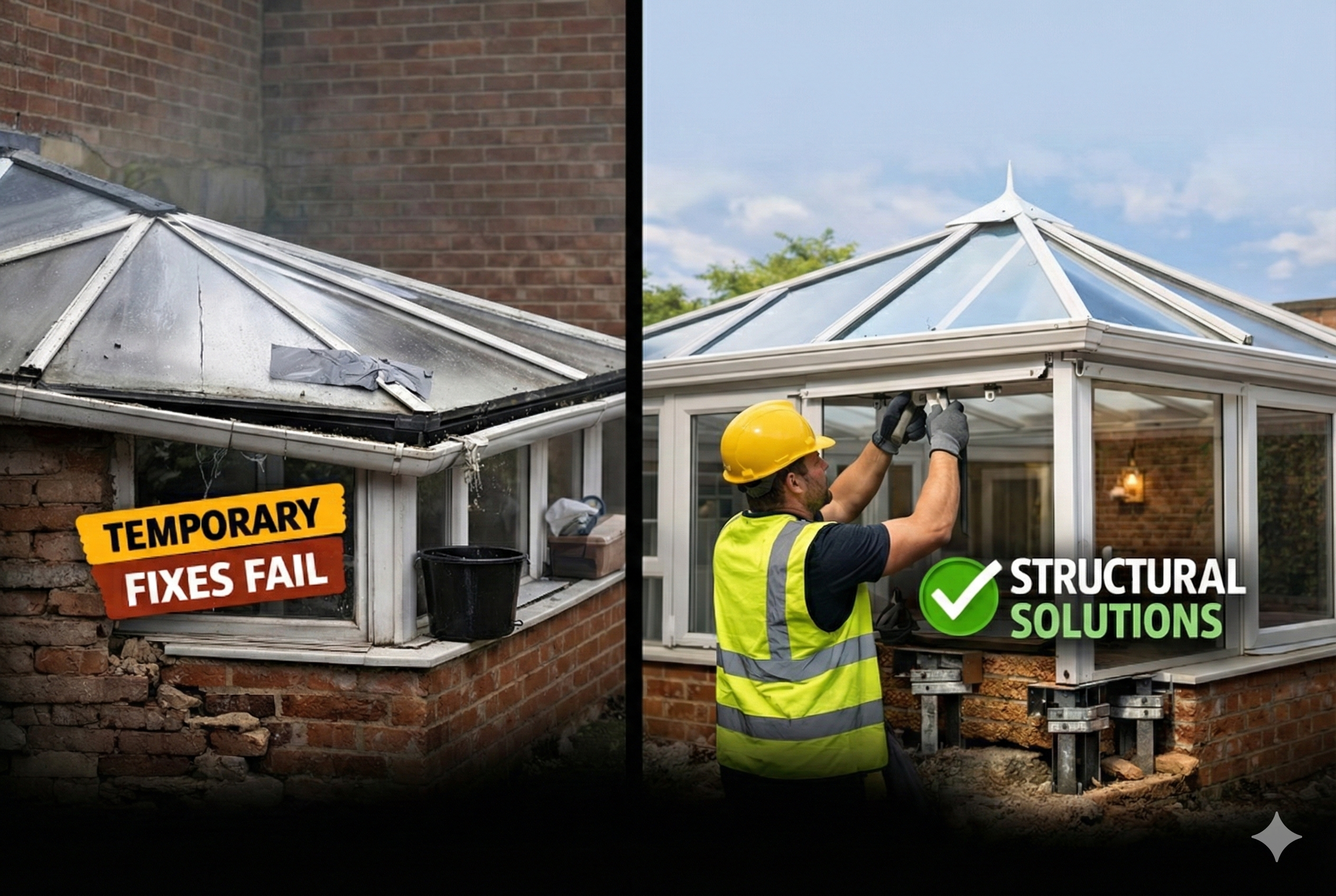
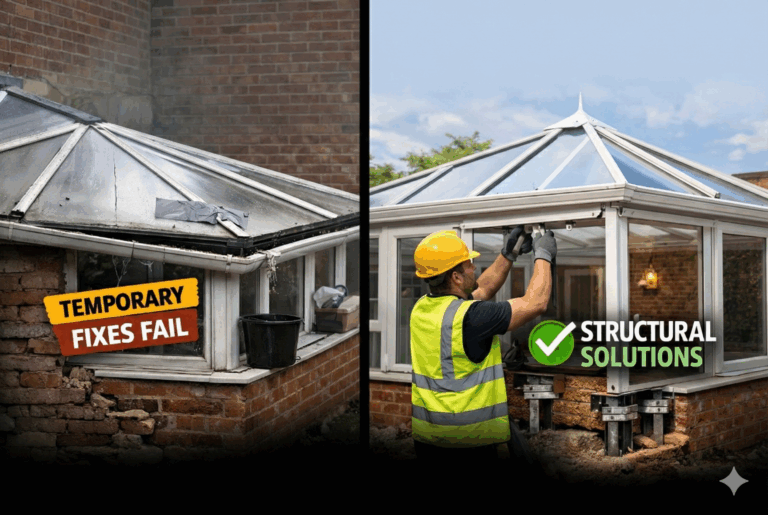
Why temporary repairs fail and what actually works. Expert guide to diagnosing foundation issues, frame deterioration, and choosing between structural repairs or full refurbishment.

Quick Answer: Why Is My Conservatory Roof Sagging?

A sagging conservatory roof typically indicates underlying structural problems—not just cosmetic wear. While temporary fixes like sealants or new panels might mask the issue, genuine structural repairs or full conservatory refurbishment are usually necessary to resolve foundation issues, frame deterioration, or inadequate original construction. Cosmetic fixes typically fail within 6-18 months, while proper structural solutions last 20-30+ years.

6-18
Months before cosmetic fixes fail
70%
Of sagging caused by foundation issues
20-30
Years lifespan with structural repairs
£4,600
Average wasted on repeated fixes
Conservatory with visible structural issues showing sagging roof panels requiring professional assessment
A sagging conservatory roof is a warning sign of deeper structural problems that require professional assessment
When homeowners notice their conservatory roof beginning to sag, the instinct is often to search for quick, affordable fixes. However, a sagging conservatory is rarely a surface-level problem. The visible dip in your roof is typically the symptom of deeper structural failures that demand professional assessment and proper remediation. Understanding the difference between cosmetic patches and genuine structural repairs can save you thousands of pounds and years of frustration. This comprehensive guide explains why conservatory roofs sag, why temporary fixes fail, and what solutions actually work for homeowners across Kent, Surrey, Sussex, and London.

Understanding Why Conservatory Roofs Sag

Structural issues in conservatories develop gradually over years, often going unnoticed until the problem becomes severe. Unlike a sudden leak or broken window, sagging happens incrementally—a few millimetres each year—until one day you realise something is seriously wrong.

The sagging you see on your roof is almost never the actual problem. Instead, it is the visible consequence of failures happening elsewhere in the structure: beneath the floor in the foundations, within the frame connections, or in the roof support system itself. Understanding the root cause is essential before committing to any repair strategy—otherwise, you risk spending money on cosmetic fixes that fail within months while the underlying damage continues to worsen.

Research from the Glass and Glazing Federation indicates that approximately 70% of conservatory structural failures originate from foundation or base issues, with frame deterioration accounting for 20% and roof-specific problems causing just 10% of sagging cases. This means that in seven out of ten cases, the roof sag you see is actually being caused by problems at ground level.

Common Causes of a Sagging Conservatory

Before you can fix a sagging conservatory, you need to understand what is causing it. Here are the three primary categories of structural failure that lead to visible roof sagging.

🏗️

Foundation & Base Issues

Ground movement, subsidence, inadequate original foundations, and drainage problems causing settlement

🔩

Frame Deterioration

Aluminium fatigue, timber rot, uPVC degradation, and connection joint failures over time

🏠

Roof Structure Failure

Glazing bar breakdown, ring beam problems, and damage from excessive snow or debris loading

Foundation and Base Issues

The most serious cause of conservatory sagging relates to foundation problems. Conservatory foundations can fail for several reasons, and without addressing these underlying issues, any repairs to the visible structure will ultimately fail.

Ground Movement and Subsidence

Clay soils—common across Kent, Surrey, and Sussex—expand and contract with moisture changes, causing gradual foundation movement. During dry summers, clay shrinks; during wet winters, it expands. This constant cycle creates stress on conservatory foundations that were often not designed to accommodate such movement. Trees planted too close to the structure can draw moisture from the soil, accelerating subsidence. Properties in areas with historic mining activity may also experience ground instability that affects conservatory foundations.

Inadequate Original Foundations

Many conservatories—particularly those built before 2000—were constructed on foundations that do not meet modern building standards. Shallow footings, insufficient concrete depth, or poor-quality materials can all contribute to foundation settlement over time. In some cases, conservatories were built on simple concrete slabs without proper strip foundations, making them vulnerable to any ground movement whatsoever.

Drainage Problems

Poor drainage around your conservatory base allows water to pool, saturating the soil and potentially washing away supporting material beneath the foundations. In winter, freeze-thaw cycles can crack inadequate foundations as trapped water expands when it freezes. Over years, this repeated damage compounds until the foundation can no longer support the structure properly.

Related Reading

For a deeper understanding of how conservatory structures work and why they fail, read our comprehensive guide: Understanding Conservatory Structural Integrity. This article explains the engineering principles behind conservatory construction and helps you recognise early warning signs.

Structural Frame Deterioration

Even if your foundations are sound, the frame itself can deteriorate over time, losing its ability to support the roof structure.

Aluminium Frame Fatigue

Older aluminium frames can develop stress fractures at connection points, particularly where the frame meets the roof structure. Years of thermal expansion and contraction—the frame expands in summer heat and contracts in winter cold—weaken these joints progressively. Eventually, the connections fail to hold the frame rigid, allowing the roof to sag under its own weight.

Timber Frame Rot

Wooden conservatory frames are vulnerable to moisture ingress, particularly at joints and connection points where water can penetrate protective coatings. Once rot takes hold in structural timbers, the frame loses its load-bearing capacity relatively quickly. Unlike surface decay that can be treated, structural rot often requires complete section replacement to restore integrity.

uPVC Frame Degradation

While uPVC is marketed as low-maintenance, it does degrade over 20-25 years. UV exposure causes brittleness, making the material prone to cracking under stress. More critically, the steel reinforcement within uPVC frames can corrode if moisture penetrates through cracks or seal failures in the plastic sheathing. Once the internal steel weakens, the frame cannot maintain its structural role.

Roof Structure Failure

In some cases, the roof structure itself is the source of the problem, though this is less common than foundation or frame issues.

Glazing Bar Breakdown

The bars that support your roof panels can bend, crack, or pull away from their fixings over time. This is especially common in polycarbonate roofs where the lightweight material does not provide much structural resistance to help the glazing bars maintain their position. Thermal movement, wind loading, and the weight of accumulated debris all stress these components.

Ring Beam Problems

The ring beam—the structural element connecting your roof to the walls—is a common failure point. If this component becomes compromised through rot, corrosion, or joint failure, the entire roof structure loses its integrity. Ring beam problems often manifest as the roof appearing to separate from the walls or visible gaps appearing at the junction.

Excessive Loading Damage

Conservatory roofs are not designed to bear significant weight. Repeated heavy snow loads or accumulated debris—leaves, branches, moss—can permanently deform roof components. A single extreme winter can cause damage that only becomes apparent months later as the deformed components continue to settle.

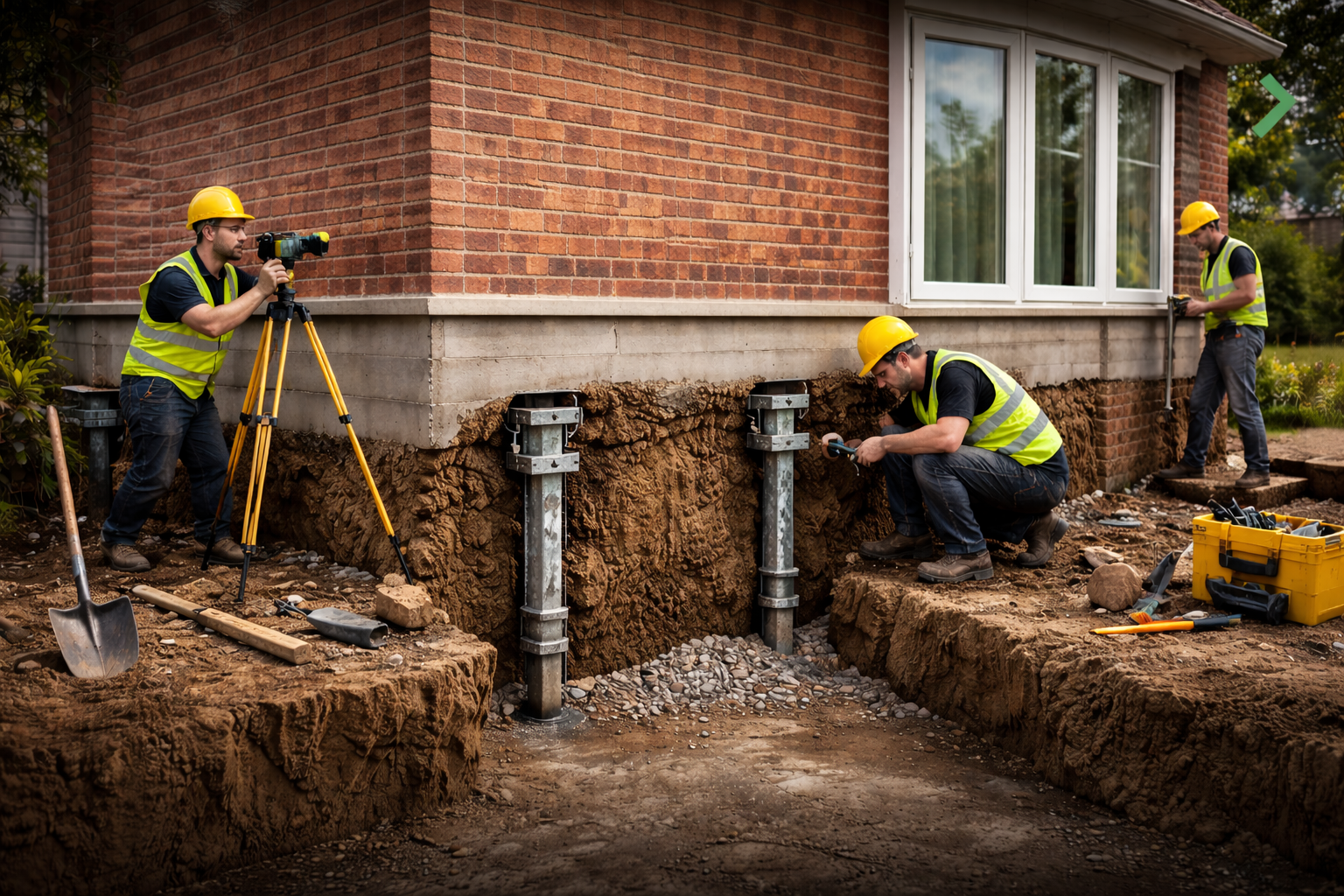
Foundation work showing proper structural support
Foundation Assessment
Frame inspection during conservatory refurbishment
Frame Inspection
Modern conservatory after successful refurbishment
After Refurbishment
Quality structural repairs completed
Quality Structural Work

Cosmetic Fixes: Why They Usually Fail

When faced with a sagging conservatory, many homeowners understandably look for the quickest, cheapest solution. Unfortunately, cosmetic fixes almost always fail—and often make the situation worse.

What Counts as a Cosmetic Fix?

Cosmetic approaches to a sagging conservatory typically include:

  • Resealing joints and gaps with silicone or mastic
  • Replacing individual roof panels without addressing the frame
  • Adding extra sealant or flashing around problem areas
  • Painting or refinishing frames to hide deterioration
  • Installing trim pieces to cover gaps between panels

❌ Cosmetic Fixes

  • Cost £200-800 per application
  • Typically last 6-18 months
  • Do not address root causes
  • Can mask worsening damage
  • Often create secondary problems
  • Waste money over time

✓ Structural Solutions

  • Cost £2,000-25,000 depending on scope
  • Last 20-30+ years
  • Fix underlying problems
  • Prevent future deterioration
  • Add value to property
  • One-time investment

The Problem with Surface-Level Solutions

They Do Not Address Root Causes

If your foundation is settling, no amount of sealant will prevent continued movement. The sagging will return—often worse than before—within months of a cosmetic repair. You cannot fix a structural problem with a non-structural solution.

They Can Mask Worsening Damage

Cosmetic fixes hide warning signs that would otherwise alert you to deteriorating conditions. By the time the problem resurfaces, structural damage may have progressed significantly. What might have been a moderate repair becomes a major refurbishment.

They Are Often False Economy

Spending £500-1,000 on temporary fixes every year or two quickly exceeds the cost of proper structural repairs. Many homeowners discover they have spent more on repeated cosmetic treatments than a full refurbishment would have cost—and they still have a failing conservatory.

They Can Create Secondary Problems

Poorly applied sealants can trap moisture within the structure, accelerating rot and corrosion that would not otherwise have occurred. New panels fitted to a warped frame will stress and crack prematurely, potentially causing leaks that damage your home’s interior. Sometimes, doing nothing is better than doing the wrong thing.

When Cosmetic Fixes Might Be Appropriate

Cosmetic approaches may be suitable only when:

  • The sagging is extremely minor (less than 5mm deviation)
  • A structural survey confirms no underlying issues
  • The conservatory is relatively new (under 10 years old)
  • You are addressing purely aesthetic concerns, not functional problems

In all other cases, a proper structural assessment should precede any repair work.

Structural Solutions That Actually Work

Unlike cosmetic patches, structural solutions address the underlying causes of your sagging conservatory. While they require greater initial investment, they provide lasting results and genuine value for money.

Professional Structural Assessment

Before any repair work begins, commission a proper structural survey. A qualified surveyor will examine:

  • Foundation condition and soil stability
  • Frame integrity at all connection points
  • Roof structure alignment and component condition
  • Evidence of water damage or material degradation
  • Overall structural calculations for the original design

This assessment typically costs £200-400 but provides essential information for planning effective repairs. It may reveal that problems are less severe than feared—or more serious than the visible symptoms suggest.

1

Foundation Remediation

£3,000 – £10,000 25+ years

For conservatories with subsidence or settlement issues, foundation work is essential before any other repairs can succeed.

  • Underpinning: Extends foundations to more stable ground by excavating beneath existing footings and pouring new concrete to greater depth
  • Mini-Piling: Drives piles to load-bearing strata for superior stability in poor ground conditions
  • Resin Injection: Modern technique that stabilises foundations without extensive excavation by injecting expanding resin to compact loose soil
2

Structural Frame Repairs

£2,000 – £6,000 15-20+ years

Once foundations are stable, frame issues can be addressed to restore structural integrity.

  • Steel Reinforcement: Additional steel supports integrated into existing frames where joints have weakened
  • Section Replacement: Individual frame sections replaced while maintaining overall structural continuity
  • Complete Frame Replacement: New frame fitted to existing base when deterioration is too extensive for repair
3

Roof Structure Restoration

£4,000 – £12,000 25-30 years

With foundation and frame secured, roof-specific problems can be definitively resolved.

  • Ring Beam Replacement: New ring beam installed with temporary propping of existing structure
  • Upgraded Glazing Bars: Heavier-duty modern profiles replacing original bars for improved rigidity
  • Solid Roof Conversion: Complete replacement with insulated, tiled roof system eliminating future glazing issues
4

Full Conservatory Refurbishment

£8,000 – £25,000 30+ years

When multiple systems are failing, comprehensive refurbishment offers the best long-term value.

  • New or reinforced foundations to current building regulations
  • Modern frame system with improved thermal performance
  • Engineered roof structure calculated for appropriate loading
  • Integrated heating, ventilation, and electrical systems
  • Full warranty coverage on all components

Cost Comparison: Cosmetic vs Structural Solutions

Understanding the true cost of different approaches helps you make an informed decision. While cosmetic fixes appear cheaper initially, the long-term mathematics often favour structural solutions.

Approach Typical Cost Expected Lifespan 10-Year Total Cost
Cosmetic repairs (sealant, patches) £200 – £800 6-18 months £4,000 – £8,000+
Individual panel replacement £300 – £1,500 2-5 years* £1,500 – £4,500
Structural frame repairs £2,000 – £6,000 15-20+ years £2,000 – £6,000
Foundation remediation £3,000 – £10,000 25+ years £3,000 – £10,000
Full roof replacement £4,000 – £12,000 25-30 years £4,000 – £12,000
Complete refurbishment £8,000 – £25,000 30+ years £8,000 – £25,000
Cosmetic Repairs
Typical Cost £200 – £800
Expected Lifespan 6-18 months
10-Year Total £4,000 – £8,000+
Structural Frame Repairs
Typical Cost £2,000 – £6,000
Expected Lifespan 15-20+ years
10-Year Total £2,000 – £6,000
Complete Refurbishment
Typical Cost £8,000 – £25,000
Expected Lifespan 30+ years
10-Year Total £8,000 – £25,000

*When underlying structural issues remain unaddressed, panel lifespan is significantly reduced.

Real-World Example: The True Cost of Cosmetic Fixes

Consider a homeowner facing a sagging conservatory with moderate frame deterioration and minor foundation settlement:

Cosmetic Approach Over 3 Years:

  • Initial repairs: £600
  • Repeat repairs at 12 months: £800
  • Further repairs at 24 months: £1,200
  • Emergency repairs at 30 months (leak damage): £2,000
  • Total: £4,600—with problems continuing to worsen

Structural Approach (One-Time Investment):

  • Professional assessment: £350
  • Foundation stabilisation: £4,000
  • Frame reinforcement: £2,500
  • Total: £6,850—with 20+ year solution

The structural approach costs more initially but proves significantly more economical over time while actually resolving the problem.

Warning Signs You Should Not Ignore

Knowing when to act can prevent small problems becoming expensive emergencies. Here are the warning signs that indicate your conservatory needs professional attention.

🚨 Emergency Indicators

Contact a structural engineer immediately if you observe:

  • Visible cracks in the conservatory base or dwarf walls
  • Doors or windows that suddenly will not open or close
  • Gaps appearing between the conservatory and main house
  • Cracking sounds from the structure
  • Rapid progression of visible sagging (changes over days or weeks)
  • Standing water that will not drain from the roof

⚠️ Progressive Warning Signs

Schedule an assessment soon if you notice:

  • Gradual difficulty with door or window operation
  • Condensation patterns suggesting frame distortion
  • Panels that no longer sit flush in their frames
  • Increasing draughts despite intact seals
  • Mould or damp patches on internal surfaces
  • Guttering that has separated from the structure

How to Choose the Right Approach for Your Situation

Making the right decision requires balancing immediate needs against long-term value. Here is a framework to help you decide.

Step 1: Get a Professional Assessment

Never attempt to self-diagnose structural problems. What appears to be a simple sagging roof may involve foundation issues invisible from the surface, or the reverse—dramatic-looking problems may have straightforward solutions. Seek assessments from:

  • A structural engineer (for foundation and frame concerns)
  • A specialist conservatory company with refurbishment experience
  • An independent building surveyor (for an unbiased opinion)

Step 2: Understand the Full Scope

Ask your assessors to explain:

  • All identified structural issues
  • Which problems are primary (causative) and which are secondary (symptoms)
  • The consequences of leaving various issues unaddressed
  • Multiple options at different price points

Step 3: Consider Your Timeline

How long do you plan to stay in your property? If you are moving within 2-3 years, cost-effective structural repairs might be appropriate. For a forever home, investing in comprehensive refurbishment makes sense.

Step 4: Evaluate Total Value

Factor in:

  • Energy efficiency improvements from modern construction
  • Increased usable space from a properly functioning conservatory
  • Property value impact of a well-maintained structure
  • Reduced stress from ending the repair cycle

When Full Refurbishment Is the Right Choice

Consider complete conservatory refurbishment when:

  • Multiple structural systems are failing simultaneously
  • The original construction quality was poor
  • Repair costs approach or exceed 50% of replacement value
  • You want to upgrade the conservatory’s specification significantly
  • The existing structure is more than 25 years old

Areas We Serve

Room Outside provides conservatory structural assessments, repairs, and full refurbishment services across the South East of England. Our experienced teams work throughout:

Kent Surrey Sussex Hampshire London Sevenoaks Guildford Chichester Brighton Tunbridge Wells Canterbury Maidstone

Not sure if we cover your area? Check our full coverage map or call us on 01243 538999 to confirm.

Sources and References

Glass and Glazing Federation: Conservatory Construction Standards; Building Research Establishment: Foundation Design Guidelines; Institution of Structural Engineers: Domestic Structure Assessment Protocols; Planning Portal UK: Building Regulations Part A (Structure); Room Outside: Internal Project Data 2018-2025.

Frequently Asked Questions

Can I fix a sagging conservatory roof myself?

DIY repairs are not recommended for structural sagging. While you might address minor seal failures, sagging indicates underlying problems requiring professional diagnosis and repair. Incorrect DIY interventions can worsen structural issues and create safety hazards.

How long does structural conservatory repair take?

Timelines vary significantly based on the work required: frame repairs take 2-5 days, foundation work takes 1-3 weeks including curing time, and full refurbishment takes 2-4 weeks. Your contractor should provide a detailed schedule during the quotation process.

Will my conservatory need to be demolished?

Not necessarily. Many structural problems can be resolved while retaining significant portions of the existing structure. Complete demolition is typically only required when foundation problems are severe or when the homeowner chooses to change the conservatory’s footprint or design.

Does a sagging conservatory affect property value?

Yes. Surveyors routinely identify conservatory defects during property valuations, and structural issues can reduce offers or cause sales to fall through. Conversely, a properly refurbished conservatory adds genuine value to your property.

Are structural repairs covered by insurance?

Standard home insurance typically covers sudden structural damage (storm, impact) but not gradual deterioration. If your conservatory was damaged in a specific event, contact your insurer. For age-related decline, repairs are generally the homeowner’s responsibility.

How do I know if my foundation is failing?

Signs of foundation problems include cracks in dwarf walls (especially diagonal cracks), the conservatory pulling away from the main house, doors and windows binding in their frames, uneven floor surfaces, and gaps at skirting board level.

What is the difference between underpinning and resin injection?

Underpinning physically extends foundations deeper into stable ground using concrete—more invasive but proven over decades. Resin injection stabilises existing ground through chemical expansion—less disruptive but not suitable for all soil types or settlement causes.

How much does it cost to fix a sagging conservatory?

Costs vary widely: cosmetic repairs cost £200-800 but typically fail within 18 months. Structural frame repairs cost £2,000-6,000 and last 15-20+ years. Foundation remediation costs £3,000-10,000. Full refurbishment costs £8,000-25,000 but provides a 30+ year solution.

Should I repair or replace my conservatory?

Consider replacement when repair costs exceed 50% of replacement value, multiple systems are failing, or the conservatory is over 25 years old. For newer structures with isolated problems, targeted repairs often provide better value.

How can I get a structural assessment?

Contact a specialist conservatory company or structural engineer. Room Outside offers free initial consultations across Kent, Surrey, Sussex, and London. Call 01243 538999 to arrange an assessment at your property.

Concerned about your sagging conservatory? Call our structural team on 01243 538999 for a free assessment

Stop Wasting Money on Temporary Fixes

Get a proper structural assessment and discover the real solution for your sagging conservatory. Our expert team provides honest advice and lasting repairs across Kent, Surrey, Sussex, and London.