

roomoutsideuk
12th January, 2026

1990s Conservatory Revival: Modern Upgrades That Transform Old Structures

1990s Conservatory Revival: Modern Upgrades | Room Outside

1990s Conservatory Revival: Modern Upgrades That Transform Old Structures

A complete guide to refurbishment and replacement options for aging conservatories—backed by independent research and real data.

The Bottom Line

53% of conservatory owners cite temperature problems as their biggest complaint. Up to 80% of heat loss in a traditional conservatory occurs through the roof alone.

The good news: Modern upgrades can reduce heat loss by up to 90% and cut heating energy consumption by 32%. A polycarbonate to glass conversion costs £3,000-£8,000, while solid roofs (£5,000-£15,000) achieve U-values of 0.15-0.18 W/m²K—matching new-build extension standards.

Key stat: Typical payback period is 3-7 years through energy savings alone, with potential property value increases of 5-15%.

80%
Heat loss through old roofs
90%
Heat loss reduction possible
£200-£500
Annual energy savings
3-7 yrs
Typical payback period
According to government statistics, approximately 18% of households in England have a conservatory, with the vast majority built during the construction boom of the late 1980s and 1990s. If you own one of these structures, you’re not alone in noticing the toll that three decades have taken. A 2024 survey by Eurocell found that 53% of conservatory owners cite temperature problems as their biggest complaint—spaces that are too hot in summer and too cold in winter. The good news is that 2026 brings more options than ever for breathing new life into these aging spaces.

Understanding the Problems with 1990s Conservatories

Before exploring solutions, it helps to understand exactly why conservatories from this era have become problematic. Independent testing at Salford University’s Energy House 2.0 facility has provided detailed data on just how much energy older conservatories waste, finding that proper insulation can reduce heat loss by up to 90% and lower heating energy consumption by up to 32%.

Polycarbonate Roofing Issues

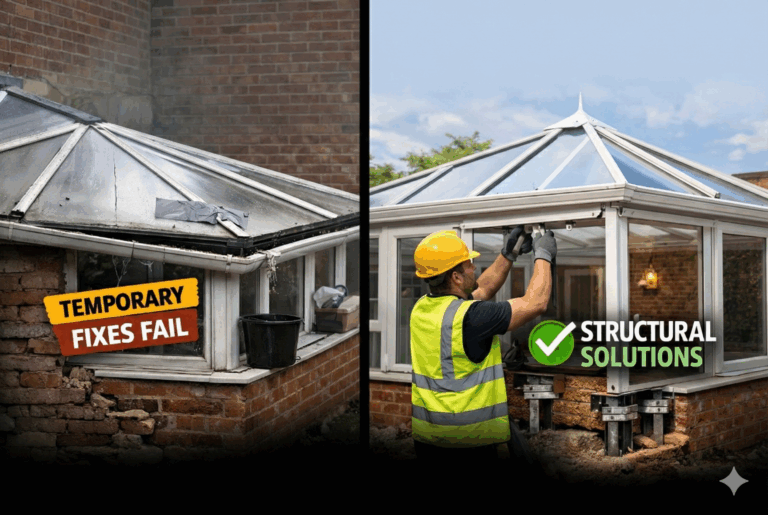
The single biggest complaint from owners of 1990s conservatories centres on polycarbonate roofing. According to research published by Ideal Home, polycarbonate roofs typically degrade within 10 to 20 years, showing clear signs of wear including leaks, cracks, and thermal failure.

The material offers a U-value of around 4.0 W/m²K or higher, compared to modern building regulations that require windows to achieve 1.4 W/m²K or lower. This means heat escapes at nearly three times the rate considered acceptable by current standards. The Eurocell Conservatory Census also found that 12% of owners specifically cite rain noise on polycarbonate roofs as a major issue, making the space unusable during wet weather.

Glazing Deficiencies

Early double-glazed units from the 1990s typically achieved U-values of 2.8 to 3.0 W/m²K—well below today’s standards. Modern double glazing with Low-E coatings achieves 1.0 to 1.1 W/m²K, while triple glazing can reach 0.6 to 0.8 W/m²K. Single-glazed panels, still found in many economy conservatories from the era, have U-values as high as 5.0 to 6.0 W/m²K, offering almost no insulation.

⚠️ The Hidden Problem: Failed Seals

Failed seals in older double-glazed units result in condensation between panes, reducing both visibility and thermal performance. If you see misting inside your glass units, the insulating gas has escaped and the unit has effectively become single-glazed in terms of thermal performance.

Structural Wear and Tear

Aluminium frames from the 1990s often lack thermal breaks, creating cold bridges that lead to condensation and heat loss. Research shows that thermally broken frames can improve overall window U-values by 0.2 to 0.3 W/m²K compared to non-broken alternatives.

uPVC frames, while more thermally efficient, can become discoloured, warped, or brittle after decades of UV exposure. Foundation and base issues also emerge over time, with some conservatories showing signs of subsidence or poor drainage.

The Scale of the Problem: UK Statistics

Understanding the scale of the issue helps put individual upgrade decisions into context. The Energy Follow-Up Survey conducted for the Department for Business, Energy and Industrial Strategy found that conservatory ownership correlates with larger homes (median floor area of 94m² compared to 77m² for homes without conservatories). The survey also revealed that households with conservatories use measurably more gas for heating.

The Numbers That Matter

A typical 12m² conservatory with poor insulation can leak 420 to 480 watts of heat per hour when outside temperatures drop just 10°C below inside temperatures. Over a 180-day heating season, this wastes over 1,500 kWh of energy. At current energy prices, that translates to hundreds of pounds in unnecessary heating costs each year.

The Polycarbonate to Glass Upgrade

One of the most popular and effective upgrades for 1990s conservatories is the polycarbonate to glass roof conversion. According to 2026 pricing data from multiple UK sources, glass roof replacements typically cost between £3,000 and £8,000 for an average-sized conservatory of around 16m². Checkatrade reports average costs of £9,450 for a 3m x 3.5m glass conservatory roof, with larger structures reaching £22,500 for 5m x 5m installations.

What Modern Glass Offers

Modern glass roof panels designed for conservatory use include multiple technologies that simply weren’t available thirty years ago:

  • Self-cleaning coatings reduce maintenance requirements
  • Solar control glass reflects unwanted heat in summer
  • Low-emissivity coatings retain warmth during winter months
  • U-values of 1.0 to 1.2 W/m²K compared to 4.0+ for polycarbonate
  • Acoustic interlayers cut rain noise substantially

Glass roofs also offer a longer lifespan than polycarbonate. While polycarbonate typically lasts 10 to 20 years, glass roofs can last 30 years or more with proper maintenance, making them a better long-term investment despite higher upfront costs.

Solid Roof Conversions: The Premium Option

For homeowners seeking the best possible thermal performance, solid roof conversions represent the premium old conservatory upgrade option. According to MyJobQuote’s 2026 pricing guide, solid conservatory roofs cost between £5,000 and £12,000 for average-sized structures, with tiled systems commanding £6,000 to £15,000 depending on specification and structural requirements.

0.15-0.18
Solid roof U-value (W/m²K)
4.0+
Old polycarbonate U-value
£200
Average annual savings
50+ yrs
Solid roof lifespan

Solid roof conversions achieve U-values of 0.15 to 0.18 W/m²K, bringing your conservatory in line with modern building regulations for new extensions. Independent research by AECOM for Guardian Building Systems found that solid roof conversions save homeowners an average of £200 per year on energy bills. The visual change is equally striking, with the finished result appearing more like a traditional extension than a conservatory.

⚠️ Structural Considerations

Solid roof conversions require careful structural assessment. The additional weight, while minimal compared to traditional roofing, may exceed what 1990s conservatory frames were designed to support. Converting from glass or polycarbonate to a solid roof typically adds £1,500 to £3,000 to the project cost for necessary structural reinforcement—a 30% to 40% premium over like-for-like replacement.

Real Energy Savings: What the Research Shows

Independent testing provides concrete data on what homeowners can expect from conservatory upgrades. Research conducted at Salford University’s Energy House 2.0 found that insulating a conservatory roof can reduce heat loss by up to 90% and lower heating energy consumption by up to 32%. This translates to annual savings of £200 to £500 depending on conservatory size, heating system, and usage patterns.

The Glass and Glazing Federation notes that a well-designed conservatory can act as a thermal buffer zone between indoor and outdoor areas. Heat that escapes through house walls into an insulated conservatory helps warm that space, and can then re-heat the main building when doors are opened. This passive solar gain effect was largely impossible with poorly insulated 1990s structures but becomes achievable with modern upgrades.

CosyPanels Research Findings

CosyPanels research indicates that modern insulated roofs reduce heat loss from 54% to just 10%—an 80% improvement that cuts heating bills proportionally. Their data suggests typical payback periods of 3 to 7 years depending on conservatory size and usage, making upgrades a financially sound decision rather than just a comfort improvement.

Impact on Property Value

The relationship between conservatories and property value is nuanced. According to the Nationwide Building Society, a high-quality conservatory can add between 5% and 15% to overall property value. Property expert Phil Spencer has stated that conservatories add an average of 7% to property value when they feel like part of the house rather than something “bolted on the back.”

❌ Poor Condition = Value Reduction

Outdated conservatory impact -£15,000
27% of owners unsure about value Risk
Unusable space perception Negative
Net impact on sale Liability

✓ Upgraded = Value Added

Quality upgrade impact +5-15%
Year-round usability Asset
Energy efficiency appeal Positive
Net impact on sale +£20,000+

However, quality matters enormously. Recent reports cited by Eurocell reveal that older conservatories with poor insulation can actually reduce home value by up to £15,000. The Eurocell Conservatory Census found that 60% of respondents believed their conservatory added value, but 27% were unsure—suggesting many owners recognise their structures may not be assets in their current condition.

2026 Cost Summary

Based on current market data from multiple UK sources, here’s what homeowners can expect to pay for different old conservatory upgrade options in 2026:

Upgrade Option Cost Range U-Value Achieved Lifespan Best For
Polycarbonate Replacement £2,000 – £5,000 1.6 – 2.4 W/m²K 10-15 years Budget option
Polycarbonate to Glass £3,000 – £8,000 1.0 – 1.2 W/m²K 30+ years Best balance
Solid/Tiled Roof £5,000 – £15,000 0.15 – 0.18 W/m²K 50+ years Maximum performance
Complete Refurbishment £8,000 – £25,000 Varies 30-50 years Multiple issues
Full Replacement £15,000 – £40,000+ 0.8 – 1.2 W/m²K 40+ years Structural problems
Polycarbonate Replacement
Cost Range £2,000 – £5,000 ✓ Cheapest
U-Value Achieved 1.6 – 2.4 W/m²K ✗ Poorest
Lifespan 10-15 years
Best For Budget option, quick fix
Polycarbonate to Glass
Cost Range £3,000 – £8,000
U-Value Achieved 1.0 – 1.2 W/m²K
Lifespan 30+ years
Best For Best balance of cost & performance ✓ Popular
Solid/Tiled Roof
Cost Range £5,000 – £15,000
U-Value Achieved 0.15 – 0.18 W/m²K ✓ Best
Lifespan 50+ years ✓ Best
Best For Maximum thermal performance
Complete Refurbishment
Cost Range £8,000 – £25,000
U-Value Achieved Varies by specification
Lifespan 30-50 years
Best For Multiple issues to address
Full Replacement
Cost Range £15,000 – £40,000+
U-Value Achieved 0.8 – 1.2 W/m²K
Lifespan 40+ years
Best For Structural problems, complete redesign

Labour costs typically account for £150 to £300 per day for a roofer, with most roof replacements requiring a two-person team for one to three days. Installation-only costs start at approximately £2,500 including the base for standard builds.

Complete 1990s Conservatory Refurbishment

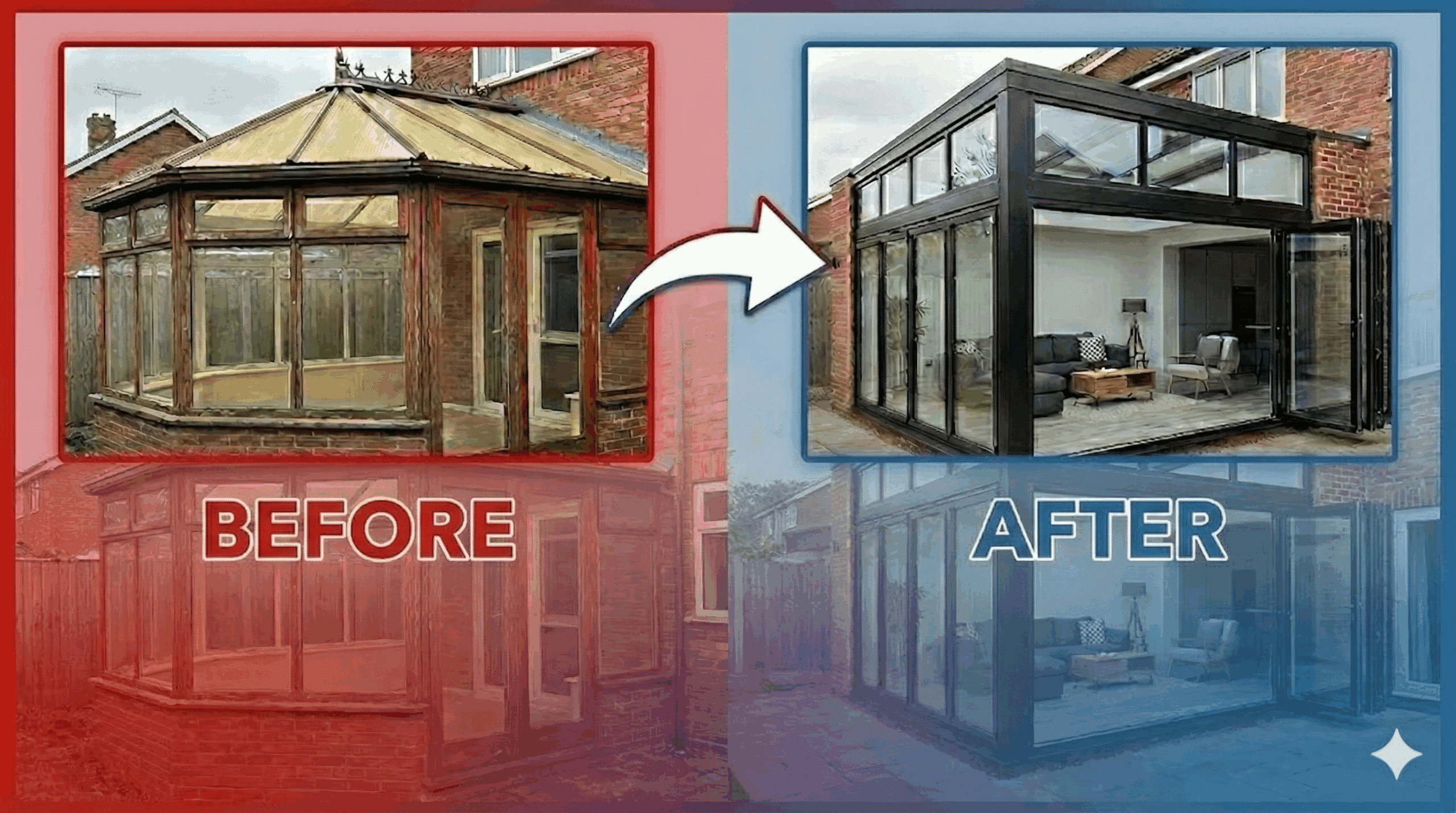
When the roof alone isn’t the only issue, a complete 1990s conservatory refurbishment addresses multiple parts at once. Based on 2026 market pricing, complete refurbishment projects commonly fall between £8,000 and £25,000 for work including roof, glazing, and frame upgrades. This compares favourably to full replacement costs, which typically start around £15,000 for modest structures and can exceed £40,000 for larger, premium installations.

What Complete Refurbishment Includes

  • Roof upgrade: Polycarbonate to glass or solid roofing
  • Glazing replacement: Modern triple-glazed units (U-values of 0.6 to 0.8 W/m²K)
  • Frame repairs: Eliminate thermal bridges
  • Base insulation: Complete the thermal envelope
  • Updated doors: Thermally efficient access points
  • Modern ventilation: Maintain air quality without compromising thermal performance

When Replacement Makes More Sense

While refurbishment offers excellent value in many situations, some circumstances point clearly toward complete replacement. According to cost comparison data, a traditional brick extension costs £1,800 to £3,500 per m², compared to £1,300 to £1,500 per m² for a new conservatory. This means a conservatory remains a more affordable way to add living space, even accounting for full replacement costs.

🔧 Choose Refurbishment If:

  • Foundations are stable with no subsidence
  • Frame structure is sound (no major rot or corrosion)
  • Current footprint and design work for your needs
  • Budget is £8,000-£25,000
  • You want to preserve the existing character

✓ Choose Replacement If:

  • Foundations show signs of failure
  • Frame has major corrosion or rot
  • You want to change footprint or design
  • Multiple structural issues exist
  • Budget allows for £15,000-£40,000+

Planning Permission and Building Regulations

Understanding regulatory requirements helps avoid costly mistakes. Like-for-like repairs and maintenance—including glass-to-glass or polycarbonate-to-polycarbonate roof replacements—typically don’t require planning permission or building regulations approval.

Building Regulations for Solid Roofs

Solid roof conversions are more complex. Many approved lightweight systems fall under Permitted Development, but almost all solid and tiled roofs require Building Regulations approval, costing £200 to £800+. Properties in conservation areas, listed buildings, or those that have exhausted permitted development allowances will need specific planning consent for any external changes.

Conservatory Exemptions

Conservatories can be exempt from building regulations if they meet specific criteria:

  • Floor area less than 30m²
  • Physically separated from the main property by an external wall or door
  • Not heated by the main heating system
  • Has independent temperature control

Upgrading an existing conservatory may affect these exemptions, so check requirements before work begins.

Project Timelines

A polycarbonate to glass roof conversion can often complete within two to three days for standard-sized conservatories. According to MyJobQuote, a typical two-person team can complete most roof replacements within this timeframe, with polycarbonate installations slightly faster than glass due to lighter weight and easier handling.

Solid roof conversions typically take one to two weeks depending on complexity, particularly if structural reinforcement is required. Industry sources note that insulated roof panels can often be fitted in just a few days as they slot into existing frames, while full tiled systems requiring new structures may take a week or longer.

Full refurbishments or replacements naturally take longer, with larger projects potentially spanning several weeks including foundation work if required. Spring and autumn typically offer the best conditions for conservatory work, though experienced contractors work year-round with appropriate weather protection.

Making Your Decision

The 1990s conservatory serving your home has likely provided years of enjoyment despite its limitations. With 65% of conservatory owners using their space daily according to the Eurocell survey, these structures remain valued parts of UK homes. The question is whether to refurbish or replace.

The Financial Case

If your frame and base remain sound, refurbishment offers excellent value. The polycarbonate to glass conversion alone can reduce U-values from 4.0+ to around 1.0 W/m²K—a fourfold improvement in thermal performance. Combined with energy savings of £200 to £500 annually and potential property value increases of 5% to 7%, the financial case for upgrading is strong.

When serious structural issues exist or when your needs have grown beyond what refurbishment can address, replacement delivers a fresh start with contemporary performance. Either path leads to the same destination: a comfortable, efficient, and attractive space that extends your living area throughout the year.

📚 Sources

Department for Energy Security and Net Zero Energy Follow-Up Survey; Salford University Energy House 2.0 research; Eurocell Conservatory Census 2024; Nationwide Building Society; Checkatrade; MyJobQuote; AECOM/Guardian Building Systems research; Glass and Glazing Federation; CosyPanels industry data; Squared Money Home Improvement Index.

Frequently Asked Questions

How do I know if my 1990s conservatory can be refurbished or needs replacing?

Start by checking the frame and base. If the frame is structurally sound without major rot, warping, or corrosion, and the base shows no signs of subsidence or cracking, refurbishment is usually viable. A professional survey will confirm whether your existing structure can support upgrades like a glass or solid roof.

Is a polycarbonate to glass roof conversion worth the money?

For most homeowners, yes. The upgrade typically costs between £3,000 and £8,000, with immediate improvements in temperature control, noise reduction, and appearance. Modern glass achieves U-values of 1.0 to 1.2 W/m²K compared to 4.0+ W/m²K for polycarbonate—a fourfold improvement in thermal performance.

Do I need planning permission to upgrade my conservatory roof?

For like-for-like replacements such as swapping polycarbonate for glass panels, planning permission usually isn’t required. Solid roof conversions are more complex—almost all solid and tiled roofs require Building Regulations approval, costing £200 to £800+. Properties in conservation areas will likely need planning consent.

How much could I save on energy bills after upgrading?

Research from Salford University shows insulation can reduce heating energy consumption by up to 32%. Industry sources cite typical annual savings of £200 to £500. Heat loss reduction from 54% to 10% cuts heating bills proportionally. Typical payback periods range from 3 to 7 years.

What’s the difference between a glass roof and a solid roof conversion?

Glass roofs maintain the light, airy feel of a traditional conservatory while offering much better thermal performance (U-values around 1.0-1.2 W/m²K) and can last 30+ years. Solid roofs achieve U-values of 0.15-0.18 W/m²K—comparable to traditional extensions—but change the character to feel more like a room.

How long does a conservatory refurbishment take?

A polycarbonate to glass roof conversion typically takes 2-3 days with a two-person team. Solid roof conversions usually require 1-2 weeks. Full refurbishments including glazing, frames, and other components can take 2-4 weeks depending on the scope of work.

Will upgrading my conservatory add value to my home?

A well-executed conservatory upgrade can add 5% to 15% to property value. However, older conservatories with poor insulation can reduce home value by up to £15,000. The key is ensuring year-round usability and thermal efficiency—making upgrades essential for protecting your investment.

What U-values should I look for in conservatory glazing?

Current Building Regulations require windows to achieve maximum U-values of 1.4 W/m²K, with the Future Homes Standard requiring 1.2 W/m²K or lower. For year-round comfort, aim for 1.2 W/m²K or lower. Premium options achieve 0.8-1.0 W/m²K using triple glazing and thermally broken frames.

Ready to Revive Your 1990s Conservatory?

Whether you need a simple roof upgrade or a complete refurbishment, our team has completed hundreds of conservatory projects across Kent and the South East. Get a free, no-obligation assessment of your structure and personalised recommendations.
roomoutsideuk
29th December, 2025

Understanding U-Values: The Metric That Separates Premium Glass Rooms from the Rest

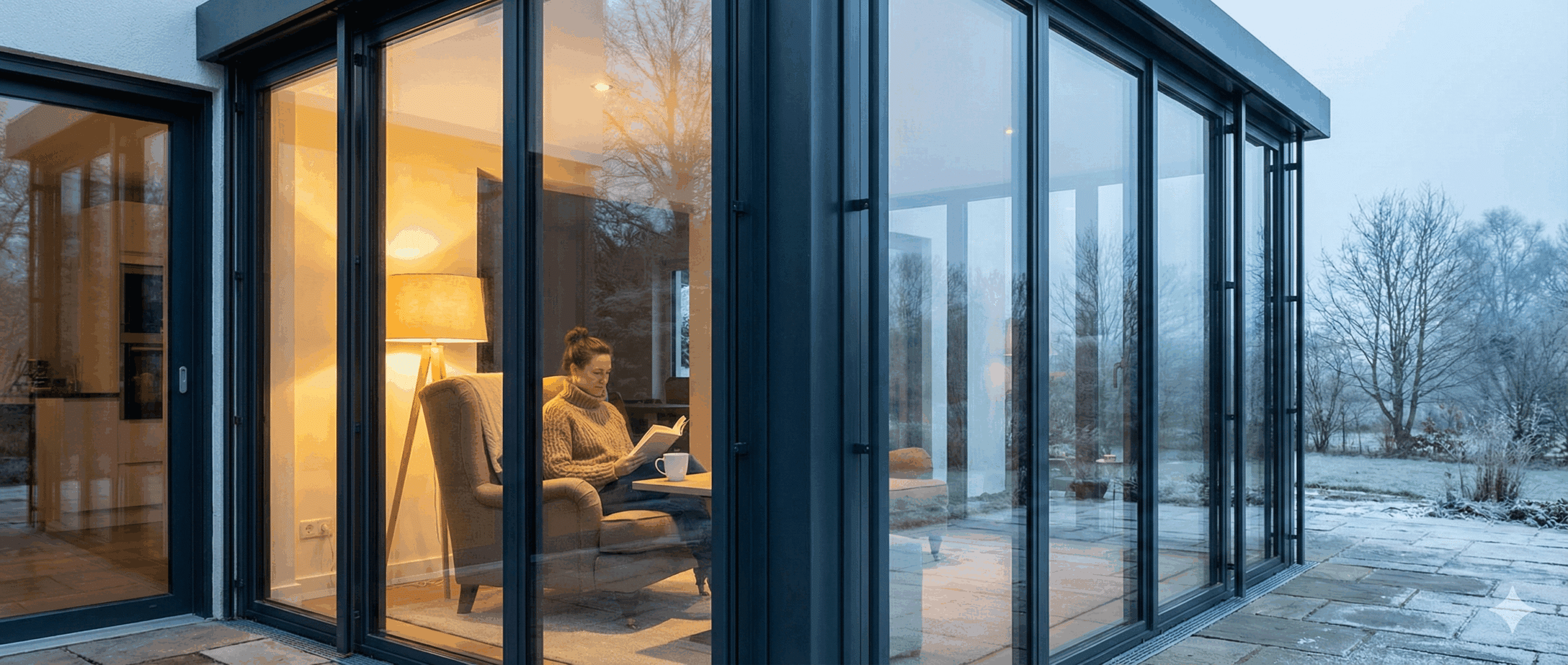
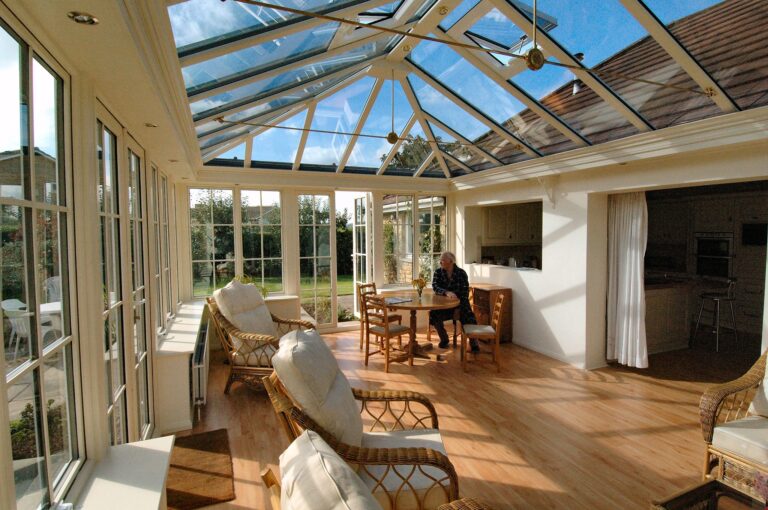
A modern glass room extension attached to a high-quality home
Understanding U-Values: Glass Room Thermal Performance Guide | Room Outside

Understanding U-Values: The Metric That Separates Premium Glass Rooms from the Rest

Why this single number determines whether your extension stays comfortable year-round or becomes a seasonal space.

The Key Numbers

Lower U-values = Better insulation. A material with U-value 0.5 W/m²K loses heat half as fast as one with 1.0 W/m²K.

Building Regulations minimum: Windows must achieve Uw ≤1.4 W/m²K. Rooflights ≤2.2 W/m²K.

Premium target: For year-round comfort, aim for Uw values of 0.8-1.0 W/m²K using triple glazing and thermally broken frames.

Always ask for Uw (whole window), not Ug (glass only). Uw includes the frame and is what Building Regulations require.

≤1.4
W/m²K max for windows (Building Regs)
0.8-1.0
W/m²K premium triple glazing target
4x
Heat loss: single vs modern double glazing
25mm+
Thermal break depth for quality frames
When you’re investing in a glass room or glazed extension, one number matters more than almost any other. It’s not the price per square metre. It’s not the size of the glass panels. It’s a figure most homeowners have never heard of: the U-value.

What Exactly Is a U-Value?

A U-value measures how quickly heat passes through a material. The technical definition is the rate of heat transfer per square metre for each degree of temperature difference between inside and outside. It’s measured in watts per square metre kelvin, written as W/m²K.

The critical point is simple: lower numbers mean better insulation. A material with a U-value of 0.5 W/m²K loses heat half as quickly as one with 1.0 W/m²K. When you’re heating a room in winter or trying to keep it cool in summer, this difference translates directly into comfort and energy costs.

According to the Open University’s research on building energy, a single-glazed window with a U-value of around 4.8 W/m²K loses heat roughly four times faster than a modern double-glazed unit with a U-value of 1.2 W/m²K. Over the course of a heating season, this difference can cost hundreds of pounds.

The Three U-Values You Need to Know

When discussing glass rooms and extensions, you’ll encounter three different types of U-value. Understanding the difference is important because some suppliers quote whichever figure makes their product look best.

Ug

Glass Only

Measures only the centre pane, ignoring frame and edges. Always the lowest, most flattering number.

Uf

Frame Only

Measures thermal performance of the frame material. Aluminium without thermal breaks can be 5.0+ W/m²K.

Uw

Whole Window ✓

The figure that matters. Combines glass, frame, spacers and seals. This is what Building Regs require.

⚠️ Always Ask for Uw Values

If a supplier quotes only glass centre-pane U-values (Ug), ask for the whole window value including frame. If they cannot or will not provide this, treat it as a warning sign. Building Regulations compliance is based on Uw values, not Ug values.

Building Regulations: What the Law Requires

Part L of the Building Regulations sets minimum thermal performance standards for all building work in England. These regulations have tightened significantly in recent years as part of the UK’s journey toward net zero carbon emissions.

Current Requirements for Extensions (2022)

Windows
≤1.4 W/m²K
Maximum Uw value
Rooflights
≤2.2 W/m²K
Maximum Uw value
Glazed Doors (60%+)
≤1.4 W/m²K
Maximum Uw value
External Walls
≤0.18 W/m²K
Maximum U-value

These are maximum allowable values. Premium glass rooms should exceed these minimums by a comfortable margin to deliver genuine year-round comfort.

The 25% Glazing Rule

There’s an important threshold in the regulations. If the glazed area of your extension exceeds 25% of the total floor area, you need to demonstrate compliance through calculation rather than simply meeting minimum U-values. This typically means specifying glazing that performs better than the bare minimums, or compensating with improved insulation in walls, roof, and floor.

What’s Coming in 2025 and Beyond

The Future Homes Standard will bring even tighter requirements. Windows are expected to require Uw values of 1.2 W/m²K or lower. Glazed doors will face the same target. For homeowners planning glass rooms now, specifying beyond current minimums makes sense.

Future-Proof Your Investment

A structure built to meet 2022 standards will look dated by 2030 if regulations continue to tighten. Building to higher standards today protects your investment and ensures the extension will remain compliant and attractive to future buyers.

How Glass Room Specifications Compare

The gap between budget and premium glass room specifications is significant when you look at U-values. This table shows typical performance figures for different approaches to glazed construction.

Glazing Type Typical Ug Typical Uw Real-World Performance
Single glazing 5.8 W/m²K 5.0+ W/m²K Unusable in cold weather. Historic only.
Basic double (pre-2010) 2.8 W/m²K 2.4+ W/m²K Does not meet current regulations.
Standard double (Low-E) 1.1 W/m²K 1.4 W/m²K Meets minimum regulations. Adequate.
High-performance double 1.0 W/m²K 1.2 W/m²K Future Homes Standard ready. Good.
Triple glazing (standard) 0.6 W/m²K 1.0 W/m²K Comfortable year-round. Excellent.
Premium triple glazing 0.5 W/m²K 0.8 W/m²K Passivhaus grade. Outstanding.
Single Glazing
Typical Ug 5.8 W/m²K
Typical Uw 5.0+ W/m²K ✗ Poor
Performance Unusable in cold weather. Historic only.
Basic Double (Pre-2010)
Typical Ug 2.8 W/m²K
Typical Uw 2.4+ W/m²K ✗ Poor
Performance Does not meet current regulations.
Standard Double (Low-E, Argon)
Typical Ug 1.1 W/m²K
Typical Uw 1.4 W/m²K
Performance Meets minimum regulations. Adequate.
High-Performance Double
Typical Ug 1.0 W/m²K
Typical Uw 1.2 W/m²K
Performance Future Homes Standard ready. Good.
Triple Glazing (Standard)
Typical Ug 0.6 W/m²K
Typical Uw 1.0 W/m²K
Performance Comfortable year-round. Excellent.
Premium Triple Glazing
Typical Ug 0.5 W/m²K
Typical Uw 0.8 W/m²K ✓ Best
Performance Passivhaus grade. Outstanding.

The difference between budget and premium specifications is not marginal. A glass room with Uw values of 1.4 W/m²K loses heat almost twice as fast as one with Uw values of 0.8 W/m²K. Over a British winter, this translates to noticeable differences in comfort and heating costs.

What Affects a Glass Room’s U-Value?

Several factors combine to determine the thermal performance of a glazed structure. Understanding these helps you evaluate specifications and ask the right questions.

The Glass Itself

Low-E Coatings

Low-emissivity coatings are microscopically thin metal oxide layers applied to the glass surface. They reflect radiant heat back into the room while remaining transparent to visible light. Without a Low-E coating, a double-glazed unit might have a Ug of 2.8 W/m²K. With a standard Low-E coating, this drops to around 1.1 W/m²K. Advanced coatings can push this below 1.0 W/m²K.

Gas Filling

The cavity between glass panes is filled with an inert gas rather than air. Argon is the standard choice, reducing convection currents that transfer heat. Krypton offers even better performance and allows thinner cavities. The gas filling typically improves the Ug value by 0.2 to 0.3 W/m²K compared to air.

Number of Panes

Triple glazing adds an extra pane and an extra insulating cavity. This additional barrier significantly reduces heat transfer. The weight penalty is the main drawback, particularly for large opening panels and roof glazing.

The Frame System

Frames often receive less attention than glass, but they can make or break thermal performance.

Thermal Breaks

Aluminium is an excellent conductor of heat, which is terrible for insulation. Premium aluminium systems include thermal breaks, typically made of polyamide, that interrupt the heat flow path through the frame. The depth and quality of these breaks directly affects the Uf value. High-performance systems feature thermal breaks of 30mm or more.

Spacer Bars

The spacer bar around the edge of the glass unit is often overlooked. Traditional aluminium spacers create a thermal bridge that increases heat loss at the perimeter. Warm edge spacers, made from less conductive materials, can improve overall Uw values by 0.1 to 0.2 W/m²K.

Installation Angle Matters

The U-values quoted in specifications are measured with glass in a vertical position. When glass is installed horizontally, as in a roof, the convection patterns change and thermal performance drops. Roof glazing typically performs 10-20% worse than the same glass in a wall. This is one reason why Building Regulations allow a higher U-value (2.2 W/m²K) for rooflights than for windows.

Beyond U-Values: The Complete Thermal Picture

U-values are critical, but they’re not the only factor in glass room comfort. A complete specification considers several additional metrics.

G-Value (Solar Heat Gain)

The G-value measures how much solar energy passes through the glass. A higher G-value means more solar heat enters the room. In winter, this free heating is welcome. In summer, it can cause unbearable overheating.

Part O of the Building Regulations now requires designers to consider overheating risk. For south or west facing glass rooms, solar control coatings that reduce the G-value may be necessary even though they slightly reduce transparency.

Airtightness

A glass room can have excellent U-values and still feel cold if air leaks through gaps in seals and junctions. Premium installations include carefully designed weatherseals and achieve airtightness ratings that minimise drafts.

Thermal Bridging

Where glass meets frame, where frames meet walls, and where different materials join, there is potential for thermal bridges. These are pathways that allow heat to bypass the insulation. Careful detailing and thermally broken connections prevent cold spots that lead to condensation and discomfort.

The Real Cost of Poor Thermal Performance

Choosing a glass room specification based primarily on initial price often proves a false economy. The ongoing costs of poor thermal performance add up quickly.

Energy Bills

A poorly insulated glass room acts as a constant drain on your heating system. Heat flows from warm areas to cold areas, which means warmth from your main house gets pulled into the glass room and then lost to the outside.

The mathematics are straightforward. If a 20 square metre glass roof has a U-value of 2.4 W/m²K instead of 1.0 W/m²K, it loses an extra 28 watts for every degree of temperature difference. Over a heating season, this translates to hundreds of extra kilowatt-hours of heat loss, directly affecting your energy bills.

Usability

A glass room that’s too cold in winter and too hot in summer is not really a room at all. It’s a seasonal space, perhaps useful for four or five months of the year, sitting empty or uncomfortable for the rest.

When you calculate the cost per usable day, an extension you can only use half the year is twice as expensive as one you can use all year round.

Property Value

Energy efficiency increasingly affects property values. EPC ratings must be disclosed when selling or renting, and buyers are growing more sophisticated about what those ratings mean for running costs.

Surveyors and valuers increasingly recognise the difference between a thermally efficient extension they can classify as habitable space and a poorly insulated structure they must treat as a seasonal room. The valuation implications can far exceed the cost difference in specification.

The Premium Difference

The difference between meeting minimum Building Regulations and specifying for genuine year-round comfort is typically 15-25% more than basic compliant specifications. But the difference in daily experience, energy costs, and long-term value is substantial.

This is why we specify premium thermal performance as standard in our glass room projects. A glass room should be an extension of your living space, not a compromise you tolerate.

How to Evaluate Glass Room Specifications

When comparing quotes and specifications for glass rooms, these questions will help you assess thermal performance properly.

  • Ask for Uw, not Ug: If a supplier quotes only glass centre-pane U-values, ask for the whole window value including frame. If they cannot or will not provide this, treat it as a warning sign.
  • Check the thermal break specification: For aluminium systems, ask about the thermal break depth and material. Premium systems use polyamide breaks of 25mm to 40mm. Budget systems might have breaks of 15mm or less.
  • Understand the roof specification: Roof glazing experiences different conditions than walls. Check that the quoted U-values account for the horizontal or angled installation.
  • Consider the whole structure: The weakest link determines comfort. Excellent glass with poor frames, or good walls with inefficient doors, creates cold spots and condensation. Look for consistent performance across all elements.
  • Ask about airtightness: How are seals designed? What weatherstripping is used? Will the installation be tested? Premium suppliers can answer these questions in detail.

Glass Room Specifications for London Properties

For homeowners in London and the surrounding areas, glass room design involves some specific considerations.

Urban Heat Island Effect

London’s dense built environment creates temperatures several degrees higher than surrounding countryside, particularly in summer. This increases the importance of solar control glazing and ventilation strategy.

Planning Constraints

Many London properties fall within conservation areas or are subject to Article 4 Directions. Glass room designs often need to balance thermal performance with aesthetic requirements set by planning authorities.

Space Premium

With London property values among the highest in the UK, the cost per square metre of additional space justifies premium specification. A glass room that adds genuine usable living area year-round represents significantly better value than a seasonal space.

Acoustic Performance

Urban noise levels in London make acoustic performance important alongside thermal specification. Triple glazing offers benefits for both sound and heat insulation, which is often worth the additional investment in city locations.

Making the Right Choice

U-values may seem like a technical detail, but they’re the single most important factor in whether your glass room becomes a genuine extension of your living space or an expensive seasonal addition you rarely use.

When evaluating glass room proposals, look beyond headline prices. Ask for complete thermal specifications including Uw values for all elements. Understand what the numbers mean for comfort and running costs. Consider how the structure will perform not just when it’s new, but in ten or twenty years when regulations have tightened and energy costs have continued to rise.

The Bottom Line

A well-specified glass room should serve your household for decades. Getting the thermal performance right from the start ensures that investment delivers genuine value throughout its lifetime.

If you’d like to discuss specifications for your project, explore our glass room design services or contact us to arrange a consultation.

Frequently Asked Questions

What is a good U-value for a glass room?

For year-round comfort, aim for whole window (Uw) values of 1.2 W/m²K or lower. Current Building Regulations require a maximum of 1.4 W/m²K for windows, but this is a minimum standard. Premium glass rooms achieve Uw values of 0.8 to 1.0 W/m²K using triple glazing and thermally broken frames.

What is the difference between Ug and Uw values?

Ug measures only the centre pane of the glass, ignoring the frame and edges. Uw measures the complete installed window including glass, frame, seals, and spacer bars. Uw is always higher (worse) than Ug because frames and edges transfer more heat. Building Regulations compliance is based on Uw values.

Do glass rooms need Building Regulations approval?

Most glass room extensions require Building Regulations approval under Part L for thermal performance. The main exception is conservatories that meet specific exemption criteria: separated from the main house by external quality doors, not heated by the main system, and have independent temperature control.

Is triple glazing worth the extra cost?

For glass rooms you want to use year-round, triple glazing is usually worth the investment. It achieves Uw values of 0.8-1.0 W/m²K compared to 1.2-1.4 W/m²K for double glazing. The additional cost is typically 15-25% more but delivers better comfort, reduced energy bills, and improved acoustic insulation.

What are thermal breaks and why do they matter?

Thermal breaks are insulating barriers built into frame profiles to prevent heat flowing through the material. Aluminium is an excellent conductor, so without thermal breaks, frames create a direct pathway for heat to escape. Quality thermal breaks are made from polyamide and should be at least 25mm deep.

Why do roof windows have higher U-value requirements?

Building Regulations allow rooflights a maximum U-value of 2.2 W/m²K compared to 1.4 W/m²K for vertical windows. This is because glass installed horizontally performs differently due to changed convection patterns. However, premium roof glazing aims for U-values of 1.4 W/m²K or lower.

How do U-values affect my EPC rating?

U-values directly affect your property’s EPC rating because they determine how much heat is lost through the building fabric. A glass room with poor U-values increases overall heat loss, dragging down the EPC score. A well-specified extension can maintain or even improve your rating.

What is a Low-E coating?

Low-E (low emissivity) coatings are microscopically thin metal oxide layers applied to glass during manufacture. They reflect radiant heat back into the room while allowing light through. A Low-E coating can reduce the Ug of a double-glazed unit from around 2.8 W/m²K to 1.0 W/m²K or lower.

Can I improve the U-value of an existing glass room?

There are limited options. Replacing glazing units while keeping frames can help if current glass is outdated. Adding secondary glazing creates an additional insulating layer but adds visual bulk. For structures with fundamentally poor frames, replacement is often more cost-effective than retrofitting.

What U-values will the Future Homes Standard require?

The Future Homes Standard, expected from 2025, will require windows to achieve Uw values of 1.2 W/m²K or lower. Building a glass room now that meets these specifications ensures it remains compliant and attractive to future buyers.

How do warm edge spacers improve U-values?

Warm edge spacers replace traditional aluminium spacer bars with lower-conductivity materials, typically composites or stainless steel with thermal breaks. Switching from aluminium typically improves overall Uw values by 0.1 to 0.2 W/m²K and significantly reduces edge condensation risk.

What is the 25% glazing rule in Building Regulations?

Building Regulations state that if the glazed area exceeds 25% of the total floor area, additional calculations are required to demonstrate compliance. This prevents meeting minimum U-values while installing vast areas of glass. Highly glazed structures must show overall thermal performance equals a standard extension.

Does glass orientation affect thermal performance?

Yes, significantly. South-facing glass receives most solar gain (beneficial in winter, risks overheating in summer). North-facing glass receives little direct sun, making low U-values particularly important. West-facing glass is most challenging with intense afternoon sun when temperatures are already highest.

Why does condensation form on some glass rooms?

Condensation forms when warm moist air meets a cold surface. Glass rooms with poor U-values have colder internal surfaces, making condensation more likely. Thermal bridges at frame edges and poorly insulated frames are common condensation points. High-performance glazing with warm edge spacers keeps surfaces warmer.

Ready to Discuss Your Glass Room Project?

Our specialists design and build premium glass rooms with year-round comfort in mind. We work across London, Surrey, Sussex, Hampshire and the South East.