
Oak Frame Garden Buildings: Smart Investment for UK Homeowners 2026
2026 Complete Guide: Oak frame buildings add 5-18% property value. Expert analysis of ROI, costs & planning permission for garden offices, orangeries & annexes.
2026 Investment Summary
2026 Data: Oak frame garden buildings add 5-18% to property values, with investment returns of 1.3x to 1.6x your spend. A £55,000 oak garden room typically adds £71,500-£88,000 to your property value.
Durability: 100-500+ year lifespan vs 10-25 years for treated softwood
2026 ROI: Outperforms kitchen renovations (55-70% ROI) and matches loft conversions (75-85% ROI)
Sustainability: Each cubic metre of oak stores ~1 tonne of CO2, meeting 2026 environmental standards
2026: Why Oak Frame Buildings Are the Top Property Investment
The UK property market continues to evolve in 2026, with homeowners prioritizing quality over quantity and long-term value over short-term fixes. The combined pressures of rising moving costs, stamp duty implications, and changing work patterns have solidified oak frame garden buildings as one of the most strategic property investments available today.
2026 marks a significant shift in buyer expectations. No longer satisfied with temporary solutions, homeowners demand improvements that offer genuine transformation, exceptional durability, and measurable financial returns. This trend is particularly strong in the South East England property market, where oak frame construction has become the gold standard for premium home extensions.
Custom-designed oak buildings deliver exactly what today’s homeowners seek: timeless aesthetics, structural integrity, and investment-grade returns. Whether you’re considering a garden office, kitchen orangery, or detached annexe, oak framing provides advantages that modern materials cannot replicate.
The Hybrid Work Revolution in 2026
Remote and hybrid working patterns are now permanent fixtures in professional life. 2026 estate agent data shows that dedicated home offices rank among the top three features buyers seek when viewing properties, second only to location and garden size.
Rightmove’s 2026 analysis reveals property listings mentioning garden offices have increased by 1,200% since 2016. This isn’t a temporary trend but a fundamental change in how people live and work. The quality of these workspaces has become equally important, with buyers actively avoiding properties with substandard garden buildings.
The 2026 Problem With Cheap Alternatives
The budget garden offices installed during the pandemic rush are now failing. Many lack proper insulation, become unusable in temperature extremes, and show significant wear after just 5-6 years. 2026 buyers are highly discerning – they want professional-grade workspaces that add genuine value, not maintenance burdens. Oak framing addresses these concerns with century-spanning durability and year-round comfort.
2026 Moving Costs vs. Improving
Moving house in the UK continues to be prohibitively expensive. With stamp duty, legal fees, estate agent commissions (1-3%+), and relocation costs, a typical move consumes £25,000-£40,000 of equity that could be invested in improving your current property.
UK house prices averaged around £285,000 in early 2026, with regional variations from £225,000 in Wales to £575,000 in London. When you analyze the total cost of trading up, investing in a quality oak garden building often delivers superior financial outcomes while avoiding the stress of moving.
2026 Sustainability & Environmental Credentials
Oak offers genuine environmental advantages that align with 2026 sustainability priorities. As a natural material, it sequesters carbon throughout its lifespan rather than releasing it during production like concrete or steel.
Latest research confirms one cubic metre of oak stores approximately one tonne of CO2. A typical garden room contains 3-5 cubic metres of structural oak, effectively locking away several tonnes of carbon dioxide for centuries. This environmental benefit resonates strongly with 2026 buyers who prioritize eco-conscious homes.
2026 Value Analysis: How Much Does Oak Add?
2026 estate agent consensus confirms that high-quality oak garden buildings add between 5% and 18% to property values, with premium examples in desirable locations achieving the upper end of this range. For a £400,000 home, this translates to a £20,000 to £72,000 increase.
Robert Ellis of Nutbrook Property offers precise 2026 analysis: “The value added typically represents 1.3 to 1.6 times the construction cost. A £55,000 oak garden room often adds £71,500 to £88,000 to property value. The multiplier effect is strongest in Surrey, Sussex, and Hampshire, where oak construction has deep architectural heritage.”
The South East remains the epicenter of the oak premium. This region’s property market actively seeks timber construction features, with period property buyers considering oak extensions the expected standard rather than an optional luxury.
2026 Case Study: Weybridge Comparison
Curchods estate agents marketed two similar properties on the same Weybridge street in 2025. The house featuring a premium oak garden studio sold for £35,000 more than its neighbour. The only meaningful difference was the quality of the garden building, demonstrating the clear value premium oak commands in competitive markets.
2026 ROI Compared to Other Home Improvements
Oak garden buildings consistently outperform traditional home improvements in return on investment. While UK home renovations average 70-75% ROI, quality oak structures regularly achieve superior returns with less household disruption.
| 2026 Improvement Type | Typical ROI | Disruption Level | Longevity |
|---|---|---|---|
| Kitchen Renovation | 55-70% | High | 15-20 years |
| Bathroom Upgrade | 55-70% | Medium-High | 15-20 years |
| Loft Conversion | 75-85% | High | 30-50 years |
| Oak Garden Building | 70-100%+ | Low | 100-500+ years |
2026 Material Analysis: Why Oak Outperforms Alternatives
Understanding oak’s superiority requires examining its material properties. European oak (Quercus robur) possesses characteristics that explain its enduring premium status in 2026 construction.
Strength & Structural Capability
Oak is classified as a dense hardwood with density ranging from 720 to 900 kg per cubic metre. Construction-grade softwoods (pine/spruce) average 450-500 kg/m³, while engineered alternatives require chemical treatments that degrade over time.
This density provides exceptional strength-to-weight ratio. Oak supports heavy roof loads with slender sections, enabling the open-plan layouts and dramatic vaulted ceilings that define premium 2026 garden buildings, without intrusive supporting structures.
Natural Durability & Maintenance Advantage
Oak heartwood carries a durability classification of Class 2 (Durable), meaning it naturally resists decay. Even without chemical treatment, properly designed oak has an expected service life exceeding 100 years above ground contact. Many historic oak structures have survived 500+ years.
This durability stems from oak’s natural chemistry. High concentrations of tannic acid act as fungicide and insecticide, while tyloses formation makes heartwood naturally waterproof. Unlike treated softwoods that require periodic re-treatment, oak maintains its integrity through natural properties.
The 2026 Self-Tightening Advantage
Green oak dries in place, shrinking across the grain while maintaining length. Traditional joints are draw-pegged with slightly offset holes. As tapered oak pegs are driven and the frame shrinks, joints mechanically tighten.
Unlike nailed softwood frames that loosen with movement, or steel-fixed alternatives that corrode, oak frames strengthen with age. This creates what engineers call a “negative degradation curve” – the structure improves during its early decades.
2026 Material Durability Comparison
| 2026 Material | Durability Class | Expected Lifespan | Main Risk | 10-Year Maintenance Cost |
|---|---|---|---|---|
| European Oak | Class 2 (Durable) | 100-500+ years | Surface weathering only | £0-£500 |
| Western Red Cedar | Class 2 (Durable) | 25-40 years | Physical damage, splitting | £1,500-£3,000 |
| Treated Softwood | Class 4 (Perishable) | 10-25 years | Rot when treatment fails | £2,000-£5,000 |
| uPVC Composite | N/A | 20-30 years | UV damage, thermal movement | £1,000-£2,000 |
| Steel Frame | N/A | 40-60 years | Corrosion, thermal bridging | £1,000-£3,000 |
2026 Oak Frame Building Types & Applications
Oak frame construction offers versatile solutions for diverse property needs. Each type delivers distinct benefits and value propositions in the 2026 market.
Oak Orangeries 2026
Semi-solid extensions with perimeter flat roof and central glazed lantern. Deliver the highest value per square metre of any extension type. Particularly effective as kitchen-dining additions in period properties across Surrey and Sussex.
Oak Garden Rooms 2026
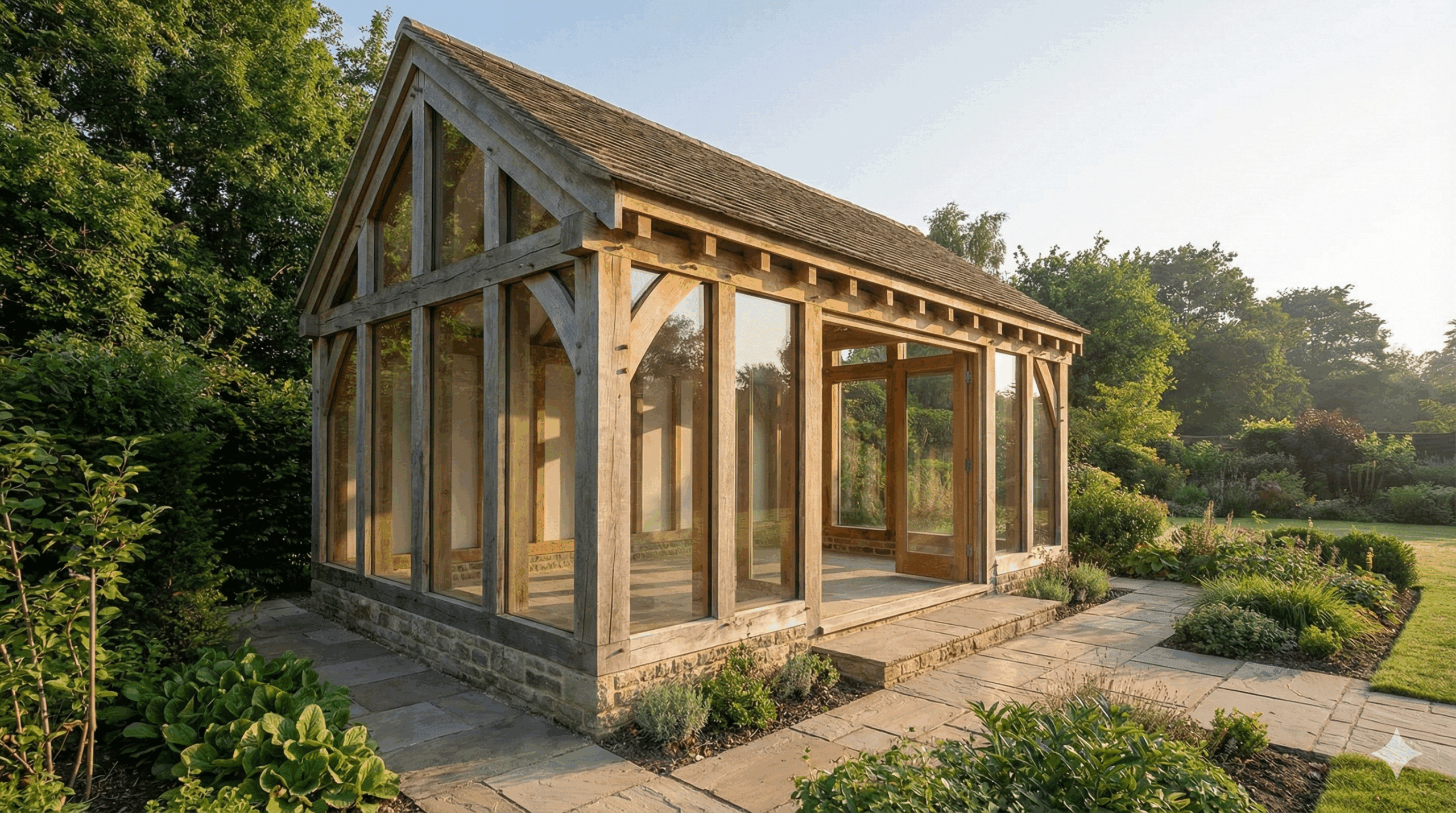
Fully pitched tiled roofs with dramatic vaulted ceilings and exposed oak trusses. Primary value driver is spatial volume – vaulted ceilings create experiential space flat-ceilinged extensions cannot match. Ideal for lounge and entertainment spaces.
Oak Garden Offices 2026
Detached workspaces creating professional separation from main residence. 2026 estate agent data shows home offices feature in 85% of buyer conversations. Premium oak construction addresses year-round comfort concerns of earlier temporary solutions.
Oak Annexes & Garages 2026
Detached annexes with independent facilities can add 20-35% to property value in suitable locations. Room-over-garage designs offer cost-effective square footage addition using existing footprint. Particularly valuable for multi-generational living.
2026 Cost & Return Summary
The following provides indicative 2026 costs and expected returns for different oak frame projects based on current market analysis.
| 2026 Project Type | Typical Cost | Value Added | ROI Range | Best For |
|---|---|---|---|---|
| Oak Garden Office | £28k – £45k | £35k – £60k | 1.25x – 1.5x | Remote workers, urban/suburban homes |
| Oak Orangery | £55k – £90k+ | £70k – £120k+ | 1.25x – 1.5x | Kitchen extensions, period homes, SE England |
| Oak Garage with Annexe | £48k – £82k | £65k – £105k | 1.35x – 1.6x | Rural properties, multi-gen living, larger plots |
| Oak Garden Room (Vaulted) | £45k – £68k | £58k – £90k | 1.3x – 1.5x | Entertainment spaces, lifestyle enhancement |
| Oak Home Gym/Studio | £32k – £52k | £40k – £65k | 1.25x – 1.45x | Wellness focus, modern lifestyle appeal |
2026 Planning Permission & Building Regulations
Understanding the 2026 regulatory framework is essential for successful oak frame projects. While regulations evolve, oak construction’s traditional nature often simplifies approval processes.
2026 Permitted Development Rights
Many detached oak garden buildings qualify under Permitted Development rights if they meet specific 2026 criteria:
- Maximum eaves height of 2.5 metres when within 2 metres of any boundary
- Maximum overall height of 4 metres with dual-pitched roof, or 3 metres otherwise
- No sleeping accommodation
- Not positioned forward of the principal elevation facing a highway
- Cover no more than 50% of garden area (excluding original house footprint)
2026 Heritage & Conservation Considerations
Properties in conservation areas, AONBs, National Parks, or World Heritage Sites face additional restrictions. Listed Building owners often find oak framing is the only viable extension route, as conservation officers favor traditional, natural materials that respect historic fabric.
2026 Tip: Always submit a Lawful Development Certificate application (£103-£258) for peace of mind, even if confident your project qualifies as Permitted Development. This provides legal proof and simplifies future sales.
2026 Building Regulations Compliance
Attached extensions must comply with updated 2026 Building Regulations. Key considerations include:
- Part L (Conservation of Fuel and Power): U-values of 0.18 W/m²K for walls, 0.15 for roofs, 1.6 W/m²K for windows
- Part F (Ventilation): Mechanical extract or whole-house ventilation systems
- Part B (Fire Safety): Adequate escape routes, fire-resistant materials where needed
- Part E (Sound): Acoustic separation where used as habitable rooms
Oak framing readily achieves these standards through modern insulation systems installed within the deep timber sections, often exceeding minimum requirements.
2026 Best Practice: Maximising Your Investment
Achieving optimal returns from an oak frame building requires strategic planning and attention to 2026 market preferences.
🌳 2026 Design Integration
- Ensure sympathetic design that complements the main house architecture
- Avoid “bolted-on” appearances that can devalue rather than enhance
- Consider roofline continuity, material harmony, window proportions
- Aim for seamless integration where the structure appears original
- Professional design services typically add 5-10% to project value
🌳 2026 Specification Quality
- Never compromise on glazing or insulation quality
- Solar control glass prevents summer overheating (essential for south-facing aspects)
- High-performance insulation maintains year-round comfort
- Underfloor heating enhances winter usability
- Professional electrical installation with sufficient capacity
🌳 2026 Documentation & Certification
- Maintain records of sustainable sourcing (FSC/PEFC certification)
- Store Building Regulations compliance certificates
- Keep energy performance calculations and warranties
- Photograph construction stages for future buyers
- Maintain a “house file” with all project documentation
2026 Final Investment Analysis
An oak frame garden building represents more than property enhancement—it’s a strategic decision combining immediate lifestyle improvement with long-term financial returns. The 2026 market data consistently supports this proposition.
Quality oak garden rooms add 5-18% to property values, with the multiplier effect typically returning 1.3 to 1.6 times your investment. Oak specifically commands a premium due to exceptional durability, natural beauty, and appreciation over time rather than depreciation.
Beyond financial calculations, consider lifestyle transformation: a dedicated professional workspace, stunning orangery for family gatherings, or peaceful garden retreat fundamentally changes how you experience your home. These qualitative benefits, while difficult to quantify, significantly enhance daily life.
The 2026 Bottom Line
Few home improvements offer oak’s compelling combination of aesthetics, functionality, and financial return. Having served British builders for centuries, oak continues proving its worth in the modern property market.
Whether planning to sell or enhance your long-term living experience, a custom oak frame garden building deserves serious consideration. While upfront investment exceeds alternatives, the returns—measured in value retention, durability, and daily enjoyment—present a compelling case for 2026 property owners across Surrey, Sussex, Hampshire and South East England.
2026 Frequently Asked Questions
How much does an oak frame garden building cost in 2026?
2026 costs: Detached oak garden office £28,000-£45,000. Attached orangery £55,000-£90,000+. Garage with room above £48,000-£82,000. Includes frame, premium insulation, glazing, electrics and finishing. South East England typically commands 10-15% premium.
How much value does an oak garden room add in 2026?
2026 data shows quality oak garden rooms add 5-18% to property values. Value typically exceeds build cost by 1.3-1.6x. A £55,000 oak garden room might add £71,500-£88,000 to property value, with highest returns in South East England.
Do I need 2026 planning permission for an oak building?
2026 regulations: Many detached buildings qualify under Permitted Development if meeting criteria: max 2.5m eaves height within 2m of boundary, not sleeping accommodation, not forward of principal elevation. Conservation areas have additional restrictions. Always verify with local planning portal.
How long does an oak frame building last?
Oak frames routinely last 200+ years with proper design. Many historic structures survive 500+ years. Natural tannins and density provide exceptional rot and pest resistance. Compared to treated softwood (10-25 years), oak offers superior longevity and value retention.
What is 2026 ROI compared to other improvements?
2026 data: Oak garden buildings (70-100%+ ROI) outperform kitchen renovation (55-70% ROI), bathroom upgrade (55-70% ROI), and match loft conversion (75-85% ROI). They offer better returns with less household disruption during construction.
Are oak buildings energy efficient in 2026?
Yes, modern oak frames achieve U-values of 0.16-0.18 W/m²K, exceeding 2026 Building Regulations. Advanced insulation systems, triple glazing options, and airtight construction make oak buildings highly energy efficient for year-round use with low running costs.
What maintenance does oak require in 2026?
Oak requires minimal maintenance. Most specialists recommend leaving exterior untreated to weather naturally to silver-grey. Interior oak can be left natural or treated with oil/wax. Ensure adequate ventilation. Annual inspection of flashings and seals is recommended.
Is oak more expensive than alternatives in 2026?
Yes, oak costs 30-50% more upfront than softwood alternatives. However, softwood lasts 10-25 years before replacement, while oak lasts centuries. When factoring replacement costs, maintenance, and value retention, oak often proves more economical long-term.
2026 Ready to Invest in Oak?
Discover how an oak frame garden building could transform your property and lifestyle in 2026. Our specialists design and build premium oak structures across Surrey, Sussex, Hampshire and the South East.