
roomoutsideuk
12th January, 2026

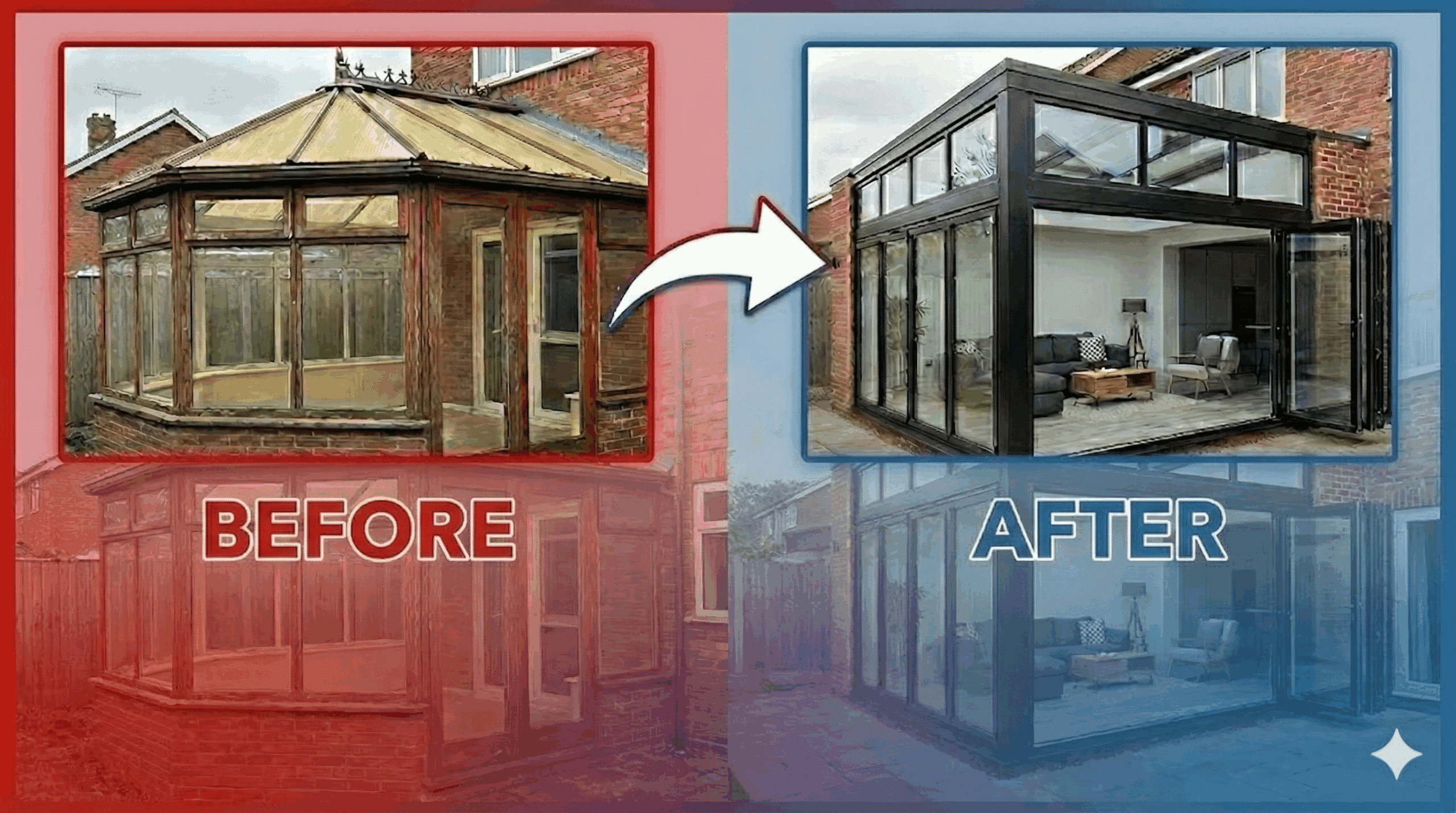
1990s Conservatory Revival: Modern Upgrades That Transform Old Structures

1990s Conservatory Revival: Modern Upgrades | Room Outside

1990s Conservatory Revival: Modern Upgrades That Transform Old Structures

A complete guide to refurbishment and replacement options for aging conservatories—backed by independent research and real data.

The Bottom Line

53% of conservatory owners cite temperature problems as their biggest complaint. Up to 80% of heat loss in a traditional conservatory occurs through the roof alone.

The good news: Modern upgrades can reduce heat loss by up to 90% and cut heating energy consumption by 32%. A polycarbonate to glass conversion costs £3,000-£8,000, while solid roofs (£5,000-£15,000) achieve U-values of 0.15-0.18 W/m²K—matching new-build extension standards.

Key stat: Typical payback period is 3-7 years through energy savings alone, with potential property value increases of 5-15%.

80%
Heat loss through old roofs
90%
Heat loss reduction possible
£200-£500
Annual energy savings
3-7 yrs
Typical payback period
According to government statistics, approximately 18% of households in England have a conservatory, with the vast majority built during the construction boom of the late 1980s and 1990s. If you own one of these structures, you’re not alone in noticing the toll that three decades have taken. A 2024 survey by Eurocell found that 53% of conservatory owners cite temperature problems as their biggest complaint—spaces that are too hot in summer and too cold in winter. The good news is that 2026 brings more options than ever for breathing new life into these aging spaces.

Understanding the Problems with 1990s Conservatories

Before exploring solutions, it helps to understand exactly why conservatories from this era have become problematic. Independent testing at Salford University’s Energy House 2.0 facility has provided detailed data on just how much energy older conservatories waste, finding that proper insulation can reduce heat loss by up to 90% and lower heating energy consumption by up to 32%.

Polycarbonate Roofing Issues

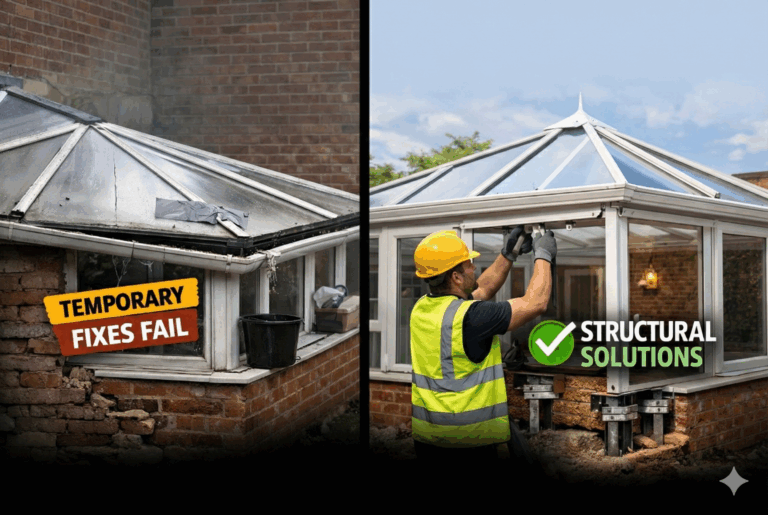
The single biggest complaint from owners of 1990s conservatories centres on polycarbonate roofing. According to research published by Ideal Home, polycarbonate roofs typically degrade within 10 to 20 years, showing clear signs of wear including leaks, cracks, and thermal failure.

The material offers a U-value of around 4.0 W/m²K or higher, compared to modern building regulations that require windows to achieve 1.4 W/m²K or lower. This means heat escapes at nearly three times the rate considered acceptable by current standards. The Eurocell Conservatory Census also found that 12% of owners specifically cite rain noise on polycarbonate roofs as a major issue, making the space unusable during wet weather.

Glazing Deficiencies

Early double-glazed units from the 1990s typically achieved U-values of 2.8 to 3.0 W/m²K—well below today’s standards. Modern double glazing with Low-E coatings achieves 1.0 to 1.1 W/m²K, while triple glazing can reach 0.6 to 0.8 W/m²K. Single-glazed panels, still found in many economy conservatories from the era, have U-values as high as 5.0 to 6.0 W/m²K, offering almost no insulation.

⚠️ The Hidden Problem: Failed Seals

Failed seals in older double-glazed units result in condensation between panes, reducing both visibility and thermal performance. If you see misting inside your glass units, the insulating gas has escaped and the unit has effectively become single-glazed in terms of thermal performance.

Structural Wear and Tear

Aluminium frames from the 1990s often lack thermal breaks, creating cold bridges that lead to condensation and heat loss. Research shows that thermally broken frames can improve overall window U-values by 0.2 to 0.3 W/m²K compared to non-broken alternatives.

uPVC frames, while more thermally efficient, can become discoloured, warped, or brittle after decades of UV exposure. Foundation and base issues also emerge over time, with some conservatories showing signs of subsidence or poor drainage.

The Scale of the Problem: UK Statistics

Understanding the scale of the issue helps put individual upgrade decisions into context. The Energy Follow-Up Survey conducted for the Department for Business, Energy and Industrial Strategy found that conservatory ownership correlates with larger homes (median floor area of 94m² compared to 77m² for homes without conservatories). The survey also revealed that households with conservatories use measurably more gas for heating.

The Numbers That Matter

A typical 12m² conservatory with poor insulation can leak 420 to 480 watts of heat per hour when outside temperatures drop just 10°C below inside temperatures. Over a 180-day heating season, this wastes over 1,500 kWh of energy. At current energy prices, that translates to hundreds of pounds in unnecessary heating costs each year.

The Polycarbonate to Glass Upgrade

One of the most popular and effective upgrades for 1990s conservatories is the polycarbonate to glass roof conversion. According to 2026 pricing data from multiple UK sources, glass roof replacements typically cost between £3,000 and £8,000 for an average-sized conservatory of around 16m². Checkatrade reports average costs of £9,450 for a 3m x 3.5m glass conservatory roof, with larger structures reaching £22,500 for 5m x 5m installations.

What Modern Glass Offers

Modern glass roof panels designed for conservatory use include multiple technologies that simply weren’t available thirty years ago:

  • Self-cleaning coatings reduce maintenance requirements
  • Solar control glass reflects unwanted heat in summer
  • Low-emissivity coatings retain warmth during winter months
  • U-values of 1.0 to 1.2 W/m²K compared to 4.0+ for polycarbonate
  • Acoustic interlayers cut rain noise substantially

Glass roofs also offer a longer lifespan than polycarbonate. While polycarbonate typically lasts 10 to 20 years, glass roofs can last 30 years or more with proper maintenance, making them a better long-term investment despite higher upfront costs.

Solid Roof Conversions: The Premium Option

For homeowners seeking the best possible thermal performance, solid roof conversions represent the premium old conservatory upgrade option. According to MyJobQuote’s 2026 pricing guide, solid conservatory roofs cost between £5,000 and £12,000 for average-sized structures, with tiled systems commanding £6,000 to £15,000 depending on specification and structural requirements.

0.15-0.18
Solid roof U-value (W/m²K)
4.0+
Old polycarbonate U-value
£200
Average annual savings
50+ yrs
Solid roof lifespan

Solid roof conversions achieve U-values of 0.15 to 0.18 W/m²K, bringing your conservatory in line with modern building regulations for new extensions. Independent research by AECOM for Guardian Building Systems found that solid roof conversions save homeowners an average of £200 per year on energy bills. The visual change is equally striking, with the finished result appearing more like a traditional extension than a conservatory.

⚠️ Structural Considerations

Solid roof conversions require careful structural assessment. The additional weight, while minimal compared to traditional roofing, may exceed what 1990s conservatory frames were designed to support. Converting from glass or polycarbonate to a solid roof typically adds £1,500 to £3,000 to the project cost for necessary structural reinforcement—a 30% to 40% premium over like-for-like replacement.

Real Energy Savings: What the Research Shows

Independent testing provides concrete data on what homeowners can expect from conservatory upgrades. Research conducted at Salford University’s Energy House 2.0 found that insulating a conservatory roof can reduce heat loss by up to 90% and lower heating energy consumption by up to 32%. This translates to annual savings of £200 to £500 depending on conservatory size, heating system, and usage patterns.

The Glass and Glazing Federation notes that a well-designed conservatory can act as a thermal buffer zone between indoor and outdoor areas. Heat that escapes through house walls into an insulated conservatory helps warm that space, and can then re-heat the main building when doors are opened. This passive solar gain effect was largely impossible with poorly insulated 1990s structures but becomes achievable with modern upgrades.

CosyPanels Research Findings

CosyPanels research indicates that modern insulated roofs reduce heat loss from 54% to just 10%—an 80% improvement that cuts heating bills proportionally. Their data suggests typical payback periods of 3 to 7 years depending on conservatory size and usage, making upgrades a financially sound decision rather than just a comfort improvement.

Impact on Property Value

The relationship between conservatories and property value is nuanced. According to the Nationwide Building Society, a high-quality conservatory can add between 5% and 15% to overall property value. Property expert Phil Spencer has stated that conservatories add an average of 7% to property value when they feel like part of the house rather than something “bolted on the back.”

❌ Poor Condition = Value Reduction

Outdated conservatory impact -£15,000
27% of owners unsure about value Risk
Unusable space perception Negative
Net impact on sale Liability

✓ Upgraded = Value Added

Quality upgrade impact +5-15%
Year-round usability Asset
Energy efficiency appeal Positive
Net impact on sale +£20,000+

However, quality matters enormously. Recent reports cited by Eurocell reveal that older conservatories with poor insulation can actually reduce home value by up to £15,000. The Eurocell Conservatory Census found that 60% of respondents believed their conservatory added value, but 27% were unsure—suggesting many owners recognise their structures may not be assets in their current condition.

2026 Cost Summary

Based on current market data from multiple UK sources, here’s what homeowners can expect to pay for different old conservatory upgrade options in 2026:

Upgrade Option Cost Range U-Value Achieved Lifespan Best For
Polycarbonate Replacement £2,000 – £5,000 1.6 – 2.4 W/m²K 10-15 years Budget option
Polycarbonate to Glass £3,000 – £8,000 1.0 – 1.2 W/m²K 30+ years Best balance
Solid/Tiled Roof £5,000 – £15,000 0.15 – 0.18 W/m²K 50+ years Maximum performance
Complete Refurbishment £8,000 – £25,000 Varies 30-50 years Multiple issues
Full Replacement £15,000 – £40,000+ 0.8 – 1.2 W/m²K 40+ years Structural problems
Polycarbonate Replacement
Cost Range £2,000 – £5,000 ✓ Cheapest
U-Value Achieved 1.6 – 2.4 W/m²K ✗ Poorest
Lifespan 10-15 years
Best For Budget option, quick fix
Polycarbonate to Glass
Cost Range £3,000 – £8,000
U-Value Achieved 1.0 – 1.2 W/m²K
Lifespan 30+ years
Best For Best balance of cost & performance ✓ Popular
Solid/Tiled Roof
Cost Range £5,000 – £15,000
U-Value Achieved 0.15 – 0.18 W/m²K ✓ Best
Lifespan 50+ years ✓ Best
Best For Maximum thermal performance
Complete Refurbishment
Cost Range £8,000 – £25,000
U-Value Achieved Varies by specification
Lifespan 30-50 years
Best For Multiple issues to address
Full Replacement
Cost Range £15,000 – £40,000+
U-Value Achieved 0.8 – 1.2 W/m²K
Lifespan 40+ years
Best For Structural problems, complete redesign

Labour costs typically account for £150 to £300 per day for a roofer, with most roof replacements requiring a two-person team for one to three days. Installation-only costs start at approximately £2,500 including the base for standard builds.

Complete 1990s Conservatory Refurbishment

When the roof alone isn’t the only issue, a complete 1990s conservatory refurbishment addresses multiple parts at once. Based on 2026 market pricing, complete refurbishment projects commonly fall between £8,000 and £25,000 for work including roof, glazing, and frame upgrades. This compares favourably to full replacement costs, which typically start around £15,000 for modest structures and can exceed £40,000 for larger, premium installations.

What Complete Refurbishment Includes

  • Roof upgrade: Polycarbonate to glass or solid roofing
  • Glazing replacement: Modern triple-glazed units (U-values of 0.6 to 0.8 W/m²K)
  • Frame repairs: Eliminate thermal bridges
  • Base insulation: Complete the thermal envelope
  • Updated doors: Thermally efficient access points
  • Modern ventilation: Maintain air quality without compromising thermal performance

When Replacement Makes More Sense

While refurbishment offers excellent value in many situations, some circumstances point clearly toward complete replacement. According to cost comparison data, a traditional brick extension costs £1,800 to £3,500 per m², compared to £1,300 to £1,500 per m² for a new conservatory. This means a conservatory remains a more affordable way to add living space, even accounting for full replacement costs.

🔧 Choose Refurbishment If:

  • Foundations are stable with no subsidence
  • Frame structure is sound (no major rot or corrosion)
  • Current footprint and design work for your needs
  • Budget is £8,000-£25,000
  • You want to preserve the existing character

✓ Choose Replacement If:

  • Foundations show signs of failure
  • Frame has major corrosion or rot
  • You want to change footprint or design
  • Multiple structural issues exist
  • Budget allows for £15,000-£40,000+

Planning Permission and Building Regulations

Understanding regulatory requirements helps avoid costly mistakes. Like-for-like repairs and maintenance—including glass-to-glass or polycarbonate-to-polycarbonate roof replacements—typically don’t require planning permission or building regulations approval.

Building Regulations for Solid Roofs

Solid roof conversions are more complex. Many approved lightweight systems fall under Permitted Development, but almost all solid and tiled roofs require Building Regulations approval, costing £200 to £800+. Properties in conservation areas, listed buildings, or those that have exhausted permitted development allowances will need specific planning consent for any external changes.

Conservatory Exemptions

Conservatories can be exempt from building regulations if they meet specific criteria:

  • Floor area less than 30m²
  • Physically separated from the main property by an external wall or door
  • Not heated by the main heating system
  • Has independent temperature control

Upgrading an existing conservatory may affect these exemptions, so check requirements before work begins.

Project Timelines

A polycarbonate to glass roof conversion can often complete within two to three days for standard-sized conservatories. According to MyJobQuote, a typical two-person team can complete most roof replacements within this timeframe, with polycarbonate installations slightly faster than glass due to lighter weight and easier handling.

Solid roof conversions typically take one to two weeks depending on complexity, particularly if structural reinforcement is required. Industry sources note that insulated roof panels can often be fitted in just a few days as they slot into existing frames, while full tiled systems requiring new structures may take a week or longer.

Full refurbishments or replacements naturally take longer, with larger projects potentially spanning several weeks including foundation work if required. Spring and autumn typically offer the best conditions for conservatory work, though experienced contractors work year-round with appropriate weather protection.

Making Your Decision

The 1990s conservatory serving your home has likely provided years of enjoyment despite its limitations. With 65% of conservatory owners using their space daily according to the Eurocell survey, these structures remain valued parts of UK homes. The question is whether to refurbish or replace.

The Financial Case

If your frame and base remain sound, refurbishment offers excellent value. The polycarbonate to glass conversion alone can reduce U-values from 4.0+ to around 1.0 W/m²K—a fourfold improvement in thermal performance. Combined with energy savings of £200 to £500 annually and potential property value increases of 5% to 7%, the financial case for upgrading is strong.

When serious structural issues exist or when your needs have grown beyond what refurbishment can address, replacement delivers a fresh start with contemporary performance. Either path leads to the same destination: a comfortable, efficient, and attractive space that extends your living area throughout the year.

📚 Sources

Department for Energy Security and Net Zero Energy Follow-Up Survey; Salford University Energy House 2.0 research; Eurocell Conservatory Census 2024; Nationwide Building Society; Checkatrade; MyJobQuote; AECOM/Guardian Building Systems research; Glass and Glazing Federation; CosyPanels industry data; Squared Money Home Improvement Index.

Frequently Asked Questions

How do I know if my 1990s conservatory can be refurbished or needs replacing?

Start by checking the frame and base. If the frame is structurally sound without major rot, warping, or corrosion, and the base shows no signs of subsidence or cracking, refurbishment is usually viable. A professional survey will confirm whether your existing structure can support upgrades like a glass or solid roof.

Is a polycarbonate to glass roof conversion worth the money?

For most homeowners, yes. The upgrade typically costs between £3,000 and £8,000, with immediate improvements in temperature control, noise reduction, and appearance. Modern glass achieves U-values of 1.0 to 1.2 W/m²K compared to 4.0+ W/m²K for polycarbonate—a fourfold improvement in thermal performance.

Do I need planning permission to upgrade my conservatory roof?

For like-for-like replacements such as swapping polycarbonate for glass panels, planning permission usually isn’t required. Solid roof conversions are more complex—almost all solid and tiled roofs require Building Regulations approval, costing £200 to £800+. Properties in conservation areas will likely need planning consent.

How much could I save on energy bills after upgrading?

Research from Salford University shows insulation can reduce heating energy consumption by up to 32%. Industry sources cite typical annual savings of £200 to £500. Heat loss reduction from 54% to 10% cuts heating bills proportionally. Typical payback periods range from 3 to 7 years.

What’s the difference between a glass roof and a solid roof conversion?

Glass roofs maintain the light, airy feel of a traditional conservatory while offering much better thermal performance (U-values around 1.0-1.2 W/m²K) and can last 30+ years. Solid roofs achieve U-values of 0.15-0.18 W/m²K—comparable to traditional extensions—but change the character to feel more like a room.

How long does a conservatory refurbishment take?

A polycarbonate to glass roof conversion typically takes 2-3 days with a two-person team. Solid roof conversions usually require 1-2 weeks. Full refurbishments including glazing, frames, and other components can take 2-4 weeks depending on the scope of work.

Will upgrading my conservatory add value to my home?

A well-executed conservatory upgrade can add 5% to 15% to property value. However, older conservatories with poor insulation can reduce home value by up to £15,000. The key is ensuring year-round usability and thermal efficiency—making upgrades essential for protecting your investment.

What U-values should I look for in conservatory glazing?

Current Building Regulations require windows to achieve maximum U-values of 1.4 W/m²K, with the Future Homes Standard requiring 1.2 W/m²K or lower. For year-round comfort, aim for 1.2 W/m²K or lower. Premium options achieve 0.8-1.0 W/m²K using triple glazing and thermally broken frames.

Ready to Revive Your 1990s Conservatory?

Whether you need a simple roof upgrade or a complete refurbishment, our team has completed hundreds of conservatory projects across Kent and the South East. Get a free, no-obligation assessment of your structure and personalised recommendations.
roomoutsideuk
17th December, 2025

Glass Extensions Surrey | What Homeowners Need to Know 2025 | Room Outside

What Surrey Homeowners Should Know Before Commissioning a Glass Extension | Room Outside

What Surrey Homeowners Should Know Before Commissioning a Glass Extension

Expert guide to Surrey’s unique planning landscape, realistic budgets, and what actually adds value to your property in 2025.

📋 The Short Answer

Before commissioning a glass extension in Surrey, you need to understand three things: (1) whether your property falls within the 73% of Surrey designated as Green Belt, which affects what you can build; (2) whether Permitted Development rights apply (most conservatories under 4m don’t need planning permission); and (3) budget expectations—with average Surrey property prices at £587,000, quality glass extensions typically cost £40,000-£120,000+ depending on specification.

So You’re Thinking About a Glass Extension in Surrey?

Let’s be honest: you’ve probably already scrolled through Pinterest boards, saved a dozen Instagram posts, and imagined morning coffee in a light-flooded kitchen-diner. The vision is clear. But somewhere between the dream and the reality, questions start multiplying.

Will I need planning permission? How much should I actually budget? Is my Edwardian terrace in Guildford even suitable? What about my 1930s semi in Woking that backs onto Green Belt?

These aren’t hypothetical concerns. After forty years of building glass extensions across Surrey—from Farnham to Reigate, Epsom to Dorking—we’ve heard them all. This guide answers the questions Surrey homeowners actually ask, with specific information relevant to properties in this county.

Because Surrey isn’t like anywhere else. It’s the second most expensive county in England (average price £587,000). It has more Green Belt than almost anywhere—73% of the county. And one quarter sits within the Surrey Hills National Landscape, with its own planning considerations.

Your glass extension project needs to account for all of this. Here’s how.

The Surrey Planning Landscape: What Makes This County Different

Before we discuss designs, materials, or budgets, let’s address the elephant in the room: can you actually build what you want?

Green Belt: 73% of Surrey Is Protected

Surrey’s Metropolitan Green Belt isn’t a single park—it’s a planning designation that covers nearly three-quarters of the county. In practical terms:

  • Woking Borough: approximately 70% Green Belt
  • Guildford Borough: 24,040 hectares of Green Belt (most in Surrey)
  • Mole Valley: extensive coverage protecting countryside character
  • Epsom and Ewell: smallest Green Belt area (1,560 hectares) but still significant

The good news: Green Belt doesn’t prevent home extensions. Permitted Development rights still apply in most cases. But councils follow a general ‘50% rule’—extensions shouldn’t increase the original house size by more than 50% in area and volume, and must have minimal visual impact on the landscape.

Surrey Hills National Landscape: A Quarter of the County

The Surrey Hills Area of Outstanding Natural Beauty (now officially a ‘National Landscape’) stretches from Farnham in the west to Oxted in the east, including the chalk slopes of the North Downs and the wooded Greensand Hills around Haslemere.

If your property falls within the Surrey Hills:

  • Permitted Development rights are more restricted for rear extensions
  • Design must conserve and enhance ‘natural and scenic beauty’
  • Local materials and styles are strongly encouraged (Bargate stone, clay tiles)
  • The Surrey Hills Board provides design guidance and may comment on applications

Conservation Areas and Listed Buildings

Every Surrey borough has Conservation Areas—from Guildford’s medieval town centre to Reigate’s Victorian suburbs. Properties within these areas face additional restrictions:

  • No Permitted Development for side extensions
  • No cladding of exterior walls
  • No rear extensions beyond one storey under PD rights
  • Design must preserve or enhance the Conservation Area’s character

Listed buildings require Listed Building Consent for almost any alteration—including internal works. This isn’t a barrier to beautiful glass extensions, but it does require specialist knowledge and early engagement with your local conservation officer.

Do You Actually Need Planning Permission?

Here’s something that surprises many Surrey homeowners: most conservatories and single-storey glass extensions can be built without planning permission under Permitted Development rights.

The Permitted Development Rules (2025)

Your glass extension qualifies as Permitted Development if it meets ALL of the following:

Requirement What This Means
Maximum projection from rear wall 4m for detached houses, 3m for semi/terraced
Maximum height 4m at highest point (3m if within 2m of boundary)
Garden coverage Cannot cover more than 50% of original garden area
Position Must be at rear of property (not front or side facing highway)
Materials Must use similar materials to existing house
Eaves and ridge Cannot be higher than the existing house

When You Definitely Need Planning Permission

  • Your property is a listed building
  • You’re in a Conservation Area and want a side extension or two-storey rear
  • Your project exceeds PD size limits
  • Previous extensions have already used your PD allowance
  • Your property is a flat or maisonette (no PD rights)
  • PD rights were removed by condition on original planning consent (common in 1970s+ builds)

Our recommendation: Even if you believe you qualify for Permitted Development, consider obtaining a Lawful Development Certificate (LDC) from your local council (£103). This provides legal certainty that’s valuable when selling your property.

Realistic Budgeting for Surrey Property Owners

Let’s talk money—because Surrey prices aren’t like anywhere else, and neither should your expectations be.

The Surrey Premium

With average property prices at £587,000 (and significantly higher in Elmbridge, Waverley, and parts of Guildford), your glass extension is protecting a substantial asset. Cutting corners on specification makes no financial sense when:

  • A quality extension adds 5-10% to property value (RICS, Savills)
  • Poor-quality builds can actually devalue your home
  • Surrey buyers are discerning—estate agents report that dated conservatories are now liabilities

What Should You Expect to Pay?

Project Type Budget Range Notes
Standard conservatory (uPVC) £15,000-£30,000 Entry point, 20-35yr lifespan
Premium conservatory (aluminium) £30,000-£50,000 40-50yr lifespan, slimmer frames
Orangery (brick/glass hybrid) £40,000-£70,000 Ideal for period properties
Contemporary glass extension £50,000-£90,000 Minimal frames, max glazing
Bespoke glass box / structural glass £80,000-£150,000+ Architectural statement pieces

Hidden Costs to Budget For

  • Structural engineer fees: £500-£1,500
  • Building Regulations application: £200-£500
  • Planning application (if required): £206 for householder applications
  • Party Wall surveyor (if applicable): £700-£1,000 per surveyor
  • Landscaping/making good: 5-10% of project cost
  • Blinds/climate control: £2,000-£8,000 depending on specification

What Surrey Property Buyers Actually Want

If you’re thinking about resale value (and in Surrey, you should be), here’s what local estate agents tell us buyers are looking for:

Year-round usability

The old polycarbonate conservatory that’s freezing in winter and sweltering in summer? That’s now seen as a negative. Buyers want spaces that work 365 days a year.

Seamless kitchen-diner flow

The extension that opens directly onto an existing kitchen—creating one large, light-filled entertaining space—commands more premium than a separate ‘added on’ room.

Quality over size

A beautifully executed 3m x 4m extension with slim aluminium frames and quality glazing will add more value than a cheap 5m x 5m box.

The Process: From First Idea to Completion

Here’s what a typical glass extension project looks like with Room Outside:

Phase Timeline Key Activities
Phase 1: Design Consultation 2-4 weeks Initial site visit, planning constraints review, preliminary designs, budget discussions
Phase 2: Planning & Permissions 4-12 weeks Permitted Development assessment, Building Regulations drawings, structural calculations
Phase 3: Construction 6-12 weeks Groundworks, structural work, frame installation, glazing, internal finishes

Frequently Asked Questions: Surrey Glass Extensions

Do I need planning permission for a conservatory in Surrey?

Most conservatories do not need planning permission under Permitted Development rights. Your project qualifies if it extends no more than 4m from the rear wall (detached houses) or 3m (semi/terraced), is under 4m high, and covers less than 50% of your garden.

How much does a glass extension cost in Surrey?

Quality glass extensions in Surrey typically cost £30,000-£90,000, with bespoke structural glass projects reaching £150,000+. Standard uPVC conservatories start around £15,000-£30,000. Factor in an additional £3,000-£5,000 for professional fees.

Can I build a glass extension if my Surrey property is in the Green Belt?

Yes. Green Belt status doesn’t prevent home extensions—Permitted Development rights still apply. With 73% of Surrey designated as Green Belt, most extensions are built successfully within these areas.

Will a glass extension add value to my Surrey home?

A well-designed glass extension typically adds 5-10% to Surrey property values (RICS, Savills). On a £587,000 average Surrey property, that’s £29,000-£58,000. However, quality matters for maintaining value.

What are the restrictions for glass extensions in Surrey Hills AONB?

Properties in the Surrey Hills National Landscape have more restricted Permitted Development rights and stricter design requirements. Extensions must conserve and enhance ‘natural and scenic beauty’ with local materials encouraged.

How do I choose between aluminium, timber, and uPVC frames?

For contemporary Surrey homes, aluminium offers the slimmest sightlines and longest lifespan (40-50 years). For period properties or Conservation Areas, timber may be required for planning approval. uPVC provides the best value but with bulkier frames.

Ready to Discuss Your Surrey Project?

Our design consultations are free, with no obligation. We’ll visit your property, discuss your vision, review any planning constraints, and provide honest guidance on what’s achievable within your budget.

roomoutsideuk
20th December, 2022

Permitted Development Rights: Everything You Need to Know About Adding a Conservatory

Do You Need Planning Permission for a Conservatory?

One of the most common questions we get is about permitted Development (PD) Rights for conservatories and other glass extensions. Many homeowners want to avoid the hassle and cost of applying for planning permission.

Fortunately, in many cases, you won’t need planning permission if your conservatory meets PD criteria. However, this depends on several factors, including size, location, and previous extensions.

Permitted Development Rights

How Big Can a Conservatory be Without Getting Planning Permission?


Permitted Development allows you to build a conservatory up to a certain size without needing planning approval.

  • 6 metres from the original rear wall for semi-detached and terraced homes.
  • 8 metres from the original rear wall for detached houses.

However, the total extension allowance applies to the entire property, not just the conservatory. If your home has already been extended, your permitted size may be reduced.

What is Permitted Development?

Permitted Development allows homeowners to make improvements to their property without applying for planning permission. However, the work must meet specific government guidelines.

In recent years, these rules have become more flexible, making it easier to add glass extensions. For example, the government introduced:

  • A fast-track option for two-storey extensions.
  • Looser restrictions on converting commercial buildings into residential properties.

Because these rules change over time, it is always a good idea to check with your local planning authority before starting a project.

What Home Improvements Are Allowed Under Permitted Development?

If your project meets PD criteria, you may be able to:

  • Build a small single-storey rear or side extension.
  • Construct a double-storey rear or side extension.
  • Add a porch to the front of the house.
  • Remove internal walls to create an open-plan layout.
  • Convert a garage, basement, or loft into a usable space.
  • Install a balcony, roof lights, or dormer windows.

However, some properties have restrictions, including:

  • Listed buildings or homes in Areas of Outstanding Natural Beauty (AONB) – Additional approvals are required.
  • Flats and maisonettes – PD rights do not apply, as modifications could impact neighbouring properties.

Even if your conservatory falls under PD, all work must still comply with Building Regulations to ensure structural safety and energy efficiency.

Using Permitted Development Rights for Conservatories

While PD makes conservatory extensions easier, there are key things to keep in mind:

  • PD applies only to the original building. If your home was extended before, the previous work reduces your allowance.
  • Larger conservatories may require planning permission. Planning officers will assess how much larger or higher the structure is before granting approval.
  • Always confirm with your local authority. Mistakes can be costly if your project doesn’t meet regulations.

Where to Find More Information

If you’re planning a conservatory under Permitted Development, here’s what to do next:

  • Check the Planning Portal – This UK government website explains PD rules in detail.
  • Consult your local authority – They can confirm if your conservatory meets PD criteria.
  • Get expert advice – Our team has over 50 years of experience in glass extensions and can guide you through the PD process.

Why This Matters: If your conservatory does not qualify under PD, you may have to apply for retrospective planning permission. If refused, enforcement action could require you to remove the structure, leading to unnecessary expenses.

Need Expert Advice on Permitted Development Rights for Conservatories?

Our specialist team can:

  • Answer your questions about PD rules and glass extensions.
  • Assess your project and advise if planning permission is needed.
  • Help you navigate regulations to avoid costly mistakes.
  • Contact us today for a no-obligation consultation!

Discuss your project, PD rights and get a no-obligation quote

Get a Quote
roomoutsideuk
14th May, 2022

Do I Need Planning Permission for a Conservatory or Orangery?

Adding a conservatory or orangery is a fantastic way to create more space, bring in natural light, and connect your home to the outdoors. It can also increase property value. However, many homeowners hesitate due to confusion about conservatory planning permission rules.

The good news? In most cases, you won’t need planning permission. Many home extensions, including glass rooms, conservatories, and orangeries, fall under Permitted Development Rights. This means you can often build without the hassle of an application.

Planning Consent for Conservatories

Is Planning Permission Required for a Conservatory?


Planning permission will not be required for most conservatories that are less than 6 metres or 8 metres in length for a detached house, as long as your home hasn’t already been extended, meets the other Permitted Development Rights and is not listed or in a conservation area.

What Are Permitted Development Rights?

According to the Government’s Permitted Development Rights for Householders – Technical Guidance (2019):

“Permitted development rights allow householders to improve and extend their homes without the need to apply for planning permission where that would be out of proportion with the impact of works carried out.”

In 2008, new regulations allowed homeowners to build a conservatory, orangery, or garden room under these rights. In May 2019, this rule became permanent. This means that in most cases, you do not need planning permission, provided you stay within specific limits.

Key Permitted Development Rules for Conservatories and Orangeries

To qualify under permitted development, a conservatory or orangery must meet these conditions:

  • It must not cover more than 50% of the land around the original house.
  • It cannot extend past the front of the property (the “Building Line”).
  • The structure must be no higher than the roof of the existing house.
  • A single-storey extension at the rear must not extend more than 3 metres (attached home) or 4 metres (detached home).
  • A two-storey extension must not extend beyond 3 metres at the rear or be within 7 metres of a boundary opposite the rear wall.
  • Homes in conservation areas, national parks, or Areas of Outstanding Natural Beauty may have additional restrictions.

If your property falls within a restricted area, you may need to apply for full planning permission. Consulting a specialist is always recommended.

For more details, visit the Government Planning Portal.

Building Regulations vs. Planning Permission

Many people confuse planning permission with building regulations. While planning permission focuses on size and appearance, building regulations cover structural integrity and safety standards.

When Is a Conservatory Exempt from Building Regulations?

A conservatory or orangery is usually exempt from building regulations if it meets these conditions:

  • It is built onto a domestic dwelling and separated by an external-quality door.
  • It has a floor area under 30 square metres.
  • It is single-storey and at ground level.
  • The roof is at least 75% glazed, and the walls are at least 50% glazed.
  • It complies with safety glazing requirements under Building Regulations BS6262 Part 4.
  • It has an independent heating system with separate temperature controls.

If your design doesn’t meet these conditions, you may need to comply with building regulations.

For full details, visit the Government website with information on Planning-Development Building-Regulations.

Listed Buildings and Conservation Areas

If you live in a listed building or a protected area, the rules are stricter. While some permitted development rights may apply, you will likely need Listed Building Consent from your Local Planning Authority.

Adding a conservatory to a listed building without consent is a criminal offence. This also applies if you are replacing an existing structure. To avoid issues, always consult your local authority before starting any work.

For more details on listed buildings, visit Planning Portal-other permissions-listed.

Final Advice and Next Steps

The rules around conservatory planning permission can be complex. While most homeowners can build under permitted development rights, some restrictions apply. It’s always best to seek professional guidance to ensure compliance.

At Room Outside, we have decades of experience designing conservatories, orangeries, and glass extensions, including projects in listed buildings and protected areas.

Get in touch today for expert advice and a free, no-obligation consultation. We can also connect you with planning specialists to guide you through the process.

Useful Resources

Got questions? Speak to One of Our Specialists.

Contact Us