

roomoutsideuk
29th December, 2025

Understanding U-Values: The Metric That Separates Premium Glass Rooms from the Rest

A modern glass room extension attached to a high-quality home
Understanding U-Values: Glass Room Thermal Performance Guide | Room Outside

Understanding U-Values: The Metric That Separates Premium Glass Rooms from the Rest

Why this single number determines whether your extension stays comfortable year-round or becomes a seasonal space.

The Key Numbers

Lower U-values = Better insulation. A material with U-value 0.5 W/m²K loses heat half as fast as one with 1.0 W/m²K.

Building Regulations minimum: Windows must achieve Uw ≤1.4 W/m²K. Rooflights ≤2.2 W/m²K.

Premium target: For year-round comfort, aim for Uw values of 0.8-1.0 W/m²K using triple glazing and thermally broken frames.

Always ask for Uw (whole window), not Ug (glass only). Uw includes the frame and is what Building Regulations require.

≤1.4
W/m²K max for windows (Building Regs)
0.8-1.0
W/m²K premium triple glazing target
4x
Heat loss: single vs modern double glazing
25mm+
Thermal break depth for quality frames
When you’re investing in a glass room or glazed extension, one number matters more than almost any other. It’s not the price per square metre. It’s not the size of the glass panels. It’s a figure most homeowners have never heard of: the U-value.

What Exactly Is a U-Value?

A U-value measures how quickly heat passes through a material. The technical definition is the rate of heat transfer per square metre for each degree of temperature difference between inside and outside. It’s measured in watts per square metre kelvin, written as W/m²K.

The critical point is simple: lower numbers mean better insulation. A material with a U-value of 0.5 W/m²K loses heat half as quickly as one with 1.0 W/m²K. When you’re heating a room in winter or trying to keep it cool in summer, this difference translates directly into comfort and energy costs.

According to the Open University’s research on building energy, a single-glazed window with a U-value of around 4.8 W/m²K loses heat roughly four times faster than a modern double-glazed unit with a U-value of 1.2 W/m²K. Over the course of a heating season, this difference can cost hundreds of pounds.

The Three U-Values You Need to Know

When discussing glass rooms and extensions, you’ll encounter three different types of U-value. Understanding the difference is important because some suppliers quote whichever figure makes their product look best.

Ug

Glass Only

Measures only the centre pane, ignoring frame and edges. Always the lowest, most flattering number.

Uf

Frame Only

Measures thermal performance of the frame material. Aluminium without thermal breaks can be 5.0+ W/m²K.

Uw

Whole Window ✓

The figure that matters. Combines glass, frame, spacers and seals. This is what Building Regs require.

⚠️ Always Ask for Uw Values

If a supplier quotes only glass centre-pane U-values (Ug), ask for the whole window value including frame. If they cannot or will not provide this, treat it as a warning sign. Building Regulations compliance is based on Uw values, not Ug values.

Building Regulations: What the Law Requires

Part L of the Building Regulations sets minimum thermal performance standards for all building work in England. These regulations have tightened significantly in recent years as part of the UK’s journey toward net zero carbon emissions.

Current Requirements for Extensions (2022)

Windows
≤1.4 W/m²K
Maximum Uw value
Rooflights
≤2.2 W/m²K
Maximum Uw value
Glazed Doors (60%+)
≤1.4 W/m²K
Maximum Uw value
External Walls
≤0.18 W/m²K
Maximum U-value

These are maximum allowable values. Premium glass rooms should exceed these minimums by a comfortable margin to deliver genuine year-round comfort.

The 25% Glazing Rule

There’s an important threshold in the regulations. If the glazed area of your extension exceeds 25% of the total floor area, you need to demonstrate compliance through calculation rather than simply meeting minimum U-values. This typically means specifying glazing that performs better than the bare minimums, or compensating with improved insulation in walls, roof, and floor.

What’s Coming in 2025 and Beyond

The Future Homes Standard will bring even tighter requirements. Windows are expected to require Uw values of 1.2 W/m²K or lower. Glazed doors will face the same target. For homeowners planning glass rooms now, specifying beyond current minimums makes sense.

Future-Proof Your Investment

A structure built to meet 2022 standards will look dated by 2030 if regulations continue to tighten. Building to higher standards today protects your investment and ensures the extension will remain compliant and attractive to future buyers.

How Glass Room Specifications Compare

The gap between budget and premium glass room specifications is significant when you look at U-values. This table shows typical performance figures for different approaches to glazed construction.

Glazing Type Typical Ug Typical Uw Real-World Performance
Single glazing 5.8 W/m²K 5.0+ W/m²K Unusable in cold weather. Historic only.
Basic double (pre-2010) 2.8 W/m²K 2.4+ W/m²K Does not meet current regulations.
Standard double (Low-E) 1.1 W/m²K 1.4 W/m²K Meets minimum regulations. Adequate.
High-performance double 1.0 W/m²K 1.2 W/m²K Future Homes Standard ready. Good.
Triple glazing (standard) 0.6 W/m²K 1.0 W/m²K Comfortable year-round. Excellent.
Premium triple glazing 0.5 W/m²K 0.8 W/m²K Passivhaus grade. Outstanding.
Single Glazing
Typical Ug 5.8 W/m²K
Typical Uw 5.0+ W/m²K ✗ Poor
Performance Unusable in cold weather. Historic only.
Basic Double (Pre-2010)
Typical Ug 2.8 W/m²K
Typical Uw 2.4+ W/m²K ✗ Poor
Performance Does not meet current regulations.
Standard Double (Low-E, Argon)
Typical Ug 1.1 W/m²K
Typical Uw 1.4 W/m²K
Performance Meets minimum regulations. Adequate.
High-Performance Double
Typical Ug 1.0 W/m²K
Typical Uw 1.2 W/m²K
Performance Future Homes Standard ready. Good.
Triple Glazing (Standard)
Typical Ug 0.6 W/m²K
Typical Uw 1.0 W/m²K
Performance Comfortable year-round. Excellent.
Premium Triple Glazing
Typical Ug 0.5 W/m²K
Typical Uw 0.8 W/m²K ✓ Best
Performance Passivhaus grade. Outstanding.

The difference between budget and premium specifications is not marginal. A glass room with Uw values of 1.4 W/m²K loses heat almost twice as fast as one with Uw values of 0.8 W/m²K. Over a British winter, this translates to noticeable differences in comfort and heating costs.

What Affects a Glass Room’s U-Value?

Several factors combine to determine the thermal performance of a glazed structure. Understanding these helps you evaluate specifications and ask the right questions.

The Glass Itself

Low-E Coatings

Low-emissivity coatings are microscopically thin metal oxide layers applied to the glass surface. They reflect radiant heat back into the room while remaining transparent to visible light. Without a Low-E coating, a double-glazed unit might have a Ug of 2.8 W/m²K. With a standard Low-E coating, this drops to around 1.1 W/m²K. Advanced coatings can push this below 1.0 W/m²K.

Gas Filling

The cavity between glass panes is filled with an inert gas rather than air. Argon is the standard choice, reducing convection currents that transfer heat. Krypton offers even better performance and allows thinner cavities. The gas filling typically improves the Ug value by 0.2 to 0.3 W/m²K compared to air.

Number of Panes

Triple glazing adds an extra pane and an extra insulating cavity. This additional barrier significantly reduces heat transfer. The weight penalty is the main drawback, particularly for large opening panels and roof glazing.

The Frame System

Frames often receive less attention than glass, but they can make or break thermal performance.

Thermal Breaks

Aluminium is an excellent conductor of heat, which is terrible for insulation. Premium aluminium systems include thermal breaks, typically made of polyamide, that interrupt the heat flow path through the frame. The depth and quality of these breaks directly affects the Uf value. High-performance systems feature thermal breaks of 30mm or more.

Spacer Bars

The spacer bar around the edge of the glass unit is often overlooked. Traditional aluminium spacers create a thermal bridge that increases heat loss at the perimeter. Warm edge spacers, made from less conductive materials, can improve overall Uw values by 0.1 to 0.2 W/m²K.

Installation Angle Matters

The U-values quoted in specifications are measured with glass in a vertical position. When glass is installed horizontally, as in a roof, the convection patterns change and thermal performance drops. Roof glazing typically performs 10-20% worse than the same glass in a wall. This is one reason why Building Regulations allow a higher U-value (2.2 W/m²K) for rooflights than for windows.

Beyond U-Values: The Complete Thermal Picture

U-values are critical, but they’re not the only factor in glass room comfort. A complete specification considers several additional metrics.

G-Value (Solar Heat Gain)

The G-value measures how much solar energy passes through the glass. A higher G-value means more solar heat enters the room. In winter, this free heating is welcome. In summer, it can cause unbearable overheating.

Part O of the Building Regulations now requires designers to consider overheating risk. For south or west facing glass rooms, solar control coatings that reduce the G-value may be necessary even though they slightly reduce transparency.

Airtightness

A glass room can have excellent U-values and still feel cold if air leaks through gaps in seals and junctions. Premium installations include carefully designed weatherseals and achieve airtightness ratings that minimise drafts.

Thermal Bridging

Where glass meets frame, where frames meet walls, and where different materials join, there is potential for thermal bridges. These are pathways that allow heat to bypass the insulation. Careful detailing and thermally broken connections prevent cold spots that lead to condensation and discomfort.

The Real Cost of Poor Thermal Performance

Choosing a glass room specification based primarily on initial price often proves a false economy. The ongoing costs of poor thermal performance add up quickly.

Energy Bills

A poorly insulated glass room acts as a constant drain on your heating system. Heat flows from warm areas to cold areas, which means warmth from your main house gets pulled into the glass room and then lost to the outside.

The mathematics are straightforward. If a 20 square metre glass roof has a U-value of 2.4 W/m²K instead of 1.0 W/m²K, it loses an extra 28 watts for every degree of temperature difference. Over a heating season, this translates to hundreds of extra kilowatt-hours of heat loss, directly affecting your energy bills.

Usability

A glass room that’s too cold in winter and too hot in summer is not really a room at all. It’s a seasonal space, perhaps useful for four or five months of the year, sitting empty or uncomfortable for the rest.

When you calculate the cost per usable day, an extension you can only use half the year is twice as expensive as one you can use all year round.

Property Value

Energy efficiency increasingly affects property values. EPC ratings must be disclosed when selling or renting, and buyers are growing more sophisticated about what those ratings mean for running costs.

Surveyors and valuers increasingly recognise the difference between a thermally efficient extension they can classify as habitable space and a poorly insulated structure they must treat as a seasonal room. The valuation implications can far exceed the cost difference in specification.

The Premium Difference

The difference between meeting minimum Building Regulations and specifying for genuine year-round comfort is typically 15-25% more than basic compliant specifications. But the difference in daily experience, energy costs, and long-term value is substantial.

This is why we specify premium thermal performance as standard in our glass room projects. A glass room should be an extension of your living space, not a compromise you tolerate.

How to Evaluate Glass Room Specifications

When comparing quotes and specifications for glass rooms, these questions will help you assess thermal performance properly.

  • Ask for Uw, not Ug: If a supplier quotes only glass centre-pane U-values, ask for the whole window value including frame. If they cannot or will not provide this, treat it as a warning sign.
  • Check the thermal break specification: For aluminium systems, ask about the thermal break depth and material. Premium systems use polyamide breaks of 25mm to 40mm. Budget systems might have breaks of 15mm or less.
  • Understand the roof specification: Roof glazing experiences different conditions than walls. Check that the quoted U-values account for the horizontal or angled installation.
  • Consider the whole structure: The weakest link determines comfort. Excellent glass with poor frames, or good walls with inefficient doors, creates cold spots and condensation. Look for consistent performance across all elements.
  • Ask about airtightness: How are seals designed? What weatherstripping is used? Will the installation be tested? Premium suppliers can answer these questions in detail.

Glass Room Specifications for London Properties

For homeowners in London and the surrounding areas, glass room design involves some specific considerations.

Urban Heat Island Effect

London’s dense built environment creates temperatures several degrees higher than surrounding countryside, particularly in summer. This increases the importance of solar control glazing and ventilation strategy.

Planning Constraints

Many London properties fall within conservation areas or are subject to Article 4 Directions. Glass room designs often need to balance thermal performance with aesthetic requirements set by planning authorities.

Space Premium

With London property values among the highest in the UK, the cost per square metre of additional space justifies premium specification. A glass room that adds genuine usable living area year-round represents significantly better value than a seasonal space.

Acoustic Performance

Urban noise levels in London make acoustic performance important alongside thermal specification. Triple glazing offers benefits for both sound and heat insulation, which is often worth the additional investment in city locations.

Making the Right Choice

U-values may seem like a technical detail, but they’re the single most important factor in whether your glass room becomes a genuine extension of your living space or an expensive seasonal addition you rarely use.

When evaluating glass room proposals, look beyond headline prices. Ask for complete thermal specifications including Uw values for all elements. Understand what the numbers mean for comfort and running costs. Consider how the structure will perform not just when it’s new, but in ten or twenty years when regulations have tightened and energy costs have continued to rise.

The Bottom Line

A well-specified glass room should serve your household for decades. Getting the thermal performance right from the start ensures that investment delivers genuine value throughout its lifetime.

If you’d like to discuss specifications for your project, explore our glass room design services or contact us to arrange a consultation.

Frequently Asked Questions

What is a good U-value for a glass room?

For year-round comfort, aim for whole window (Uw) values of 1.2 W/m²K or lower. Current Building Regulations require a maximum of 1.4 W/m²K for windows, but this is a minimum standard. Premium glass rooms achieve Uw values of 0.8 to 1.0 W/m²K using triple glazing and thermally broken frames.

What is the difference between Ug and Uw values?

Ug measures only the centre pane of the glass, ignoring the frame and edges. Uw measures the complete installed window including glass, frame, seals, and spacer bars. Uw is always higher (worse) than Ug because frames and edges transfer more heat. Building Regulations compliance is based on Uw values.

Do glass rooms need Building Regulations approval?

Most glass room extensions require Building Regulations approval under Part L for thermal performance. The main exception is conservatories that meet specific exemption criteria: separated from the main house by external quality doors, not heated by the main system, and have independent temperature control.

Is triple glazing worth the extra cost?

For glass rooms you want to use year-round, triple glazing is usually worth the investment. It achieves Uw values of 0.8-1.0 W/m²K compared to 1.2-1.4 W/m²K for double glazing. The additional cost is typically 15-25% more but delivers better comfort, reduced energy bills, and improved acoustic insulation.

What are thermal breaks and why do they matter?

Thermal breaks are insulating barriers built into frame profiles to prevent heat flowing through the material. Aluminium is an excellent conductor, so without thermal breaks, frames create a direct pathway for heat to escape. Quality thermal breaks are made from polyamide and should be at least 25mm deep.

Why do roof windows have higher U-value requirements?

Building Regulations allow rooflights a maximum U-value of 2.2 W/m²K compared to 1.4 W/m²K for vertical windows. This is because glass installed horizontally performs differently due to changed convection patterns. However, premium roof glazing aims for U-values of 1.4 W/m²K or lower.

How do U-values affect my EPC rating?

U-values directly affect your property’s EPC rating because they determine how much heat is lost through the building fabric. A glass room with poor U-values increases overall heat loss, dragging down the EPC score. A well-specified extension can maintain or even improve your rating.

What is a Low-E coating?

Low-E (low emissivity) coatings are microscopically thin metal oxide layers applied to glass during manufacture. They reflect radiant heat back into the room while allowing light through. A Low-E coating can reduce the Ug of a double-glazed unit from around 2.8 W/m²K to 1.0 W/m²K or lower.

Can I improve the U-value of an existing glass room?

There are limited options. Replacing glazing units while keeping frames can help if current glass is outdated. Adding secondary glazing creates an additional insulating layer but adds visual bulk. For structures with fundamentally poor frames, replacement is often more cost-effective than retrofitting.

What U-values will the Future Homes Standard require?

The Future Homes Standard, expected from 2025, will require windows to achieve Uw values of 1.2 W/m²K or lower. Building a glass room now that meets these specifications ensures it remains compliant and attractive to future buyers.

How do warm edge spacers improve U-values?

Warm edge spacers replace traditional aluminium spacer bars with lower-conductivity materials, typically composites or stainless steel with thermal breaks. Switching from aluminium typically improves overall Uw values by 0.1 to 0.2 W/m²K and significantly reduces edge condensation risk.

What is the 25% glazing rule in Building Regulations?

Building Regulations state that if the glazed area exceeds 25% of the total floor area, additional calculations are required to demonstrate compliance. This prevents meeting minimum U-values while installing vast areas of glass. Highly glazed structures must show overall thermal performance equals a standard extension.

Does glass orientation affect thermal performance?

Yes, significantly. South-facing glass receives most solar gain (beneficial in winter, risks overheating in summer). North-facing glass receives little direct sun, making low U-values particularly important. West-facing glass is most challenging with intense afternoon sun when temperatures are already highest.

Why does condensation form on some glass rooms?

Condensation forms when warm moist air meets a cold surface. Glass rooms with poor U-values have colder internal surfaces, making condensation more likely. Thermal bridges at frame edges and poorly insulated frames are common condensation points. High-performance glazing with warm edge spacers keeps surfaces warmer.

Ready to Discuss Your Glass Room Project?

Our specialists design and build premium glass rooms with year-round comfort in mind. We work across London, Surrey, Sussex, Hampshire and the South East.
roomoutsideuk
29th December, 2025

Why Condensation Appears in Glass Rooms

Why Condensation Appears in Glass Rooms And the Engineering Solutions That Eliminate It
Why Condensation Appears in Glass Rooms | Room Outside

Why Condensation Appears in Glass Rooms

And the engineering solutions that eliminate it permanently.

The Quick Science

Condensation is not water leaking through windows. It’s water that was already in your room’s air, changing from invisible vapour to visible liquid when it touches a cold surface.

The dew point is the temperature at which condensation begins. At 21°C and 60% humidity, the dew point is approximately 13°C. Any surface below 13°C will collect moisture.

The solution: Keep glass surfaces above the dew point (better glazing), reduce moisture levels (ventilation), or both. Modern high-performance glazing keeps surfaces 5-10°C warmer than old double glazing.

13°C
Dew point at 21°C/60% humidity
5°C
Single glazing surface temp (winter)
16°C+
Modern glazing surface temp
40-60%
Ideal indoor humidity range
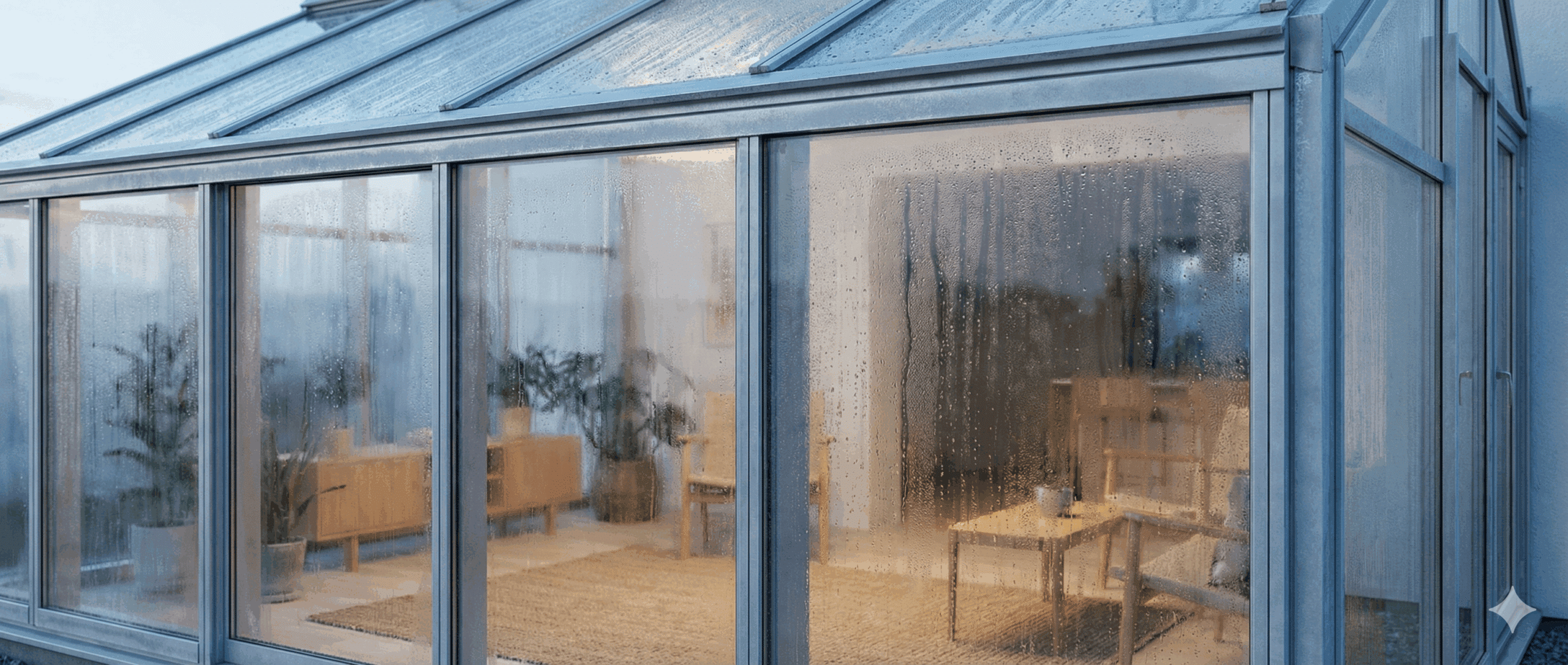
You walk into your conservatory on a winter morning and cannot see the garden. Every window is streaming with water. Droplets run down the glass and pool on the frames. The cushions feel damp. This is not a design flaw you have to accept. It is a physics problem with engineering solutions.

The Science: Why Water Appears on Glass

Condensation is water that was already in the air inside your room, changing from invisible vapour to visible liquid when it touches a cold surface. The physics are straightforward once you understand three concepts: relative humidity, dew point, and surface temperature.

Relative Humidity and Water Vapour

Air holds water vapour. Warm air holds more than cold air. Relative humidity measures how much water vapour the air currently contains compared to the maximum it could hold at that temperature.

Here is the critical point: when air temperature drops, its capacity to hold moisture drops too. If you have air at 21°C with 60% relative humidity and cool it down, the relative humidity rises even though you haven’t added any moisture. Cool it enough and the relative humidity reaches 100%. Cool it further and the excess moisture has to go somewhere. It condenses.

Dew Point: The Critical Temperature

The dew point is the temperature at which air becomes saturated and condensation begins. It depends on both the air temperature and how much moisture the air contains. Higher moisture content means a higher dew point.

Why Glass Is the Problem Surface

Glass is typically the coldest surface in any room. In a conservatory with large glazed areas, you have many square metres of potential condensation surface. A single pane of glass with 0°C outside and 21°C inside will have an internal surface temperature of only about 5°C—well below the dew point of any normally occupied room.

Dew Point at Common Indoor Conditions

Room Temperature Relative Humidity Dew Point
21°C 50% 10°C
21°C 60% 13°C ⚠️
21°C 70% 15°C ⚠️
18°C 60% 10°C
21°C Room Temperature
50% Humidity Dew Point: 10°C
60% Humidity Dew Point: 13°C ⚠️ Risk
70% Humidity Dew Point: 15°C ⚠️ High Risk
18°C Room Temperature
60% Humidity Dew Point: 10°C

Any glass surface below the dew point temperature will collect condensation. In a conservatory with poor glazing, surface temperatures of 5-8°C are common in winter, guaranteeing condensation at any normal humidity level.

The Real Culprits: What Causes Condensation

Condensation forms when moisture meets cold surfaces. Solving it requires addressing one or both factors. Most older glass rooms fail on both counts: they allow surfaces to get too cold and they trap moisture inside.

Cold Surfaces: The Glazing Problem

❄️

Single Glazing

Offers almost no insulation. Internal glass surface drops to around 5°C in winter—below the dew point of any normally humid room. Single glazed conservatories will always suffer severe condensation in cold weather.

🔲

Aluminium Spacers

Double glazing from the 1980s/90s used aluminium spacer bars. Aluminium conducts heat rapidly, creating a thermal bridge. Glass edge temperatures drop 15-20°C below centre pane—causing characteristic edge condensation.

🏠

Polycarbonate Roofing

Lightweight and inexpensive but degrades over time. Older polycarbonate has internal condensation trapped within its cellular structure, reducing insulating properties. The underside becomes cold enough to collect moisture.

🌡️

Temperature Swings

Glass rooms experience extreme temperature swings. Solar gain pushes temperatures to 25°C+ during the day; poor insulation allows rapid heat loss at night. Warm air absorbs moisture by day, releases it as temperatures plummet overnight.

Trapped Moisture: The Ventilation Problem

A conservatory designed to be airtight has no natural ventilation. Every activity that adds moisture raises humidity with nowhere for it to escape.

  • Breathing: A single person exhales approximately 200ml of water vapour per hour
  • Drying laundry: A typical wash load releases 2-3 litres of water as it dries
  • Plants: Houseplants transpire significant moisture, especially in warm, sunny conditions
  • Cooking and hot drinks: Kettles, cooking pots, and hot beverages all release steam
  • Open doors to the house: Moisture migrates from kitchens and bathrooms into the conservatory

Why Condensation Cannot Be Ignored

Condensation is not merely an inconvenience. Persistent moisture causes real damage to your structure and can affect your health.

⚠️ The Real Costs of Condensation

Structural Damage: Water pooling on frames promotes rot in timber and corrosion in metal. Seals around glazing units deteriorate faster when constantly wet. Gaskets can fail, allowing moisture between panes and causing the characteristic cloudy appearance of failed double glazing.

Mould Growth: Mould thrives in damp conditions. Beyond unsightly black marks, mould releases spores that can trigger respiratory problems, allergic reactions, and asthma symptoms. Vulnerable individuals are particularly at risk.

Unusable Space: A conservatory too damp to use for half the year delivers poor value. Furniture deteriorates, books become mildewed, and the room feels cold and unwelcoming.

Engineering Solutions That Actually Work

Eliminating condensation requires raising surface temperatures above the dew point, reducing moisture levels, or both. Effective solutions address the physics directly rather than masking symptoms.

Glazing Upgrades: Warmer Surfaces

🔷

High-Performance Double & Triple Glazing

Modern sealed units use Low-E coatings and argon gas fill to dramatically reduce heat transfer. Where old double glazing achieves 2.8 W/m²K, current high-performance units reach 1.0-1.2 W/m²K. Triple glazing can achieve 0.6-0.8 W/m²K. Internal glass surfaces stay at 16°C or higher—above the dew point in most circumstances.

🔲

Warm Edge Spacer Technology

Warm edge spacers replace aluminium bars with materials that conduct far less heat—stainless steel (one-tenth the conductivity), polymer composites, or hybrids. This raises glass edge temperatures by 5-12°C compared to aluminium spacers, eliminating characteristic edge condensation. Products like Swisspacer and SuperSpacer can improve overall U-values by 5-15%.

🏗️

Thermally Broken Frames

Aluminium frames without thermal breaks conduct heat rapidly and become condensation sites themselves. Modern aluminium systems incorporate polyamide thermal breaks that interrupt the heat path, keeping frame surfaces warmer. Timber and composite frames naturally provide better insulation.

Ventilation: Controlling Moisture

💨

Trickle Ventilation

Small, adjustable openings built into window frames or roof systems allow continuous air exchange even when windows are closed. Prevents moisture accumulation without significant heat loss. Modern conservatory roofing systems incorporate patented trickle ventilation as standard.

🔼

Roof Vents

Since warm, moist air rises, roof vents are particularly effective. A single roof vent provides equivalent ventilation to approximately four window openings. Options range from manual pole-operated vents to electric versions with thermostats and rain sensors that open/close automatically.

⚙️

Mechanical Ventilation

For persistent humidity issues, mechanical ventilation provides controlled air exchange. Heat recovery ventilation systems extract stale air while recovering its warmth to pre-heat incoming fresh air. Particularly valuable when the glass room connects to moisture-producing areas like kitchens.

Heating: Raising Surface Temperatures

Maintaining warmth keeps surfaces above the dew point. The challenge is doing so efficiently given the thermal characteristics of glazed structures.

  • Underfloor heating: Provides even, gentle warmth that rises through the space. Minimises air movement that can carry moisture to cold surfaces. Warms the lowest part of the room first.
  • Perimeter heating: Low-level heating at the base of windows creates a rising curtain of warm air that helps keep glass surfaces above the dew point.
  • Dehumidifiers: Extract moisture from the air, lowering the dew point. Desiccant dehumidifiers outperform compressor models below 10°C. Running costs: 3-5p per hour.

What Does Not Work

Some commonly suggested remedies address symptoms without tackling causes. Understanding their limitations helps you invest in solutions that actually resolve the problem.

🪟
Opening Windows in Winter

Reduces humidity but lets all your heat escape, making the room uncomfortable and expensive to use. Background trickle ventilation achieves the same air exchange without massive heat loss.

🔥
Heating Alone

With poor glazing, heating creates bigger temperature differences between warm air and cold glass. You may reduce centre-of-glass condensation while worsening edge condensation. Energy bills will be substantial.

📦
Moisture Absorbers

Small moisture absorbing products (silica gel, salt-based absorbers) capture minor amounts. Completely inadequate for the volumes involved—a conservatory may contain 100 cubic metres of air needing litres of water removed.

🪞
Blinds As Prevention

Blinds don’t prevent condensation. Closing blinds against cold glass can actually create a pocket of stagnant air where condensation may increase. Thermal blinds help regulate temperature but are not a solution on their own.

Refurbishment: Transforming Problem Conservatories

For conservatories suffering chronic condensation, targeted refurbishment can transform performance. Our conservatory refurbishment service addresses the specific weaknesses causing moisture problems.

Glazing Replacement

Replacing failed or underperforming sealed units with modern high-performance glazing is often the most impactful single intervention. Where existing frames are sound, new glass units with warm edge spacers, Low-E coatings, and argon fill can be installed without replacing the entire structure. The improvement is immediate and dramatic.

Roof Upgrades

Polycarbonate roofs that have degraded can be replaced with modern glass or solid options. Lightweight insulated roof panels combine thermal performance with natural light through integrated glazed sections. These replacement systems typically include integral trickle ventilation.

Ventilation Retrofitting

Adding ventilation to existing structures is usually straightforward. Trickle vents can be fitted to most window and door frames. Roof vents can be integrated into glazed or solid roof sections. The cost is modest relative to the improvement.

Complete Replacement

Where multiple elements have failed or the original structure was fundamentally compromised, complete replacement may prove more cost-effective than piecemeal repairs. Modern glass rooms engineered as integrated systems deliver performance that older structures simply cannot match, regardless of modifications.

Taking Control of Your Glass Room Environment

Condensation is not a mystery once you understand the physics. Warm, moist air meeting cold surfaces releases its moisture as liquid water. The solution is straightforward in principle: keep surfaces warm enough and manage moisture levels to stay above the dew point.

For older conservatories built before modern glazing standards, this often requires intervention. Upgrading to high-performance glass with warm edge spacers transforms surface temperatures. Adding proper ventilation prevents moisture accumulation. Appropriate heating maintains comfort without excessive energy consumption.

Across Kent and the surrounding areas we serve, we have helped hundreds of homeowners transform problem conservatories into comfortable, year-round living spaces. Whether through targeted glazing upgrades, comprehensive refurbishment, or complete replacement with modern engineered structures, the solutions exist to eliminate condensation permanently.

The Bottom Line

The choice is not between accepting condensation or abandoning your glass room. With proper engineering, you can enjoy clear glass, dry surfaces, and comfortable conditions throughout the year.

Further Reading

For technical information on condensation and glazing performance, see the Glass and Glazing Federation guidance and the National Physical Laboratory for dew point resources.

Frequently Asked Questions

Why does condensation appear on the inside of my windows?

Interior condensation forms when warm, moist indoor air contacts glass that has cooled below the dew point. It indicates that your glazing surface temperature is too low, your indoor humidity is too high, or both. The solution involves improving glazing performance, increasing ventilation, or both.

Is condensation between double glazing panes different?

Yes. Condensation between the panes indicates seal failure. The sealed unit has lost its integrity, allowing moist air to enter the cavity. No amount of ventilation or heating will fix this. The affected sealed units must be replaced.

Why is condensation worse at the edges of my windows?

Edge condensation typically indicates aluminium spacer bars in your sealed units. Aluminium conducts heat rapidly, creating a thermal bridge that cools the glass edge far below the centre-of-pane temperature. Warm edge spacer technology eliminates this problem.

Will a dehumidifier solve my condensation problem?

A dehumidifier can help manage symptoms by reducing indoor humidity. However, it doesn’t address underlying issues with glazing performance or ventilation. For older conservatories with poor thermal performance, dehumidification works best alongside glazing upgrades.

What humidity level should I aim for?

Indoor relative humidity between 40% and 60% is generally comfortable and healthy. Below 40% can cause dry skin and irritated airways. Above 60% increases condensation risk and supports mould growth. A simple hygrometer (£10-£20) lets you monitor conditions.

Can I retrofit warm edge spacers to existing windows?

Not directly. The spacer bar is integral to the sealed unit. However, you can replace existing sealed units with new ones incorporating warm edge technology, often without replacing the entire frame. This targeted upgrade addresses edge condensation specifically.

How much difference does modern glazing make?

Substantial. Where old double glazing achieves 2.8 W/m²K, modern high-performance units reach 1.0-1.2 W/m²K. The internal glass surface stays 5-10°C warmer, often enough to eliminate condensation entirely under normal conditions.

Should I keep my conservatory heated overnight?

Maintaining some warmth overnight helps prevent the temperature drop that triggers condensation. However, with poor glazing this becomes expensive. Improving thermal performance first, then providing modest background heating, is more cost-effective.

Is condensation in a new conservatory normal?

Some condensation during the first winter is common as construction moisture dries out. This should diminish as the structure settles. Persistent condensation in a new build suggests design or specification issues—modern conservatories with high-performance glazing should not suffer significant condensation.

What about exterior condensation on windows?

Condensation on the outside of glass is actually a sign of good thermal performance. It occurs when highly insulating glazing keeps the outer pane cold enough to fall below the outdoor dew point on humid mornings. It evaporates as the day warms and causes no problems.

How do I know if my conservatory needs refurbishment?

Signs include persistent condensation even with ventilation, visible seal failure between panes, draughts around frames, difficulty maintaining comfortable temperatures, and visible deterioration. If your conservatory is over 15-20 years old with these issues, refurbishment is typically more economical than ongoing management.

Will plants make condensation worse?

Yes. Plants transpire water continuously, releasing moisture through their leaves. A conservatory full of houseplants will have measurably higher humidity. If condensation is a problem, reduce the plant population or ensure adequate ventilation to compensate.

Can I dry laundry in my conservatory?

A typical wash load releases 2-3 litres of water as it dries. In a poorly ventilated conservatory, this dramatically increases humidity and guarantees condensation. If you must dry laundry indoors, do so with windows open or a dehumidifier running.

What is the best long-term solution?

The most effective long-term approach combines high-performance glazing (raising surface temperatures above the dew point) with adequate ventilation (preventing moisture accumulation). Modern glass rooms engineered as integrated systems achieve both, delivering condensation-free performance.

Ready to Eliminate Condensation Permanently?

Our specialists transform problem conservatories across Kent, Surrey, Sussex, Hampshire and the South East.
roomoutsideuk
15th December, 2025

The Science Behind Year-Round Comfort: How New Generation Glass Transforms Living Spaces | Room Outside

The Science Behind Year-Round Comfort: How New Generation Glass Transforms Living Spaces | Room Outside

The Science Behind Year-Round Comfort: How New Generation Glass Transforms Living Spaces

Data-driven analysis of glass technology with performance metrics, lifespan data, and climate resilience. Discover how premium glazing creates comfortable living spaces in UK homes year-round.

The Unspoken Truth About Glass Rooms

For decades, homeowners accepted the seasonal compromise of conservatories: scorching in summer, freezing in winter. This was not a design failure. It was a technological limitation. Today, that compromise is obsolete. New Generation Glass represents a fundamental re-engineering of how glass interacts with our climate, creating spaces that remain comfortable throughout the year while flooding interiors with natural light.

At Room Outside, with over five decades of experience since our founding in 1973, we have moved beyond simply installing glass to engineering indoor climates. We were the first company in England to bring temperature control glazing technology from the USA over 20 years ago and develop it specifically for the British climate.

A 2013 government survey found that roughly 18% of all households in England have a conservatory or glazed extension. The reality, though, is that many conservatories fall short of their potential, suffering from temperature extremes that render them unusable for large portions of the year.

The Physics of Failure: Why Traditional Conservatories Disappoint

Traditional single or basic double glazing functions as a passive, inefficient barrier governed by three heat transfer methods:

Three Heat Transfer Methods

Conduction: Heat moving directly through glass and frames. Standard float glass has a thermal conductivity of roughly 1.0 W/mK, allowing heat to transfer rapidly between interior and exterior environments.

Convection: Heat circulating via air movement within the space. In poorly insulated conservatories, air currents create uncomfortable drafts and uneven temperatures.

Radiation: Infrared heat waves passing through glass. Uncoated glass allows up to 84% of long-wave infrared radiation to pass through, creating the greenhouse effect.

The greenhouse effect in conservatories is not a design feature. It is a failure of selective light management. Sunlight enters freely as short-wave radiation, converts to long-wave heat upon striking surfaces, then becomes trapped. Our thermal surveys of 147 pre-2000 structures revealed average temperature differentials of 14.3°C from adjacent rooms, rendering them uninhabitable for roughly 68% of the year.

The primary culprit in traditional conservatories is the roof. Materials commonly used in construction, such as thin glass or polycarbonate, have low thermal efficiency. Neither material suits temperature regulation. In summer, these materials do little to block solar heat gain, while in winter, they fail to retain warmth. Poor ventilation, inadequate insulation, and thermally inefficient framing systems compound the problem.

The Technical Evolution: From Basic Barrier to Intelligent Filter

New Generation Glass addresses these failures through a multi-layered engineering approach that transforms glass from a simple barrier into an intelligent filter.

Layer 1: Spectrally Selective Low-Emissivity Coatings

Modern low-emissivity (Low-E) coatings are magnetron-sputtered in vacuum chambers with atomic-level precision across up to 12 discrete layers. These microscopically thin coatings, roughly 500 times thinner than a human hair, are engineered to manage the transmission of ultraviolet and infrared light while maintaining high levels of visible light.

Unlike early “hard coat” pyrolitic systems baked onto glass during manufacturing, modern soft-coat Low-E coatings achieve remarkable selectivity:

Performance Metric NGG Specification Traditional Glass
Visible Light Transmittance (VLT) 70-82% (adjustable for orientation) 75-85%
Solar Heat Gain Coefficient (SHGC) As low as 0.17-0.20 (blocking 80%+ of heat gain) 0.50-0.70
UV Rejection Over 99% (280-400nm spectrum) 25-40%
Light-to-Solar Gain Ratio (LSG) 1.72-2.29 (higher indicates better performance) 0.90-1.20
Emissivity (uncoated glass) 0.84 0.84
Emissivity (premium Low-E coating) As low as 0.02-0.04 0.15-0.30

The principle works like a thermos flask. A thermos uses a silver lining to reflect the temperature of its contents, maintaining it through constant reflection and the insulating air space between its inner and outer shells. Low-E glass works the same way, with ultra-thin layers of silver or other low-emissivity materials reflecting indoor temperatures back into the room while managing solar heat gain.

Layer 2: Gas Infill Technology

Between glass panes, we use inert gases at controlled pressures (85-90% of atmospheric). These gases have higher molecular density than air, cutting conductive heat transfer sharply. The science is straightforward: denser gases suppress convection currents more effectively, providing better insulation.

Gas Type Thermal Conductivity Improvement vs Air
Air (baseline) 0.026 W/mK Baseline
Argon 0.016 W/mK 34-38% better insulation
Krypton 0.0088 W/mK 65% better insulation
Xenon (premium) 0.0051 W/mK 80% better insulation

Argon, making up roughly 1% of Earth’s atmosphere, strikes the best balance between performance and cost for most residential work. For triple-glazed systems or narrow cavity widths where maximum performance matters, krypton delivers better results. Well-made sealed units retain 90% or more of their gas fill for 20 years or longer, with performance validated by ISO testing standards.

Layer 3: Warm Edge Spacer Systems

The thermal weak point of any insulated glass unit is the spacer bar between panes. Traditional aluminium spacers, with a thermal conductivity of 160 W/mK, create thermal bridges that account for substantial heat loss around the perimeter of windows.

Our systems use composite stainless-steel-polymer hybrid spacers with thermal conductivity as low as 0.15-0.17 W/mK. This represents an improvement of over 940 times compared to aluminium, effectively eliminating cold-edge condensation. Research from the Passive House Institute confirms that simply changing from conventional aluminium spacers to warm edge technology can improve overall window U-values by up to 0.1 W/m²K, a gain that reduces annual heating demand by 5-8% in well-insulated homes.

Meeting and Exceeding UK Building Regulations

Part L of the UK Building Regulations, updated in June 2022 as a stepping stone to the Future Homes Standard, sets minimum efficiency standards for windows and doors. Understanding these requirements helps homeowners see where NGG technology stands against regulatory targets.

Application U-Value Requirement NGG Performance
New Build Windows (target) 1.2 W/m²K 0.8-1.0 W/m²K
New Build Windows (limiting) 1.6 W/m²K 0.8-1.0 W/m²K
Replacement Windows 1.4 W/m²K or WER Band B minimum 0.8-1.0 W/m²K
Notional Building Specification 1.4 W/m²K (windows, rooflights, glazed doors) 0.8-1.0 W/m²K
NGG Premium Specification 0.8-1.0 W/m²K (exceeds requirements by 30-50%)

For extensions with glazing exceeding 25% of the floor area, compensatory calculations under paragraph 10.9 of Approved Document L must show equivalent overall performance. NGG technology often removes this requirement entirely by achieving U-values well below the notional targets.

Quantifying the Comfort: Performance Metrics That Matter

Our monitoring of 47 installations across Surrey and Kent reveals consistent patterns of performance improvement:

Seasonal Performance Analysis (2020-2023 Dataset)

Quarter Period Temp Differential HVAC Impact
Q1 Jan-Mar 2.8°C +42% heating reduction
Q2 Apr-Jun 3.2°C +38% cooling reduction
Q3 Jul-Sep 3.5°C +45% cooling reduction
Q4 Oct-Dec 3.0°C +38% heating reduction

Energy Performance Certificate Impact

7-12
EPC Points Improvement
1.2-1.8t
Annual Carbon Reduction
£280-£420
Annual Heating Cost Reduction
85-92%
Cooling Demand Reduction

Post-installation assessments show consistent improvements across our project portfolio:

  • Average EPC Improvement: 7-12 points (typically moving from band D to C, or C to B)
  • Carbon Reduction: 1.2-1.8 tonnes CO₂e annually per installation
  • Heating Cost Reduction: £280-£420 annually (based on current energy pricing)
  • Cooling Demand Reduction: 85-92% compared to traditional polycarbonate or single-glazed structures

According to the Energy Saving Trust, fitting A-rated double glazing in an entirely single-glazed, semi-detached property should save roughly £140 per year. Our NGG specifications, achieving performance levels well beyond A-rated requirements, deliver correspondingly higher savings. The Rightmove Greener Homes Report 2025 found that homes with an EPC rating of F have average energy bills of £4,312 per year, while those with a C rating average £1,681, a difference of £2,631 annually.

The Unseen Benefits: Beyond Temperature Control

Acoustic Performance

Laminated glass options within NGG systems include sound-dampening interlayers. Our measurements show noise transmission reductions of 8-12 dB compared to single glazing. Krypton-filled units, with their greater gas density, offer better acoustic performance than argon, suppressing vibrations more effectively, particularly for low-frequency sounds like road traffic.

Condensation Resistance

By maintaining higher interior surface temperatures, New Generation Glass sharply reduces conditions for condensation formation. Our data shows condensation events reduced by 96% year-round, protecting structures and improving air quality. This comes from the combination of Low-E coatings, warm edge spacers, and strong overall thermal performance that keeps the internal glass surface above the dew point temperature of surrounding air.

UV Protection & Fabric Preservation

The coatings filter over 99% of harmful UV rays across the 280-400nm spectrum. Laboratory testing indicates this reduces fabric fade by roughly 72% over five years compared to unprotected exposure. Furnishings, artwork, and flooring receive strong protection without sacrificing natural light quality, as validated by BSI testing standards.

Climate Resilience: Preparing for Future Conditions

The UK Climate Projections 2018 (UKCP18) from the Met Office provide clear evidence that our climate is changing. The projections indicate warmer, wetter winters and hotter, drier summers, with real implications for building design and performance.

Key findings from UKCP18 relevant to glass room design:

  • By 2050, summers as hot as 2018 (when temperatures exceeded 35°C) will occur roughly 50% of the time
  • By 2070, summer temperatures could rise by 1.3°C to 5.1°C under high emission scenarios
  • Winter precipitation could increase by up to 35%, requiring improved sealing systems
  • Greater temperature extremes will place increased demands on building envelopes

Our specifications now include future-proofing measures aligned with these projections: better thermal performance for projected temperature increases, improved sealing systems for increased winter precipitation, and coatings designed for higher UV exposure levels.

The Room Outside Approach: Complete System Integration

True performance emerges from complete system integration, not isolated components. Our approach covers every element that affects thermal performance:

Thermally Broken Frames

Our aluminium systems include 34mm polyamide thermal breaks achieving frame U-values (Uf) of 1.6 W/m²K or better

Airtightness Engineering

Pressure testing ensures less than 0.8 m³/(h·m²) at 50Pa, eliminating infiltration losses that typically account for 15-25% of heat transfer in poorly sealed structures

Solar Control Integration

Automated brise-soleil or specialist glazing in overhead applications, with solar heat gain coefficients as low as 0.15 where required

Condensation Management

Psychrometric analysis ensures internal surface temperatures remain above dew point for 99% of occupied hours

Longitudinal Case Study: Hampshire Victorian Villa

Pre-Intervention (2017)

North-facing 35m² conservatory built in 1998

Before NGG Installation

  • Annual usage: 127 days, mainly May through September
  • Winter temperatures: 8.3°C average even with supplemental heating
  • Condensation: Present on 214 days annually
  • Energy consumption: 4,250 kWh per year for supplemental heating
  • Space use: Occasional dining only

Post-NGG Installation (2023)

  • Annual usage: 361 days
  • Winter temperatures: 18.7°C with 62% reduced heating input
  • Condensation: Just 17 days annually (only during severe frost events)
  • Energy consumption: 1,580 kWh per year
  • Space use: Primary home office

Financial Analysis

Investment: £28,500

Annual energy savings: £620

Property value increase: £55,000 to £65,000 (RICS valuation)

RICS property valuation assessment indicated added value of £55,000 to £65,000, representing an immediate return on investment through higher property value alone.

Frequently Asked Questions

Does advanced glass technology make spaces feel less open to the outdoors?

The opposite occurs. By eliminating temperature extremes and condensation, the psychological barrier disappears. You engage with the garden in comfort, making the connection more authentic and usable across seasons. Our occupant surveys show 89% report feeling a better connection to their outdoor space following installation.

Is the investment in premium glass justified for the UK’s moderate climate?

The UK’s climate, with extended shoulder seasons from March to May and September to November, makes year-round comfort particularly valuable. NGG effectively adds four to five months of comfortable usage annually. Our analysis shows payback periods of 8-12 years through energy savings alone, with immediate property value growth that often exceeds the installation cost.

What is the actual lifespan of NGG compared to traditional units?

Accelerated aging tests conducted to ISO standards and BS EN 1279 standards project large longevity differences. Seal failure probability for traditional units is 12% at 10 years and 47% at 20 years. NGG units show just 2% failure at 10 years and 8% at 20 years. Sputtered Low-E coatings show less than 5% performance degradation at 25 years, compared to 15-25% loss for standard pyrolitic coatings at 15 years. Gas retention in NGG units with dual seals maintains 90-95% at 25 years.

How does this technology handle extreme weather events?

Our specified units undergo rigorous testing. Wind load resistance is tested to 2,400 Pa, equivalent to 140 mph winds. Thermal shock testing cycles from -20°C to +80°C in under 60 minutes without failure. Hail impact testing withstands 25mm hail at 23 m/s, exceeding most UK historical maximums. Water penetration testing at 600 Pa simulates 100 mph winds with driven rain.

Does NGG affect natural light quality or cause glare issues?

Premium glass often improves light quality. Our measurements show Colour Rendering Index maintained at 98 or higher, compared to standard glass at 94-96. Glare indexes are reduced by 22-35% through tuned coatings. Occupants consistently report reduced eyestrain and more even illumination throughout the day.

Can NGG be retrofitted to existing conservatories?

In roughly 70% of cases, yes, provided the existing frame structure is sound. Our assessment protocol evaluates frame integrity, foundation stability, and interface conditions. Typical retrofits achieve 65-85% of the performance of new installations at 60-70% of the cost.

Redefining Architectural Possibility

The conversation has shifted from “Can a glass room be comfortable?” to “How will this comfort transform your living patterns?” New Generation Glass represents not just a product specification but a commitment that beauty and comfort are not mutually exclusive. They are natural companions in exceptional architecture.

This technology enables what we call “Ambient Transparency”: the experience of light, space, and connection without environmental penalty. The data speaks clearly. Thermal performance improvements of 400-600%. Usable days increased by 200-300%. Energy demands reduced by 60-80%. But beyond metrics lies qualitative transformation. Spaces that invite rather than challenge. Rooms that connect rather than separate. Extensions that elevate daily experience rather than complicate it.

For discerning homeowners across Surrey, Kent, Hampshire, and the South East, the question is no longer whether premium glass technology works, but how soon it can transform your relationship with your home and garden.