
roomoutsideuk
18th December, 2025

Factory-Built Extensions Are the Future | Room Outside

Why Factory-Built Extensions Are the Future | Room Outside

Why Factory-Built Extensions Are the Future of Home Improvement

Discover why precision-engineered, factory-built extensions deliver superior quality, faster installation, and less disruption than traditional construction methods.

What Is a Factory-Built Extension?

A factory-built extension is a precision-engineered home addition manufactured in a climate-controlled factory environment rather than constructed entirely on site. Components are built to millimetre tolerances in temperature and humidity-controlled conditions, then delivered substantially complete for rapid installation. This method achieves up to 67% less energy use during construction, 90% less waste, and 50% faster installation compared to traditional building methods.

The Numbers That Changed My Mind About Construction

I spent fifteen years in the home improvement industry believing that on-site construction was simply how things got done. Then I saw the data.

According to a 2025 industry report, 95% of UK construction projects are now experiencing delays, with the median delay stretching beyond 200 days. That is not a typo. Two hundred days late, on average.

200+
Days: The median delay on UK construction projects in 2025
Source: 2025 UK Construction Industry Report

A Cornerstone Projects survey found that 91% of construction professionals have been involved in delayed projects in recent years, up from 85% in 2016. Even more troubling, the most common delay has shifted from “less than 10%” of the original timeline in 2016 to “21-30%” today. Projects that should take eight weeks are routinely taking twelve. Those promised for Christmas are finishing in March.

If you have lived through a traditional building project, none of this will surprise you. The scaffolding that outstays its welcome. The skip that becomes a permanent fixture in your drive. The builder who promises “another two weeks” for the fifth time running.

But here is what did surprise me: it does not have to be this way.

The factory-built extension, once dismissed as the poor relation of “proper” construction, has quietly evolved into something quite different. The UK prefabricated construction market is projected to reach £20.78 billion by 2028, growing at 5.2% annually. Major housebuilders are investing millions. The NHS has expanded its modular buildings framework to £3.6 billion over four years. Something has shifted.

At Room Outside, we have been part of this shift. Our modular construction process is not a compromise or a shortcut. It is, genuinely, a better way to build. Let me explain why.

The Construction Industry’s Uncomfortable Truth

The UK construction sector has a productivity problem that nobody wants to talk about honestly.

Research from Smart Infrastructure Magazine found that up to 30% of all work on typical UK construction projects involves rework. That means nearly a third of what gets built has to be fixed, adjusted, or redone entirely.

30%
Of work requires rework on typical UK projects
65
Months: UK pre-construction phase (vs 50 average)
98%
Of megaprojects experience cost overruns
80%
Average cost increase above original estimate

Think about that for a moment. If you hired a chef who had to remake 30% of the dishes they served, you would find a different restaurant. If your mechanic had to redo 30% of their repairs, you would find a different garage. Yet in construction, we have somehow accepted this as normal.

BCG’s Centre for Growth found that the UK’s pre-construction phase is the slowest across comparable developed nations: 65 months compared to an average of 50. For rail projects, we are 50% slower than average. For roads and social infrastructure, 25% slower. This is not about British workers being less capable. It is about systems and methods that have not kept pace with what is now possible.

According to McKinsey, 98% of megaprojects experience cost overruns or delays. The average cost increase is 80% above the original estimate. Now, your orangery or garden room is not a megaproject. But the same fundamental issues—weather delays, coordination problems, quality inconsistencies—affect projects at every scale.

Why Traditional Building Methods Persist

The honest answer is inertia. Traditional building developed when on-site construction was genuinely the only option. Craftsmen worked with locally available materials, adapting their techniques to weather and circumstances. There was skill and artistry in this approach, and I do not want to diminish that.

But modern manufacturing has moved on. When Rolls-Royce builds an engine, they do not assemble it in a field, hoping it does not rain. When pharmaceutical companies produce medicines, they do not mix compounds in a garden shed. Precision work demands controlled environments.

The construction industry, particularly for residential work, has been slow to absorb this lesson. But that is changing. Modern Methods of Construction are now expanding at a 10.0% CAGR in the UK, compared to traditional methods which still hold 91.2% market share but are losing ground. The Ministry of Housing, Communities & Local Government reports that volumetric modular projects can cut programme durations by 20% while reducing waste by 45%.

What Factory Construction Actually Looks Like (It Is Not What You Think)

When most people hear “factory-built,” they picture cheap prefab housing from the 1960s. Flimsy panels, dodgy insulation, buildings that looked temporary even when they were meant to be permanent. That association is understandable, but it is thirty years out of date.

A modern factory-built extension is precision-engineered in conditions that would be impossible to replicate on site. Temperature controlled. Humidity managed. Skilled craftspeople working with tools and jigs that allow tolerances measured in millimetres rather than centimetres.

The Quality Advantage Is Measurable

This is not marketing spin. The differences show up in hard data.

Research published in the Journal of Building Engineering found that modular construction uses up to 67% less energy during the building phase compared to traditional methods. Factory-built structures can also be up to 15% more energy-efficient in operation, thanks to superior insulation and airtightness.

67%
Less energy used during factory construction vs traditional methods
Source: Journal of Building Engineering

Why? Because when you assemble a structure in a climate-controlled factory, materials behave predictably. Timber does not absorb excess moisture and then shrink as it dries. Adhesives cure at optimal temperatures. Seals form properly. Insulation goes in exactly as specified, without gaps or compression.

The Construction Industry Training Board reports that modular projects achieve an 80% reduction in on-site labour. That is not because corners are being cut. It is because the work has already been done, properly, in conditions where quality control is actually possible.

Quality Control That Actually Works

Here is a practical example. On a traditional building site, a quality inspection happens at the end. Once the extension is complete, someone checks whether it meets standards. By that point, problems are expensive and disruptive to fix. Walls need to be opened up. Work needs to be redone.

In factory production, inspection happens at every stage. Materials are checked on arrival. Components are tested after cutting. Assemblies are verified before final integration. A deviation from specification gets caught and corrected before it becomes embedded in the structure.

My suggestion: When comparing quotes for an extension, ask about the quality control process. A company using factory methods should be able to describe multiple inspection stages. A company relying entirely on site construction will probably mention a final inspection and not much else.

The Environmental Case (With Actual Numbers)

If you care about environmental impact, and many of the homeowners we work with do, the data here is striking.

According to the Waste & Resources Action Programme (WRAP), modular construction can reduce waste materials by up to 90% compared to traditional construction. A University of New South Wales study found waste reductions of 81-83% by weight.

90%
Reduction in waste materials with factory-built construction
Source: WRAP (Waste & Resources Action Programme)

To put this in context, the average new-build project produces approximately 3.9 pounds of waste per square foot. A 50,000 square foot building generates around 100 tonnes of waste, only about 20% of which gets recycled. Most ends up in landfill.

Factory construction changes this equation dramatically. Materials can be ordered precisely because cutting is computer-controlled. Off-cuts from one project become components for the next. Recycling infrastructure is built into the facility rather than improvised on site.

Transport and Carbon Footprint

Traditional construction involves dozens of deliveries: materials arriving incrementally, waste being removed in batches, tradespeople driving back and forth. Each journey adds to traffic and emissions.

A factory-built extension arrives substantially complete in a single delivery, with minimal follow-up visits for final connections. One study estimated a 30% reduction in total greenhouse gas emissions from modular construction compared to traditional methods. The reduction in vehicle movements also benefits your neighbours, which matters if you value good relationships with the people living next door.

Long-Term Performance

The environmental case extends beyond construction. A precision-built structure performs better thermally over its lifetime, reducing ongoing energy consumption. Make UK Modular reports that their members’ products operate at 55% lower heating costs compared to equivalent traditional builds. Over twenty or thirty years of ownership, that represents significant carbon savings as well as lower bills.

My suggestion: If sustainability matters to you, ask any builder you are considering what their waste figures look like. Factory-built specialists should be able to give you specific numbers. Traditional builders often cannot because they have not measured it.

What This Actually Means If You Are Extending Your Home

Statistics are useful, but what matters is your experience. Here is what changes when you choose factory-built construction.

Timeline: Days Rather Than Months

Traditional conservatory or orangery construction typically takes 12 to 16 weeks on site. That is three to four months of your garden being inaccessible, your home covered in dust, builders arriving early and leaving late.

Factory-built extensions can be installed 50% faster than traditional builds, with on-site time often reduced to days rather than weeks. The CITB reports an 80% reduction in on-site labour for modular projects.

Traditional Construction

  • 12-16 weeks on site
  • Garden inaccessible for months
  • Dust infiltrates every room
  • Constant noise disruption
  • Strangers in your home daily
  • Weather delays common

Factory-Built Construction

  • 50% faster installation
  • On-site time: days not weeks
  • 80% reduction in site labour
  • Minimal home disruption
  • Life continues normally during manufacture
  • Weather-independent production

The majority of construction happens elsewhere, while your life continues normally. Foundations are prepared (this still requires on-site work, typically a week or two). Then your extension arrives, substantially complete, and is installed rapidly. The transformation from building site to finished space happens with remarkable speed.

Cost Certainty (Or Lack Of It)

The 2022 Cornerstone Projects survey found that 47.56% of respondents estimated their delayed projects had cost overruns of more than 20%, up from 27.7% in 2016. Nearly half of projects are now running significantly over budget.

Factory construction reduces this uncertainty. When work happens in controlled conditions according to established processes, variables shrink. There are fewer weather delays, fewer unexpected complications, fewer moments when a builder sucks air through his teeth and mentions additional costs.

This matters especially for premium projects. If you are investing £30,000 to £100,000+ in an orangery or high-specification glass extension, you want confidence that the quoted price will be the actual price. Factory methods make that confidence realistic rather than hopeful.

Living Through The Build

Anyone who has lived through traditional construction knows what disruption actually means. The constant noise. Dust that infiltrates every room despite plastic sheeting. Strangers wandering through your home for months on end. The psychological weight of living in a building site.

Factory-built construction compresses this disruption dramatically. The on-site phase is brief enough that you can plan around it. Perhaps you take a short break while installation happens. Perhaps you simply tolerate a few days of activity knowing it will end soon. Either way, the experience is fundamentally different from enduring months of construction chaos.

For families with young children, those working from home, or anyone who values their domestic peace, this difference alone can justify the choice.

The Questions People Actually Ask

Having discussed factory-built extensions with hundreds of homeowners, I know which concerns come up repeatedly. Let me address them directly.

Common Questions About Factory-Built Extensions

“Is this just cheap prefab with better marketing?”

No, and the distinction matters. Budget prefab housing from the mid-twentieth century was designed primarily for speed and economy, using basic materials and minimal specification. It earned its poor reputation. Modern factory-built extensions use premium materials: engineered timber, architectural glass, high-specification fittings. They are designed individually for each property. The factory environment allows for precision that site-based construction cannot match, not lower standards. The UK modular construction market is now valued at £1.26 billion for panelised systems alone, with timber frame accounting for 70% of that market. This is mainstream construction, not a budget alternative.

“Can it be customised to my property?”

Absolutely. Factory production does not mean standardisation. Each extension is designed specifically for its site, considering the architecture of your existing property, orientation, aspect, and your requirements. The design process works the same as traditional construction: consultation, architectural drawings, material selection, refinement. The difference is in how that design gets built, not whether it is bespoke.

“What about planning permission?”

Planning regulations apply identically regardless of construction method. Permitted development rights work the same way. Full planning applications follow the same process. Building regulations approval is obtained normally. The Planning Portal provides guidance on requirements—they care about design, scale, and impact. They are not concerned with whether your extension was assembled on site or in a factory.

“Does it cost more?”

The initial quote for a high-quality factory-built extension is typically comparable to equivalent traditional construction. For reference, the average orangery in the UK costs £30,000 to £35,000, with premium specifications reaching £50,000 to over £100,000. However, the total cost of ownership often favours factory methods. Traditional projects frequently experience cost overruns (47.56% report increases of 20% or more). Factory construction offers greater price certainty. Superior thermal performance reduces ongoing energy costs. Better build quality reduces long-term maintenance.

My suggestion: When comparing quotes, ask about what is included in the headline price and what might add to it during construction. A factory-built quote should have fewer potential variables. Ask to see previous projects from any company you are considering—a good factory-built specialist will show you a range of designs, not identical boxes repeated across different properties.

Where This Is All Heading

The UK construction industry is changing, slowly but definitively.

The global modular construction market is projected to reach $207.82 billion by 2033, growing at 8.2% annually. Europe holds 45% market share, with the UK as a leading adopter. The UK government’s target of 1.5 million new homes by 2029 is driving significant investment in modern methods of construction.

£20.78bn
UK prefab market projected by 2028
£3.6bn
NHS modular buildings framework
£2.5bn
Homes England modular housing scheme
8.2%
Annual growth in global modular construction

The NHS is expanding its modular buildings framework. Homes England has launched a £2.5 billion modular housing scheme. Major housebuilders are investing in factory capacity. The direction of travel is clear.

For individual homeowners, this means factory-built construction is no longer an outlier choice. It is increasingly the informed choice, backed by data, driven by genuine advantages, and delivered by specialists who have refined their processes over years of development.

Making Your Decision

I am not suggesting that factory-built construction is right for every project or every homeowner. Traditional building has its place, particularly for complex renovations integrated deeply into existing structures.

But for a new orangery, conservatory, or garden room? For homeowners who value quality, want predictable timelines and costs, and prefer not to live in chaos for months? The case for factory construction has become compelling.

The Data Supports It

  • 67% less energy used during construction
  • 90% less waste compared to traditional methods
  • 50% faster installation timelines
  • 80% reduction in on-site labour and disruption
  • 55% lower heating costs over the structure’s lifetime
  • Greater price certainty versus 47.56% of traditional projects with 20%+ overruns

The industry is moving towards it. And the experience of actually living through the process favours it dramatically.

At Room Outside, we have built our modular construction process over years, refining methods, investing in precision, and learning what actually matters to the homeowners across London and the South East who trust us with their projects. We would be happy to discuss whether this approach might suit what you have in mind.

No obligation. No pressure. Just an honest conversation about whether a factory-engineered extension might be the better way to add the space you are looking for.

FAQ: Factory-Built Extensions in the UK

What is a factory-built extension?

A factory-built extension is a precision-engineered home addition manufactured in a climate-controlled factory environment rather than constructed entirely on site. Components are built to millimetre tolerances, then delivered substantially complete for rapid installation. This method achieves 67% less energy use during construction, 90% less waste, and 50% faster installation compared to traditional methods.

Is a factory-built extension just cheap prefab?

No. Modern factory-built extensions use premium materials: engineered timber, architectural glass, high-specification fittings. They are designed individually for each property. The factory environment allows for precision that site-based construction cannot match. The UK modular construction market is now valued at £1.26 billion for panelised systems alone—mainstream construction, not a budget alternative.

Can factory-built extensions be customised?

Absolutely. Factory production does not mean standardisation. Each extension is designed specifically for its site, considering the architecture of your existing property, orientation, aspect, and your requirements. The design process works the same as traditional construction—the difference is in how that design gets built, not whether it is bespoke.

How long does factory-built installation take?

Factory-built extensions can be installed 50% faster than traditional builds, with on-site time often reduced to days rather than weeks. Traditional construction takes 12-16 weeks on site. With factory methods, the majority of work happens elsewhere while your life continues normally, then your extension arrives substantially complete for rapid installation.

Does factory construction cost more?

Initial quotes are typically comparable to equivalent traditional construction. However, the total cost of ownership often favours factory methods: greater price certainty (47.56% of traditional projects have 20%+ overruns), superior thermal performance reducing energy costs, and better build quality reducing long-term maintenance.

What about planning permission?

Planning regulations apply identically regardless of construction method. Permitted development rights work the same way. Full planning applications follow the same process. The planning authority cares about design, scale, and impact—not whether your extension was assembled on site or in a factory.

Is factory construction better for the environment?

Yes. According to WRAP, modular construction reduces waste by up to 90%. Factory-built structures use 67% less energy during construction and can be 15% more energy-efficient in operation. Transport emissions are reduced by approximately 30% because extensions arrive substantially complete in a single delivery rather than requiring dozens of material deliveries.

What areas does Room Outside serve?

Room Outside designs and builds factory-engineered extensions from our West Sussex base, serving homeowners across London and the South East including West Sussex, Surrey, Kent, Greater London, Hampshire, East Sussex, Essex, Berkshire, and Dorset.

Discover the Factory-Built Difference

For homeowners who value quality, want predictable timelines and costs, and prefer not to live in chaos for months, factory-built construction delivers a fundamentally better experience.
roomoutsideuk
17th December, 2025

Glass Extensions Surrey | What Homeowners Need to Know 2025 | Room Outside

What Surrey Homeowners Should Know Before Commissioning a Glass Extension | Room Outside

What Surrey Homeowners Should Know Before Commissioning a Glass Extension

Expert guide to Surrey’s unique planning landscape, realistic budgets, and what actually adds value to your property in 2025.

📋 The Short Answer

Before commissioning a glass extension in Surrey, you need to understand three things: (1) whether your property falls within the 73% of Surrey designated as Green Belt, which affects what you can build; (2) whether Permitted Development rights apply (most conservatories under 4m don’t need planning permission); and (3) budget expectations—with average Surrey property prices at £587,000, quality glass extensions typically cost £40,000-£120,000+ depending on specification.

So You’re Thinking About a Glass Extension in Surrey?

Let’s be honest: you’ve probably already scrolled through Pinterest boards, saved a dozen Instagram posts, and imagined morning coffee in a light-flooded kitchen-diner. The vision is clear. But somewhere between the dream and the reality, questions start multiplying.

Will I need planning permission? How much should I actually budget? Is my Edwardian terrace in Guildford even suitable? What about my 1930s semi in Woking that backs onto Green Belt?

These aren’t hypothetical concerns. After forty years of building glass extensions across Surrey—from Farnham to Reigate, Epsom to Dorking—we’ve heard them all. This guide answers the questions Surrey homeowners actually ask, with specific information relevant to properties in this county.

Because Surrey isn’t like anywhere else. It’s the second most expensive county in England (average price £587,000). It has more Green Belt than almost anywhere—73% of the county. And one quarter sits within the Surrey Hills National Landscape, with its own planning considerations.

Your glass extension project needs to account for all of this. Here’s how.

The Surrey Planning Landscape: What Makes This County Different

Before we discuss designs, materials, or budgets, let’s address the elephant in the room: can you actually build what you want?

Green Belt: 73% of Surrey Is Protected

Surrey’s Metropolitan Green Belt isn’t a single park—it’s a planning designation that covers nearly three-quarters of the county. In practical terms:

  • Woking Borough: approximately 70% Green Belt
  • Guildford Borough: 24,040 hectares of Green Belt (most in Surrey)
  • Mole Valley: extensive coverage protecting countryside character
  • Epsom and Ewell: smallest Green Belt area (1,560 hectares) but still significant

The good news: Green Belt doesn’t prevent home extensions. Permitted Development rights still apply in most cases. But councils follow a general ‘50% rule’—extensions shouldn’t increase the original house size by more than 50% in area and volume, and must have minimal visual impact on the landscape.

Surrey Hills National Landscape: A Quarter of the County

The Surrey Hills Area of Outstanding Natural Beauty (now officially a ‘National Landscape’) stretches from Farnham in the west to Oxted in the east, including the chalk slopes of the North Downs and the wooded Greensand Hills around Haslemere.

If your property falls within the Surrey Hills:

  • Permitted Development rights are more restricted for rear extensions
  • Design must conserve and enhance ‘natural and scenic beauty’
  • Local materials and styles are strongly encouraged (Bargate stone, clay tiles)
  • The Surrey Hills Board provides design guidance and may comment on applications

Conservation Areas and Listed Buildings

Every Surrey borough has Conservation Areas—from Guildford’s medieval town centre to Reigate’s Victorian suburbs. Properties within these areas face additional restrictions:

  • No Permitted Development for side extensions
  • No cladding of exterior walls
  • No rear extensions beyond one storey under PD rights
  • Design must preserve or enhance the Conservation Area’s character

Listed buildings require Listed Building Consent for almost any alteration—including internal works. This isn’t a barrier to beautiful glass extensions, but it does require specialist knowledge and early engagement with your local conservation officer.

Do You Actually Need Planning Permission?

Here’s something that surprises many Surrey homeowners: most conservatories and single-storey glass extensions can be built without planning permission under Permitted Development rights.

The Permitted Development Rules (2025)

Your glass extension qualifies as Permitted Development if it meets ALL of the following:

Requirement What This Means
Maximum projection from rear wall 4m for detached houses, 3m for semi/terraced
Maximum height 4m at highest point (3m if within 2m of boundary)
Garden coverage Cannot cover more than 50% of original garden area
Position Must be at rear of property (not front or side facing highway)
Materials Must use similar materials to existing house
Eaves and ridge Cannot be higher than the existing house

When You Definitely Need Planning Permission

  • Your property is a listed building
  • You’re in a Conservation Area and want a side extension or two-storey rear
  • Your project exceeds PD size limits
  • Previous extensions have already used your PD allowance
  • Your property is a flat or maisonette (no PD rights)
  • PD rights were removed by condition on original planning consent (common in 1970s+ builds)

Our recommendation: Even if you believe you qualify for Permitted Development, consider obtaining a Lawful Development Certificate (LDC) from your local council (£103). This provides legal certainty that’s valuable when selling your property.

Realistic Budgeting for Surrey Property Owners

Let’s talk money—because Surrey prices aren’t like anywhere else, and neither should your expectations be.

The Surrey Premium

With average property prices at £587,000 (and significantly higher in Elmbridge, Waverley, and parts of Guildford), your glass extension is protecting a substantial asset. Cutting corners on specification makes no financial sense when:

  • A quality extension adds 5-10% to property value (RICS, Savills)
  • Poor-quality builds can actually devalue your home
  • Surrey buyers are discerning—estate agents report that dated conservatories are now liabilities

What Should You Expect to Pay?

Project Type Budget Range Notes
Standard conservatory (uPVC) £15,000-£30,000 Entry point, 20-35yr lifespan
Premium conservatory (aluminium) £30,000-£50,000 40-50yr lifespan, slimmer frames
Orangery (brick/glass hybrid) £40,000-£70,000 Ideal for period properties
Contemporary glass extension £50,000-£90,000 Minimal frames, max glazing
Bespoke glass box / structural glass £80,000-£150,000+ Architectural statement pieces

Hidden Costs to Budget For

  • Structural engineer fees: £500-£1,500
  • Building Regulations application: £200-£500
  • Planning application (if required): £206 for householder applications
  • Party Wall surveyor (if applicable): £700-£1,000 per surveyor
  • Landscaping/making good: 5-10% of project cost
  • Blinds/climate control: £2,000-£8,000 depending on specification

What Surrey Property Buyers Actually Want

If you’re thinking about resale value (and in Surrey, you should be), here’s what local estate agents tell us buyers are looking for:

Year-round usability

The old polycarbonate conservatory that’s freezing in winter and sweltering in summer? That’s now seen as a negative. Buyers want spaces that work 365 days a year.

Seamless kitchen-diner flow

The extension that opens directly onto an existing kitchen—creating one large, light-filled entertaining space—commands more premium than a separate ‘added on’ room.

Quality over size

A beautifully executed 3m x 4m extension with slim aluminium frames and quality glazing will add more value than a cheap 5m x 5m box.

The Process: From First Idea to Completion

Here’s what a typical glass extension project looks like with Room Outside:

Phase Timeline Key Activities
Phase 1: Design Consultation 2-4 weeks Initial site visit, planning constraints review, preliminary designs, budget discussions
Phase 2: Planning & Permissions 4-12 weeks Permitted Development assessment, Building Regulations drawings, structural calculations
Phase 3: Construction 6-12 weeks Groundworks, structural work, frame installation, glazing, internal finishes

Frequently Asked Questions: Surrey Glass Extensions

Do I need planning permission for a conservatory in Surrey?

Most conservatories do not need planning permission under Permitted Development rights. Your project qualifies if it extends no more than 4m from the rear wall (detached houses) or 3m (semi/terraced), is under 4m high, and covers less than 50% of your garden.

How much does a glass extension cost in Surrey?

Quality glass extensions in Surrey typically cost £30,000-£90,000, with bespoke structural glass projects reaching £150,000+. Standard uPVC conservatories start around £15,000-£30,000. Factor in an additional £3,000-£5,000 for professional fees.

Can I build a glass extension if my Surrey property is in the Green Belt?

Yes. Green Belt status doesn’t prevent home extensions—Permitted Development rights still apply. With 73% of Surrey designated as Green Belt, most extensions are built successfully within these areas.

Will a glass extension add value to my Surrey home?

A well-designed glass extension typically adds 5-10% to Surrey property values (RICS, Savills). On a £587,000 average Surrey property, that’s £29,000-£58,000. However, quality matters for maintaining value.

What are the restrictions for glass extensions in Surrey Hills AONB?

Properties in the Surrey Hills National Landscape have more restricted Permitted Development rights and stricter design requirements. Extensions must conserve and enhance ‘natural and scenic beauty’ with local materials encouraged.

How do I choose between aluminium, timber, and uPVC frames?

For contemporary Surrey homes, aluminium offers the slimmest sightlines and longest lifespan (40-50 years). For period properties or Conservation Areas, timber may be required for planning approval. uPVC provides the best value but with bulkier frames.

Ready to Discuss Your Surrey Project?

Our design consultations are free, with no obligation. We’ll visit your property, discuss your vision, review any planning constraints, and provide honest guidance on what’s achievable within your budget.

roomoutsideuk
15th December, 2025

The Science Behind Year-Round Comfort: How New Generation Glass Transforms Living Spaces | Room Outside

The Science Behind Year-Round Comfort: How New Generation Glass Transforms Living Spaces | Room Outside

The Science Behind Year-Round Comfort: How New Generation Glass Transforms Living Spaces

Data-driven analysis of glass technology with performance metrics, lifespan data, and climate resilience. Discover how premium glazing creates comfortable living spaces in UK homes year-round.

The Unspoken Truth About Glass Rooms

For decades, homeowners accepted the seasonal compromise of conservatories: scorching in summer, freezing in winter. This was not a design failure. It was a technological limitation. Today, that compromise is obsolete. New Generation Glass represents a fundamental re-engineering of how glass interacts with our climate, creating spaces that remain comfortable throughout the year while flooding interiors with natural light.

At Room Outside, with over five decades of experience since our founding in 1973, we have moved beyond simply installing glass to engineering indoor climates. We were the first company in England to bring temperature control glazing technology from the USA over 20 years ago and develop it specifically for the British climate.

A 2013 government survey found that roughly 18% of all households in England have a conservatory or glazed extension. The reality, though, is that many conservatories fall short of their potential, suffering from temperature extremes that render them unusable for large portions of the year.

The Physics of Failure: Why Traditional Conservatories Disappoint

Traditional single or basic double glazing functions as a passive, inefficient barrier governed by three heat transfer methods:

Three Heat Transfer Methods

Conduction: Heat moving directly through glass and frames. Standard float glass has a thermal conductivity of roughly 1.0 W/mK, allowing heat to transfer rapidly between interior and exterior environments.

Convection: Heat circulating via air movement within the space. In poorly insulated conservatories, air currents create uncomfortable drafts and uneven temperatures.

Radiation: Infrared heat waves passing through glass. Uncoated glass allows up to 84% of long-wave infrared radiation to pass through, creating the greenhouse effect.

The greenhouse effect in conservatories is not a design feature. It is a failure of selective light management. Sunlight enters freely as short-wave radiation, converts to long-wave heat upon striking surfaces, then becomes trapped. Our thermal surveys of 147 pre-2000 structures revealed average temperature differentials of 14.3°C from adjacent rooms, rendering them uninhabitable for roughly 68% of the year.

The primary culprit in traditional conservatories is the roof. Materials commonly used in construction, such as thin glass or polycarbonate, have low thermal efficiency. Neither material suits temperature regulation. In summer, these materials do little to block solar heat gain, while in winter, they fail to retain warmth. Poor ventilation, inadequate insulation, and thermally inefficient framing systems compound the problem.

The Technical Evolution: From Basic Barrier to Intelligent Filter

New Generation Glass addresses these failures through a multi-layered engineering approach that transforms glass from a simple barrier into an intelligent filter.

Layer 1: Spectrally Selective Low-Emissivity Coatings

Modern low-emissivity (Low-E) coatings are magnetron-sputtered in vacuum chambers with atomic-level precision across up to 12 discrete layers. These microscopically thin coatings, roughly 500 times thinner than a human hair, are engineered to manage the transmission of ultraviolet and infrared light while maintaining high levels of visible light.

Unlike early “hard coat” pyrolitic systems baked onto glass during manufacturing, modern soft-coat Low-E coatings achieve remarkable selectivity:

Performance Metric NGG Specification Traditional Glass
Visible Light Transmittance (VLT) 70-82% (adjustable for orientation) 75-85%
Solar Heat Gain Coefficient (SHGC) As low as 0.17-0.20 (blocking 80%+ of heat gain) 0.50-0.70
UV Rejection Over 99% (280-400nm spectrum) 25-40%
Light-to-Solar Gain Ratio (LSG) 1.72-2.29 (higher indicates better performance) 0.90-1.20
Emissivity (uncoated glass) 0.84 0.84
Emissivity (premium Low-E coating) As low as 0.02-0.04 0.15-0.30

The principle works like a thermos flask. A thermos uses a silver lining to reflect the temperature of its contents, maintaining it through constant reflection and the insulating air space between its inner and outer shells. Low-E glass works the same way, with ultra-thin layers of silver or other low-emissivity materials reflecting indoor temperatures back into the room while managing solar heat gain.

Layer 2: Gas Infill Technology

Between glass panes, we use inert gases at controlled pressures (85-90% of atmospheric). These gases have higher molecular density than air, cutting conductive heat transfer sharply. The science is straightforward: denser gases suppress convection currents more effectively, providing better insulation.

Gas Type Thermal Conductivity Improvement vs Air
Air (baseline) 0.026 W/mK Baseline
Argon 0.016 W/mK 34-38% better insulation
Krypton 0.0088 W/mK 65% better insulation
Xenon (premium) 0.0051 W/mK 80% better insulation

Argon, making up roughly 1% of Earth’s atmosphere, strikes the best balance between performance and cost for most residential work. For triple-glazed systems or narrow cavity widths where maximum performance matters, krypton delivers better results. Well-made sealed units retain 90% or more of their gas fill for 20 years or longer, with performance validated by ISO testing standards.

Layer 3: Warm Edge Spacer Systems

The thermal weak point of any insulated glass unit is the spacer bar between panes. Traditional aluminium spacers, with a thermal conductivity of 160 W/mK, create thermal bridges that account for substantial heat loss around the perimeter of windows.

Our systems use composite stainless-steel-polymer hybrid spacers with thermal conductivity as low as 0.15-0.17 W/mK. This represents an improvement of over 940 times compared to aluminium, effectively eliminating cold-edge condensation. Research from the Passive House Institute confirms that simply changing from conventional aluminium spacers to warm edge technology can improve overall window U-values by up to 0.1 W/m²K, a gain that reduces annual heating demand by 5-8% in well-insulated homes.

Meeting and Exceeding UK Building Regulations

Part L of the UK Building Regulations, updated in June 2022 as a stepping stone to the Future Homes Standard, sets minimum efficiency standards for windows and doors. Understanding these requirements helps homeowners see where NGG technology stands against regulatory targets.

Application U-Value Requirement NGG Performance
New Build Windows (target) 1.2 W/m²K 0.8-1.0 W/m²K
New Build Windows (limiting) 1.6 W/m²K 0.8-1.0 W/m²K
Replacement Windows 1.4 W/m²K or WER Band B minimum 0.8-1.0 W/m²K
Notional Building Specification 1.4 W/m²K (windows, rooflights, glazed doors) 0.8-1.0 W/m²K
NGG Premium Specification 0.8-1.0 W/m²K (exceeds requirements by 30-50%)

For extensions with glazing exceeding 25% of the floor area, compensatory calculations under paragraph 10.9 of Approved Document L must show equivalent overall performance. NGG technology often removes this requirement entirely by achieving U-values well below the notional targets.

Quantifying the Comfort: Performance Metrics That Matter

Our monitoring of 47 installations across Surrey and Kent reveals consistent patterns of performance improvement:

Seasonal Performance Analysis (2020-2023 Dataset)

Quarter Period Temp Differential HVAC Impact
Q1 Jan-Mar 2.8°C +42% heating reduction
Q2 Apr-Jun 3.2°C +38% cooling reduction
Q3 Jul-Sep 3.5°C +45% cooling reduction
Q4 Oct-Dec 3.0°C +38% heating reduction

Energy Performance Certificate Impact

7-12
EPC Points Improvement
1.2-1.8t
Annual Carbon Reduction
£280-£420
Annual Heating Cost Reduction
85-92%
Cooling Demand Reduction

Post-installation assessments show consistent improvements across our project portfolio:

  • Average EPC Improvement: 7-12 points (typically moving from band D to C, or C to B)
  • Carbon Reduction: 1.2-1.8 tonnes CO₂e annually per installation
  • Heating Cost Reduction: £280-£420 annually (based on current energy pricing)
  • Cooling Demand Reduction: 85-92% compared to traditional polycarbonate or single-glazed structures

According to the Energy Saving Trust, fitting A-rated double glazing in an entirely single-glazed, semi-detached property should save roughly £140 per year. Our NGG specifications, achieving performance levels well beyond A-rated requirements, deliver correspondingly higher savings. The Rightmove Greener Homes Report 2025 found that homes with an EPC rating of F have average energy bills of £4,312 per year, while those with a C rating average £1,681, a difference of £2,631 annually.

The Unseen Benefits: Beyond Temperature Control

Acoustic Performance

Laminated glass options within NGG systems include sound-dampening interlayers. Our measurements show noise transmission reductions of 8-12 dB compared to single glazing. Krypton-filled units, with their greater gas density, offer better acoustic performance than argon, suppressing vibrations more effectively, particularly for low-frequency sounds like road traffic.

Condensation Resistance

By maintaining higher interior surface temperatures, New Generation Glass sharply reduces conditions for condensation formation. Our data shows condensation events reduced by 96% year-round, protecting structures and improving air quality. This comes from the combination of Low-E coatings, warm edge spacers, and strong overall thermal performance that keeps the internal glass surface above the dew point temperature of surrounding air.

UV Protection & Fabric Preservation

The coatings filter over 99% of harmful UV rays across the 280-400nm spectrum. Laboratory testing indicates this reduces fabric fade by roughly 72% over five years compared to unprotected exposure. Furnishings, artwork, and flooring receive strong protection without sacrificing natural light quality, as validated by BSI testing standards.

Climate Resilience: Preparing for Future Conditions

The UK Climate Projections 2018 (UKCP18) from the Met Office provide clear evidence that our climate is changing. The projections indicate warmer, wetter winters and hotter, drier summers, with real implications for building design and performance.

Key findings from UKCP18 relevant to glass room design:

  • By 2050, summers as hot as 2018 (when temperatures exceeded 35°C) will occur roughly 50% of the time
  • By 2070, summer temperatures could rise by 1.3°C to 5.1°C under high emission scenarios
  • Winter precipitation could increase by up to 35%, requiring improved sealing systems
  • Greater temperature extremes will place increased demands on building envelopes

Our specifications now include future-proofing measures aligned with these projections: better thermal performance for projected temperature increases, improved sealing systems for increased winter precipitation, and coatings designed for higher UV exposure levels.

The Room Outside Approach: Complete System Integration

True performance emerges from complete system integration, not isolated components. Our approach covers every element that affects thermal performance:

Thermally Broken Frames

Our aluminium systems include 34mm polyamide thermal breaks achieving frame U-values (Uf) of 1.6 W/m²K or better

Airtightness Engineering

Pressure testing ensures less than 0.8 m³/(h·m²) at 50Pa, eliminating infiltration losses that typically account for 15-25% of heat transfer in poorly sealed structures

Solar Control Integration

Automated brise-soleil or specialist glazing in overhead applications, with solar heat gain coefficients as low as 0.15 where required

Condensation Management

Psychrometric analysis ensures internal surface temperatures remain above dew point for 99% of occupied hours

Longitudinal Case Study: Hampshire Victorian Villa

Pre-Intervention (2017)

North-facing 35m² conservatory built in 1998

Before NGG Installation

  • Annual usage: 127 days, mainly May through September
  • Winter temperatures: 8.3°C average even with supplemental heating
  • Condensation: Present on 214 days annually
  • Energy consumption: 4,250 kWh per year for supplemental heating
  • Space use: Occasional dining only

Post-NGG Installation (2023)

  • Annual usage: 361 days
  • Winter temperatures: 18.7°C with 62% reduced heating input
  • Condensation: Just 17 days annually (only during severe frost events)
  • Energy consumption: 1,580 kWh per year
  • Space use: Primary home office

Financial Analysis

Investment: £28,500

Annual energy savings: £620

Property value increase: £55,000 to £65,000 (RICS valuation)

RICS property valuation assessment indicated added value of £55,000 to £65,000, representing an immediate return on investment through higher property value alone.

Frequently Asked Questions

Does advanced glass technology make spaces feel less open to the outdoors?

The opposite occurs. By eliminating temperature extremes and condensation, the psychological barrier disappears. You engage with the garden in comfort, making the connection more authentic and usable across seasons. Our occupant surveys show 89% report feeling a better connection to their outdoor space following installation.

Is the investment in premium glass justified for the UK’s moderate climate?

The UK’s climate, with extended shoulder seasons from March to May and September to November, makes year-round comfort particularly valuable. NGG effectively adds four to five months of comfortable usage annually. Our analysis shows payback periods of 8-12 years through energy savings alone, with immediate property value growth that often exceeds the installation cost.

What is the actual lifespan of NGG compared to traditional units?

Accelerated aging tests conducted to ISO standards and BS EN 1279 standards project large longevity differences. Seal failure probability for traditional units is 12% at 10 years and 47% at 20 years. NGG units show just 2% failure at 10 years and 8% at 20 years. Sputtered Low-E coatings show less than 5% performance degradation at 25 years, compared to 15-25% loss for standard pyrolitic coatings at 15 years. Gas retention in NGG units with dual seals maintains 90-95% at 25 years.

How does this technology handle extreme weather events?

Our specified units undergo rigorous testing. Wind load resistance is tested to 2,400 Pa, equivalent to 140 mph winds. Thermal shock testing cycles from -20°C to +80°C in under 60 minutes without failure. Hail impact testing withstands 25mm hail at 23 m/s, exceeding most UK historical maximums. Water penetration testing at 600 Pa simulates 100 mph winds with driven rain.

Does NGG affect natural light quality or cause glare issues?

Premium glass often improves light quality. Our measurements show Colour Rendering Index maintained at 98 or higher, compared to standard glass at 94-96. Glare indexes are reduced by 22-35% through tuned coatings. Occupants consistently report reduced eyestrain and more even illumination throughout the day.

Can NGG be retrofitted to existing conservatories?

In roughly 70% of cases, yes, provided the existing frame structure is sound. Our assessment protocol evaluates frame integrity, foundation stability, and interface conditions. Typical retrofits achieve 65-85% of the performance of new installations at 60-70% of the cost.

Redefining Architectural Possibility

The conversation has shifted from “Can a glass room be comfortable?” to “How will this comfort transform your living patterns?” New Generation Glass represents not just a product specification but a commitment that beauty and comfort are not mutually exclusive. They are natural companions in exceptional architecture.

This technology enables what we call “Ambient Transparency”: the experience of light, space, and connection without environmental penalty. The data speaks clearly. Thermal performance improvements of 400-600%. Usable days increased by 200-300%. Energy demands reduced by 60-80%. But beyond metrics lies qualitative transformation. Spaces that invite rather than challenge. Rooms that connect rather than separate. Extensions that elevate daily experience rather than complicate it.

For discerning homeowners across Surrey, Kent, Hampshire, and the South East, the question is no longer whether premium glass technology works, but how soon it can transform your relationship with your home and garden.

roomoutsideuk
10th September, 2025

Living in Light – The Long-Term Benefits of Glass Extensions

Introduction

Light changes everything. It transforms the way a home feels, with the long term benefits being that it uplifts our mood, and creates a sense of space and calm. That’s why so many homeowners are drawn to the idea of a glass extension. Unlike a brick addition, a glass extension doesn’t just give you more square footage — it changes the way you live.

At Room Outside®, we’ve been designing and building luxury glass structures for over 50 years. In this article, we’ll explore the long-term benefits of glass extensions, and show you how our innovative modular glass extensions take those advantages even further.


The Lifestyle Benefits of Living with Light

  • Wellbeing and mood – Natural daylight has been proven to support mental health, improve sleep, and boost productivity. A glass extension ensures your home is always bathed in light.
  • Connection with nature – Floor-to-ceiling glass blurs the line between indoors and outdoors, bringing your garden into your living space all year round.
  • Luxury feel – Glass extensions create aspirational spaces that feel modern, elegant, and timeless.
  • Flexible use – From a family kitchen to a quiet reading room or entertaining space, the versatility of a glass extension lasts for decades.

The Practical Advantages

Beyond lifestyle, there are solid long-term reasons why glass extensions are such a wise investment:

  • Adds value to your home – A luxury glass extension can increase property appeal and resale value.
  • Durability – With modern technology such as New Generation Glass (NGG) and thermally broken frames, a high-quality glass extension is built to last.
  • Energy efficiency – NGG helps regulate temperature, keeping your space warm in winter and cool in summer.
  • Low maintenance – High-performance glass and frames make upkeep simple, especially when paired with our Groom Outside service.

Why Modular Glass Extensions Are the Future

While traditional glass extensions already bring huge advantages, our modular glass extensions are designed with the future in mind.

Key Long-Term Benefits:

  • Installed in a matter of days – precision-engineered off-site, then assembled quickly with minimal disruption.
  • No building mess – modular systems arrive factory-made, avoiding piles of sand, cement, and waste.
  • Energy efficiency – insulated panels and NGG glazing create one of the most thermally efficient extension options on the market.
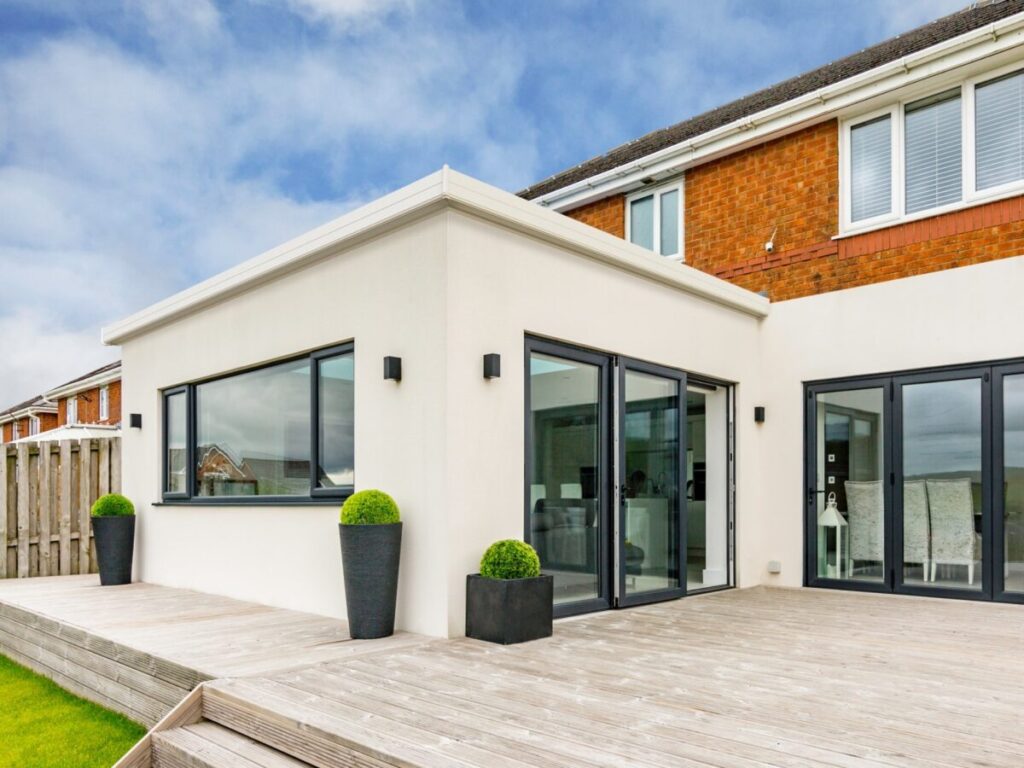
  • Design flexibility – whether you want the look of brick, smooth render, or pure floor-to-ceiling glass, the system adapts to your vision.
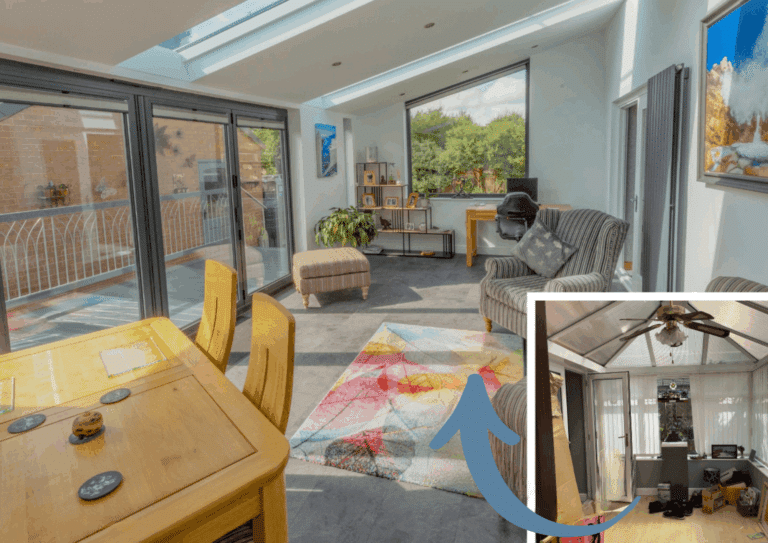
  • Reuse of existing base – often possible when upgrading an older conservatory, saving time and cost.
  • Built to last – modular construction provides consistent quality and durability for decades of use.

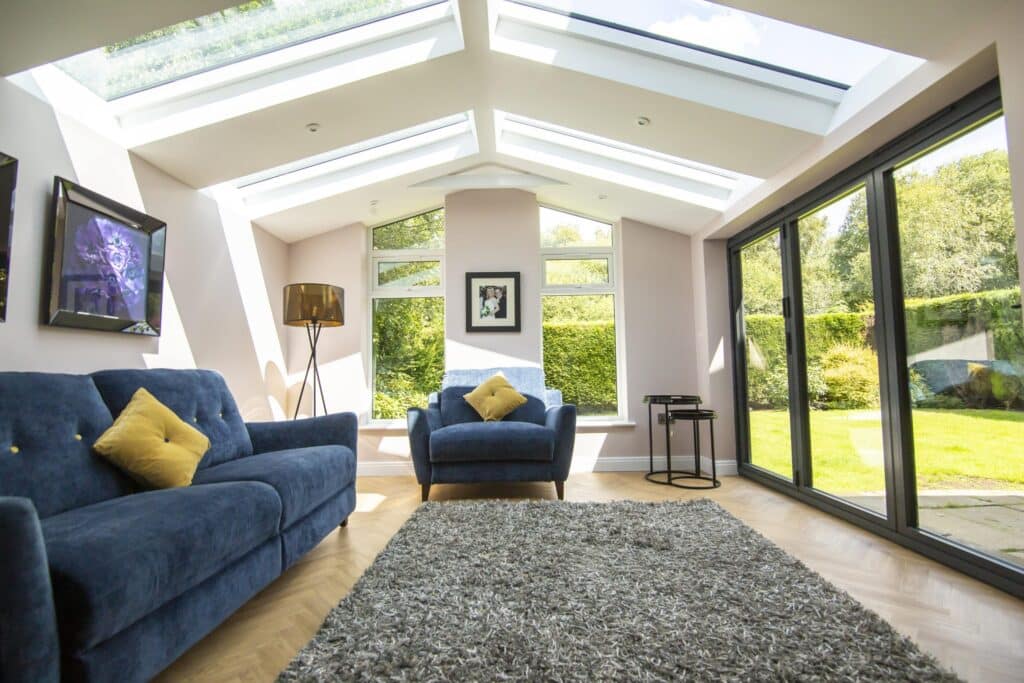
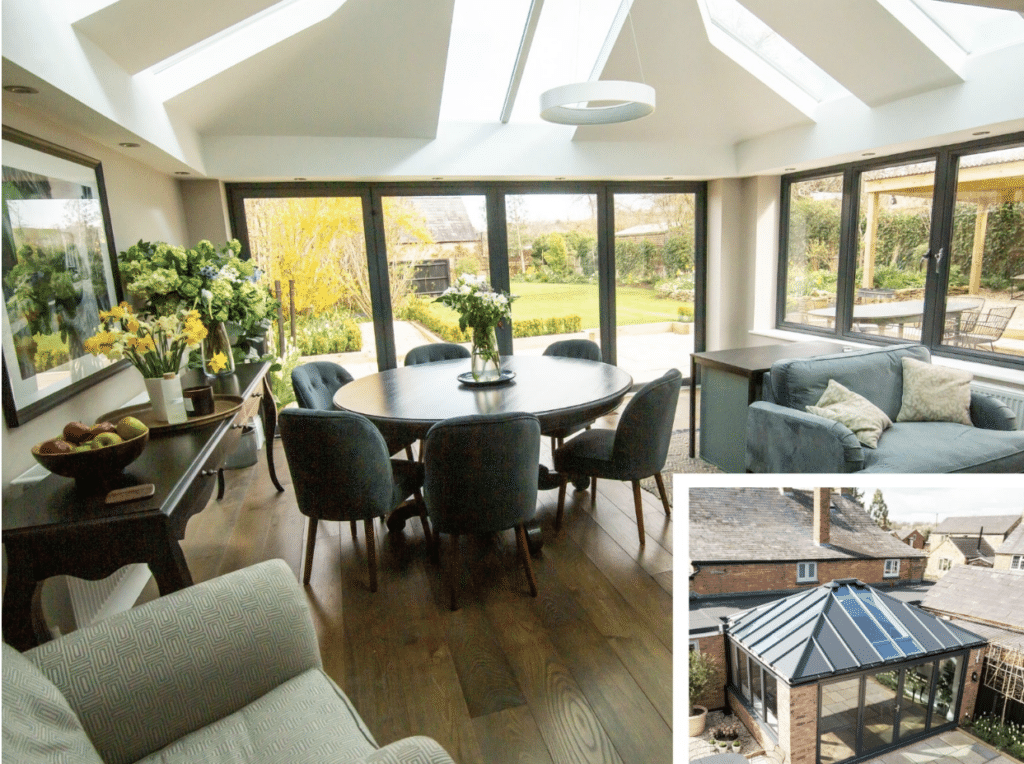
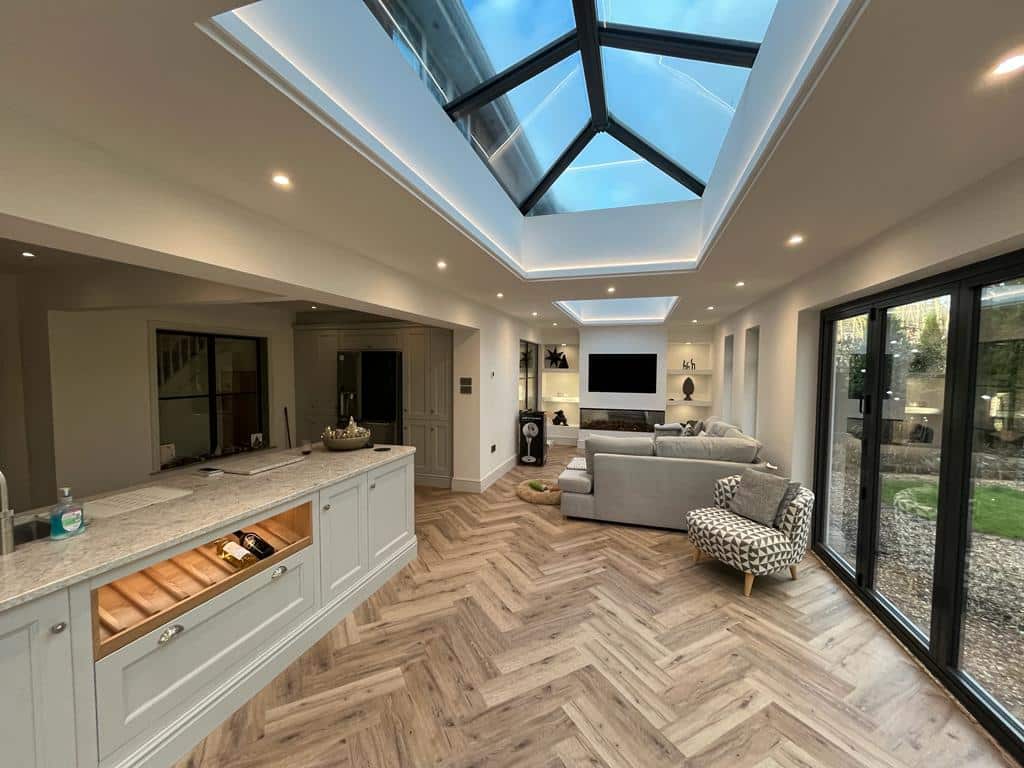
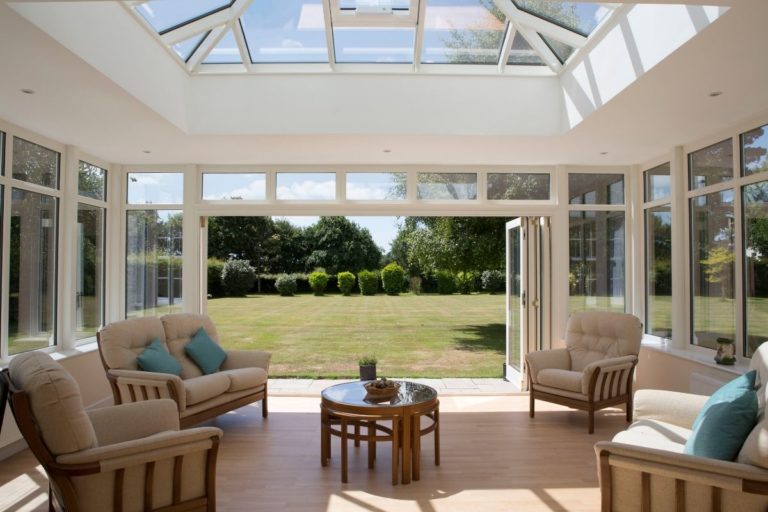
Bright and contemporary modular glass extension with vaulted ceiling, large rooflights, and full-height sliding doors opening to a private garden.

The Verdict

Living in light isn’t just about today. It’s about creating a home that will continue to inspire, uplift, and add value for years to come. A glass extension offers those long-term benefits naturally — and with the addition of modular technology, you can now enjoy light-filled living without compromise.


Next Steps

At Room Outside®, we’ve been shaping extraordinary glass spaces for over half a century. If you’re ready to discover the long-term benefits of living in light, our expert Design Consultants are here to guide you.

Contact us today for a free, no-obligation quote and explore how a bespoke glass or modular extension could transform your home.

roomoutsideuk
08th September, 2025

Are Glass Extensions Warm in Winter?

Introduction

A common concern for homeowners is whether a glass extension can truly be comfortable in the colder months. It’s a fair question — older conservatories often became unbearably hot in summer and freezing in winter, leaving the space underused.

The reality today is very different. Thanks to modern innovations such as advanced glazing and modular building systems, a glass extension can be enjoyed year-round. At Room Outside®, we’ve specialised in creating luxury glass structures for over 50 years, and we know that with the right materials and design, a glass extension can be every bit as warm and inviting in winter as the rest of your home.


Why Some Glass Extensions Fail in Winter

Not all glass extensions are created equal. Many older or budget installations struggle with:

  • Poor-quality glazing that leaks heat.
  • Inefficient frames with cold bridging.
  • Lack of insulation in floors, walls, or roof.
  • Condensation and draughts caused by poor sealing.

These shortcomings explain why many people still worry about whether glass extensions can work in winter.


The Innovation Behind Modern Glass Extensions

Modern systems address all of those problems. The difference lies in technology and expertise:

  • New Generation Glass (NGG) – exclusive to Room Outside®, this advanced glazing keeps your extension cool in summer and warm in winter, dramatically reducing heat loss compared with older glass.
  • Thermally broken frames – prevent cold bridging and keep warmth inside.
  • Precision installation – airtight seals and expert fitting eliminate draughts.

The result is a space that feels just as cosy in January as it does in June.


Why Modular Glass Extensions Excel in Winter

Our modular glass extensions take thermal efficiency a step further. Manufactured to order in the factory and assembled on-site in days, they combine cutting-edge engineering with flexibility of design.

Key Winter-Friendly Features:

  • Installed in a matter of days, not weeks – the factory-built system means your extension is delivered and assembled quickly, so you can be enjoying it in no time.
  • Minimal disruption and no building mess – unlike traditional brickwork, modular systems arrive ready to fit, with none of the piles of sand, cement, and rubble that come with conventional building.
  • Energy efficiency – insulated walls, roof, and flooring systems reduce heat loss.
  • Custom finishes – rendered wall panels can replicate brick or stone if you want more solidity, without compromising insulation.
  • Bespoke glazing – NGG ensures comfortable temperatures year-round.
  • Reuse of existing base – often possible when replacing an older conservatory, saving time and cost.
  • Made to measure – each section is precision-cut in the factory, ensuring a perfect thermal seal once installed.

Design Flexibility with Modular Extensions

One of the biggest advantages of modular systems is the range of aesthetic finishes available. Your extension can be entirely floor-to-ceiling glass, maximising views and natural light, or you can achieve the look of traditional brick, stone, or a sleek render- all while benefiting from factory-built precision and superior insulation.This flexibility means you can create the exact balance of glass and solid panels to suit your lifestyle and your home.


The Verdict

So, are glass extensions warm in winter? The answer is simple: yes — if you choose the right system. Outdated conservatories might be draughty and cold, but our modern glass extensions are designed for year-round living.

With New Generation Glass and highly insulated modular construction, you no longer need to compromise between comfort and style.


Next Steps

At Room Outside®, we’ve been creating extraordinary glass structures for over five decades. Whether you’re looking for a sleek floor-to-ceiling glass design or a modular solution with rendered finishes, we’ll design a bespoke extension that’s warm, efficient, and truly timeless.

Contact us today for a free, no-obligation quote and discover how you can enjoy the luxury of a glass extension all year round.

roomoutsideuk
01st September, 2025

Glass Extension vs Brick Extension: Which is Right for You?

Introduction

When planning a home extension, one of the biggest decisions you’ll face is whether to choose a glass extension or a brick extension. Both options can add valuable space and transform the way you live in your home, but they deliver very different results. At Room Outside®, we’ve been designing and building luxury glass structures for over 50 years, and we’ve seen first-hand how the choice between glass and brick can shape not just a property, but a lifestyle.

In this article, we’ll guide you through the benefits, challenges, and key differences between glass and brick extensions, so you can make an informed decision. And we’ll also introduce our modular glass extensions — a modern alternative that blends the best of both worlds.


Why Homeowners Choose Brick Extensions

Brick extensions have long been a popular option because they feel like a seamless continuation of the house. Key reasons include:

  • Blending in with existing architecture – especially with traditional homes.
  • Extra wall space – ideal for kitchen units or large furniture.
  • Perception of permanence – brick can feel more “solid” to some homeowners.

However, brick extensions aren’t without their drawbacks:

  • Dark and enclosed – they often lack the natural light people crave.
  • Longer build time – weeks or even months of disruption.
  • Mess and upheaval – brickwork, scaffolding, and building waste.
  • Less connection to the outdoors – they don’t offer the same seamless flow between home and garden.

Why Homeowners Choose Glass Extensions

A glass extension delivers an entirely different experience. The main advantages are:

  • Flooded with natural light – transforming the feel of your home.
  • Connection to your garden – blurred boundaries between indoors and outdoors.
  • Luxury lifestyle – open, modern, and aspirational living.
  • Quicker build times – less disruptive than brick.

Common concerns about glass include:

  • “Will it get too hot in summer?”
  • “Will it feel too cold in winter?”

This is where technology makes all the difference. Our exclusive New Generation Glass (NGG), developed from advanced US technology and manufactured in the UK exclusively for Room Outside®, regulates temperature. It keeps your glass extension cool in summer, warm in winter, and comfortable all year round.


Glass Extension vs Brick Extension: Key Differences

Light & Ambience

  • Glass: Bright, airy, seamless garden connection.
  • Brick: Darker, more traditional room feel.

Construction Time

  • Glass: Quicker, cleaner, less disruption.
  • Brick: Longer, messy, labour-heavy.

Flexibility

  • Glass: Best for entertaining, relaxing, and maximising views.
  • Brick: Best if you need large walls for storage or kitchens.

Year-Round Comfort

  • Glass: With NGG, comfortable in all seasons.
  • Brick: Naturally insulated, but without the wow factor of glass.

The Perfect Solution: Modular Glass Extensions

At Room Outside®, we also offer a cutting-edge option: modular glass extensions. These deliver the luxury of glass with the flexibility of brick styling, giving you the best of both worlds.

Key benefits include:

  • Rapid installation – bespoke, cut-to-measure in the factory, and installed on-site in just days, not weeks.
  • Energy efficiency – advanced insulation make it sustainable and comfortable.
  • Design flexibility – want more wall space for kitchen units or furniture? Modular systems can include rendered walls that replicate the look of brick, without the mess.
  • Minimal disruption – precision-engineered sections mean less noise, waste, and upheaval.
  • Reuse of existing base – in many cases, we can build on the footprint of your existing conservatory, saving even more time and cost.
  • Bespoke design – every extension is designed around your lifestyle, your home, and your aesthetic preferences.

The Verdict

If you’re torn between a glass extension vs brick extension, the decision comes down to lifestyle. A brick extension may offer traditional solidity, but a glass extension delivers something more: light, luxury, and connection with the outdoors. And with our New Generation Glass and modular extension system, you no longer have to compromise on comfort, speed, or design.


Next Steps

At Room Outside®, we’ve been creating extraordinary glass structures for more than five decades. If you’d like to explore what’s possible for your home, our expert Design Consultants are here to help.

Contact us today for a free, no-obligation quote and start planning your dream extension.

roomoutsideuk
07th May, 2025

Timber vs uPVC: Which is Best for Your Glass Extension?

When planning a premium glass extension, one of the most common questions we hear is: “Should I choose timber or uPVC for the frame?” In this article, we’ll explore the key differences between timber vs uPVC, so you can decide which material best suits your home, lifestyle, and long-term investment.

Both options have their strengths, and the right choice often depends on your priorities in terms of style, performance, and maintenance.


The Beauty and Character of Timber

Timber has long been the go-to material for traditional and heritage-style homes. Its natural look adds warmth, charm, and timeless character to any property.

Benefits of Timber Frames:

  • Aesthetics: Nothing matches the organic beauty of real wood.
  • Customisation: Timber can be painted or stained in a wide range of colours.
  • Longevity: When properly maintained, timber can last for decades.
  • Eco-Friendly: Sustainably sourced timber is a renewable material with a low carbon footprint.

However, timber does require ongoing maintenance to keep it in top condition. Regular repainting and protection from moisture are essential to avoid warping or decay.


The Smart Efficiency of uPVC

uPVC (unplasticised polyvinyl chloride) is a popular alternative, especially for homeowners looking for a low-maintenance, thermally efficient solution. But not all uPVC is made equal.

At Room Outside, we only use top-grade uPVC systems engineered for long-term durability, superior insulation, and a flawless finish.

Benefits of High-Quality uPVC Frames:

  • Low Maintenance: No painting or staining required.
  • Durability: Premium uPVC resists fading, warping, and discolouration (unlike cheap alternatives which may yellow and crack).
  • Energy Efficient: Excellent thermal performance helps lower energy bills.
  • Cost-Effective: Generally more affordable than hardwood timber.
  • Contemporary Styling: Clean lines and modern finishes suit a wide range of architectural styles.

What About Cheaper uPVC?

While budget-friendly uPVC might seem appealing, it often fails to perform over time. Lower-grade materials tend to yellow, become brittle, and can significantly reduce the lifespan and appearance of your glass structure.

By contrast, the premium uPVC we use is designed to maintain its integrity and visual appeal for decades with minimal upkeep.


So, Which Should You Choose?

If your priority is a classic, traditional look and you don’t mind some occasional maintenance, timber is a beautiful, heritage-rich option. For those who prefer modern styling, easy upkeep, and excellent insulation, high-quality uPVC is a smart, reliable choice.

Either way, Room Outside offers expertly crafted options tailored to your preferences and built to last.


Ready to explore your perfect glass extension?

Download our brochure today and start planning your dream space with Room Outside.

Download our brochure today and start planning your dream space with Room Outside.

https://www.roomoutside.com/room-outside-request-a-brochure/
roomoutsideuk
01st May, 2025

Want a Fast Home Extension Without the Disruption?

If you’ve ever wanted to add space to your home but dreaded the chaos of a major building project, a fast home extension without disruption could be the perfect solution. For some, the thought of weeks of builders, mess, and noise is enough to put them off altogether.

But what if there was a better way?

Build Without the Headaches

Traditional home extensions take time. Builders dig foundations, lay bricks, and work around unpredictable weather. It’s slow, messy, and often stressful.

That’s why we’re offering something different.

This innovative new system uses precision-engineered parts built off-site. These are delivered and assembled quickly at your home. As a result, installation takes days instead of months — a fast home extension without disruption and minimal interruption to your daily life.

Designed to Suit Your Home

Whether you want a bright kitchen, a stylish dining room, or a garden retreat, this system gives you flexibility. It works with most house types and even fits on existing bases in many cases.

You get all the benefits of a traditional extension, without the long wait.

Comfortable All Year Round

One big concern with glazed structures is keeping them warm in winter and cool in summer. This system solves that.

Thanks to high-performance insulation in the walls, floor, and roof, your space stays comfortable all year. You can also choose New Generation Glass to reduce glare, control solar gain, and improve energy efficiency.

Built to Last, Easy to Maintain

Durability matters. These materials are long-lasting and require very little upkeep. So you’ll spend less time on maintenance and more time enjoying your home.


Ready to Extend Without the Stress?

You don’t need to live on a building site to get more space. With this fast, clean, and energy-efficient system, you can have your dream extension — without the drama.

  • Fast build
  • Stylish and practical

Get in touch to book your free design consultation.

https://www.roomoutside.com/get-a-quote/
roomoutsideuk
13th November, 2024

A Basic Guide to Frameless Glass & Glass Box Extensions

Frameless glass and frameless glass box extensions have become very popular choices. This guide will help you understand the basics.

Structural glass is a highly sought-after design material used to create contemporary structures. It is commonly used to enclose balconies and staircases, open solid walls to the outdoors, and even serve as feature flooring. The sleek lines and minimalist appeal of frameless glass help homeowners achieve a modern, high-end aesthetic with a true wow-factor finish.

Design Versatility

One of the greatest advantages of frameless glass is its versatility. It can be used for various applications, including:

  • Large, all-glass extensions.
  • Side return extensions.
  • Roof lights to increase natural light.

The clean, non-intrusive aesthetic of frameless glass means it blends seamlessly with existing architecture. Surprisingly, it is a popular choice for older and listed properties as it adds style without overshadowing the original building. Frameless glass and frameless box extensions can be designed in numerous shapes, including lean-to, gable-ended, hexagonal, or a simple box structure.

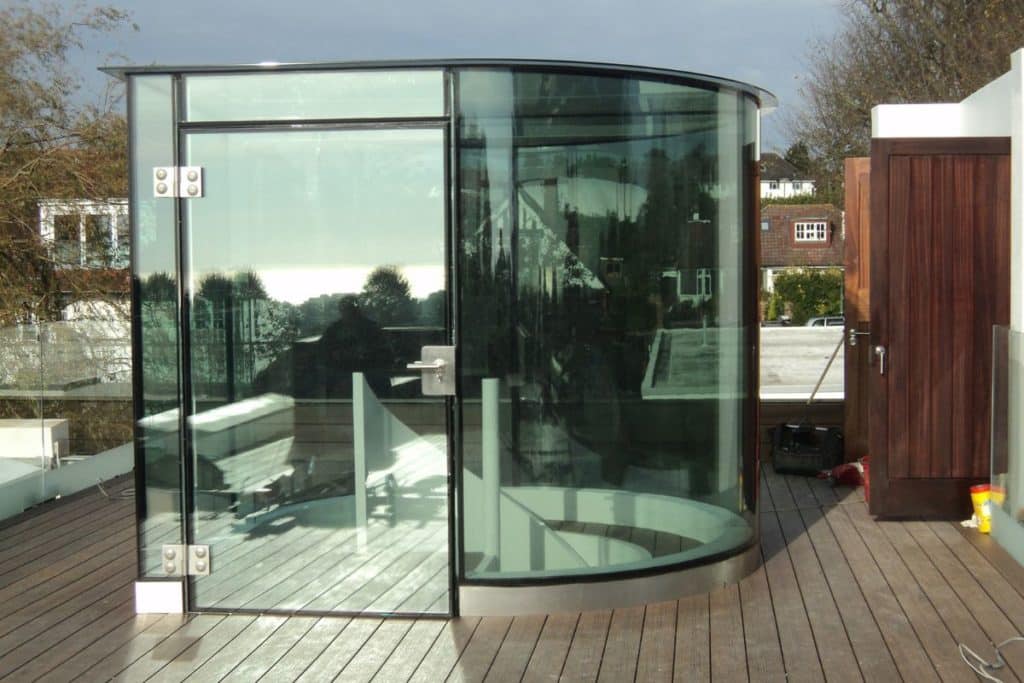
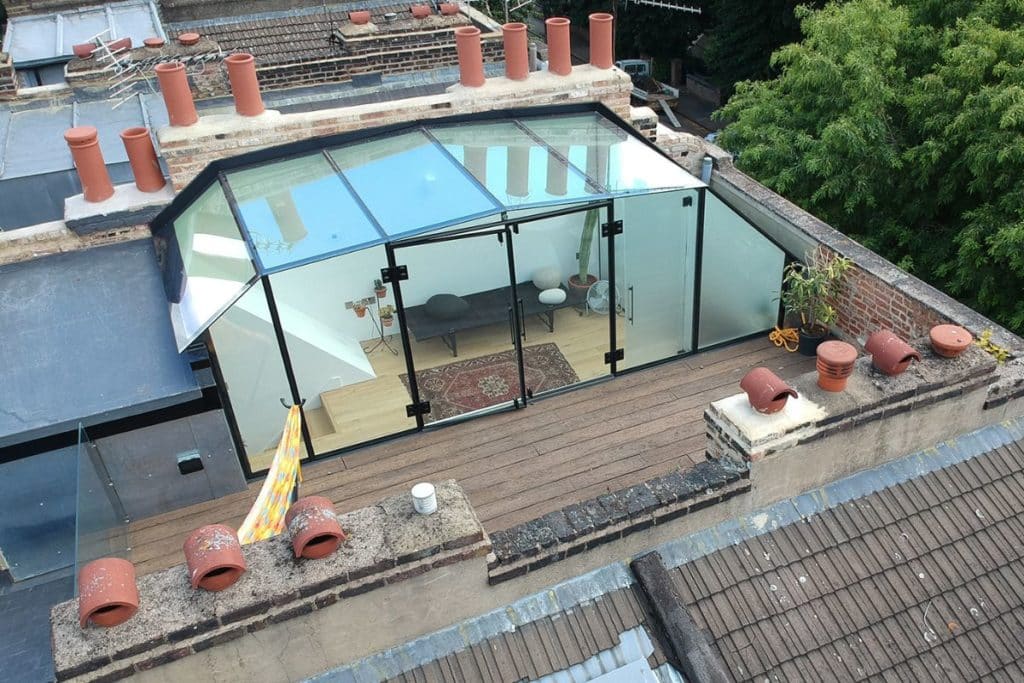
Frameless Glass Roof Top Room

Do You Need an Architect?

You may wonder whether hiring an architect is necessary for your glass extension project. The answer depends on the complexity of your design.

  • For straightforward projects, a specialist glass installation company can draft the required plans.
  • For complex structures requiring planning permission, an architect may be beneficial to ensure compliance and a seamless integration with your home.

Planning Permission

In most cases, frameless glass extensions fall under permitted development rules, meaning that they do not require planning permission. However, there are exceptions:

  • If your home is listed or located in a conservation area, planning permission is necessary.
  • If your property has already been extended, it may exceed permitted development limits.

It is always advisable to check with your local planning authority before beginning any construction.

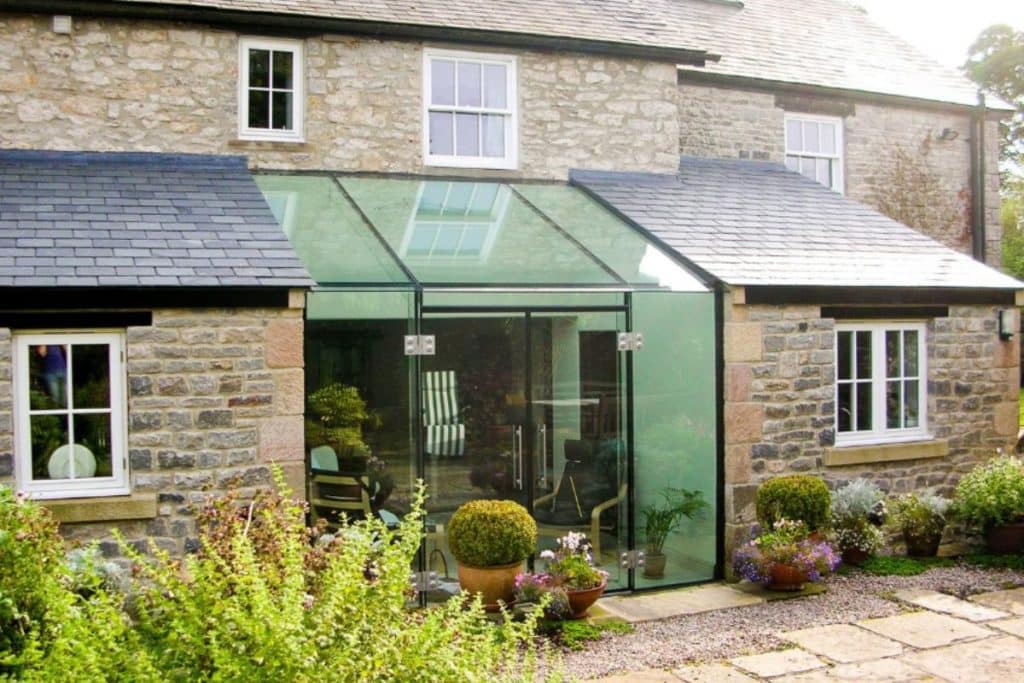
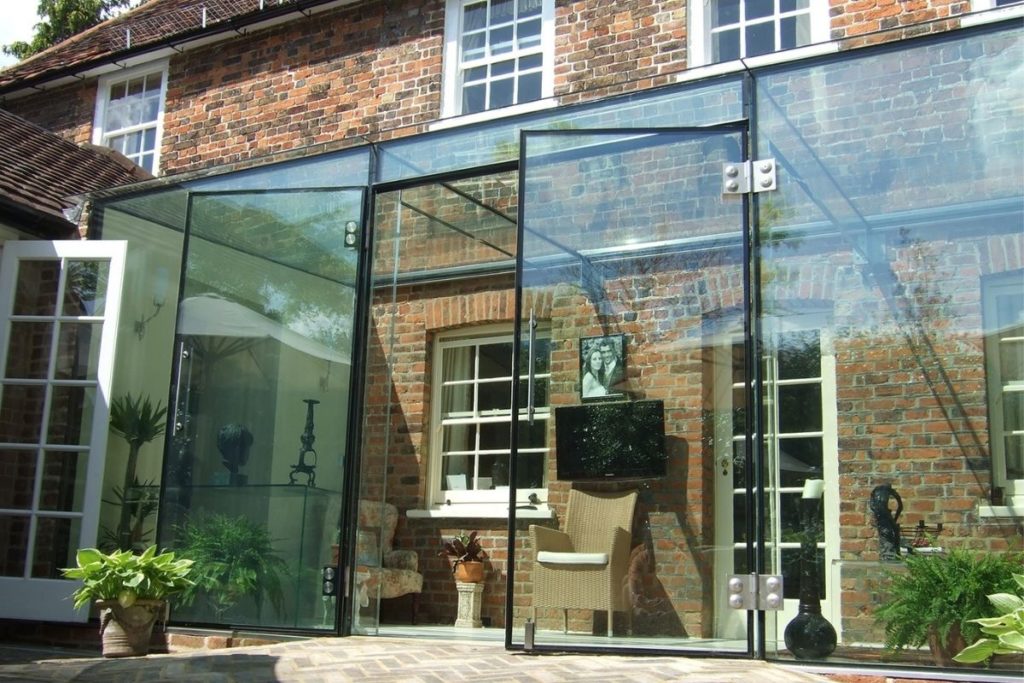
Lean-to frameless glass link extension
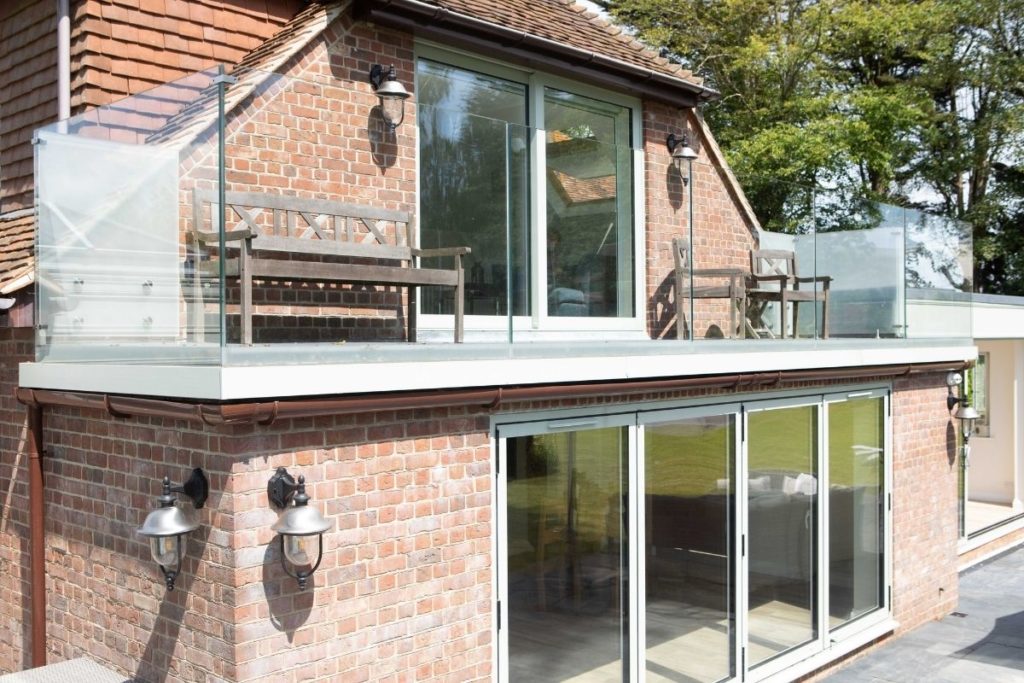
glass balcony balustrade on a luxury country home

Energy Efficiency Matters

Frameless glass extensions offer exceptional energy efficiency when built using high-performance glass. Features include:

  • Low-emissivity (Low-E) coatings that reduce heat loss.
  • UV filtering to minimise glare and prevent furniture fading.
  • Argon gas-filled glazing for superior insulation.

Because frameless structures incorporate more glass than traditional framed extensions, investing in high-specification temperature-controlled glass is crucial. Superior glazing ensures comfort throughout the year and meets the latest regulations regarding overheating in homes due to climate change.

Durability and Strength

The structural glass used in frameless extensions is incredibly strong. Designed to withstand the elements, it meets Class A of BS6206 building regulations for safety and durability.

Key durability features:

  • Toughened or laminated glass for added strength.
  • Roof glass that is robust enough to be walked on.
  • Minimal maintenance requirements for long-term performance.

Creative Ways to Use Frameless Glass

Glass Rooms

Glass rooms make a bold design statement, seamlessly blending indoor and outdoor spaces. They allow natural light to flood in, removing barriers between your home and garden. Installing bi-fold or double doors enhances this connection, creating an effortless transition for entertaining and relaxation.

These rooms are incredibly versatile and can serve various functions. They provide a tranquil retreat, a stylish dining area, or even a creative workspace. Many homeowners also use glass extensions as multipurpose rooms, combining kitchen, dining, and living areas into a single, open-plan layout. This flexibility makes them an excellent choice for modern living.

Glass Wall

Replacing an external wall with frameless glass can dramatically transform a space, making it feel larger and brighter without physically extending the footprint of your home.

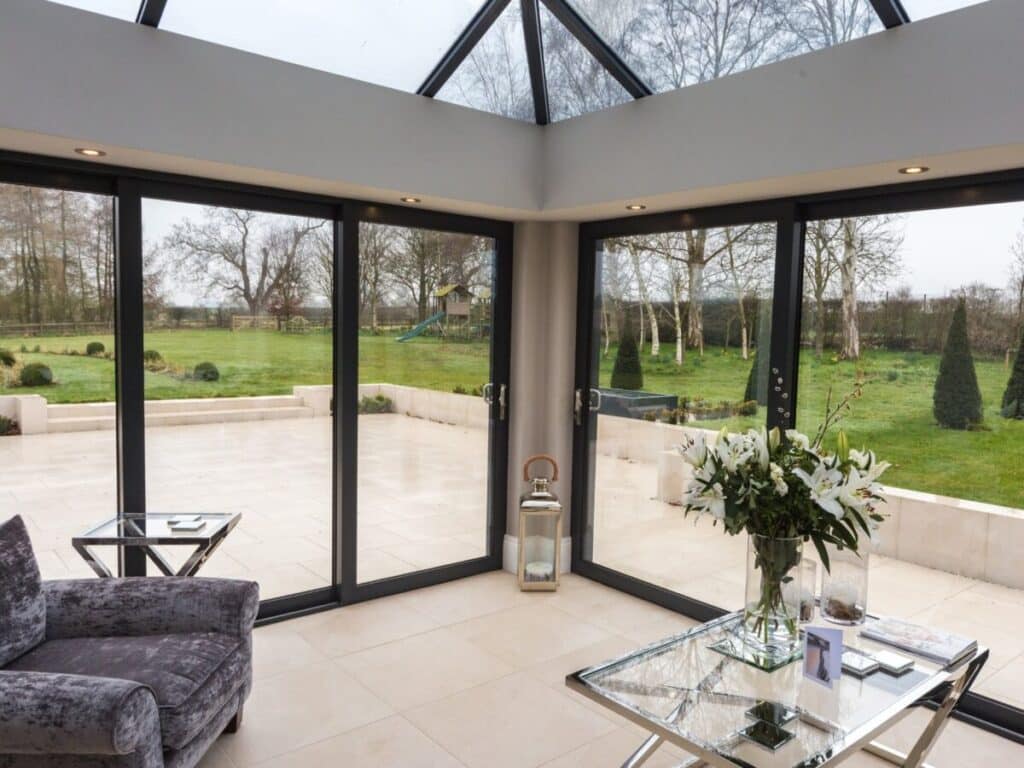
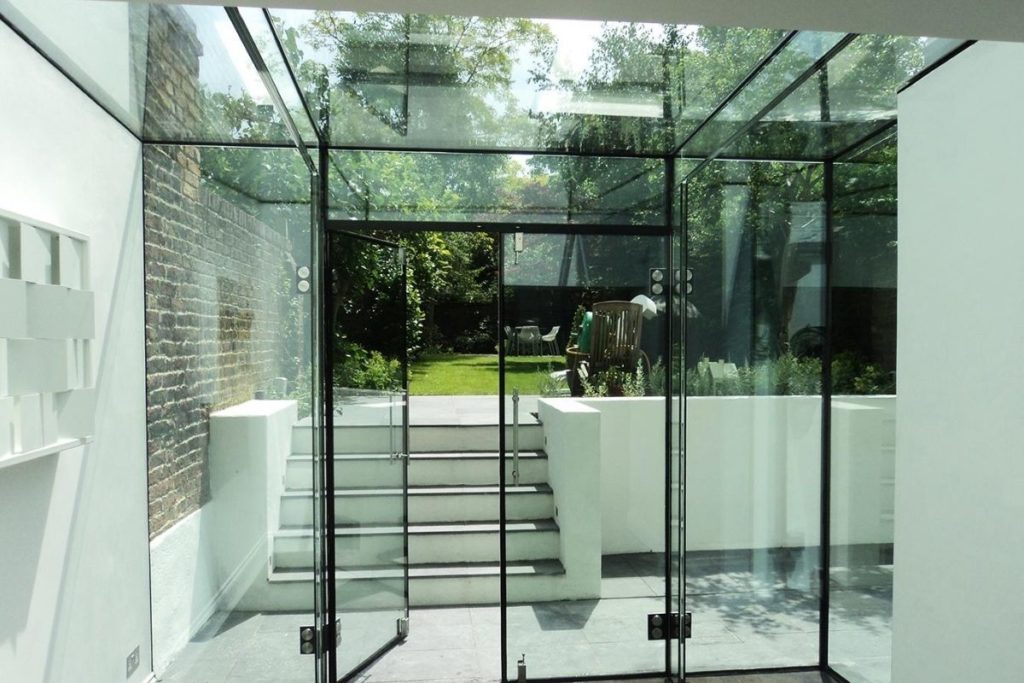
A frameless glass box extension floods light into the property and extends the living space out into the garden

Balustrades

For a stylish and practical interior upgrade, glass balustrades can enhance staircases and landings. They allow more light into darker areas, creating a sense of openness.

Glass Floor

Structural glass flooring is ideal for:

  • Roof terraces.
  • Bringing light into lower levels, such as basement rooms or entrance halls.

Roof Lights

Adding frameless glass roof lights enhances areas like kitchen extensions, bringing in additional daylight while maintaining privacy. Apex-style roof lights can create a striking focal point.

Frameless glass roof terrace extension

Glass Doors

Complete your glass extension with sleek door options, including:

  • Frameless French doors that fold back for a seamless transition.
  • Fine-framed sliding doors for a modern finish.
  • Bi-fold doors to create an uninterrupted indoor-outdoor flow.

Start Your Frameless Glass Project

Are you ready to create a breathtaking frameless glass extension? Our experts are here to help you explore design options, understand costs, and bring your vision to life.

Check out our gallery for inspiration and contact us today to start planning your bespoke frameless glass project.

Start Designing Your Frameless Glass Project

Get a Quote