
Lantern Roofs Explained: When They Work, When They Don’t & What They Cost
A roof lantern is the heart of an orangery — and the single biggest design decision you’ll make. Here’s exactly where lantern roofs work brilliantly, where another roof serves you better, what they really cost, and the planning rules that apply across Berkshire.
A lantern roof is the right call for a solid-roof room — not a substitute for a glass one
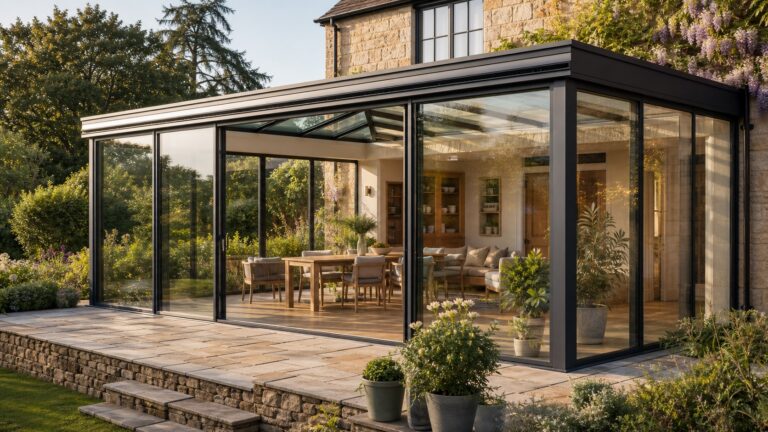
A roof lantern is a raised glazed structure that sits on a flat, insulated roof to draw daylight down from above. It works best on orangeries, kitchen and dining extensions and flat-roof rooms where you want bright, calm light, comfortable temperatures and usable wall space. It’s the wrong choice when what you really want is a fully glazed roof and the open, all-glass conservatory feel.
Cost runs from roughly £1,200 for a small standalone lantern to around £30,000–£70,000 for a complete lantern-roof orangery. Many orangeries can be built under permitted development, but conservation areas and Article 4 directions across Berkshire often change the picture — always check with your local authority first.
Last updated: May 2026 — based on UK industry data and Room Outside engineering specifications. Figures are indicative.
What a Lantern Roof Actually Is
A lantern roof — also called a roof lantern or lantern light — is a raised, glazed framework that sits on top of a flat roof section, lifting daylight up and over the room and drawing it down from above. Think of a glass ridge floating over an otherwise solid ceiling. It is the architectural signature of the orangery: a structure with a solid, insulated flat-roof perimeter and a glazed lantern set into the centre.
That distinction matters. A traditional conservatory has a fully glazed roof. An orangery keeps most of the roof solid and insulated, then frames a generous glazed lantern in the middle. You get a striking, light-filled centrepiece — without the thermal extremes of an all-glass roof, and with proper plastered ceiling perimeters that read like part of the house.
Modern lanterns are built from slim thermally broken aluminium, which allows fine sightlines and large glass panes with minimal frame. Timber and uPVC versions exist, but aluminium dominates premium work for its strength, longevity and clean lines. The glass is where most of the performance lives — low-E coatings, argon fill and warm-edge spacers, or temperature-control glazing for the best results.
When a Lantern Roof Works Brilliantly
A lantern roof shines when you want daylight and a comfortable, usable room — not just a glass box. These are the situations where it consistently earns its place.
Orangeries
The natural home of the lantern. A solid, insulated perimeter roof with a central glazed lantern gives you a bright, year-round room that feels like an extension of the house, not a bolt-on.
Ideal fitKitchen & dining extensions
A lantern floods an open-plan kitchen-diner with overhead light while leaving the ceiling perimeter solid for spotlights, extraction and a calmer atmosphere.
Ideal fitFlat-roof rear extensions
Where a single-storey extension would otherwise have a dark centre, a lantern brings the middle of the room to life without losing insulation across the rest of the roof.
Strong fitReplacing a tired conservatory roof
Converting an old polycarbonate or all-glass roof to a solid roof with a lantern transforms comfort while keeping a real sense of light and height.
Strong fitRooms you want to use all year
Because the bulk of the roof is insulated, an orangery stays far more stable through summer and winter than a fully glazed room — making it a genuine living space, not a seasonal one.
Strong fitPeriod & traditional homes
A lantern’s classic proportions suit older properties and sit comfortably alongside brick, rendered or stone elevations — often easier to get right aesthetically than a full glass roof.
Good fitThe common thread
A lantern works best when the room needs light from above but comfort all year. The solid roof does the insulating; the lantern does the drama. That balance is exactly what makes an orangery feel like part of the home rather than a glazed afterthought.
When a Lantern Roof Isn’t the Answer
A roof lantern is a wonderful product in the right project and a compromise in the wrong one. Being honest about that saves disappointment later. Here’s where we’d usually steer you elsewhere.
You want the full conservatory feel
If the dream is a fully glazed roof and the maximum possible light and openness, a lantern’s solid perimeter will feel like it’s holding you back. A high-performance glass roof is the better route.
ReconsiderThe room is small
On a very compact footprint, the solid roof perimeter can leave too little glazed area to justify the lantern, while still adding structural cost. A glazed roof or rooflights often do more.
ReconsiderThe structure is pitched, not flat
Lanterns are designed to sit on flat or low-pitch roofs. On a steeply pitched roof, rooflights or a glazed ridge are usually the appropriate solution instead.
Wrong toolBudget is the hard constraint
A quality lantern plus the solid insulated roof around it costs more than a basic glazed roof. If budget is fixed and tight, a simpler roof with good glass may be the sensible call.
Weigh it upIt’s specified cheaply
A bargain uPVC lantern with thick frames and ordinary glass can overheat in summer and lose warmth in winter — the very problems an orangery is meant to avoid. The product is only as good as the glass and frame.
Spec carefullyPlanning rules it out
Height limits, boundary distances or conservation-area restrictions can occasionally make a raised lantern impractical. A flush rooflight may achieve a similar effect within the rules.
Check firstWhat Lantern Roofs Cost
The honest answer to “what does a lantern roof cost?” is that it depends on what you’re buying — the lantern alone, or the whole room around it. Below are indicative 2026 UK ranges to set expectations; an accurate figure always needs a site assessment, because groundworks, structure and access vary enormously.
| What you’re buying | Typical size | Indicative cost | Notes |
|---|---|---|---|
| Standalone aluminium lantern (supply only) | ~1.5 × 1m | £1,200–£2,500 | Small units, off-the-shelf |
| Mid-size aluminium lantern (supply only) | ~2.5 × 1.5m | £2,500–£4,500 | Most common domestic size |
| Large / high-spec lantern (supply only) | 3 × 2m+ | £4,500–£7,500+ | Slim sightlines, premium glass |
| Lantern fitted to an existing flat roof | Varies | +£1,500–£4,000 install | Structure & weather-sealing |
| Complete lantern-roof orangery (designed & built) | 15–25m² | £30,000–£70,000+ | Bespoke, all-in |
Indicative ranges for southern England in 2026, including Berkshire. Final cost depends on size, glazing specification, frame material, groundworks, electrics, the state of the existing structure and access. A free consultation gives you a firm figure.
Where does the money go? Roughly: the glass and frame of the lantern itself, the solid insulated roof it sits within, the structure and groundworks below, and the finishes — plastered ceilings, lighting, flooring and decoration that turn a shell into a room. Skimping on the glass to save a few hundred pounds is the classic false economy: it’s the part that determines whether the room is comfortable for the next twenty years.
A note on value, not just price
A well-built orangery adds genuinely usable floor area and is widely regarded as one of the home improvements most likely to add value at resale — particularly when it links the kitchen to the garden. The cheapest lantern is rarely the best investment; the right specification, built once, almost always is.
Wondering what your project would cost?
Every orangery is different — size, structure, ground conditions and glazing all move the number. Our consultation gives you a clear, itemised figure with no obligation, so you know exactly where you stand before deciding.
Book a Free ConsultationCall us anytime – David, our digital assistant, will take a few details so the right specialist can follow up personally. 01243 538999
Planning & Building Regulations in Berkshire
This is where many lantern-roof projects stall — usually needlessly. The good news: a lantern-roof orangery is treated as an extension for planning purposes, and many can be built under permitted development (PD) rather than requiring a full planning application. The catch is that PD comes with limits, and those limits tighten across much of Berkshire.
The usual permitted development limits
Depth of the extension
A single-storey rear extension is generally limited to projecting no more than 3m from the original rear wall on an attached house, or 4m on a detached one — with larger projections sometimes possible via the prior-approval process. Side extensions are more restricted.
Size limitHeight
A single-storey rear extension typically must not exceed 4m in overall height, with eaves no higher than 3m where it sits within 2m of a boundary. The raised lantern needs to be accounted for within these limits.
Height limitHow much of the garden you can cover
Extensions together must not cover more than half the land around the original house. If previous additions have used up that allowance, PD may no longer apply.
Coverage limitDesignated land & Article 4
In conservation areas, on listed buildings, and where an Article 4 direction is in force, permitted development rights are reduced or removed entirely — and these designations are common across Berkshire’s towns and villages.
RestrictionsBerkshire: who decides, and why it varies
Berkshire has no single county planning authority — applications are handled by the unitary council for your area: Reading, West Berkshire, Wokingham, Bracknell Forest, the Royal Borough of Windsor & Maidenhead, or Slough. Each interprets and applies rules locally, and parts of West Berkshire fall within the North Wessex Downs National Landscape, where extra protections apply. That’s why the same orangery can be straightforward in one street and need a full application in another.
Building Regulations — separate from planning
Planning permission and Building Regulations are two different approvals. Some glazed extensions can be exempt from full Building Regs if they’re built at ground level under a certain floor area, separated from the house by external-quality doors, and fitted with independent heating controls. Because an orangery has a substantial solid insulated roof rather than a mostly glazed one, it often falls outside that conservatory exemption and needs full Building Regulations approval — covering structure, insulation, thermal performance and drainage. This isn’t a hurdle so much as a quality safeguard, and a good design team handles it as standard.
The practical takeaway
Don’t assume, and don’t be put off. Many Berkshire orangeries proceed smoothly under permitted development; others need a straightforward application. The only reliable way to know is to check your property’s specific designations with your local authority — something we do for clients as part of the design process, so nothing comes as a surprise.
Planning rules change and are applied locally. The limits above are a general guide for England as a starting point, not a substitute for confirmation from your local planning authority or a professional assessment of your specific property.
Lantern Roof vs the Alternatives
Each roof type trades light, comfort, character and cost differently. Here’s how the main options compare so you can match the roof to how you’ll actually use the room.
| Roof type | Light from above | Year-round comfort | Wall & ceiling use | Best for |
|---|---|---|---|---|
| Lantern roof (orangery) | Generous, central | Excellent | Solid perimeter — very usable | Year-round living, kitchens & diners |
| Fully glazed conservatory roof | Maximum | Good with right spec | Little — all glass | Maximum light & classic feel |
| Solid / tiled roof with rooflights | Modest, targeted | Excellent | Mostly solid ceiling | Warm rooms, less glare |
| Glass box / flush flat rooflight | Good, contemporary | Very good with right glass | Flat ceiling, minimal frame | Modern homes, sleek lines |
| Old polycarbonate roof | Diffused, poor | Poor — noisy in rain | — | Nothing — replace it |
New Generation Glass — what makes a lantern comfortable
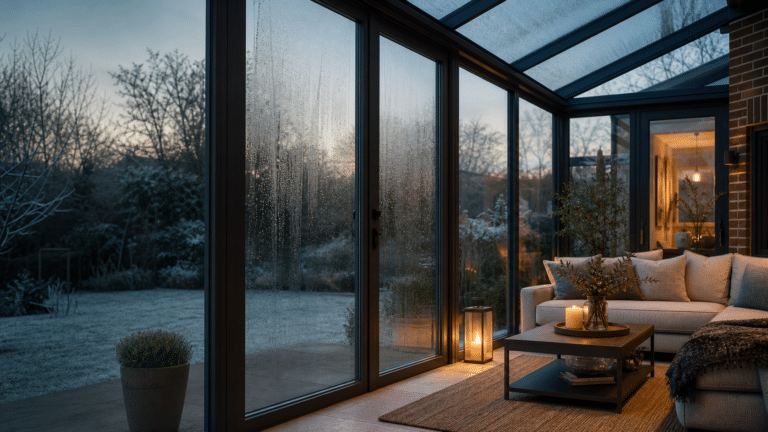
A lantern is only as good as its glass. We were the first company in England to bring temperature-control glazing to the UK, developed for our climate. In a roof lantern it does the hard work: holding warmth in through winter, taming summer glare and overheating, and keeping the room usable every month of the year — so your orangery is a living space, not a seasonal one.
Is a Lantern Roof Right for Your Project?
It comes down to how you want the room to feel and how you’ll use it. Here’s the honest test.
Go with a lantern roof if…
Consider an alternative if…
The honest rule of thumb
Choose a lantern roof when you want light and comfort in a room you’ll use every day — that’s an orangery, and it’s what the product was built for. Choose a fully glazed roof when openness matters more than insulation, and a rooflight when the structure or the look calls for something flatter. A site visit settles it in minutes.

Explore Room Outside’s guides
Sources & further reading
Based on UK Building Regulations Part L, permitted development guidance via the Planning Portal, industry data from the GGF, and Room Outside engineering specifications. For independent guidance, see the Planning Portal — extensions and Homebuilding & Renovating. Planning rules are applied locally and change over time — always confirm with your local authority. Last updated May 2026.
Frequently Asked Questions
The lantern roof and orangery questions we’re asked most often.
What is a lantern roof?
A raised glazed structure that sits on a flat roof to bring daylight in from above. It’s the defining feature of an orangery — a solid, insulated flat-roof perimeter with a glazed lantern set into the centre. Modern lanterns use slim thermally broken aluminium and energy-efficient glass for a bright, architectural focal point without the all-glass roof of a conservatory.
Do I need planning permission for a lantern-roof orangery in Berkshire?
Often it can be built under permitted development, provided it stays within size, height and boundary limits and your home hasn’t already used up its allowances. But PD rights are reduced or removed in conservation areas, on listed buildings and where an Article 4 direction applies — all common across Berkshire. Because rules differ between Reading, West Berkshire, Wokingham, Bracknell Forest and Windsor & Maidenhead, always confirm with your local authority first.
How much does a lantern roof cost?
A standalone aluminium lantern ranges from around £1,200 for a small unit to £7,500 or more for a large high-spec one, supply-only. A complete lantern-roof orangery — designed, built and glazed — more commonly falls between roughly £30,000 and £70,000 depending on size, specification and groundworks. Figures are indicative for 2026; an accurate price needs a site assessment.
Is a lantern roof the same as a roof lantern?
Yes. Lantern roof, roof lantern and lantern light all describe the same thing — a glazed framework raised above a flat roof to draw daylight down into the room below. The phrasing varies by region and supplier, but the product is identical.
Will a lantern roof make the room too hot or too cold?
Only if it’s poorly specified. Modern glass and a thermally broken frame control heat far better than older glazing, and because the surrounding roof is solid and insulated, an orangery is naturally more stable than an all-glass conservatory. Temperature-control glazing such as New Generation Glass keeps the room comfortable through both summer and winter.
Lantern roof or fully glazed roof — which is better?
Neither is universally better; they suit different goals. A lantern on a solid, insulated roof gives calmer light, more usable wall space, better thermal stability and a room that reads as part of the house — ideal for kitchens and dining spaces. A fully glazed roof maximises light and keeps the classic conservatory feel. The right choice depends on how you’ll use the room.
Call us anytime – David, our digital assistant, will take a few details so the right specialist can follow up personally. 01243 538999
Design an Orangery That Works Every Day of the Year
A lantern roof is a beautiful thing in the right project. Let’s look at your home, your light and your plans — and design a room you’ll actually live in, built to the right specification the first time.
Call us anytime – David, our digital assistant, will take a few details.
01243 538999 ·
Room Outside, orangery & glass extension specialists since 1973
Berkshire · Surrey · Hampshire · West Sussex · East Sussex · Kent · Essex · London · Dorset